


Key Takeaways
What You’ll Learn
- Coupang operates as a high-performance e-commerce platform with strong emphasis on logistics, speed, and user experience.
- Security is critical due to sensitive user data, payment processing, and high transaction volume.
- White-label Coupang clone apps must implement secure authentication and encrypted data handling.
- Backend infrastructure plays a key role in preventing fraud and protecting transactions.
- Scalability and security must go together to support real-world e-commerce growth.
Stats That Matter
- Coupang serves millions of active users daily with high-frequency transactions.
- E-commerce fraud is expected to exceed $48 billion globally in the coming years.
- Over 60% of online shoppers consider security a key factor before making purchases.
- Data breaches can cost businesses millions in both revenue and trust.
- Secure platforms see higher user retention and repeat purchases.
Real Insights
- User trust is built on security, not just fast delivery or pricing.
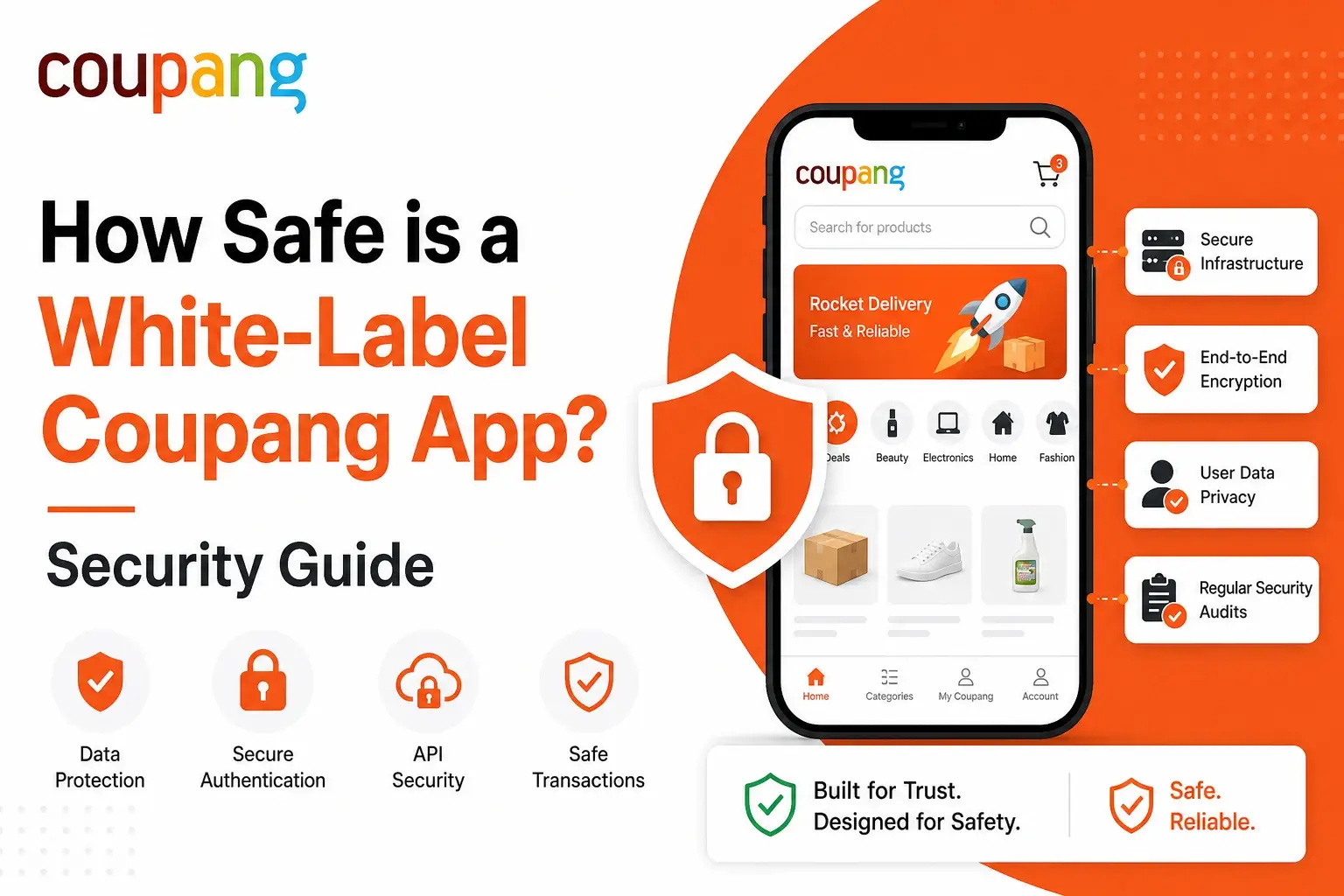
- Strong apps implement end-to-end encryption and secure APIs.
- Payment protection systems reduce fraud and chargebacks significantly.
- Regular security audits are essential for maintaining platform integrity.
- Long-term growth depends on reliability, security, and consistent performance.
You’ve heard the horror stories about data breaches, stolen payment details, and apps getting taken down because they failed compliance checks. And if you’re planning to launch a white-label Coupang app -style marketplace , you’re right to be concerned. In 2026, safety matters more than ever because marketplace apps handle everything at once: customer data, seller data, payments, delivery addresses, and sometimes even live location tracking. One weak point can expose the entire business.
In this guide, I’ll give you an honest security assessment of white-label Coupang apps, the real risks, the standards you must meet, and practical steps to launch safely. And I’ll also show why Miracuves is positioned as a security-first white-label app provider, not just another “quick app” seller.
Understanding White-Label Coupang App Security Landscape
White-label app security is the set of technical and compliance measures that protect a third-party branded app from threats — whether it’s data leaks, unauthorized access, or legal non-compliance.
Common Security Myths vs Reality
Many think white-label apps are inherently unsafe. That’s a myth. Security depends on implementation, not the app type.
Why People Worry About White-Label Apps
Because some providers cut corners — no audits, weak authentication, or poor encryption.
Current Threat Landscape for Marketplace Apps
Fraud, account takeovers, API misuse, and unpatched vulnerabilities are the top vectors in 2026.
Security Standards in 2026
Expect ISO 27001, SOC 2, GDPR/CCPA compliance, and regular penetration testing as table stakes.
Real-World Statistics
Marketplace apps saw a double-digit rise in breaches tied to API and third-party integration flaws in the past two years.
Key Security Risks & How to Identify Them
A white-label Coupang app is basically a high-value target because it handles users, sellers, payments, and delivery operations in one place. That means more attack surfaces than a normal ecommerce app.
Data Protection & Privacy (Highest Risk Area)
User personal information
Names, phone numbers, addresses, order history, and login credentials are extremely sensitive.
Payment data security
If payments are handled poorly, the app becomes a direct PCI DSS liability risk.
Location tracking concerns
Delivery tracking, live rider location, and address history can become a major privacy issue if logs are not protected.
GDPR/CCPA compliance
If you serve EU or US users, you must handle:
- data deletion requests
- consent logging
- breach reporting
- data access requests
Technical Vulnerabilities
Code quality issues
Some providers reuse old codebases and never refactor. That creates hidden vulnerabilities.
Server security gaps
Misconfigured cloud storage, weak firewall rules, and no rate-limiting are common.
API vulnerabilities
Marketplace apps rely heavily on APIs:
- user login API
- order placement API
- seller product API
- payment confirmation API
If one is weak, the entire system is exposed.
Third-party integrations
Common risky integrations include:
- payment gateways
- SMS/OTP providers
- maps + location APIs
- analytics tools
Business Risks
Legal liability
If data is leaked, the business owner is responsible — not the white-label vendor.
Reputation damage
Marketplace trust is fragile. One breach can destroy growth permanently.
Financial losses
Fraud refunds, chargebacks, and downtime can cost more than the app itself.
Regulatory penalties
Fines can apply if you fail compliance (especially GDPR).
Risk Assessment Checklist (Quick but Powerful)
Use this checklist before buying any white-label Coupang app:
- Is user data encrypted at rest and in transit?
- Is payment data stored anywhere? (It should not be)
- Are APIs protected with authentication + rate limiting?
- Is there role-based access control for admin/sellers?
- Are logs protected from exposure?
- Is there a security patch policy?
- Is there an incident response plan?
- Are backups automated and tested?
- Is compliance documentation available (GDPR/CCPA/PCI)?
Security Standards Your White-Label Coupang App Must Meet
If a provider cannot clearly explain their security standards, that’s your first warning sign.
In 2026, marketplace apps must meet global compliance expectations — not just basic hosting security.
Essential Certifications
ISO 27001 Compliance
Proves the provider follows structured information security management practices.
SOC 2 Type II
Validates operational security controls over time, not just at a single audit moment.
GDPR Compliance
Mandatory if serving EU users. Requires consent logging, data minimization, and breach reporting within 72 hours.
HIPAA (If Applicable)
Only required if the app handles health-related transactions or data.
PCI DSS for Payments
Critical for marketplace apps. Payment data must never be stored without PCI compliance.
Technical Requirements
End-to-End Encryption
All user data must be encrypted in transit (TLS 1.3) and sensitive data encrypted at rest (AES-256).
Secure Authentication
2FA, OAuth 2.0, strong password hashing (bcrypt/Argon2).
Regular Security Audits
Quarterly vulnerability assessments and annual penetration testing.
Penetration Testing
Ethical hackers must test the app before and after launch.
SSL Certificates
Valid SSL with HSTS enabled.
Secure API Design
Token-based authentication, rate limiting, and proper input validation.
Security Standards Comparison Table
| Security Element | Basic Provider | Secure Provider | Miracuves Standard |
|---|---|---|---|
| Encryption | SSL only | SSL + AES | End-to-end + AES-256 |
| PCI DSS | Not clear | Partial | Fully integrated gateway model |
| SOC 2 | No | Optional | Security-first architecture |
| Pen Testing | Rare | Annual | Pre-launch + scheduled |
| GDPR Tools | Manual | Limited | Built-in compliance workflows |
| Monitoring | Basic logs | Alert system | 24/7 monitoring |
If your white-label Coupang app provider cannot meet these standards, you are taking unnecessary risk.
Read more : – Business Model of Coupang : Complete Strategy Breakdown 2025
Red Flags: How to Spot Unsafe White-Label Providers
Not all white-label Coupang app providers prioritize security. Some focus only on fast delivery and low pricing.
Here’s how to identify unsafe vendors quickly.
No Security Documentation
If they cannot provide compliance details, audit reports, or security architecture overview — walk away.
Cheap Pricing Without Explanation
Enterprise-grade security costs money. Extremely low pricing often means corners are cut.
No Compliance Certifications
No mention of ISO 27001, SOC 2, GDPR processes, or PCI readiness is a major concern.
Outdated Technology Stack
Old frameworks and unsupported libraries create vulnerabilities.
Poor Code Quality
Messy admin panels, slow APIs, or frequent crashes signal deeper technical problems.
No Security Updates Policy
Ask: “How often do you release patches?” If there’s no clear answer, that’s risky.
Lack of Data Backup Systems
Backups must be automated, encrypted, and tested regularly.
No Insurance Coverage
Professional liability and cyber insurance indicate serious providers.
Evaluation Checklist
Questions to Ask Providers
- Do you conduct regular penetration testing?
- Is payment processing PCI DSS compliant?
- How do you handle breach notifications?
- Where is data hosted?
Documents to Request
- Security policy document
- Compliance certifications
- Data processing agreement (DPA)
- Audit summaries
Testing Procedures
- Perform third-party security audit
- Test authentication flow
- Run vulnerability scans
- Conduct API testing
Due Diligence Steps
- Review past project security history
- Check client testimonials
- Verify hosting infrastructure
- Confirm update frequency
Choosing the wrong white-label Coupang app provider can cost far more than the app itself.
Best Practices for Secure White-Label Coupang App Implementation
Security doesn’t end when you purchase the app. Implementation determines real-world safety.
Keep it structured and controlled.
Pre-Launch Security
Security Audit Process
Conduct a full vulnerability assessment before going live. Include API testing and role access validation.
Code Review Requirements
Ensure secure coding standards are followed (OWASP Top 10 protection).
Infrastructure Hardening
- Configure firewall rules
- Enable DDoS protection
- Use secure cloud storage permissions
Compliance Verification
Confirm GDPR workflows, cookie consent systems, and PCI-compliant payment gateway setup.
Staff Training Programs
Train admins and support teams on phishing risks, password policies, and data handling.
Post-Launch Monitoring
Continuous Security Monitoring
Use real-time intrusion detection and log monitoring.
Regular Updates and Patches
Monthly security patch cycle minimum.
Incident Response Planning
Create a documented breach response plan with defined responsibilities.
User Data Management
Limit data retention. Apply role-based access control.
Backup and Recovery Systems
Daily encrypted backups with periodic restoration testing.
Legal & Compliance Considerations
A white-label Coupang app is not just a tech product — it’s a legal responsibility. If something goes wrong, regulators and customers will hold the business owner accountable.
Regulatory Requirements
Data protection laws by region
- EU: GDPR
- USA: CCPA/CPRA (California) + state privacy laws
- UK: UK GDPR
- India: DPDP Act
- UAE/Saudi: Local privacy and data hosting rules
Industry-specific regulations
If your marketplace includes restricted categories (medicine, alcohol, finance products), additional laws apply.
User consent management
You must record:
- cookie consent
- marketing consent
- location tracking consent
- data sharing consent
Privacy policy requirements
Your privacy policy must clearly explain:
- what data is collected
- why it is collected
- who it is shared with
- how deletion requests work
Terms of service essentials
Marketplace apps must define:
- seller responsibility
- refund policy
- delivery disputes
- prohibited items
- fraud handling
Liability Protection
Insurance requirements
Cyber insurance is strongly recommended for marketplace apps.
Legal disclaimers
Disclaim liability for seller fraud, delayed delivery, and third-party service issues (within legal limits).
User agreements
Clear contracts for:
- customers
- sellers
- delivery partners
Incident reporting protocols
You must define:
- breach notification timelines
- user notification templates
- regulator reporting workflows
Regulatory compliance monitoring
Compliance is not one-time. It requires continuous monitoring and policy updates.
Compliance Checklist by Region
| Region | Key Laws | Must-Have Requirements |
|---|---|---|
| EU | GDPR | DPA, consent logs, 72-hour breach reporting |
| USA | CCPA/CPRA | opt-out, data deletion, disclosure policies |
| UK | UK GDPR | GDPR-style compliance + local processing rules |
| India | DPDP Act | consent-based collection + secure processing |
| Middle East | Local laws | hosting + privacy disclosure requirements |
If you want your white-label Coupang app to scale globally, compliance must be designed from day one.
Why Miracuves White-Label Coupang App is Your Safest Choice
Choosing a white-label Coupang app provider is not just about features. It is about who protects your business when things go wrong.
Miracuves is built on a security-first architecture, not a shortcut development model.
Miracuves Security Advantages
Enterprise-Grade Security Architecture
Secure cloud infrastructure with hardened server configurations and protected admin access.
Regular Security Audits and Certifications
Periodic vulnerability assessments and structured security processes aligned with global standards.
GDPR/CCPA Compliant by Default
Built-in consent management, data access controls, and deletion workflows.
24/7 Security Monitoring
Continuous monitoring systems to detect suspicious activity early.
Encrypted Data Transmission
TLS-based encrypted communication and secure storage practices.
Secure Payment Processing
PCI-compliant gateway integrations so payment data is never improperly stored.
Regular Security Updates
Scheduled patches and framework updates to prevent exploit risks.
Insurance Coverage Included
Professional safeguards that protect your business from unexpected cyber risks.
Conclusion
Miracuves has successfully delivered 9k+ projects with a strong security record and zero major security breaches reported.
Miracuves white-label Coupang app solutions come with enterprise-grade protection built-in.Talk to Our Security Experts Now and see why businesses trust Miracuves for safe, compliant marketplace platforms.
A white-label Coupang app is only as safe as the standards behind it.
Security is not optional in 2026. It is the foundation of trust, growth, and long-term survival. Choose a provider that treats security as infrastructure — not as an add-on.
FAQs
1. How secure is a white-label Coupang app compared to custom development?
A properly built white-label Coupang app can be just as secure as custom development — if it follows ISO, SOC 2, and PCI standards. Security depends on architecture, not development model.
2. What happens if there’s a security breach?
You must activate your incident response plan, notify users and regulators (if required), patch vulnerabilities, and conduct a forensic audit.
3. Who is responsible for security updates?
Responsibility depends on the contract. A professional provider like Miracuves includes structured security update cycles.
4. How is user data protected in white-label apps?
Through encryption (TLS + AES), access controls, secure hosting, and strict data processing policies.
5. What compliance certifications should I look for?
ISO 27001, SOC 2 Type II, GDPR readiness, and PCI DSS compliance for payments.
6. Can a white-label Coupang app meet enterprise security standards?
Yes — if built with enterprise infrastructure, audited security controls, and continuous monitoring.
7. How often should security audits be conducted?
At minimum, quarterly vulnerability scans and annual penetration testing.
8. What’s included in Miracuves security package?
Secure infrastructure, encrypted data handling, compliance-ready architecture, monitoring, and structured updates.
9. How to handle security in different countries?
Implement region-based compliance workflows and follow local data protection laws.
10. What insurance is needed for app security?
Cyber liability insurance and professional indemnity coverage are recommended.
Related Articles