



Key Takeaways
- Cohere earns through enterprise AI solutions for businesses and developers.
- API usage is a key revenue source based on model access and consumption.
- Custom AI deployments help serve large companies with specific needs.
- Enterprise contracts support stable and scalable revenue growth.
- The model depends on AI adoption, usage volume, security, and business demand.
What You’ll Learn
- How Cohere makes money through AI products and services.
- API pricing helps monetize text generation, search, and language models.
- Enterprise AI tools support automation, knowledge search, and productivity.
- Private and secure deployments attract businesses with strict data needs.
- Revenue growth depends on clients, integrations, model quality, and AI demand.
Real Insights
- Cohere grows with enterprise AI adoption across different industries.
- Businesses value secure AI that fits internal workflows.
- API-based access creates flexible usage-based monetization.
- Custom solutions increase value for high-demand enterprise clients.
- The best insight is that Cohere earns by turning AI infrastructure into business-ready tools.
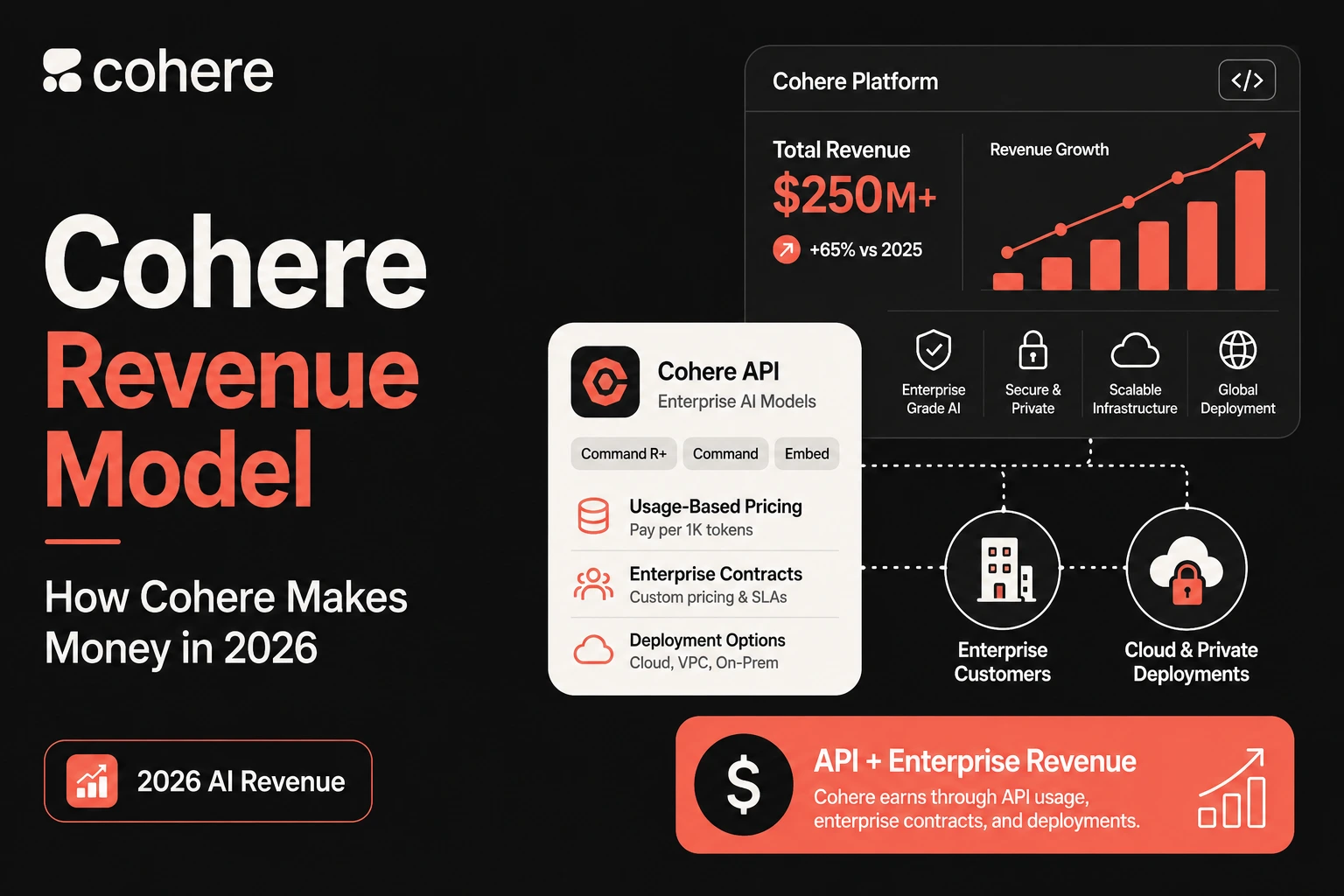
Cohere is estimated to generate between $180 million and $220 million in revenue in 2026, positioning itself as one of the fastest-growing enterprise AI infrastructure companies globally.
Unlike consumer AI platforms, Cohere focuses almost entirely on enterprise-grade large language model deployments, APIs, and secure AI infrastructure. Its strategy is built around long-term contracts, compliance readiness, and deep system integrations rather than mass-market subscriptions.
What makes Cohere particularly strategic is its infrastructure-first positioning. Instead of competing for consumer attention, it embeds itself into enterprise workflows — powering internal search, knowledge assistants, automation tools, and decision-support systems. That creates switching costs and predictable recurring usage revenue.
Cohere also benefits from the structural shift toward private and sovereign AI deployments. Many enterprises and governments prefer models that can run within controlled environments, and Cohere’s private LLM offerings directly address that demand.
Cohere Revenue Overview – The Big Picture
Estimated Revenue: Cohere’s annual revenue is estimated to be in the range of $180M–$220M, supported by enterprise AI contracts, private model deployments, and API-based usage.
Estimated Valuation: Cohere’s valuation is estimated at around $5B–$6B, reflecting strong investor confidence in enterprise-focused generative AI infrastructure.
YoY Growth: 80–100% growth driven by enterprise AI adoption
Revenue by Region:
• North America: ~65%
• Europe: ~20%
• Asia-Pacific: ~15%
Profit Margins (Estimated):
• Gross margin: 65–75% (cloud infrastructure heavy but high pricing power)
• EBITDA: Likely reinvested into growth
• Net Profit: Not yet consistently profitable (growth-stage AI firm)
Competition Benchmark :
• OpenAI (enterprise API)
• Anthropic
• Google DeepMind (Gemini enterprise)
• AWS Bedrock
• Micosoft Azure OpenAI
Read More: How Cohere Works: Command Models, Embeddings, Rerank, and Production Deployment
Cohere’s core strength lies in enterprise-first AI monetization — not mass-market subscriptions but high-value corporate contracts.
Primary Revenue Streams Deep Dive
Revenue Stream #1: Enterprise API Usage (~50%)
Cohere charges companies for API access to its language models.
• Pricing based on token usage
• Tiered enterprise contracts
• Custom pricing for high-volume clients
• Recurring usage-based revenue
Revenue Stream #2: Private LLM Deployment (~20%)
Companies pay for custom model deployment within private cloud or on-premise environments.
• Multi-million-dollar annual contracts
• High retention rates
• Strong security compliance positioning
Revenue Stream #3: Fine-Tuning & Custom Models (~15%)
Cohere trains models on proprietary enterprise datasets.
• Setup fees
• Ongoing inference charges
• Higher margins due to specialization
Revenue Stream #4: Strategic Partnerships & Cloud Integrations (~10%)
Revenue-sharing agreements with cloud providers and system integrators.
Revenue Stream #5: AI Platform Tools & Add-ons (~5%)
Developer dashboards, embeddings APIs, retrieval tools, and knowledge connectors.
Table: Revenue Streams Percentage Breakdown
| Revenue Stream | Estimated Share | Pricing Model |
|---|---|---|
| Enterprise API Usage | 50% | Token-based usage pricing |
| Private LLM Deployment | 20% | Annual enterprise contracts |
| Custom Fine-Tuning | 15% | Setup + usage-based fees |
| Cloud/Strategic Partnerships | 10% | Revenue-sharing agreements |
| Platform Tools & Add-ons | 5% | Subscription + usage pricing |
The Fee Structure Explained
User-Side Fees
• No consumer subscription model
• Enterprise-only billing
Enterprise Client Fees
• Token-based pricing per million tokens
• Custom negotiated annual contracts
• Infrastructure hosting fees
• Deployment consulting charges
Hidden Revenue Layers
• Overages beyond usage tiers
• Premium model access tiers
• Data security compliance packages
Regional Pricing Variation
• Higher enterprise pricing in US markets
• Custom compliance-driven pricing in EU
• Emerging market discounts for expansion
Table: Complete Fee Structure by User Type
| Client Type | Fee Type | Pricing Structure |
|---|---|---|
| Enterprise (API) | Token Usage | Variable per million tokens |
| Enterprise (Private) | Dedicated Model Deployment | Multi-million annual contracts |
| Enterprise (Custom) | Fine-Tuning Services | Setup + recurring usage fees |
| Cloud Partners | Revenue Share | Percentage-based agreements |
| Developers | Platform Add-ons | Tiered subscription + usage pricing |
How Cohere Maximizes Revenue Per Client
Segmentation
Cohere focuses on high-value industries: finance, healthcare, legal, telecom.
Upselling
Clients start with API usage and upgrade to private deployments.
Cross-Selling
Fine-tuning services bundled with long-term contracts.
Dynamic Pricing
Token usage tiers increase cost efficiency for high-volume users.
Retention Monetization
Long-term enterprise contracts with auto-renew clauses.
LTV Optimization
Enterprise clients often sign 2–3 year deals, increasing lifetime value significantly.
Psychological Pricing
Enterprise tier packaging creates anchor pricing for premium services.
Real Data Example
Large financial institutions can spend several million dollars annually on secure AI infrastructure and custom deployments.
Cost Structure & Profit Margins
Infrastructure Costs
• GPU cloud compute (major expense)
• Model training clusters
• Storage & bandwidth
CAC & Sales
• Enterprise sales teams
• Business development partnerships
Operations
• Compliance & legal teams
• Customer success managers
R&D
• Model development
• Safety & alignment research
• Retrieval-augmented generation improvements
Unit Economics
• High gross margins once scale improves
• Heavy upfront training cost
• Strong recurring inference revenue
Margin Optimization
Moving toward optimized models that reduce GPU dependency per token.
Profitability Path
Scale enterprise contracts + infrastructure efficiency improvements.
Future Revenue Opportunities & Innovations
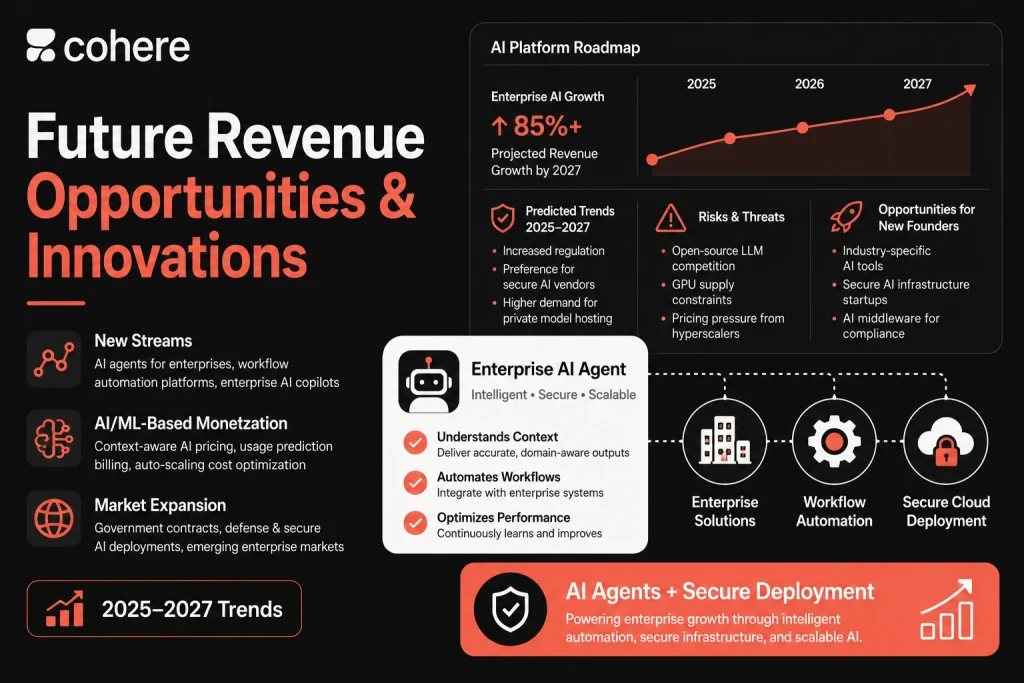
New Streams
• AI agents for enterprises
• Workflow automation platforms
• Enterprise AI copilots
AI/ML-Based Monetization
• Context-aware AI pricing
• Usage prediction billing
• Auto-scaling cost optimization
Market Expansion
• Government contracts
• Defense & secure AI deployments
• Emerging enterprise markets
Predicted Trends 2025–2027
• Increased regulation
• Enterprise preference for secure AI vendors
• Higher demand for private model hosting
Risks & Threats
• Open-source LLM competition
• GPU supply constraints
• Pricing pressure from hyperscalers
Opportunities for New Founders
• Industry-specific AI vertical tools
• Secure AI infrastructure startups
• AI middleware for compliance
Lessons for Entrepreneurs & Your Opportunity
What Works
• Enterprise-first strategy
• Usage-based pricing
• High switching costs
What to Replicate
• API monetization
• Tiered enterprise packaging
• Compliance-driven differentiation
Market Gaps
• SME-focused AI platforms
• Affordable private LLM hosting
• Localized language model infrastructure
Final Thought
Cohere shows that enterprise AI can become a powerful recurring revenue engine when it is built around security, customization, and real business needs. Instead of focusing only on consumer-facing AI tools, Cohere positions its models for enterprises that need private deployment, data control, workflow integration, and long-term reliability.
For founders, the lesson is clear: infrastructure may not always look as flashy as consumer apps, but it can scale faster and monetize deeper. Enterprise AI businesses win when they solve serious operational problems, build trust with large clients, and create long-term contracts that generate predictable revenue.
Contact Us today to explore secure, scalable, and customizable AI app development solutions for your business.
FAQs
1. How much does Cohere make per transaction?
Cohere earns based on token usage, often billed per million tokens consumed.
2. What’s Cohere’s most profitable revenue stream?
Enterprise API usage is likely the highest-margin recurring stream.
3. How does Cohere’s pricing compare to competitors?
It is competitive with other enterprise LLM providers but positioned as secure and customizable.
4. What percentage does Cohere take from clients?
It does not take commission; it charges usage-based or contract-based fees.
5. How has Cohere’s revenue model evolved?
It shifted from developer API focus to enterprise-grade private deployments.
6. Can small platforms use similar models?
Yes, especially in niche AI vertical markets.
7. What’s the minimum scale for profitability?
Infrastructure efficiency and enterprise contracts determine profitability thresholds.
8. How to implement similar revenue models?
Offer API access, tiered pricing, enterprise packages, and customization services.
9. What are alternatives to Cohere’s model?
Open-source AI services, SaaS-based AI tools, or freemium AI subscription apps.