



Key Takeaways
What You’ll Learn
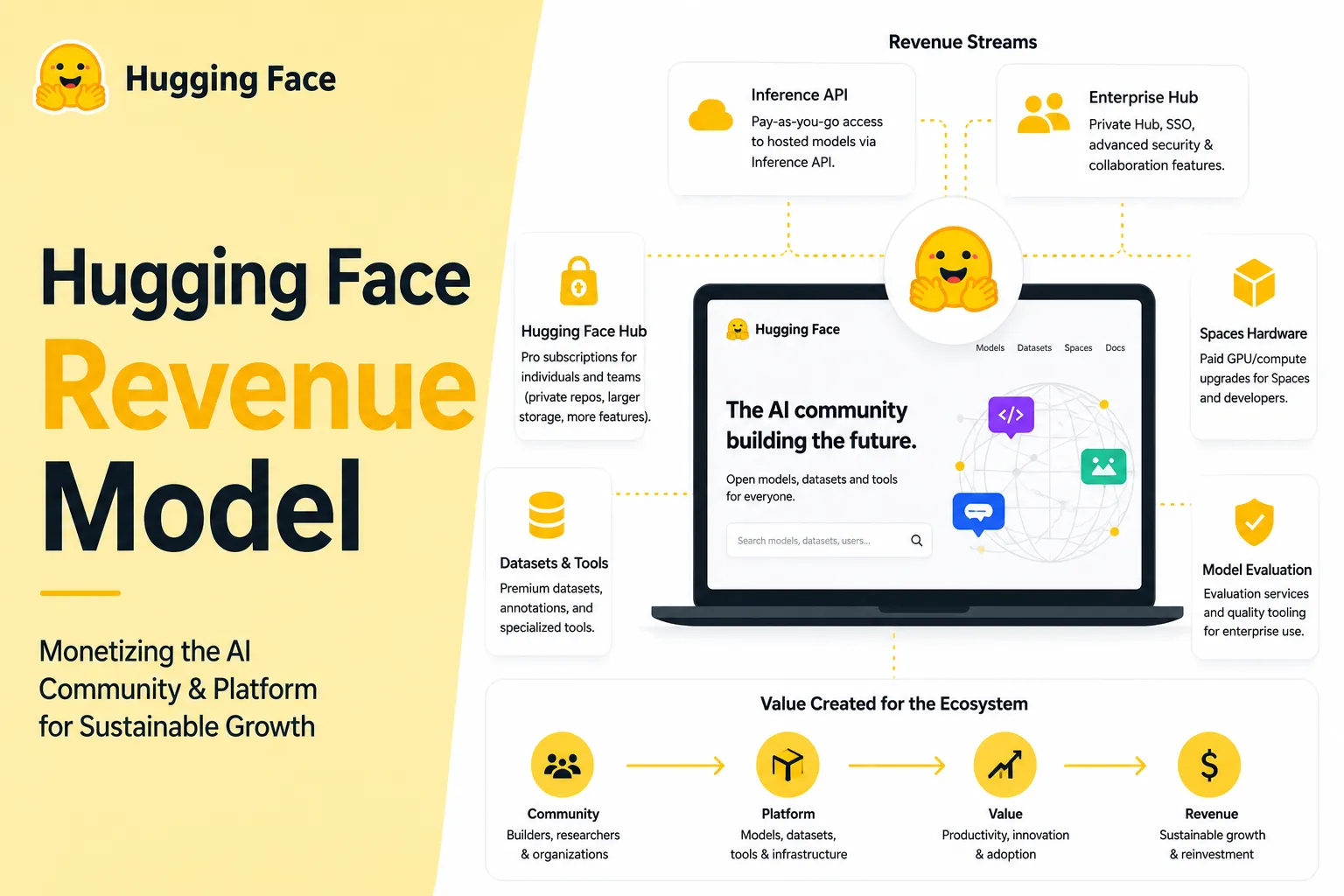
- Hugging Face operates as an open-source AI platform for models, datasets, and machine learning tools.
- The company follows a freemium business model with paid enterprise and infrastructure services.
- Revenue comes from enterprise subscriptions, API usage, inference endpoints, and cloud infrastructure.
- Enterprise collaboration tools are major monetization drivers.
- The model focuses on community growth first and monetization through scalable AI infrastructure.
Stats That Matter
- Revenue is generated through enterprise subscriptions, API access, and hosted AI services.
- Most users access the free ecosystem, while enterprises pay for advanced infrastructure and collaboration.
- The platform hosts millions of AI models and datasets for developers and organizations.
- Hosted inference and cloud-based AI infrastructure support recurring revenue growth.
- Enterprise AI adoption continues to increase demand for scalable infrastructure platforms.
Real Insights
- Open-source ecosystems help attract developers and accelerate platform adoption.
- Freemium models become effective when enterprise infrastructure becomes essential.
- AI infrastructure platforms generate recurring revenue through hosted compute and collaboration tools.
- Community trust and transparency create long-term competitive advantages.
- Long-term success depends on balancing open access with sustainable enterprise monetization.
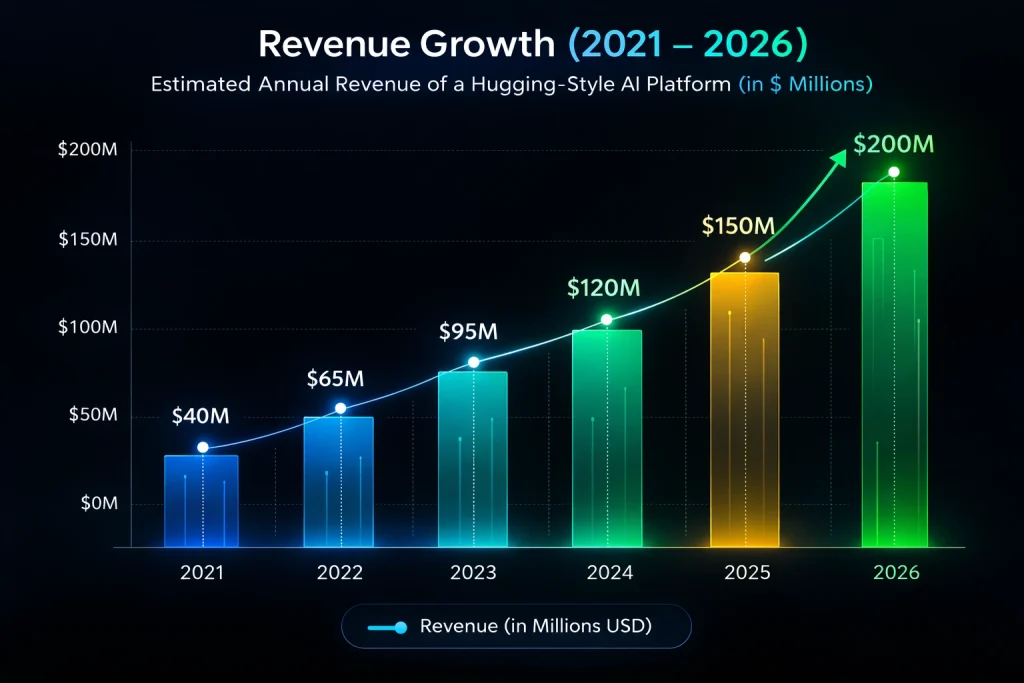
AI developer platforms have quickly become one of the most powerful infrastructure layers in the modern technology stack. By early 2026, platforms similar to Hugging Face are estimated to operate at a $150M–$200M annual revenue run rate, fueled by explosive demand for machine learning models, datasets, and AI deployment infrastructure.
For founders building AI tools or infrastructure startups, studying this model is incredibly valuable. These platforms combine open-source ecosystems, developer communities, and enterprise infrastructure to create scalable monetization engines. Understanding how these systems generate revenue can help entrepreneurs design sustainable AI businesses.
Hugging Face Revenue Overview – The Big Picture
A Hugging Face-style AI platform functions as a central hub for machine learning development, enabling developers to discover, train, share, and deploy AI models. The value of the platform increases as more developers contribute models, datasets, and tools.
Financial Snapshot (Estimated 2025–2026)
- Estimated Annual Revenue Run Rate: $150M–$200M
- Estimated Valuation: $4B–$5B range
- Estimated Year-over-Year Growth: ~60–80% due to enterprise AI adoption
- Core Business Model: Open-core AI developer platform
- Profitability Status: Near break-even while reinvesting heavily into infrastructure
- Primary Revenue Driver: Enterprise AI deployments and infrastructure usage
Regional Revenue Distribution (Estimated)
- North America: ~55%
- Europe: ~25%
- Asia-Pacific: ~15%
- Other regions: ~5%
Competitive Landscape
AI developer platforms operate alongside several major ecosystems including cloud machine-learning services, enterprise AI infrastructure providers, and generative AI platforms. However, the Hugging-style platform stands out because it combines open-source collaboration with enterprise-grade infrastructure.
Read More: How Hugging Face Works: Hub, Spaces, Inference, and the Open-Source AI Stack
Primary Revenue Streams Deep Dive
AI model platforms generate revenue through multiple streams that combine SaaS subscriptions, infrastructure usage, and enterprise contracts.
Revenue Stream #1: Enterprise AI Infrastructure
The largest portion of revenue comes from enterprise customers deploying AI systems at scale.
Enterprises require:
- private model hosting
- secure AI environments
- model deployment infrastructure
- internal AI collaboration tools
Large companies pay significant annual contracts to run AI workloads securely.
Estimated revenue share: 50–60%
Pricing model typically includes:
- enterprise licensing
- infrastructure costs
- dedicated support
Enterprise clients often represent the highest-value customers on the platform.
Revenue Stream #2: Developer Subscriptions
Developer platforms typically follow a freemium model.
Free users gain access to:
- public model hosting
- community datasets
- limited compute usage
Paid plans unlock advanced capabilities such as:
- private repositories
- collaboration features
- increased compute limits
- faster model deployments
Estimated revenue share: 15–20%
Monthly subscription plans allow the platform to generate recurring SaaS revenue while maintaining a large developer ecosystem.
Revenue Stream #3: AI Compute and Hosting
AI models require substantial computational power to run.
Platforms monetize this by charging for:
- GPU infrastructure
- model inference endpoints
- hosted machine-learning demos
- large-scale model deployments
Developers pay based on compute usage, making this a scalable revenue engine as AI adoption grows.
Estimated revenue share: 15–20%
Usage-based infrastructure pricing aligns revenue directly with platform growth.
Revenue Stream #4: Model Licensing and Commercial APIs
Some AI models can be deployed as commercial services.
Companies often pay licensing or API access fees to integrate advanced models into their products.
Typical use cases include:
- chatbot AI models
- computer vision systems
- recommendation engines
- language models
Estimated revenue share: 5–10%
This stream becomes more valuable as proprietary or specialized models emerge.
Revenue Stream #5: Marketplace Ecosystem
As AI platforms mature, they evolve into model marketplaces.
Developers and companies can publish:
- premium AI models
- specialized datasets
- enterprise AI tools
The platform then takes a commission on marketplace transactions.
Estimated revenue share: less than 5% currently, but expected to grow significantly as the ecosystem expands.
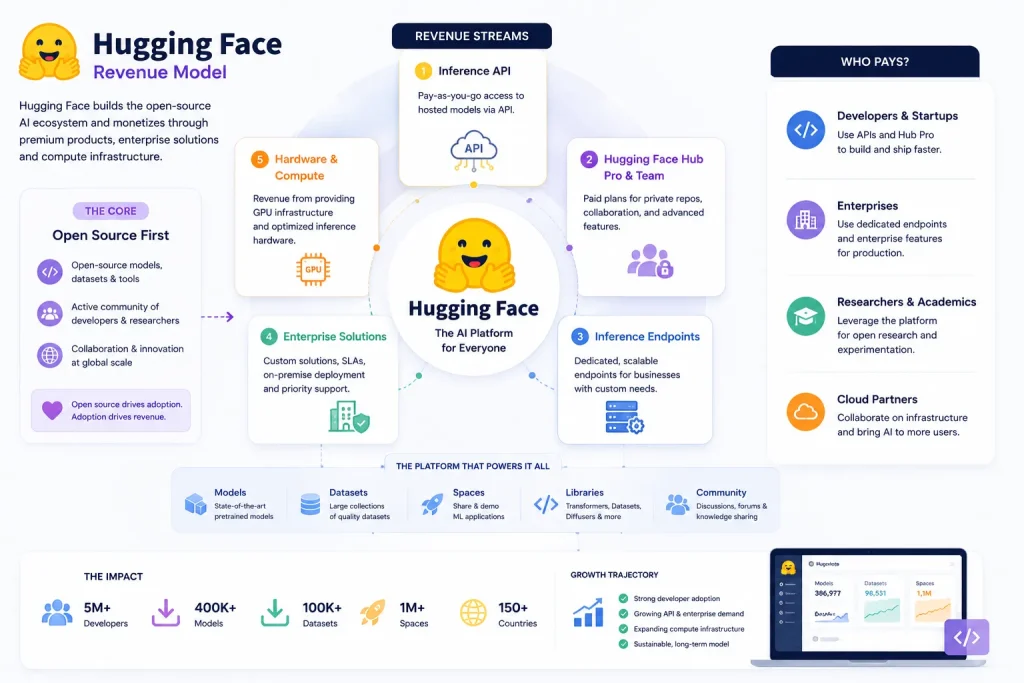
Revenue Streams Breakdown (Latest Estimated Data)
| Revenue Stream | Description | Estimated Revenue Share | Pricing Model |
|---|---|---|---|
| Enterprise AI Infrastructure | Private deployments, enterprise AI environments | 50–60% | Custom enterprise contracts |
| Developer Subscriptions | Paid plans for developers and teams | 15–20% | Monthly SaaS pricing |
| AI Compute & Hosting | GPU infrastructure and inference endpoints | 15–20% | Usage-based pricing |
| Model Licensing | Commercial AI model APIs and licensing | 5–10% | API pricing or licensing |
| Marketplace Ecosystem | Dataset and model marketplace commissions | <5% | Platform commission |
The Fee Structure Explained
AI developer platforms generate revenue through a layered pricing model that balances accessibility with scalable infrastructure fees.
User-Side Fees
Developers can access the platform for free initially.
Paid developer plans unlock additional tools such as:
- private model hosting
- team collaboration features
- expanded storage and compute
This structure encourages widespread adoption while converting power users into paying customers.
Provider-Side Fees
Model creators or dataset providers may also generate revenue through marketplace transactions.
The platform typically collects a commission fee on these sales.
Infrastructure Usage Fees
The most scalable monetization layer is infrastructure usage.
Charges may include:
- GPU compute time
- model inference requests
- storage costs for datasets and models
Usage-based pricing ensures revenue grows as companies scale their AI workloads.
Hidden Revenue Layers
Additional revenue sources include:
- enterprise consulting
- AI deployment services
- premium datasets
- advanced developer analytics
These layers often increase average revenue per customer.
Platform Fee Structure (Estimated Data)
| User Type | Fee Type | Typical Fee Range | Notes |
|---|---|---|---|
| Individual Developers | Pro Subscription | $9–$20/month | Advanced development tools |
| Startup Teams | Collaboration Plan | $20–$50/user/month | Shared repositories and workflows |
| Enterprise Customers | Private AI Platform | $10K–$150K+ annually | Secure infrastructure deployments |
| Developers | GPU Compute Usage | $0.50–$40/hour | Depends on hardware |
| API Users | Model Inference Fees | Variable per request | Scales with traffic |
How a Hugging Clone Maximizes Revenue Per User
AI infrastructure platforms rely heavily on power-user monetization.
Most developers join the platform for free, but revenue comes from users who scale their AI products.
Customer Segmentation
Typical customer segments include:
- independent developers
- AI startups
- enterprise ML teams
- academic research groups
Enterprise teams generate the largest revenue due to large-scale infrastructure needs.
Upselling Mechanics
Upselling opportunities include:
- increased compute usage
- enterprise security features
- dedicated model hosting
As companies deploy AI products into production, their infrastructure requirements increase significantly.
Cross-Selling
Platforms cross-sell complementary services such as:
- datasets
- model optimization tools
- enterprise integrations
These add-ons expand total revenue per customer.
Dynamic Pricing Models
Infrastructure services often use dynamic pricing based on usage.
Customers pay more as they scale:
- inference traffic
- model training
- dataset storage
This pricing strategy ensures revenue grows with AI adoption.
Lifetime Value Optimization
Developer platforms achieve high lifetime value by building ecosystem lock-in.
Once a company integrates the platform into its AI pipeline, switching becomes costly and technically difficult.
Cost Structure & Profit Margins
While AI platforms generate significant revenue, their cost structures are also complex.
The largest expense category is compute infrastructure.
Infrastructure Costs
Major cost components include:
- GPU clusters
- cloud infrastructure
- dataset storage
- model hosting servers
These costs scale with platform growth.
Customer Acquisition Cost
Unlike traditional SaaS, developer platforms often have low acquisition costs because growth comes from:
- open-source communities
- developer adoption
- research institutions
Community-driven growth significantly reduces marketing spending.
Marketing and Developer Relations
Marketing investment focuses on:
- developer conferences
- AI research partnerships
- educational resources
These initiatives help build long-term ecosystem adoption.
Research and Development
AI infrastructure platforms invest heavily in:
- machine learning frameworks
- model training tools
- dataset infrastructure
- developer APIs
Continuous innovation is required to remain competitive.
Unit Economics
Higher-margin revenue sources include:
- enterprise subscriptions
- SaaS developer plans
Lower-margin segments include:
- compute infrastructure services
Balancing these revenue streams is essential for profitability.
Future Revenue Opportunities (2026–2028 Outlook)
AI infrastructure platforms still have massive growth opportunities ahead.
AI Model Marketplaces
One major opportunity is expanding AI model marketplaces where developers sell specialized models.
This could create an entirely new revenue category for AI ecosystems.
AI Infrastructure Expansion
Demand for inference infrastructure will increase dramatically as more companies deploy AI applications.
This creates opportunities for:
- AI hosting services
- model deployment platforms
- distributed inference networks
AI Dataset Economy
Datasets are becoming as valuable as models.
Platforms can monetize curated datasets for industries such as:
- healthcare
- finance
- robotics
Global Market Expansion
AI adoption is accelerating in emerging markets, opening opportunities for regional developer ecosystems.
Risks and Threats
Key risks include:
- competition from major cloud providers
- rising GPU infrastructure costs
- open-source alternatives
Startups entering this space must differentiate through community, performance, or specialized tools.
Lessons for Entrepreneurs
The Hugging-style platform model offers several valuable lessons for founders.
Build Ecosystems, Not Just Products
The real strength of this model lies in its developer ecosystem. Platforms grow stronger as more developers contribute models and datasets.
Freemium Drives Network Effects
Allowing free access attracts a large developer community, which later converts into enterprise customers.
Infrastructure Monetization Scales
Usage-based infrastructure pricing ensures revenue grows automatically as AI workloads increase.
Marketplace Models Unlock Long-Term Growth
Platforms that evolve into marketplaces can generate additional revenue from third-party developers.
Opportunities for New Startups
Startups can still innovate by focusing on:
- specialized AI domains
- vertical industry datasets
- model optimization tools
The AI infrastructure market remains early and full of opportunity.
Miracuves Hugging Face-Like AI Model Hub Platform Solution Cost and Tech Stack
Miracuves Pricing for a Hugging Face-Like AI Model Hub & Machine Learning Platform developed using Node.js / React.js Architecture is available on request. Contact Miracuves for custom pricing based on platform features, scalability requirements, AI integrations, infrastructure scope, and deployment requirements. Estimated delivery timeline: 30 to 90 Days.
Build a powerful AI model hosting and machine learning collaboration platform designed for startups, AI companies, research organizations, SaaS businesses, developers, and enterprise AI operations.
Core Workflows: AI model hosting, model sharing, dataset management, API deployment, inference workflows, collaborative AI development, version control systems, and machine learning pipeline operations.
Built-in AI Operations: Model training workflows, AI inference management, dataset processing, GPU resource allocation, model evaluation systems, API orchestration, experiment tracking, and AI performance analytics.
Management Hub: Admin dashboards, AI model management, user collaboration systems, API monitoring, analytics reporting, moderation workflows, storage management, audit logs, and centralized AI operations control.
Enterprise-Ready: Fully customizable architecture prepared for secure scaling, large-scale AI infrastructure, cloud GPU orchestration, enterprise AI workflows, multi-user collaboration ecosystems, and long-term platform growth.
Why does a Hugging Face-Like Platform require Node.js / React.js architecture?
AI model hub platforms process high-performance inference workloads, dataset management systems, API operations, and collaborative machine learning workflows. These platforms require scalable infrastructure, responsive dashboards, and efficient orchestration for complex AI operations.
We recommend a modern JavaScript-based architecture for this type of platform because:
Built for Real-Time Operations: Node.js enables scalable backend operations for AI inference requests, model deployment workflows, dataset synchronization, API orchestration, and concurrent developer activities.
Advanced Dashboard Experience: React.js supports highly interactive interfaces for AI model browsing, dataset management, API dashboards, experiment tracking, analytics reporting, and seamless collaboration experiences.
Enterprise Scalability: This architecture is well-suited for handling large-scale AI workloads, multi-user collaboration systems, GPU-intensive operations, and enterprise machine learning ecosystems.
Flexible Integration Layer: Easily integrates with cloud GPU infrastructure, vector databases, AI frameworks, storage systems, analytics platforms, authentication systems, and third-party AI services.
You get a scalable, enterprise-grade AI model hosting and machine learning platform designed for long-term operational growth.
Note: Final pricing depends on AI infrastructure requirements, GPU orchestration complexity, storage systems, deployment scale, third-party integrations, and custom workflow development.
Conclusion
AI developer platforms are becoming the foundation of the modern machine-learning economy. The Hugging-style model demonstrates how open-source ecosystems can evolve into powerful infrastructure businesses. By combining developer communities, shared model repositories, and scalable AI infrastructure, these platforms create strong network effects that accelerate innovation across the industry.
For founders building AI products, understanding this revenue model offers a blueprint for creating scalable and sustainable platforms. The real power of this model lies in its ability to convert a large open-source community into enterprise customers over time. As developers build, test, and deploy models on the platform, the ecosystem becomes deeply integrated into their workflows, making the platform increasingly valuable.
FAQs
How much does a Hugging-style platform make per transaction?
Most revenue comes from infrastructure usage and enterprise contracts rather than single transactions.
What is the most profitable revenue stream for these platforms?
Enterprise AI infrastructure contracts typically generate the highest margins and revenue.
What percentage does the platform take from providers?
Marketplace commissions typically range from 10–30% depending on the product or dataset sold.
How has this revenue model evolved?
The model has evolved from open-source hosting toward enterprise infrastructure and AI marketplaces.
Can small startups use a similar model?
Yes. Many startups begin by building developer tools and later expand into infrastructure services.
What scale is needed for profitability?
Profitability usually requires large enterprise adoption and significant infrastructure usage.
How can founders implement a similar model?
Start by building developer communities, offer freemium tools, and monetize through infrastructure and enterprise features.
What alternatives exist to this revenue model today?
Alternatives include API-based AI services, vertical AI SaaS products, and managed AI infrastructure platforms.