



Key Takeaways
What You’ll Learn
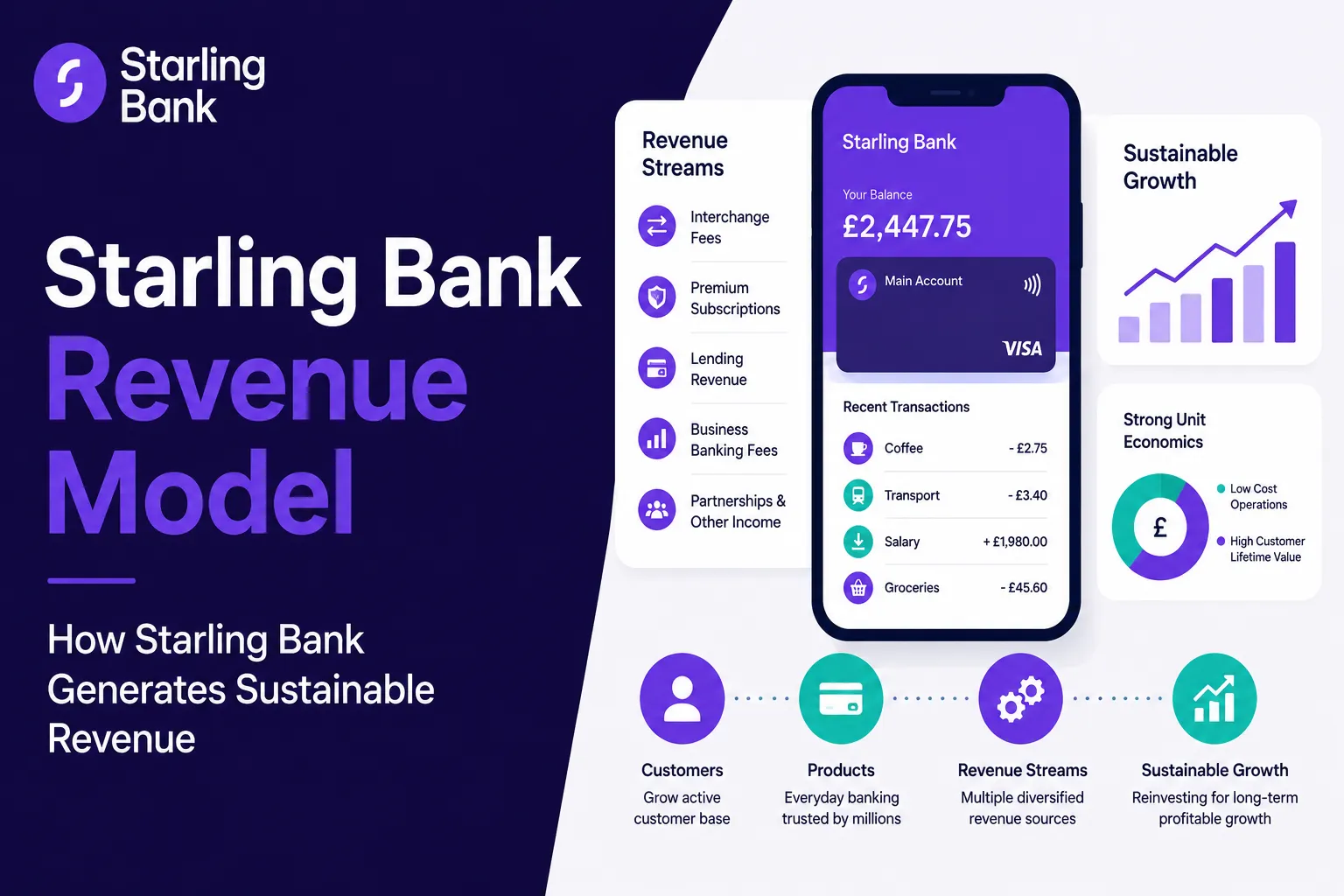
- Starling Bank’s revenue model is multi-layered, combining traditional banking income with modern fintech infrastructure services.
- Lending and interest income form the largest share of revenue, driven by loans, overdrafts, and credit products.
- Interchange fees from card payments generate consistent income based on transaction volume.
- Business banking tools and subscriptions provide recurring revenue from SMEs and premium users.
- Banking-as-a-Service (BaaS) enables additional income by offering infrastructure and APIs to other fintech companies.
Stats That Matter
- Lending typically contributes the largest revenue share, often forming the core income stream in digital banking models.
- Interchange fees scale with transaction volume, creating steady income from everyday user payments.
- Business accounts generate higher revenue per user compared to personal accounts due to added tools and services.
- BaaS and API-based services are emerging as key growth drivers in modern neobank ecosystems.
Real Insights
- Digital banks rely on volume-based growth, where more users and transactions directly increase revenue potential.
- Lending unlocks higher margins, making it a key profitability driver compared to payment fees.
- Infrastructure monetization through BaaS creates long-term scalability beyond direct users.
- Free core accounts attract users, while advanced services and financial products generate revenue.
- The most successful digital banks succeed by combining payments, lending, subscriptions, and fintech infrastructure into one scalable ecosystem.
Digital banks have transformed the financial industry by removing physical branches and building entirely app-based financial ecosystems. By 2026, successful neobanks similar to Starling operate at estimated hundreds of millions in annual revenue, driven by payment activity, lending products, and fintech platform services.
For founders and fintech builders, studying this model reveals how a digital banking platform can scale profitably without traditional banking infrastructure. The Starling-style model combines mobile banking, payment networks, and financial products into a powerful monetization system.
Starling Revenue Overview – The Big Picture
A Starling-style neobank functions as a digital financial platform, offering personal banking, business banking, payments, and lending through a mobile-first ecosystem.
Financial Snapshot (Estimated 2025–2026)
Estimated Revenue Range: $700M–$900M annual run rate
Estimated Valuation: $3B–$4B range for leading digital banks
Growth Rate: ~30–50% year-over-year as digital banking adoption increases
Profitability Status: Many leading neobanks have reached profitability through lending and infrastructure services
Primary Users: Retail banking customers, freelancers, and small businesses
Regional Revenue Distribution (Typical)
Europe: ~60%
North America: ~20%
Asia-Pacific: ~15%
Other regions: ~5%
Competitive Benchmark
A Starling-style digital bank competes with:
- other neobanks
- digital challenger banks
- fintech payment platforms
- traditional banks transitioning to digital services
However, the main advantage of a digital bank is lower operational costs and faster product innovation.
Read More: Business Model of Starling Bank: Strategy, Revenue & Growth
Primary Revenue Streams Deep Dive
Digital banks generate income from multiple financial products rather than relying solely on account fees.
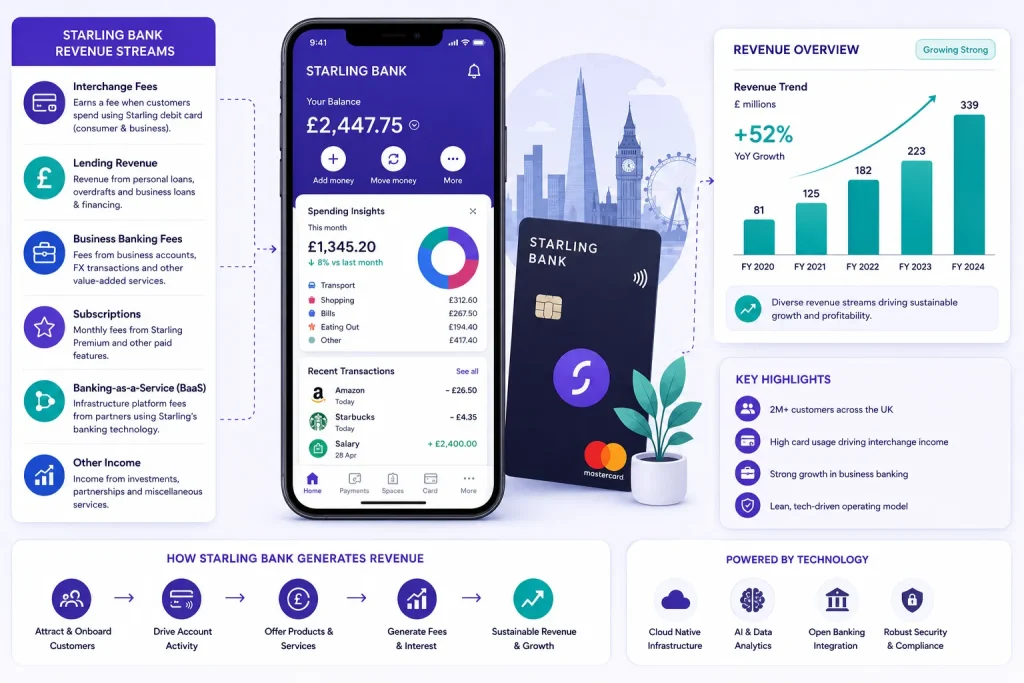
Revenue Stream #1: Interchange Fees
Every time a customer uses a debit card for a transaction, the merchant’s bank pays an interchange fee to the card issuer.
Neobanks earn a small percentage of each transaction processed through their cards.
Key characteristics:
- Revenue scales with transaction volume
- Millions of daily payments generate consistent income
- Higher card usage increases platform revenue
Estimated revenue share: 25–35%
Revenue Stream #2: Lending Products
Lending is one of the most profitable parts of digital banking.
Common lending products include:
- personal loans
- overdraft facilities
- small business loans
- credit lines
Neobanks generate revenue from interest margins, which represent the difference between borrowing costs and lending rates.
Estimated revenue share: 35–45%
Revenue Stream #3: Business Banking Services
Many digital banks provide specialized tools for businesses and freelancers.
These services include:
- invoicing tools
- expense management
- payroll integrations
- multi-user banking accounts
Businesses often pay monthly fees for premium financial tools.
Estimated revenue share: 10–15%
Revenue Stream #4: Premium Banking Subscriptions
Neobanks frequently offer premium account tiers with additional features.
These may include:
- advanced financial analytics
- international payments
- travel insurance
- higher transaction limits
Monthly subscription pricing allows predictable recurring revenue.
Estimated revenue share: 5–10%
Revenue Stream #5: Banking-as-a-Service (BaaS)
One of the fastest-growing opportunities for digital banks is Banking-as-a-Service infrastructure.
This allows other fintech startups to build products using the bank’s technology and regulatory infrastructure.
Services offered may include:
- payment processing
- account infrastructure
- card issuing
- financial APIs
Estimated revenue share: 10–15%
Revenue Streams Breakdown (Latest Estimated Data)
| Revenue Stream | Description | Estimated Revenue Share | Pricing Model |
|---|---|---|---|
| Lending Products | Interest income from loans and credit lines | 35–45% | Interest margin |
| Interchange Fees | Revenue from debit card transactions | 25–35% | Percentage per transaction |
| Business Banking | Tools and services for SMEs and freelancers | 10–15% | Monthly subscription |
| Banking-as-a-Service | Infrastructure for fintech platforms | 10–15% | API and infrastructure fees |
| Premium Accounts | Paid banking tiers with extra features | 5–10% | Monthly subscription |
The Fee Structure Explained
Digital banks structure their pricing carefully to attract large numbers of users while monetizing advanced services.
User-Side Fees
Most neobanks offer free basic accounts to encourage rapid customer adoption.
However, users may pay fees for:
- international transfers
- premium accounts
- overdraft services
Merchant-Side Revenue
When customers pay merchants with their debit cards, interchange fees generate revenue for the bank.
Even though each fee is small, the massive transaction volume creates significant income.
Lending Fees
Interest on loans is a major monetization layer.
Banks also earn from:
- late payment fees
- credit services
- overdraft usage
Platform Infrastructure Fees
Fintech startups that use the bank’s infrastructure pay for:
- API access
- payment processing
- account management tools
How a Starling Clone Maximizes Revenue Per User
Digital banks rely heavily on customer engagement and financial product adoption. The more services a user adopts, the higher the revenue per customer.
Customer Segmentation
Neobanks typically serve:
- everyday banking customers
- freelancers
- small businesses
- fintech startups
Business accounts often generate significantly higher revenue than personal accounts.
Upselling Financial Products
Banks increase revenue through upselling:
- credit products
- investment tools
- insurance services
- premium account tiers
Cross-Selling Financial Services
A digital bank can offer multiple financial services within the same app, including:
- loans
- savings accounts
- international payments
- budgeting tools
This integrated ecosystem increases customer lifetime value.
Dynamic Pricing
Financial products often use dynamic pricing based on:
- credit risk
- transaction volume
- business size
This ensures pricing remains profitable while remaining competitive.
Retention and Customer Lifetime Value
Neobanks focus on long-term customer relationships.
Once users rely on a digital bank for daily finances, switching to another bank becomes inconvenient. This significantly increases customer lifetime value (LTV).
Cost Structure & Profit Margins
Although digital banks eliminate physical branches, they still face substantial operational costs.
Infrastructure Costs
Key infrastructure expenses include:
- cloud banking systems
- payment network integration
- cybersecurity systems
- regulatory compliance platforms
Customer Acquisition Cost (CAC)
Fintech companies often spend heavily on marketing to attract users.
Common acquisition channels include:
- referral programs
- digital advertising
- partnerships with fintech platforms
Regulatory and Compliance Costs
Banks must comply with strict financial regulations, including:
- anti-money-laundering monitoring
- identity verification systems
- financial reporting infrastructure
These costs are significant but necessary for legal operation.
Technology and Product Development
Continuous innovation is essential in digital banking.
Investment areas include:
- mobile app development
- payment infrastructure
- fraud detection systems
- data analytics platforms
Unit Economics
Digital banks aim to achieve profitability through scale.
Key advantages include:
- lower operational costs compared to traditional banks
- scalable infrastructure
- recurring revenue from financial services
Future Revenue Opportunities (2026–2028 Outlook)
Digital banking continues to evolve rapidly.
Embedded Finance
Embedded finance allows non-financial companies to integrate banking services into their platforms.
Digital banks can power these services through API-based infrastructure.
AI-Driven Financial Services
Artificial intelligence will increasingly power:
- personalized financial advice
- automated lending decisions
- fraud detection systems
AI can significantly improve efficiency and profitability.
Global Digital Banking Expansion
Digital banks are expanding into new markets as regulatory frameworks evolve.
Emerging markets offer significant opportunities due to high mobile banking adoption.
Financial Super Apps
Future neobanks may evolve into financial super apps offering:
- payments
- investments
- insurance
- credit services
This expansion can dramatically increase revenue per user.
Lessons for Entrepreneurs
The Starling-style digital bank offers valuable lessons for fintech founders.
Focus on Mobile-First Experiences
Digital banks succeed by delivering seamless mobile banking experiences. User-friendly apps drive high customer engagement.
Build Multiple Revenue Streams
Relying on a single monetization channel is risky.
Successful neobanks combine:
- payments
- lending
- subscriptions
- fintech infrastructure
Infrastructure Platforms Create Strong Moats
Banking-as-a-Service platforms enable banks to generate revenue from other fintech companies. This creates strong ecosystem advantages.
Scale Matters in Financial Platforms
Financial platforms benefit greatly from scale.
More customers lead to more transactions, loans, and financial products.
Miracuves Starling Bank-Like Digital Banking Platform Solution Cost and Tech Stack
Miracuves Pricing for a Starling Bank-Like Digital Banking Platform developed using Node.js / React.js Architecture is available on request. Contact Miracuves for custom pricing based on platform features, scalability requirements, banking integrations, compliance scope, and deployment infrastructure. Estimated delivery timeline: 30 to 90 Days.
Build a powerful digital banking and fintech platform designed for startups, neobanks, fintech companies, payment providers, and enterprise financial operations.
Core Workflows: Digital account management, money transfers, card management, transaction tracking, savings management, budgeting tools, payment processing, and mobile-first banking workflows.
Built-in Finance: Real-time transaction monitoring, banking API integrations, KYC and AML workflows, expense analytics, subscription tracking, fraud detection systems, financial reporting, and settlement management operations.
Management Hub: Admin dashboards, customer management systems, compliance controls, fraud monitoring workflows, analytics reporting, audit logs, card management systems, and centralized banking operations management.
Enterprise-Ready: Fully customizable architecture prepared for secure scaling, multi-region banking operations, compliance-ready infrastructure, high-volume financial transactions, and long-term fintech platform growth.
Why does a Starling Bank-Like Platform require Node.js / React.js architecture?
Digital banking platforms process real-time financial transactions, payment operations, compliance workflows, and secure customer account management systems. These platforms require scalable infrastructure, low-latency financial processing, and highly responsive interfaces across web and mobile ecosystems.
We recommend a modern JavaScript-based architecture for this type of platform because:
Built for Real-Time Operations: Node.js enables scalable backend operations for instant payments, transaction processing, account synchronization, fraud monitoring, and concurrent banking activities.
Advanced Dashboard Experience: React.js supports highly interactive interfaces for banking dashboards, transaction analytics, card management, budgeting tools, and seamless customer experiences.
Enterprise Scalability: This architecture is well-suited for handling high-volume financial operations, multi-user banking ecosystems, compliance workflows, and rapidly growing fintech platforms.
Flexible Integration Layer: Easily integrates with banking APIs, payment gateways, KYC and AML providers, card issuing systems, fraud detection tools, analytics platforms, and financial infrastructure services.
You get a scalable, enterprise-grade digital banking platform designed for long-term operational growth.
Note: Final pricing depends on banking modules, compliance requirements, third-party integrations, deployment infrastructure, security systems, and custom workflow development.
Conclusion
The Starling-style neobank model demonstrates how digital technology can reshape traditional banking. By combining mobile banking, payments, and financial infrastructure, fintech startups can build scalable platforms that challenge legacy banks.
For entrepreneurs entering the fintech space, this model provides a powerful blueprint for building the next generation of digital financial services.
FAQs
1. How much does a Starling-style bank earn per transaction?
Neobanks earn a small interchange fee on each card transaction, typically a fraction of a percent.
2. What is the most profitable revenue stream for digital banks?
Lending products usually generate the highest margins through interest income.
3. How do neobank fees compare to traditional banks?
Neobanks typically offer lower fees because they operate without expensive physical branch networks.
4. What percentage do banks earn from interchange fees?
Interchange fees typically range from roughly 0.2% to 1% depending on region and payment network.
5. How has the neobank revenue model evolved?
Modern digital banks now combine payments, lending, subscriptions, and fintech infrastructure services.
6. Can startups replicate this business model?
Yes, but it requires strong regulatory compliance, banking partnerships, and scalable financial infrastructure.
7. What scale is required for profitability?
Digital banks usually need millions of active users or strong lending products to achieve sustainable profitability.
8. How can founders build a similar fintech platform?
Founders typically start with mobile banking features and gradually expand into lending, payments, and financial infrastructure.
9. What alternatives exist to this revenue model today?
Alternatives include fintech payment apps, digital wallets, and embedded finance platforms.