Key Takeaways
What You’ll Learn
- Carta works as a financial infrastructure platform for cap tables, equity management, and fund administration.
- Its business model goes beyond software subscriptions into transaction services and financial operations.
- Recurring SaaS revenue is a major foundation across startups, investors, and private companies.
- Liquidity events, fund services, and compliance workflows expand monetization.
- Long-term growth depends on trust, workflow depth, and platform integration into private markets.
Stats That Matter
- The article presents Carta around cap table management, equity administration, valuations, and fund services.
- Subscription revenue is shown as a major part of the business model.
- Liquidity programs, compliance support, valuations, and investor services are treated as added revenue layers.
- Startups, venture firms, and private companies are positioned as key customer groups.
- The model combines SaaS income with financial workflow monetization across the private market ecosystem.
Real Insights
- Carta becomes more valuable when it is embedded into critical financial workflows.
- Trust matters deeply because the platform handles ownership, equity, and compliance data.
- Recurring software revenue is stronger when tied to operational dependency.
- Financial services increase revenue depth beyond simple software access.
- The strongest fintech platforms grow by becoming part of the operating system for their market.
Carta has become one of the most recognized fintech SaaS platforms for equity management, cap table management, and private market infrastructure. The company helps startups, investors, venture capital firms, and growing businesses manage ownership, fundraising, employee equity, and compliance through a centralized digital platform. As more startups and private companies move toward digital financial operations, Carta has positioned itself as a major player in the fintech ecosystem.
What makes Carta especially interesting is its scalable and recurring revenue model. Instead of depending on a single service, the company generates revenue through subscriptions, fund administration, equity management tools, valuation services, and private market transactions. This diversified business strategy has helped Carta expand rapidly while serving thousands of companies and stakeholders worldwide.
In this blog, we will explore Carta revenue model, major income streams, business strategy, and the key factors behind its long-term fintech growth.
Carta Revenue Overview – The Big Picture
Carta operates as a SaaS fintech infrastructure platform focused on private company ownership management.
Instead of offering traditional banking services, Carta provides the tools that power the ownership layer of the startup ecosystem.
Its platform enables:
- cap table management
- employee equity management
- fund administration
- startup valuations
- private market liquidity
Key Financial Snapshot
| Metric | Latest Data |
|---|---|
| Estimated Revenue | $450M+ (2025) |
| Customers | 40,000+ companies |
| Stakeholders Managed | 2M+ |
| Assets Administered | $150B+ private assets |
| Core Product | Equity management software |
| Estimated Valuation | ~$8B–$10B |
Carta’s growth has been fueled by the explosion of venture-backed startups and private equity ownership structures.
Read More: Carta Explained: What It Is and How It Works
Primary Revenue Streams Deep Dive
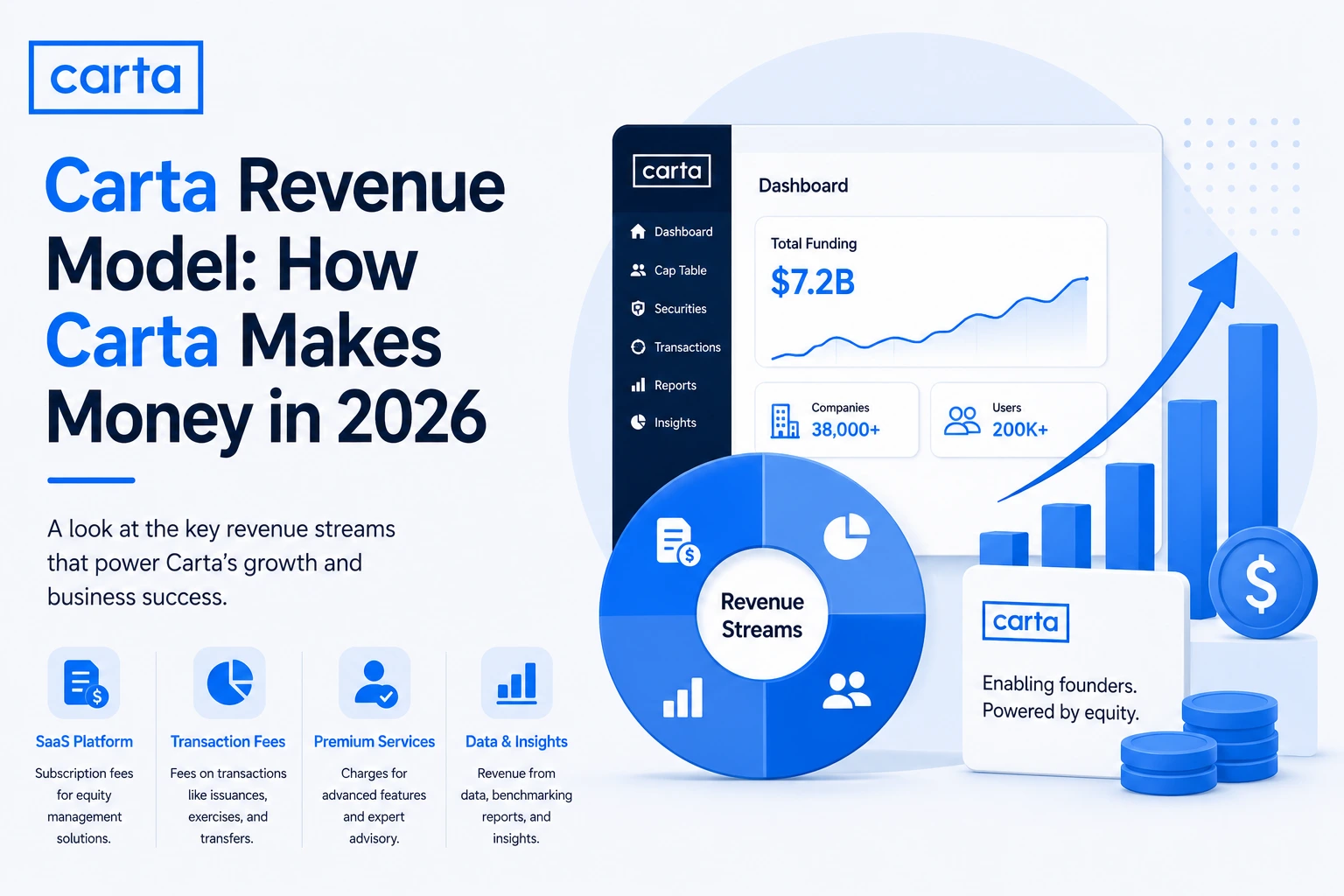
Carta’s monetization is built around SaaS subscriptions and financial infrastructure services.
Revenue Stream #1: Cap Table Management Software
Carta’s core product is cap table management software.
This tool helps companies manage:
- shareholder ownership
- employee stock options
- equity issuance
- fundraising rounds
Startups pay annual SaaS subscription fees based on:
- company stage
- number of stakeholders
- features required
Estimated contribution: 40–45%
Pricing model:
- annual SaaS subscription
- tiered pricing based on company size
Revenue Stream #2: Fund Administration Services
Carta provides fund administration for venture capital and private equity funds.
These services include:
- investor reporting
- fund accounting
- capital calls
- compliance management
Funds pay recurring service fees.
Estimated contribution: 25–30%
Pricing model:
- annual administration fees
- asset-based pricing
Revenue Stream #3: Equity Management for Employees
Carta offers equity management tools for employees and founders.
Services include:
- stock option tracking
- tax planning tools
- liquidity event management
Companies pay for employee equity management as part of platform packages.
Estimated revenue share: 10–15%
Revenue Stream #4: Liquidity & Private Market Transactions
Carta operates marketplaces that allow private shares to be traded between investors and employees.
These include:
- tender offers
- secondary share sales
- liquidity events
Carta charges transaction fees for facilitating these trades.
Estimated contribution: 10–12%
Revenue Stream #5: Valuation & Compliance Services
Carta also offers financial compliance services such as:
- 409A startup valuations
- regulatory reporting
- audit preparation
These services are required for companies issuing stock options.
Estimated contribution: 5–10%
Revenue Streams Breakdown (Latest Available Data)
| Revenue Stream | Description | Estimated Revenue Share | Pricing Model |
|---|---|---|---|
| Cap Table Software | Equity ownership management platform | 40–45% | SaaS subscription |
| Fund Administration | Venture fund accounting and reporting | 25–30% | Asset-based fees |
| Employee Equity Tools | Stock option and equity management | 10–15% | Subscription |
| Liquidity Marketplace | Secondary share trading services | 10–12% | Transaction fees |
| Valuation Services | 409A valuations and compliance tools | 5–10% | Service fees |
The Fee Structure Explained
Carta monetizes through both subscription software pricing and financial transaction fees.
Platform Fee Structure (Latest Available Data)
| User Type | Fee Type | Typical Fee Range | Notes |
|---|---|---|---|
| Startups | SaaS subscription | $2,000–$20,000/year | Based on company stage |
| Venture Funds | Administration fees | 0.05–0.2% of AUM | Fund accounting services |
| Investors | Marketplace transaction fees | 1–3% per trade | Secondary share sales |
| Companies | Valuation services | $1,000–$5,000 per valuation | 409A valuations |
| Employees | Equity tools | Included in company plans | Option management |
How Carta Maximizes Revenue Per User
Carta’s monetization strategy focuses on lifecycle expansion.
1. Startups Grow Into Bigger Customers
A company might start paying a few thousand dollars annually for cap table software.
As the startup grows, it may adopt:
- fund administration tools
- liquidity services
- compliance products
This dramatically increases lifetime value.
2. Investor Ecosystem Expansion
Carta doesn’t just serve startups.
It also serves:
- venture funds
- private equity firms
- angel investors
This creates two-sided monetization opportunities.
3. Financial Infrastructure Lock-In
Equity management is extremely sensitive data.
Once companies adopt Carta, switching platforms is difficult.
This leads to very high customer retention.
4. Private Market Liquidity Platform
By enabling private share trading, Carta captures revenue from secondary markets that previously lacked infrastructure.
Cost Structure & Profit Margins
Although Carta operates as SaaS, its fintech services create additional costs.
Major Cost Categories
Technology infrastructure
- secure equity databases
- fintech compliance systems
- financial transaction infrastructure
Customer acquisition
- startup partnerships
- VC ecosystem marketing
Compliance and regulation
- legal compliance
- financial reporting requirements
Operations
- fund accounting teams
- customer support
Typical Cost Structure
| Cost Category | Description |
|---|---|
| Infrastructure | Platform engineering and data systems |
| Customer Acquisition | Marketing to startups and venture funds |
| Compliance | Financial and legal regulations |
| Operations | Fund administration staff |
| R&D | Product development and fintech tools |
Carta’s SaaS model enables strong margins once customers are acquired.
Read More: Best Carta Clone Scripts 2026 | Equity & Cap Table Software
Miracuves Carta-Like Platform Solution Cost and Tech Stack
Miracuves Pricing for a Carta-Like Equity Management Platform developed using Node.js / React.js Architecture is available on request. Contact Miracuves for custom pricing based on platform features, scalability requirements, integrations, and deployment scope. Estimated delivery timeline: 30 to 90 Days.
Build a powerful equity management and cap table platform designed for startups, investors, venture firms, and enterprise ownership operations.
- Core Workflows: Cap table management, equity allocation, shareholder records, vesting schedules, ESOP management, fundraising tracking, and ownership reporting.
- Built-in Finance: Valuation workflows, equity calculations, investor reporting, compliance-ready financial logic, and transaction tracking.
- Management Hub: Admin dashboards, stakeholder access controls, document management, audit logs, and centralized company governance tools.
- Enterprise-Ready: Fully customizable architecture prepared for secure scaling, multi-company management, compliance operations, and long-term platform growth.
Why does a Carta-Like Platform require Node.js / React.js architecture?
Equity management platforms process highly sensitive ownership data, investor workflows, financial operations, and real-time reporting systems. These platforms often require scalable infrastructure, secure data handling, and advanced dashboard performance across multiple stakeholders.
We recommend a modern JavaScript-based architecture for this type of platform because:
- Built for Real-Time Operations: Node.js enables scalable backend operations for live equity updates, reporting systems, investor actions, and concurrent user activity.
- Advanced Dashboard Experience: React.js supports highly interactive interfaces for cap table visualization, financial analytics, document workflows, and shareholder management.
- Enterprise Scalability: This architecture is well-suited for handling complex ownership structures, compliance workflows, and growing startup or investor ecosystems.
- Flexible Integration Layer: Easily integrates with payment systems, compliance tools, accounting platforms, digital signature systems, and investor management workflows.
You get a scalable, enterprise-grade ownership management platform designed for long-term operational growth.
Note: Final pricing depends on platform modules, compliance requirements, integrations, deployment infrastructure, and custom workflow development.
Future Revenue Opportunities (2026–2028 Outlook)
Carta still has several expansion opportunities.
1. Private Market Trading Platforms
Private stock trading could become a massive secondary market, and Carta is positioned to build the infrastructure.
2. Global Startup Infrastructure
International startups are increasingly adopting cap table platforms.
Global expansion could significantly grow revenue.
3. Embedded Finance for Startups
Future offerings may include:
- startup banking
- payroll systems
- financial analytics tools
4. AI-Powered Ownership Analytics
AI could provide:
- equity planning tools
- startup ownership forecasting
- automated financial reporting.
Lessons for Entrepreneurs
Carta provides valuable lessons for founders.
1. Build Infrastructure, Not Just Tools
Infrastructure platforms become deeply embedded in customer workflows.
2. Start Narrow, Expand Later
Carta began with cap table management, then expanded into fund administration and liquidity markets.
3. Two-Sided Platforms Increase Revenue
Serving both companies and investors creates multiple monetization paths.
4. Compliance Products Are Sticky
Financial compliance software has extremely high retention rates.
Final Thought
Carta shows how a simple SaaS product can evolve into critical financial infrastructure for an entire industry.
By owning the ownership layer of startups, Carta positioned itself at the center of the global venture ecosystem.
What started as a straightforward tool to manage cap tables has expanded into a comprehensive platform that supports fund administration, employee equity management, valuations, and private market liquidity. This evolution allowed Carta to move beyond being just a software provider and become an essential part of how startups, investors, and venture funds manage ownership and capital.
FAQs
What is Carta’s revenue model?
Carta’s revenue model is mainly based on SaaS subscriptions, equity management tools, cap table software, fund administration services, compliance solutions, and private market liquidity services.
How does Carta make money?
Carta makes money by charging companies, startups, investors, and funds for equity management, cap table tracking, valuation support, fund administration, compliance tools, and private market transaction services.
Who uses Carta?
Carta is used by startups, private companies, venture capital firms, investors, employees with equity, and finance teams that need to manage ownership, shares, stock options, and investor records.
What are Carta’s main revenue streams?
Carta’s major revenue streams include subscription fees, fund administration fees, valuation services, equity plan management, compliance support, and transaction-based revenue from private market services.
Why is Carta’s business model successful?
Carta’s model works because equity management is a recurring business need. As companies grow, raise funding, issue stock options, or manage investors, they need reliable software to track ownership and compliance.
Can startups build a platform like Carta?
Yes, startups can build a Carta-like fintech SaaS platform with features such as cap table management, investor dashboards, equity tracking, document management, compliance workflows, and subscription billing.
Why choose Miracuves to build a Carta-like platform?
Miracuves helps businesses build scalable fintech SaaS platforms with secure architecture, custom dashboards, subscription models, payment integrations, compliance-focused workflows, and growth-ready product development.