


Key Takeaways
What You’ll Learn
- Khatabook operates on a freemium fintech and SaaS business model.
- The platform earns revenue through subscriptions, lending services, and transaction-based income.
- Digital bookkeeping helps small businesses replace traditional paper ledgers.
- Khatabook combines accounting, payments, and financial tools inside one ecosystem.
- Its focus on India’s small merchants helped the platform scale rapidly across regional markets.
Stats That Matter
- Khatabook serves millions of merchants and small businesses across India.
- The company crossed ₹100 crore in operational revenue during FY24.
- Digital payments and lending services are becoming major fintech growth drivers for the platform.
- India’s MSME digitization market continues expanding rapidly with smartphone adoption.
- Fintech platforms targeting small businesses are creating new recurring revenue opportunities through SaaS tools.
Real Insights
- Simple financial tools often scale faster when designed for non-technical business owners.
- Freemium models help fintech apps acquire users quickly in price-sensitive markets.
- Integrated lending and payments create stronger monetization opportunities for fintech platforms.
- Regional language support improves adoption among small merchants in emerging markets.
- Platforms that solve real operational problems build stronger long-term customer retention.
Khatabook has quietly become one of India’s most influential fintech platforms for small businesses. As of early 2026, the platform generates an estimated $120M+ in annual revenue, serving millions of merchants who use the app to manage digital ledgers, payments, and business finances.
For founders and product builders, Khatabook is a powerful case study of how a simple SMB productivity tool can evolve into a full fintech ecosystem monetizing payments, lending, and financial services.
Khatabook Revenue Overview – The Big Picture
Khatabook operates as a merchant-focused fintech platform designed primarily for India’s small and medium businesses.
Originally launched as a digital ledger app replacing traditional paper “khata books”, it has expanded into payments, lending, and financial services.
Key financial snapshot (latest available data):
• Estimated annual revenue: $120M+
• Company valuation: ~$600M–$800M estimated
• Merchants using the platform: 15M+ businesses
• Primary markets: India’s SMB sector
• Business model: Fintech services + SaaS tools
Compared with fintech platforms like Paytm for Business and Razorpay, Khatabook focuses specifically on micro and small merchants rather than large online businesses.
Read More: What is Khatabook? How India’s Digital Khata App Works
Primary Revenue Streams Deep Dive
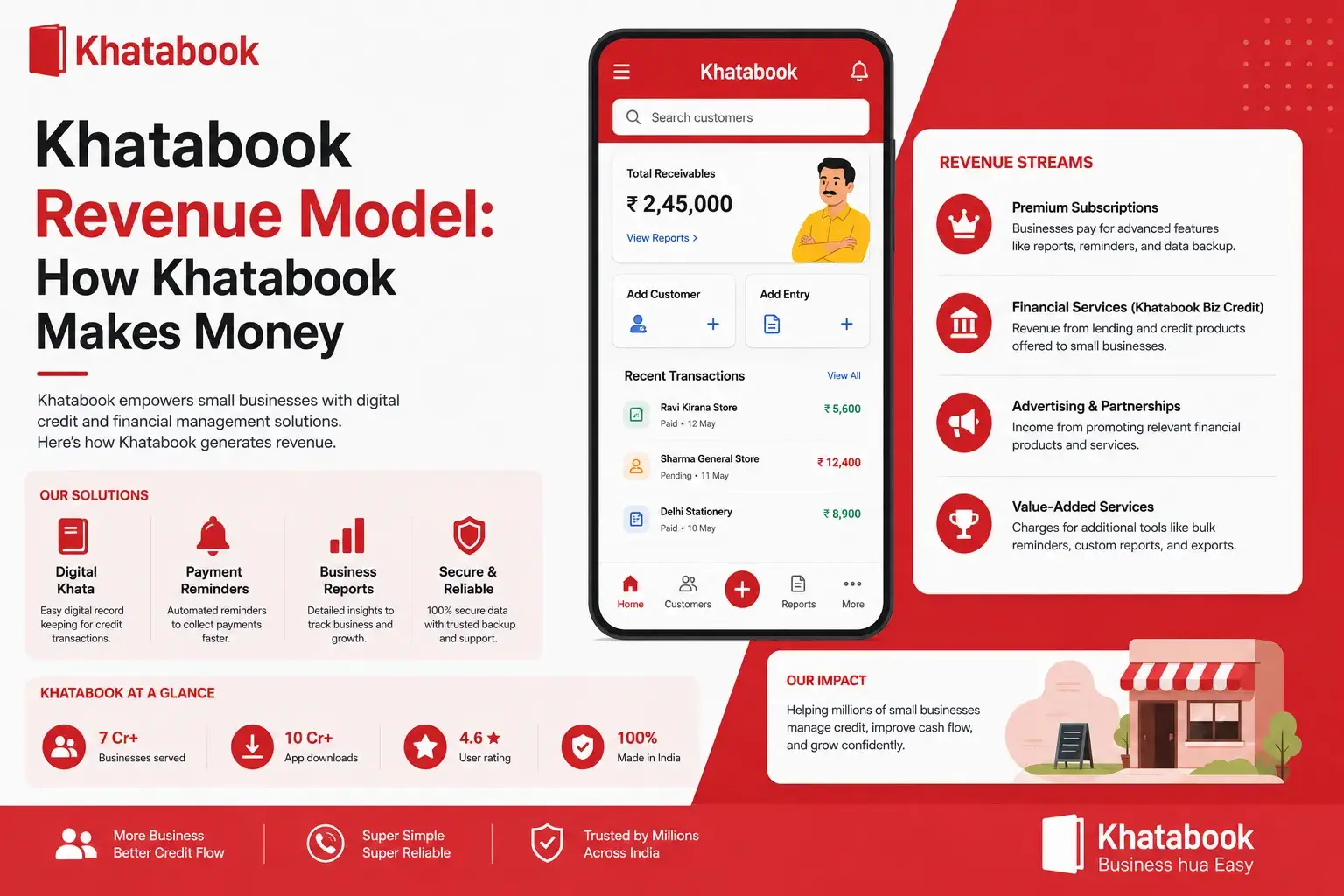
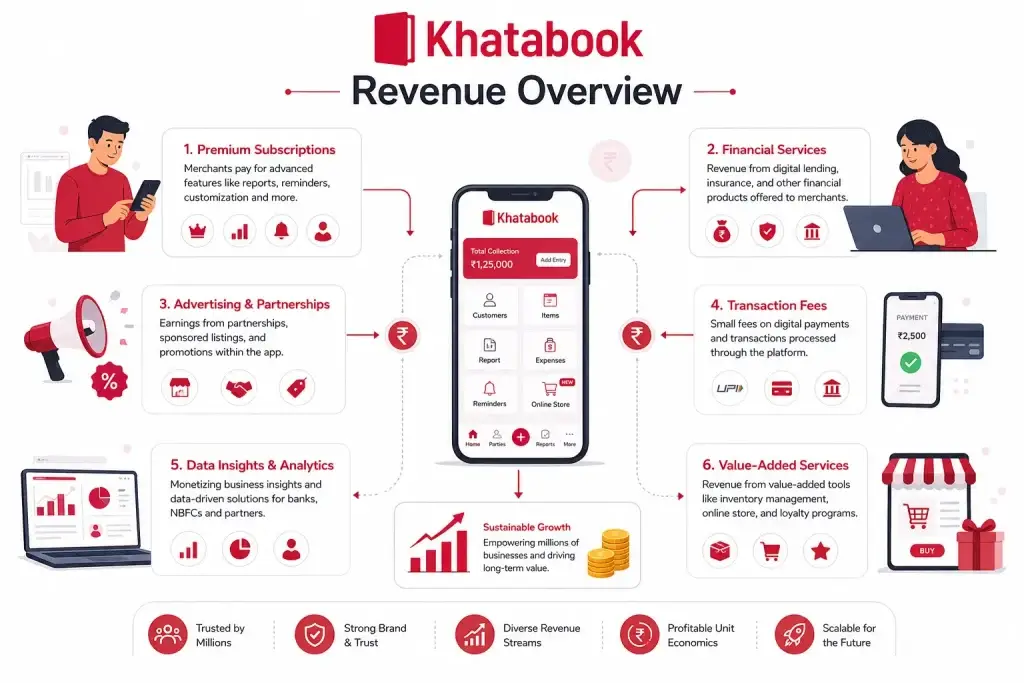
Khatabook’s revenue model has evolved from a simple accounting app to a multi-layer fintech monetization system.
Revenue Stream #1
Merchant SaaS Subscriptions
Khatabook offers premium tools for merchants beyond the basic free ledger.
Premium features include:
• automated business reports
• advanced transaction analytics
• GST tools
• customer reminders
• business insights dashboards
These premium tools are offered through subscription plans for merchants.
Estimated contribution: ~35–40% of revenue
Pricing model:
• monthly subscription
• annual subscription
This SaaS layer allows Khatabook to generate predictable recurring revenue from its merchant base.
Revenue Stream #2
Merchant Lending Partnerships
One of Khatabook’s fastest-growing revenue streams is credit access for small businesses.
Using merchant transaction data, the platform helps financial institutions offer:
• working capital loans
• short-term business loans
• merchant credit lines
Khatabook earns revenue through:
• loan origination commissions
• lending partner revenue share
Estimated contribution: ~25–30% of revenue
This model is powerful because the platform already has deep financial data on merchant cash flow.
Revenue Stream #3
Digital Payment Services
Khatabook enables merchants to accept digital payments through UPI and other payment rails.
Revenue comes from:
• payment processing commissions
• merchant service partnerships
• payment infrastructure integrations
Estimated contribution: ~15–20% of revenue
Payments also increase user engagement and data visibility, strengthening other revenue streams.
Revenue Stream #4
Financial Services Marketplace
Khatabook is increasingly becoming a financial marketplace for SMBs.
Products offered include:
• insurance products
• financial services partnerships
• tax solutions
• business tools
Khatabook earns commissions on each product sold.
Estimated contribution: ~10–12% of revenue
Revenue Stream #5
Data Insights & Merchant Tools
With millions of merchants using the platform, Khatabook has access to valuable SMB financial insights.
The platform monetizes this through:
• analytics tools for merchants
• premium reporting dashboards
• financial insights features
Estimated contribution: ~5–8% of revenue
Revenue Streams Breakdown (Latest Available Data)
| Revenue Stream | Description | Estimated Revenue Share | Pricing Model |
|---|---|---|---|
| Merchant SaaS Subscriptions | Premium accounting and analytics tools | ~35–40% | Subscription SaaS |
| Lending Partnerships | Small business credit services | ~25–30% | Commission per loan |
| Digital Payments | Merchant payment infrastructure | ~15–20% | Processing fees |
| Financial Marketplace | Insurance and financial products | ~10–12% | Commission |
| Data Insights Tools | Business analytics and insights | ~5–8% | SaaS add-ons |
The Fee Structure Explained
Khatabook monetizes through a layered fintech structure.
The platform initially attracts merchants with a free ledger app, then upsells additional services.
Key monetization layers include:
• merchant subscription fees
• loan commissions
• payment processing fees
• financial product commissions
• analytics subscriptions
Platform Fee Structure (Latest Available Data)
| User Type | Fee Type | Typical Fee Range | Notes |
|---|---|---|---|
| Basic merchants | Freemium tools | $0 | Core ledger features |
| Premium merchants | SaaS subscription | $2–6 per month | Advanced features |
| Lending customers | Loan commission | 1–3% of loan value | Paid by lenders |
| Payment users | Payment processing fee | 0–1% | Depends on payment method |
| Financial products | Commission | Variable | Insurance and services |
The freemium approach allows Khatabook to onboard millions of merchants before monetizing.
How Khatabook Maximizes Revenue Per User
Khatabook’s monetization strategy focuses on merchant lifecycle monetization.
Customer segmentation
• micro merchants
• retail store owners
• wholesalers
• service businesses
Upselling mechanics
Free ledger users are gradually introduced to:
• analytics dashboards
• automated reports
• credit offers
Cross-selling systems
Once merchants trust the platform, Khatabook promotes:
• loans
• payment acceptance tools
• financial products
Dynamic pricing
Merchant services vary depending on business size and transaction activity.
Retention monetization
Merchants use the platform daily to track transactions, making churn extremely low.
LTV optimization
The more transactions merchants record, the more valuable the platform becomes.
Psychological pricing tactics
• free core product
• small affordable premium upgrades
• instant financial benefits like credit access
Miracuves Khatabook-Like Platform Solution Cost and Tech Stack
Miracuves Pricing for a Khatabook-Like Digital Ledger & Business Accounting Platform developed using Node.js / React.js Architecture is available on request. Contact Miracuves for custom pricing based on platform features, scalability requirements, integrations, and deployment scope. Estimated delivery timeline: 30 to 90 Days.
Build a powerful digital bookkeeping and small business accounting platform designed for startups, fintech companies, merchants, retailers, and enterprise financial operations.
Core Workflows: Digital ledger management, credit and debit tracking, customer account management, payment reminders, transaction recording, invoice generation, and business bookkeeping workflows.
Built-in Finance: Expense tracking, payment collection workflows, GST-ready calculations, financial reporting, transaction analytics, cash flow monitoring, and settlement management systems.
Management Hub: Admin dashboards, merchant management systems, customer account controls, reporting dashboards, audit logs, analytics tracking, and centralized financial operations management.
Enterprise-Ready: Fully customizable architecture prepared for secure scaling, multi-business management, payment integrations, compliance-ready infrastructure, and long-term operational growth.
Why does a Khatabook-Like Platform require Node.js / React.js architecture?
Digital ledger and accounting platforms process large volumes of financial records, payment operations, real-time transaction updates, and customer account workflows. These platforms require scalable infrastructure, secure financial data handling, and responsive dashboards for merchants and administrators.
We recommend a modern JavaScript-based architecture for this type of platform because:
Built for Real-Time Operations: Node.js enables scalable backend operations for live transaction recording, payment tracking, notification systems, account synchronization, and concurrent merchant activities.
Advanced Dashboard Experience: React.js supports highly interactive interfaces for financial reporting, ledger management, analytics dashboards, transaction histories, and merchant account operations.
Enterprise Scalability: This architecture is well-suited for handling large merchant networks, high transaction volumes, multi-business ecosystems, and growing fintech operations.
Flexible Integration Layer: Easily integrates with payment gateways, UPI systems, SMS and WhatsApp notifications, GST tools, banking APIs, accounting software, and analytics platforms.
You get a scalable, enterprise-grade business accounting platform designed for long-term operational growth.
Note: Final pricing depends on platform modules, payment integrations, accounting workflows, deployment infrastructure, third-party services, and custom feature development.
Read More: Best Khatabook Clone Script 2026 | Digital Ledger App Development
Future Revenue Opportunities (2026–2028 Outlook)
Khatabook is positioned to become a full digital financial operating system for small businesses.
Emerging opportunities include:
Embedded finance
Financial products integrated directly into merchant workflows.
AI accounting assistants
Automated financial insights for small businesses.
Merchant credit scoring
AI-powered credit models based on transaction behavior.
Market expansion
• Southeast Asia SMB markets
• additional fintech services
• cross-border payments
Key risks
• regulatory pressure in fintech
• competition from larger payment platforms
• credit risk in lending partnerships
For startups, the opportunity lies in vertical fintech tools tailored to specific industries.
Lessons for Entrepreneurs
What works well in this model
• freemium acquisition strategy
• daily-use business tools
• fintech monetization layers
What startups can replicate
• simple productivity apps for underserved markets
• embedded finance models
• merchant ecosystem platforms
Market gaps still available
• vertical SaaS tools for SMB niches
• AI bookkeeping platforms
• financial automation for small retailers
Potential improvements founders could build
• automated tax filing
• AI accounting copilots
• integrated inventory and accounting systems
Conclusion
Khatabook’s journey highlights an important lesson for startups and fintech innovators: solving a simple, everyday problem can open the door to much larger opportunities. By first digitizing the traditional credit ledger used by millions of small merchants, the company built trust and widespread adoption before introducing additional financial services. This strong distribution allowed Khatabook to layer products like payments, lending, and financial insights directly into the daily operations of businesses.
As a result, the platform not only becomes more valuable to merchants but also creates strong user retention and a data advantage that supports smarter financial products. Ultimately, Khatabook demonstrates how starting with a focused utility and gradually expanding into embedded finance can lead to a scalable and sustainable fintech ecosystem.
FAQs
1. How much does Khatabook make per merchant?
Revenue varies widely depending on services used, but premium subscriptions and financial services generate recurring income per merchant.
2. What is the most profitable revenue stream for Khatabook?
Merchant SaaS subscriptions and lending partnerships generate the largest share of revenue.
3. How does Khatabook’s pricing compare to competitors?
Khatabook is priced very affordably for small merchants, encouraging massive adoption.
4. What percentage does Khatabook take from loans?
The platform typically earns commission from lending partners rather than charging merchants directly.
5. How has Khatabook’s revenue model evolved?
The platform expanded from a simple ledger app to include payments, lending, and financial services.
6. Can startups replicate this model?
Yes. Many fintech startups build productivity tools first and monetize later with financial services.
7. What scale is needed for profitability?
Platforms typically need millions of users to unlock strong fintech economics.
8. How can founders implement a similar model?
By building high-frequency tools used daily by businesses, then layering financial services.
9. What alternatives exist to this revenue model today?
Alternatives include pure SaaS accounting software, payment platforms, or lending marketplaces.