



Key Takeaways
What You’ll Learn
- Changelly operates as a non-custodial crypto exchange platform.
- The platform earns revenue through exchange fees, spreads, and partner integrations.
- Fiat-to-crypto purchases create additional transaction-based income streams.
- Affiliate programs and API integrations expand Changelly’s business ecosystem.
- Fast crypto swaps and simplified user experience help attract global users.
Stats That Matter
- Changelly supports more than 1,000 cryptocurrencies for exchange and trading.
- The platform is trusted by millions of crypto users globally.
- Changelly charges a standard exchange commission of around 0.25% on swaps.
- Crypto exchange platforms continue growing alongside the expanding digital asset market.
- Mobile crypto trading and instant exchanges are driving higher transaction volumes worldwide.
Real Insights
- Simple user experience is one of Changelly’s biggest competitive advantages.
- Partnership-based models help crypto platforms scale faster without owning all infrastructure.
- Transparent fees and fast execution improve user trust in crypto exchanges.
- Non-custodial systems reduce risks associated with storing customer funds.
- Revenue diversification helps crypto businesses stay resilient during market volatility.
In early 2026, the instant crypto exchange Changelly generates an estimated $7 million in annual revenue while operating with a relatively small team and a lightweight infrastructure compared with large centralized exchanges.
The company has built a profitable niche by focusing on instant crypto swaps rather than traditional exchange custody. Instead of holding user funds, Changelly acts as a crypto exchange aggregator, connecting users to multiple liquidity providers and earning fees on each transaction.
For founders and product builders, Changelly is a fascinating example of a low-infrastructure fintech platform that monetizes transaction flow rather than asset custody.
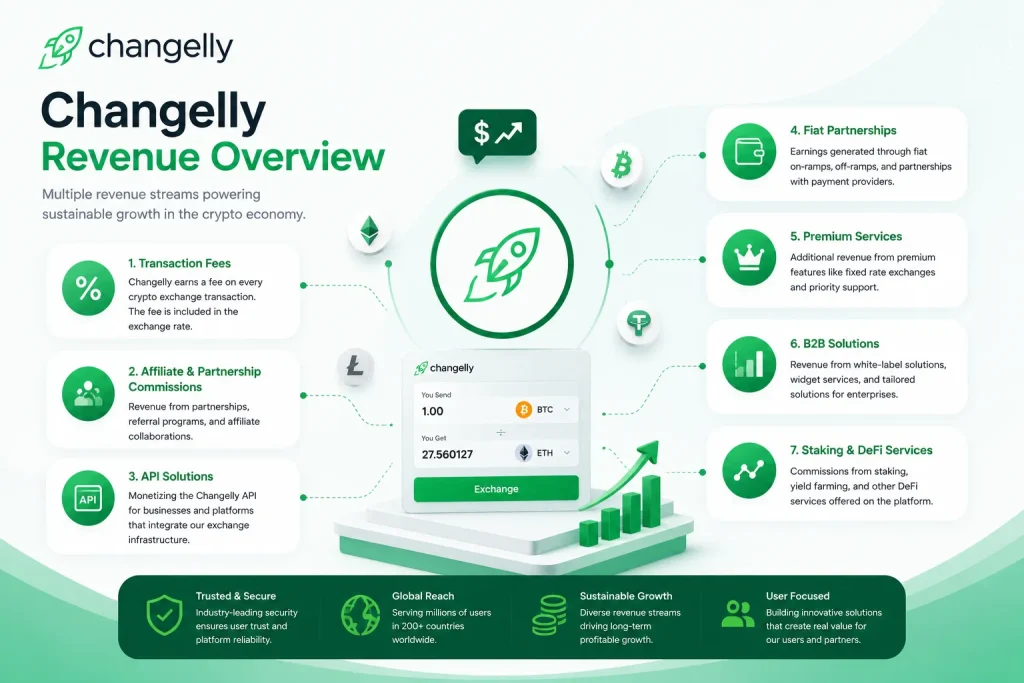
Changelly Revenue Overview – The Big Picture
Changelly operates as a non-custodial cryptocurrency exchange aggregator, meaning it routes trades between external liquidity providers rather than maintaining large order books itself.
This model drastically reduces operational risk and infrastructure costs compared to traditional crypto exchanges.
Key financial snapshot (latest available data):
• Estimated annual revenue: ~$7 million
• Company type: Private fintech platform
• Employees: ~60 people
• Business model: Transaction-based crypto exchange aggregator
• Profitability status: Likely profitable due to low infrastructure costs
• Market competitors: Binance, Coinbase, ChangeNOW
Compared with giants like Binance or Coinbase, Changelly operates at a much smaller scale, but its model focuses on simplicity, quick swaps, and wallet integrations rather than full exchange infrastructure.
Primary Revenue Streams Deep Dive
Changelly generates revenue primarily through transaction commissions and spreads embedded in exchange rates.
Revenue Stream #1
Crypto Swap Transaction Fees
The core product of Changelly is instant cryptocurrency swaps.
Users select two assets, and Changelly automatically finds the best rates from liquidity providers.
Revenue mechanics:
• Flat commission per transaction
• Typically around 0.25% for floating-rate swaps
• Charged on each exchange operation
This is the largest revenue driver, as every trade passing through the platform generates a small fee.
Revenue Stream #2
Trading Fees (Changelly Pro)
Changelly Pro offers a more traditional exchange environment with order books.
The platform uses a maker-taker fee model:
• Starter accounts: about 0.1% maker / 0.1% taker fee
• Lower fees for higher trading volumes
This allows the platform to compete with centralized exchanges while maintaining predictable revenue from trading activity.
Revenue Stream #3
Fiat-to-Crypto Purchases
Users can buy cryptocurrencies with:
• Credit cards
• Bank transfers
• Apple Pay
• Third-party payment providers
These purchases include fiat conversion fees, often between 1% and 7% depending on the payment method.
Changelly earns a portion of this through payment gateway partnerships and spreads.
Revenue Stream #4
Affiliate Program Commissions
Changelly operates a referral program that allows partners to earn:
• Up to 50% of transaction fees generated by referrals
• Limited duration revenue share windows
This program helps drive growth through crypto bloggers, wallets, and fintech platforms.
Revenue Stream #5
Wallet & API Integrations
Changelly integrates with 350+ crypto platforms, wallets, and exchanges.
Examples include wallet apps and crypto platforms that embed Changelly’s swap widget.
Revenue is generated through:
• API usage
• Revenue share with partner wallets
• White-label integrations
This B2B infrastructure strategy allows Changelly to monetize transactions even when users never visit its website.
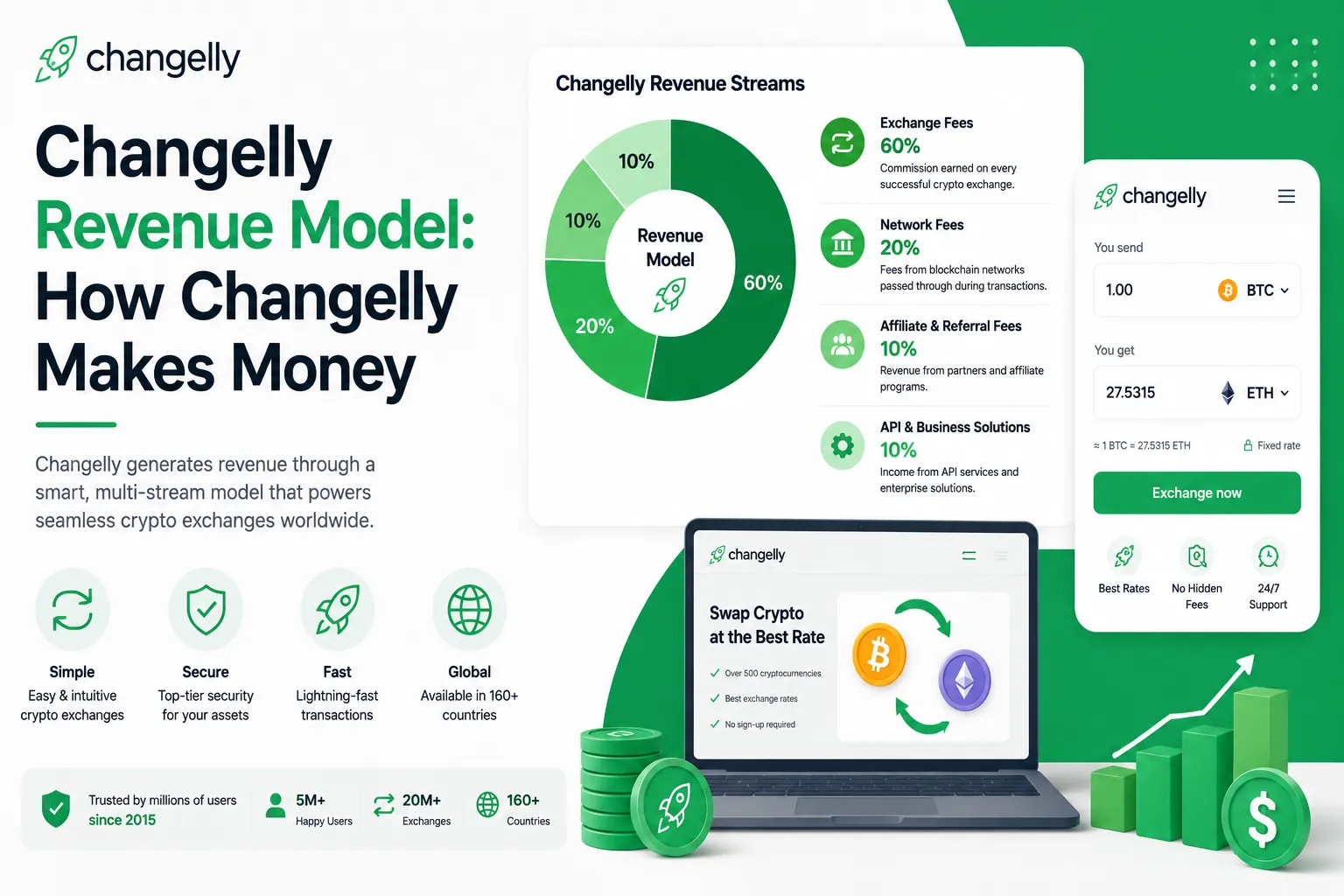
Revenue Streams Breakdown (Latest Available Data)
| Revenue Stream | Description | Estimated Revenue Share | Pricing Model |
|---|---|---|---|
| Crypto Swap Fees | Commission charged on instant crypto swaps | ~40–45% | ~0.25% transaction fee |
| Trading Fees (Pro Exchange) | Maker/taker trading commissions | ~20–25% | 0.1% trading fees |
| Fiat-to-Crypto Purchases | Fees on card and bank purchases | ~20–25% | 1–7% conversion fees |
| Affiliate Program | Referral-driven transactions | ~5–10% | Revenue share |
| API & Wallet Integrations | Embedded exchange infrastructure | ~5–10% | Partner commissions |
The Fee Structure Explained
Changelly’s monetization structure is layered and depends on the type of transaction.
Key revenue layers include:
• Swap commissions
• Trading fees
• Fiat purchase spreads
• Liquidity routing spreads
• Affiliate commissions
Because the platform aggregates prices from multiple exchanges, it also earns revenue from rate spreads between liquidity providers and the final user price.
Platform Fee Structure (Latest Available Data)
| User Type | Fee Type | Typical Fee Range | Notes |
|---|---|---|---|
| Crypto swap users | Exchange fee | ~0.25% | Floating-rate swaps |
| Pro traders | Maker/taker fee | ~0.1% | Volume-based discounts |
| Fiat buyers | Payment gateway fee | ~1–7% | Depends on payment provider |
| Partners / affiliates | Commission split | Up to 50% revenue share | Referral program |
| API partners | Integration fee | Variable | Wallet integrations |
How Changelly Maximizes Revenue Per User
Changelly’s monetization strategy focuses on transaction volume rather than asset custody.
Key tactics include:
Customer segmentation
• Beginners using instant swaps
• Traders using Changelly Pro
• Wallet users via integrations
Upselling mechanics
• From instant swaps → Pro trading
• From crypto swaps → fiat purchases
Cross-selling systems
• Wallet integrations
• API partner ecosystems
Dynamic pricing
• Floating exchange rates during swaps
• Liquidity provider routing
Retention monetization
• Easy onboarding (minimal signup for crypto swaps)
• Wallet compatibility with many crypto wallets
Psychological pricing tactics
• Simple flat fees instead of complicated spreads
• Quick transaction flow to reduce decision friction
This simplicity helps Changelly convert casual crypto users into repeat traders.
Miracuves Changelly-Like Platform Solution Cost and Tech Stack
Miracuves Pricing for a Changelly-Like Cryptocurrency Exchange Platform developed using Node.js / React.js Architecture is available on request. Contact Miracuves for custom pricing based on platform features, scalability requirements, integrations, and deployment scope. Estimated delivery timeline: 30 to 90 Days.
Build a powerful cryptocurrency exchange and digital asset trading platform designed for startups, crypto businesses, fintech companies, and enterprise blockchain operations.
Core Workflows: Instant crypto exchange, crypto-to-crypto swaps, fiat on-ramp and off-ramp operations, wallet integrations, liquidity aggregation, transaction management, and real-time trading workflows.
Built-in Finance: Crypto payment processing, exchange rate management, trading fee systems, transaction tracking, liquidity monitoring, commission handling, and blockchain transaction verification. Changelly itself supports crypto exchange, fiat integrations, and non-custodial swap operations across multiple cryptocurrencies.
Management Hub: Admin dashboards, liquidity provider management, user verification systems, compliance workflows, transaction monitoring, analytics reporting, audit logs, and centralized crypto operations management.
Enterprise-Ready: Fully customizable architecture prepared for secure scaling, high-volume crypto transactions, blockchain integrations, multi-currency operations, compliance-ready infrastructure, and long-term platform growth.
Why does a Changelly-Like Platform require Node.js / React.js architecture?
Cryptocurrency exchange platforms process high-frequency transactions, blockchain interactions, real-time exchange rates, and secure financial workflows. These platforms require scalable infrastructure, low-latency processing, and highly interactive dashboards for both users and administrators.
We recommend a modern JavaScript-based architecture for this type of platform because:
Built for Real-Time Operations: Node.js enables scalable backend operations for instant crypto swaps, blockchain transaction processing, live exchange rates, wallet synchronization, and concurrent trading activities.
Advanced Dashboard Experience: React.js supports highly interactive interfaces for crypto trading dashboards, portfolio management, transaction tracking, analytics visualization, and seamless user experiences.
Enterprise Scalability: This architecture is well-suited for handling high transaction volumes, multi-currency operations, liquidity aggregation systems, and growing crypto ecosystems.
Flexible Integration Layer: Easily integrates with blockchain networks, crypto wallets, liquidity providers, payment gateways, KYC/AML tools, fiat providers, analytics systems, and crypto payment infrastructure.
You get a scalable, enterprise-grade cryptocurrency exchange platform designed for long-term operational growth.
Note: Final pricing depends on platform modules, blockchain integrations, liquidity systems, compliance requirements, deployment infrastructure, and custom workflow development.
Major expenses include:
Infrastructure costs
• Cloud infrastructure
• API integrations with liquidity providers
Customer acquisition cost
• Crypto partnerships
• affiliate payouts
Marketing spend
• Influencer marketing
• crypto review sites
Operations
• compliance and regulatory management
Research and development
• blockchain integrations
• trading platform updates
Unit economics
Because Changelly does not operate large custody infrastructure, its margins are likely higher than typical exchanges.
Future Revenue Opportunities (2026–2028 Outlook)
Changelly has several potential growth paths over the next few years.
Emerging monetization opportunities
DeFi integrations
Connecting decentralized liquidity pools
AI-driven rate optimization
Automatically routing swaps for best yield
Institutional OTC services
High-volume crypto swaps for funds
Cross-chain swap infrastructure
Interoperability between blockchains
Market expansion potential
• Emerging markets
• mobile-first crypto trading
• Web3 wallet integrations
Key risks
• Regulatory pressure on crypto platforms
• competition from large exchanges
• decentralized exchange growth
For startups entering the space, the biggest opportunity lies in better liquidity aggregation and cross-chain infrastructure.
Lessons for Entrepreneurs
What works well in this model
• Asset-light fintech infrastructure
• revenue based on transaction flow
• platform integrations instead of direct customer acquisition
What startups can replicate
• API-first financial products
• embedded fintech platforms
• affiliate-driven growth
Market gaps still available
• cross-chain DeFi aggregators
• AI-driven crypto routing
• decentralized liquidity optimization
Potential improvements founders could build
• lower swap spreads
• deeper liquidity pools
• institutional trading tools
Conclusion
Changelly proves that fintech platforms do not always need massive infrastructure to generate meaningful revenue. By focusing on transaction routing and liquidity aggregation, the company built a sustainable business model in the fast-moving crypto industry. More importantly, it highlights the strength of lean, asset-light approaches where value is created through smart positioning rather than ownership of assets. By acting as an intermediary layer, Changelly avoids direct competition with exchanges while still capturing consistent value from transactions. Its emphasis on simplicity and user experience shows how reducing friction can drive adoption even in complex markets like crypto.
At the same time, its partnership-led distribution model demonstrates how integrations can scale reach efficiently without heavy customer acquisition costs. Overall, Changelly reflects a broader fintech shift toward aggregation and connectivity, where enabling access and efficiency can be just as powerful as building the underlying infrastructure itself.
FAQs
1. How much does Changelly make per transaction?
Changelly typically charges around 0.25% per crypto swap, though rates may vary depending on liquidity and transaction type.
2. What is the most profitable revenue stream for Changelly?
Crypto swap transaction fees are the largest revenue driver.
3. How does Changelly’s pricing compare to competitors?
Its swap fees are competitive with many instant exchange platforms but higher than high-volume centralized exchanges.
4. What percentage does Changelly take from providers?
The platform typically takes a small commission or spread from routed liquidity providers.
5. How has Changelly’s revenue model evolved?
It expanded from simple crypto swaps to include trading platforms, fiat purchases, and API integrations.
6. Can small startups use a similar model?
Yes. Many crypto startups build aggregator platforms rather than full exchanges.
7. What scale is needed for profitability?
Transaction-based platforms can become profitable with moderate trading volume due to low infrastructure costs.
8. How can founders implement a similar model?
By building API-based liquidity aggregation platforms and charging transaction commissions.
9. What alternatives exist to this revenue model today?
Alternatives include centralized exchanges, decentralized exchanges (DEXs), and peer-to-peer crypto marketplaces.