



Yardi quietly built one of the most profitable SaaS platforms in real estate technology. The company crossed roughly $1.6 billion in revenue in recent years and continues expanding globally, serving property managers, investors, and real estate operators with a full-stack software ecosystem.
For founders, Yardi offers an important lesson: dominating a vertical SaaS niche can produce massive recurring revenue without the hype of consumer tech.
Yardi Revenue Overview — The Big Picture
Yardi Systems operates as a private PropTech SaaS platform serving real estate companies worldwide. Its software suite manages everything from property accounting to tenant leasing and asset management.
2026 Estimated Snapshot
| Metric | Value |
|---|---|
| Estimated Revenue (2026) | ~$1.8B |
| Estimated YoY Growth | ~10–12% |
| Employees | ~10,000 |
| Customers | ~20,000 real estate organizations |
| Company Type | Private SaaS |
| Estimated Market Position | Top global property management platform |
Yardi has steadily grown through long-term SaaS contracts and enterprise property portfolios, allowing it to maintain predictable recurring revenue.
Its biggest competitors include platforms like RealPage, AppFolio, Entrata, and Buildium, though Yardi often wins large enterprise real estate clients.
Read More: Yardi: Real Estate Software Energized For Tomorrow, Today
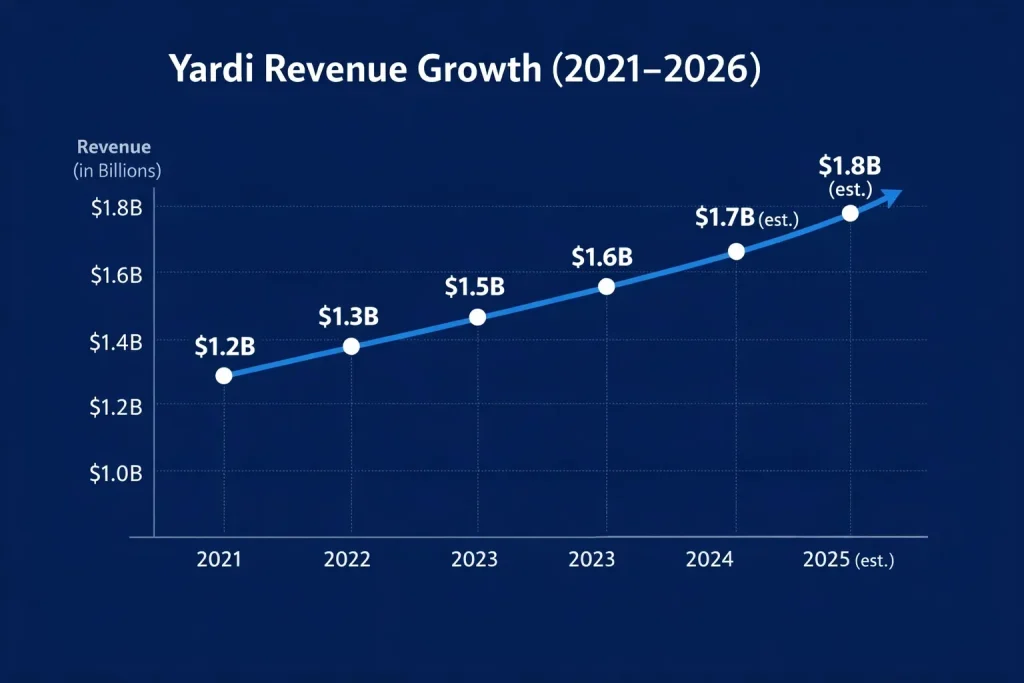
Estimated trajectory:
| Year | Revenue |
|---|---|
| 2021 | ~$1.2B |
| 2022 | ~$1.3B |
| 2023 | ~$1.5B |
| 2024 | ~$1.6B |
| 2025 | ~$1.7B (est.) |
| 2026 | ~$1.8B (est.) |
Primary Revenue Streams Deep Dive
Yardi runs a multi-product SaaS ecosystem designed specifically for real estate operators.
Enterprise Property Management Software
The backbone of Yardi’s business is Yardi Voyager, its enterprise-grade property management system.
It manages:
- accounting
- tenant billing
- leasing
- maintenance
- investment tracking
Real estate firms use it to manage portfolios with thousands of units.
Pricing is typically based on:
- number of properties
- number of units
- modules activated
Typical enterprise clients include:
- property management firms
- REITs
- real estate investment funds
Estimated revenue contribution: ~40–45%
Vertical SaaS Modules
Yardi expanded its core platform into dozens of add-on modules such as:
- Yardi Breeze
- Yardi CRM
- Yardi Elevate
- Yardi Orion (investment management)
- Yardi Corom (workspace management)
These modules extend functionality for specific industries like:
- student housing
- senior living
- affordable housing
- coworking
Clients often start with Voyager and then add modules.
Estimated revenue contribution: ~25–30%
Rental Marketplaces (RentCafe)
Yardi also operates RentCafe, a rental marketplace where tenants search for apartments and apply online.
The platform generates revenue through:
- listing subscriptions
- lead generation
- tenant screening
- online application processing
RentCafe integrates directly with Yardi property management software, creating a powerful ecosystem lock-in.
Estimated revenue contribution: ~10–15%
Data & Market Intelligence
Yardi Matrix provides:
- commercial real estate analytics
- rental market data
- investor intelligence
- property valuation insights
This data is used by:
- hedge funds
- institutional investors
- developers
- lenders
Pricing typically uses annual enterprise subscriptions.
Estimated revenue contribution: ~10–12%
Payment Processing & Financial Services
Yardi earns additional revenue from payment processing and financial integrations, including:
- online rent payments
- tenant billing
- utility management
- payment gateway services
The company often earns transaction fees or revenue shares from payment partners.
Estimated revenue contribution: ~5–8%
Revenue Streams Breakdown (Latest Available Data)
| Revenue Stream | Description | Estimated Revenue Share | Pricing Model |
|---|---|---|---|
| Property Management SaaS | Core enterprise platform (Voyager) | 40–45% | SaaS subscription |
| SaaS Modules | Add-on vertical solutions | 25–30% | Per-unit SaaS |
| RentCafe Marketplace | Apartment listings and leasing | 10–15% | Listing fees |
| Data & Analytics | Market intelligence subscriptions | 10–12% | Annual enterprise license |
| Payment & Financial Services | Rent payment processing | 5–8% | Transaction fees |
The Fee Structure Explained
Yardi monetizes through multi-layer SaaS pricing combined with transaction revenue.
Most customers pay monthly fees per property unit.
For example:
- property manager pays SaaS subscription
- tenant pays online transaction fees
- landlords pay listing and marketing fees
Platform Fee Structure (Latest Available Data)
| User Type | Fee Type | Typical Fee Range | Notes |
|---|---|---|---|
| Property Managers | SaaS subscription | $1–$5 per unit/month | Core Voyager platform |
| Enterprise Real Estate Firms | Platform license | $10k–$100k+/year | Portfolio-based |
| Landlords | Listing fees | Variable | Via RentCafe |
| Tenants | Payment processing | ~2–3% per transaction | Online rent payment |
| Investors | Data subscriptions | $5k–$50k/year | Yardi Matrix analytics |
This multi-sided monetization model allows Yardi to capture revenue from multiple stakeholders in the real estate ecosystem.
How Yardi Maximizes Revenue Per User
Yardi is a masterclass in enterprise SaaS expansion strategy.
Portfolio-Based Pricing
Instead of charging per user, Yardi charges per property unit or portfolio size.
This aligns pricing with customer growth.
More properties = more revenue.
Modular Upselling
A typical customer journey:
- Start with property management software
- Add CRM
- Add marketing tools
- Add tenant payments
- Add data analytics
Each module increases ARPU.
Ecosystem Lock-In
Yardi integrates:
- leasing
- payments
- analytics
- accounting
- maintenance
Once integrated, switching platforms becomes extremely difficult.
This results in high retention and long contracts.
Cross-Selling Marketplaces
Platforms like RentCafe connect:
- renters
- landlords
- property managers
This creates additional revenue layers beyond SaaS subscriptions.
Long-Term Contracts
Enterprise customers often sign multi-year contracts, stabilizing revenue.
Cost Structure & Profit Margins
Yardi’s cost structure is typical of enterprise SaaS platforms.
Major cost centers include:
Infrastructure
- cloud hosting
- data storage
- security systems
R&D
Continuous development of:
- AI analytics
- property automation
- tenant management tools
Sales and Enterprise Onboarding
Selling to large real estate portfolios requires:
- enterprise sales teams
- implementation specialists
- onboarding support
Customer Support
Real estate clients require high-touch support.
Margin Strategy
Vertical SaaS companies often achieve strong margins after scale because:
- software distribution costs are low
- enterprise contracts are recurring
- switching costs are high

Future Revenue Opportunities (2026–2028 Outlook)
The next phase of growth for Yardi will likely come from AI-powered PropTech and real estate digitization.
AI Property Management
Potential innovations:
- predictive maintenance
- automated rent optimization
- AI tenant screening
- automated leasing agents
Smart Buildings
Integration with:
- IoT sensors
- smart energy systems
- building automation
Financial Services Expansion
Yardi could expand into:
- rent financing
- landlord credit products
- embedded insurance
- real estate payment networks
Global Expansion
High-growth markets include:
- Southeast Asia
- Middle East
- Latin America
These regions are rapidly digitizing real estate operations.
Competitive Risks
Major threats include:
- RealPage
- AppFolio
- new AI property management startups
However, Yardi’s deep enterprise relationships provide a strong competitive moat.
Lessons for Entrepreneurs
Yardi demonstrates how vertical SaaS dominance can outperform broad software platforms.
What Works Well
- niche specialization
- ecosystem lock-in
- modular upselling
- recurring enterprise contracts
What Startups Can Replicate
Founders can build similar models in:
- logistics SaaS
- healthcare SaaS
- legal SaaS
- construction SaaS
The key is solving one industry’s full workflow.
Market Gaps
Opportunities still exist in:
- AI-powered property operations
- smart building analytics
- tenant financial tools
- real estate automation platforms
Final Thought
Yardi proves that massive software companies can be built by dominating a single industry. Instead of chasing trends, the company focused on solving real estate’s operational complexity—and built a multi-billion-dollar platform in the process.
What makes this even more powerful is how Yardi didn’t stop at a single product. It systematically expanded into a full ecosystem, layering accounting, leasing, payments, analytics, and marketplaces into one integrated platform. This created deep customer lock-in and turned Yardi from a tool into the operating system for real estate businesses.
For founders, the real insight is this: the biggest opportunities are often hidden in industries that are complex, fragmented, and underserved by modern software. Yardi didn’t reinvent real estate—it digitized it end-to-end.
FAQs
1. How much does Yardi make per transaction?
Payment processing fees for rent payments typically range around 2–3% depending on payment method.
2. What is the most profitable revenue stream for Yardi?
The enterprise property management SaaS platform is likely the most profitable due to high recurring subscription margins.
3. How does Yardi’s pricing compare to competitors?
Yardi generally targets large enterprise real estate portfolios, while competitors like AppFolio focus more on smaller property managers.
4. What percentage does Yardi take from providers?
Yardi mainly charges subscription SaaS fees rather than percentage commissions, though transaction fees apply for payments.
5. How has Yardi’s revenue model evolved?
The company expanded from property accounting software to a full real estate operating system with analytics, payments, and marketplaces.
6. Can small startups use a similar model?
Yes—many vertical SaaS startups replicate this structure by focusing on a specific industry workflow.
7. What scale is needed for profitability?
Vertical SaaS companies often reach strong profitability once they secure thousands of enterprise clients and recurring contracts
8. How can founders implement a similar model?
Focus on one industry, build the core workflow software first, and then layer additional revenue modules over time.
9. What alternatives exist to this revenue model today?
Alternative approaches include usage-based SaaS pricing, API monetization, and AI automation platforms.