



Booking.com generates an estimated $25B+ revenue in 2026 through hotel commissions, advertising, and travel services across its global marketplace.
Booking.com is one of the most powerful engines in global travel, generating tens of billions in revenue by connecting travelers with accommodations worldwide. As part of Booking Holdings, it dominates the online travel agency (OTA) space with unmatched inventory and demand.
For founders, Booking.com is a masterclass in marketplace scale, pricing power, and conversion optimization at global scale.
Booking.com Revenue Overview — The Big Picture
Booking.com operates as a two-sided global travel marketplace, connecting millions of travelers with hotels, apartments, and alternative accommodations.
Its core strength lies in:
- massive global inventory
- high conversion rates
- strong brand trust
- performance-based monetization
2026 Estimated Snapshot
| Metric | Value |
|---|---|
| Estimated Revenue (2026) | ~$25B+ |
| YoY Growth | ~12–15% |
| Parent Company | Booking Holdings |
| Global Listings | ~28M+ |
| Market Coverage | 220+ countries |
| Profitability | High operating margins |
Booking.com competes with:
- Airbnb
- Expedia Group
- Agoda
- Trip.com
However, it remains one of the highest-converting travel platforms globally.
Read More: What Is Booking.com? A Simple Guide to the Global Travel Platform
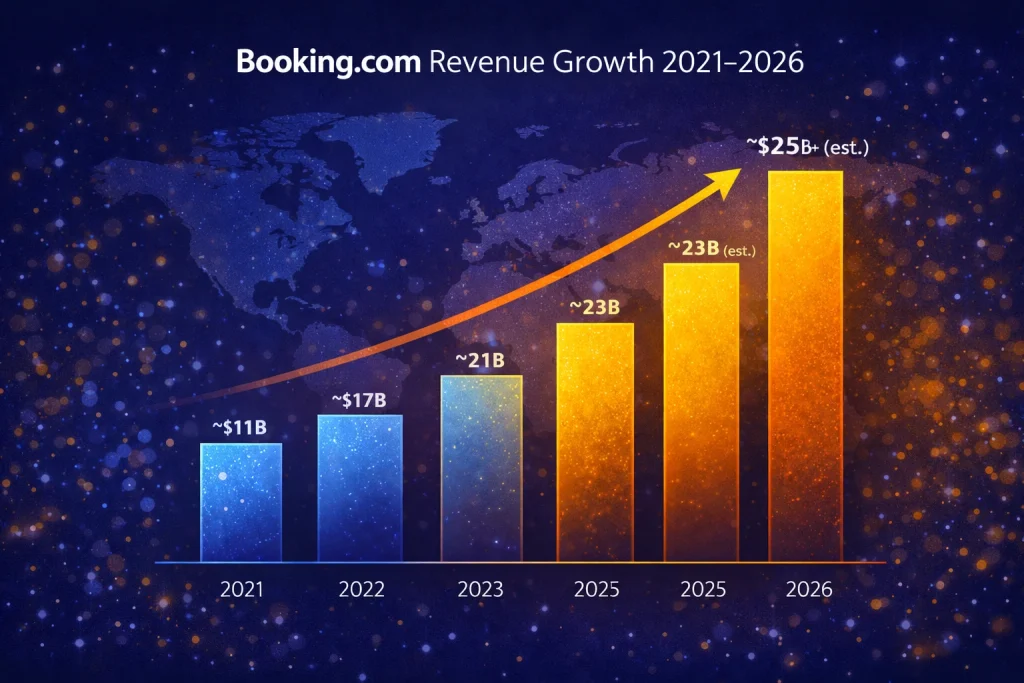
Estimated trajectory:
| Year | Revenue |
|---|---|
| 2021 | ~$11B |
| 2022 | ~$17B |
| 2023 | ~$21B |
| 2025 | ~$23B (est.) |
| 2026 | ~$25B+ (est.) |
Primary Revenue Streams Deep Dive
Booking.com operates a performance-based marketplace model, earning primarily from commissions on bookings.
Accommodation Commissions
The largest revenue stream comes from commissions charged to accommodation providers.
Hotels and property owners pay Booking.com a percentage for each successful booking.
Typical commission range:
~10–25% per booking
This varies based on:
- location
- competition
- property type
- visibility programs
Estimated revenue contribution: ~70–75%
Preferred Partner Program (Visibility Boost)
Booking.com offers a Preferred Partner Program where hotels can pay higher commissions for better visibility.
Benefits include:
- higher search ranking
- increased booking volume
- better exposure
Hotels may pay an additional:
~3–5% commission uplift
Estimated revenue contribution: ~8–10%
Advertising & Sponsored Listings
Hotels can pay for sponsored placements within search results.
This includes:
- boosted listings
- visibility campaigns
- targeted promotions
This is similar to performance marketing inside the platform.
Estimated revenue contribution: ~5–7%
Payment Processing & Financial Services
Booking.com also earns through:
- payment processing margins
- currency conversion fees
- fraud protection services
These are often embedded into transactions.
Estimated revenue contribution: ~5–6%
Travel Add-Ons & Cross-Selling
Booking.com cross-sells:
- flights
- car rentals
- airport taxis
- travel insurance
This increases overall transaction value and monetization.
Estimated revenue contribution: ~4–6%
Revenue Streams Breakdown (Latest Available Data)
| Revenue Stream | Description | Estimated Revenue Share | Pricing Model |
|---|---|---|---|
| Accommodation Commissions | Commission per booking | 70–75% | % of booking |
| Preferred Program | Higher visibility fees | 8–10% | Commission uplift |
| Advertising | Sponsored listings | 5–7% | Pay-per-click |
| Payments & FX | Transaction fees | 5–6% | Processing margin |
| Travel Add-ons | Cross-sold services | 4–6% | Service fees |
The Fee Structure Explained
Booking.com uses a performance-based monetization model, primarily charging suppliers rather than travelers.
Platform Fee Structure (Latest Available Data)
| User Type | Fee Type | Typical Fee Range | Notes |
|---|---|---|---|
| Hotels | Commission | ~10–25% | Paid per booking |
| Hotels | Preferred program | +3–5% | Optional visibility boost |
| Hotels | Sponsored ads | Variable | Pay for exposure |
| Travelers | Service fees | Usually included | Embedded pricing |
| Partners | Payment processing | ~1–3% | FX and transaction margin |
This model ensures low friction for users while maximizing supplier-side monetization.
How Booking.com Maximizes Revenue Per User
Booking.com is one of the most optimized marketplaces in the world.
Conversion Optimization
The platform uses:
- urgency messaging (“Only 1 room left”)
- social proof (“Booked 10 times today”)
- price comparison
These tactics increase conversion rates significantly.
Dynamic Pricing
Booking.com leverages real-time pricing based on:
- demand
- seasonality
- competition
This maximizes booking value.
Supply-Side Competition
Hotels compete for visibility by:
- increasing commissions
- joining preferred programs
This creates auction-like economics.
Cross-Selling Ecosystem
Users booking hotels are offered:
- flights
- car rentals
- insurance
This increases revenue per customer.
Global Demand Aggregation
Booking.com aggregates massive demand, giving it strong negotiation power over suppliers.
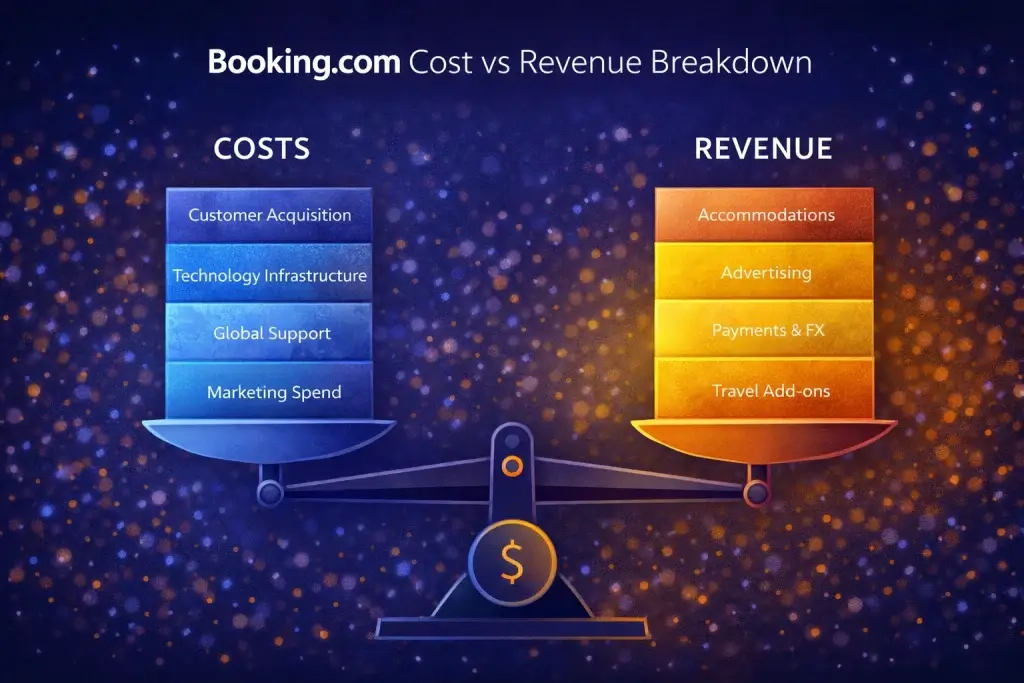
Cost Structure & Profit Margins
Booking.com operates a highly profitable marketplace with strong margins.
Customer Acquisition Costs
A major expense is:
- Google ads
- search engine marketing
- affiliate partnerships
Technology Infrastructure
Costs include:
- global booking systems
- payment infrastructure
- fraud prevention
Customer Support
24/7 global support for:
- cancellations
- disputes
- booking issues
Marketing Spend
Heavy investment in:
- brand marketing
- performance ads
Margin Strategy
Booking.com achieves strong margins through:
Future Revenue Opportunities (2026–2028 Outlook)
Booking.com continues to expand beyond accommodations.
AI-Powered Travel Planning
AI will enable:
- personalized trip recommendations
- dynamic pricing optimization
- automated itineraries
Super App Strategy
Booking.com is moving toward becoming a full travel super app.
This includes:
- flights
- hotels
- experiences
- payments
Alternative Accommodations Growth
Expansion into:
- vacation rentals
- apartments
- unique stays
Financial Services Expansion
Opportunities include:
- travel financing
- insurance
- embedded payments
Competitive Risks
Major risks include:
- Airbnb’s brand dominance
- Google Travel
- direct hotel bookings
Lessons for Entrepreneurs
Booking.com is one of the best examples of marketplace execution.
What Works Well
- performance-based monetization
- strong supply-demand balance
- conversion optimization
What Startups Can Replicate
- commission-based models
- marketplace liquidity strategies
- pricing optimization
Market Opportunities
- niche travel marketplaces
- AI travel platforms
- local experience marketplaces
Final Thought
Booking.com didn’t just scale inventory—it engineered a system where every participant is continuously optimizing. Hotels compete not only on price, but on visibility, reviews, cancellation policies, and responsiveness. This creates a self-reinforcing loop: better-performing suppliers get more bookings, which incentivizes others to improve, raising the overall quality of the marketplace. The platform, in turn, benefits from higher conversion rates without owning any inventory.
What makes this especially powerful is the data advantage. With millions of transactions flowing through the system, Booking.com can fine-tune ranking algorithms, pricing insights, and demand forecasting in ways individual suppliers never could. This asymmetry strengthens the platform’s position over time—suppliers depend on it for demand, while customers rely on it for trust and choice.
Ultimately, the lesson isn’t just about travel—it’s about control points. The most valuable marketplaces don’t just connect buyers and sellers; they actively shape behavior on both sides. By owning discovery, trust signals, and transaction flow, they turn fragmented markets into highly efficient, high-margin ecosystems.
FAQs
1. How much does Booking.com make per transaction?
Typically 10–25% commission per booking, depending on the property.
2. What is the most profitable revenue stream?
Accommodation commissions drive the majority of revenue.
3. How does pricing compare to competitors?
Booking.com often has similar or slightly higher commissions than competitors but delivers higher booking volume.
4. What percentage does Booking.com take from hotels?
Around 10–25% per booking.
5. How has the model evolved?
It expanded from hotel bookings to a full travel ecosystem.
6. Can startups replicate this model?
Yes, in niche vertical marketplaces.
7. What scale is needed for profitability?
Massive supply and demand liquidity is required.
8. How can founders build a similar platform?
Focus on trust, supply onboarding, and demand aggregation.
9. What alternatives exist today?
Direct booking platforms, SaaS booking engines, and niche travel marketplaces.