




Ripple didn’t just enter the financial system — it challenged its very foundation. From a niche blockchain startup in 2012 to influencing over $15 trillion in global cross-border payment flows, Ripple has emerged as a strong alternative to legacy systems like SWIFT. Today, with 300+ financial institutions across 55+ countries, the business model of Ripple is redefining how money moves globally.
What makes Ripple unique is its hybrid approach. It’s not just a cryptocurrency company — it’s a fintech infrastructure provider combining enterprise SaaS, blockchain technology, and on-demand liquidity solutions. This layered structure allows Ripple to integrate seamlessly with existing financial systems while improving speed, cost, and efficiency.
For modern founders, the key takeaway is clear: innovation doesn’t always mean disruption. The Ripple business model proves that integrating and optimizing legacy systems can unlock massive value. At Miracuves, we see a growing demand for scalable fintech platforms inspired by models like Ripple — combining compliance, speed, and global interoperability.
How the Ripple Business Model Works
Ripple operates at the intersection of finance, blockchain, and enterprise infrastructure, making its business model both layered and strategic.
At its core, Ripple is not trying to replace banks — it’s building the plumbing that connects them more efficiently.
Core Business Model Overview
Ripple follows a hybrid model combining:
- Enterprise SaaS (B2B Fintech Infrastructure)
- Blockchain-based Liquidity Network (XRP Ledger)
- Transaction & Liquidity Services (RippleNet & ODL)
This positions Ripple as a financial infrastructure provider, not just a crypto company.
Type of Business Model
Ripple’s model can be classified as:
- B2B Platform Model – serving banks, payment providers, and financial institutions
- Fintech Infrastructure-as-a-Service (IaaS)
- Hybrid Blockchain + Enterprise Model
Think of Ripple as the “AWS of cross-border payments”, but built on blockchain rails.
Value Proposition
Ripple delivers value to multiple stakeholders:
1. Financial Institutions (Banks, Payment Providers)
- Faster cross-border transactions (seconds vs days)
- Reduced transaction costs (up to 60% savings vs SWIFT)
- Real-time settlement and liquidity access
2. Businesses & Enterprises
- Seamless global payments
- Predictable pricing and reduced FX risk
- API-based integration with existing systems
3. Developers & Ecosystem Players
- Access to XRP Ledger for building apps
- Tokenization and smart contract capabilities (expanded in 2025–2026)
4. Regulators & Governments
- Transparent, traceable transactions
- Infrastructure for CBDCs and digital currencies
Strategic Insight (Miracuves Perspective)
Ripple demonstrates a critical lesson for platform builders:
- Build infrastructure that plugs into existing ecosystems
- Prioritize compliance + scalability
- Design systems that create multi-sided value exchange
At Miracuves, we apply similar principles when building fintech platforms and blockchain-based ecosystems — ensuring they scale globally while staying regulation-ready.
Read more : What Is Ripple and How Does It Work?
Target Market & Customer Segmentation Strategy
Ripple’s growth isn’t driven by mass consumers — it’s driven by high-value institutional adoption.
Unlike typical fintech apps that scale through millions of users, Ripple scales through fewer, high-impact clients that move billions in transaction volume.
Primary & Secondary Customer Segments
Ripple targets a layered market with precision:
Primary Segments (High Revenue Impact)
1. Banks & Financial Institutions
- Commercial banks, central banks, and neobanks
- Need: Faster, cheaper cross-border settlement
- Example: SBI Holdings, Santander
2. Payment Service Providers (PSPs)
- Companies handling remittances and global transfers
- Need: Liquidity and real-time settlement
- Example: Tranglo, Bitso
Secondary Segments (Ecosystem Growth)
3. Enterprises & Corporates
- Global businesses managing cross-border payments
- Need: Predictable FX rates and efficient treasury ops
4. Governments & Central Banks
- Exploring CBDCs (Central Bank Digital Currencies)
- Ripple provides infrastructure and advisory
5. Developers & Web3 Startups
- Build on XRP Ledger (XRPL)
- Use cases: DeFi, tokenization, NFTs (especially post-2025 upgrades)
Customer Journey: From Discovery → Adoption → Retention
Ripple’s journey is more consultative than transactional:
1. Discovery
- Enterprise sales teams
- Industry conferences (Fintech, Blockchain, Banking)
- Strategic partnerships
2. Evaluation & Conversion
- Proof of Concept (PoC) integrations
- Compliance and regulatory alignment
- ROI demonstration (cost + speed benefits)
3. Integration
- API-based onboarding into RippleNet
- Technical and operational setup
- Liquidity corridor activation (ODL)
4. Retention & Expansion
- Increased transaction volumes
- Expansion into new corridors (countries)
- Additional services (CBDC, tokenization)
Strategic Insight (Miracuves Perspective)
Ripple proves that you don’t need millions of users to scale — you need the right users.
For founders:
- Focus on high-value segments instead of mass adoption early
- Build deep integration products that increase switching costs
- Design for long-term contracts and recurring enterprise value
At Miracuves, we help entrepreneurs build platforms that target high-LTV customer segments, especially in fintech and B2B ecosystems — where scalability comes from depth, not just breadth.
Revenue Streams and Monetization Design
Now that we understand who Ripple serves, let’s break down how money actually flows through its ecosystem — and why its monetization strategy is both subtle and powerful.
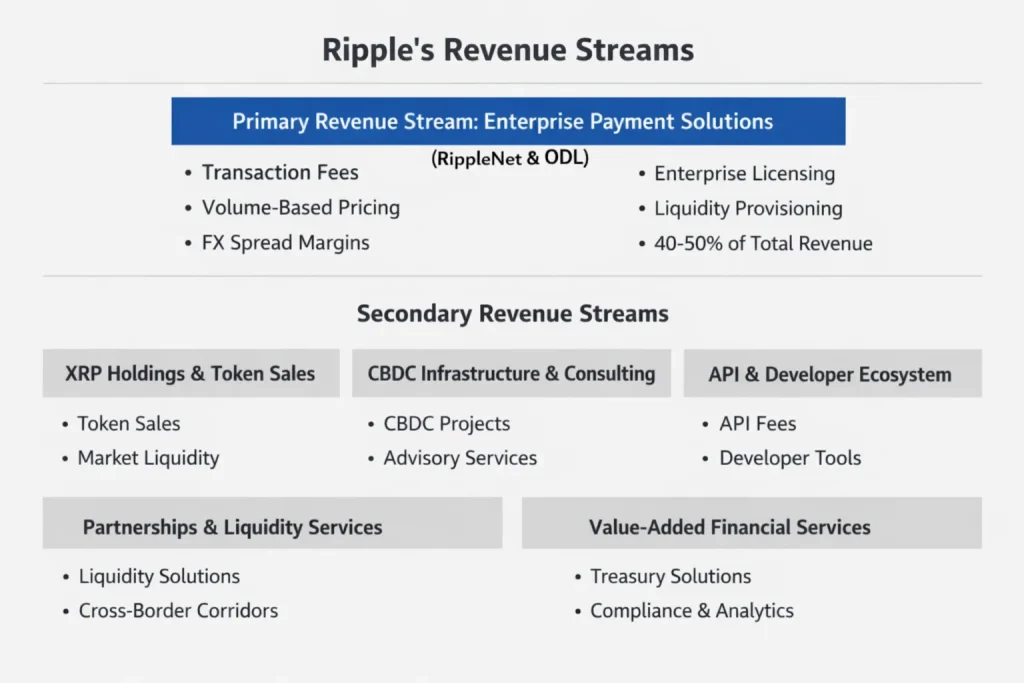
Ripple doesn’t rely on a single revenue stream. Instead, it uses a multi-layered monetization architecture combining software, liquidity, and asset-based economics.
Primary Revenue Stream: Enterprise Payment Solutions
Ripple’s core revenue driver comes from its enterprise-grade payment infrastructure.
How it works
- Financial institutions pay to use RippleNet, Ripple’s global payments network
- Fees are generated through:
- Transaction processing
- Network usage
- Liquidity provisioning via On-Demand Liquidity (ODL)
- Transaction processing
Pricing Model
- Volume-based pricing
- Subscription or licensing fees for enterprise access
- FX spread margins in liquidity transactions
Revenue Contribution
- Estimated to contribute 40–50% of Ripple’s total revenue (2025–2026)
- Fastest-growing segment due to expansion of ODL corridors globally
ODL is especially powerful because it eliminates the need for pre-funded accounts, creating a strong economic incentive for adoption.
Secondary Revenue Streams
1. XRP Holdings & Token Sales
- Ripple holds a significant portion of XRP supply (escrow-controlled)
- Revenue generated through:
- Strategic sales to institutions
- Liquidity support for markets
- Strategic sales to institutions
This acts as both:
- A treasury asset
- A market liquidity engine
2. CBDC Infrastructure & Consulting (Emerging Growth Engine)
- Ripple partners with governments to build Central Bank Digital Currencies
- Revenue from:
- Infrastructure licensing
- Advisory and implementation services
- Infrastructure licensing
By 2026, CBDC partnerships are becoming a major strategic revenue pillar.
3. API & Developer Ecosystem Monetization
- Developers use XRP Ledger for:
- Payments
- Tokenization
- Smart contract applications
- Payments
Revenue streams include:
- API usage fees
- Enterprise developer tools
- Ecosystem services
4. Partnerships & Liquidity Services
- Revenue from:
- Liquidity provisioning
- Market-making partnerships
- Cross-border corridor enablement
- Liquidity provisioning
Strategic Insight
Ripple teaches a powerful monetization lesson:
- Build multiple revenue layers around a core platform
- Monetize both usage (transactions) and infrastructure (APIs, licensing)
- Use asset-backed economics (like XRP) to enhance liquidity and scale
At Miracuves, we help founders design multi-stream revenue architectures — ensuring platforms don’t rely on a single monetization channel but instead create sustainable, compounding revenue systems.
Read more : Ripple Revenue Model: How Ripple Makes Money in 2026
Operational Model & Key Activities
Behind Ripple’s elegant business model lies a highly sophisticated operational engine — one that balances technology, compliance, liquidity, and global coordination.
Unlike traditional startups, Ripple operates more like a hybrid of a fintech company, infrastructure provider, and financial network orchestrator.
Core Operations
Ripple’s day-to-day operations revolve around maintaining a high-performance, always-on financial network:
1. Platform & Network Management
- Operating and scaling RippleNet globally
- Ensuring uptime, transaction speed, and reliability
- Managing liquidity corridors across regions
2. Blockchain Infrastructure (XRP Ledger)
- Continuous upgrades to XRPL (speed, scalability, tokenization features)
- Validator ecosystem management
- Security and decentralization balance
3. Liquidity & Treasury Management
- Managing XRP reserves and escrow releases
- Supporting On-Demand Liquidity (ODL) corridors
- Partnering with market makers and exchanges
4. Compliance & Regulatory Operations
- Working closely with regulators across jurisdictions
- Ensuring AML, KYC, and financial compliance standards
- Navigating evolving crypto regulations (a major focus post-2024)
This is one of Ripple’s biggest operational differentiators — compliance-first execution.
5. Enterprise Sales & Client Success
- Dedicated teams for onboarding banks and institutions
- Custom integration support
- Long-term relationship management
6. Developer & Ecosystem Support
- Supporting developers building on XRPL
- Grants, hackathons, and ecosystem funding
- Expanding tokenization and DeFi capabilities
Strategic Insight (Miracuves Perspective)
Ripple shows that operations in a platform business should be:
- Modular (API-driven systems)
- Scalable (cloud + automation)
- Compliance-integrated (not an afterthought)
For founders building fintech or platform-based apps:
- Design operations that scale without linear cost growth
- Invest early in compliance architecture
- Build developer-friendly infrastructure to expand your ecosystem
At Miracuves, we architect platforms with operational scalability at the core, ensuring businesses can grow across regions without breaking their infrastructure.
Strategic Partnerships & Ecosystem Development
Ripple’s growth is not just driven by its technology — it’s powered by a deep, strategic partner ecosystem.
In fact, partnerships are the backbone of Ripple’s business model. Instead of building everything internally, Ripple focuses on orchestrating a global network of financial, technological, and regulatory allies.
Collaboration Philosophy
Ripple doesn’t aim to disrupt the financial system overnight.
It takes a more pragmatic approach:
“Collaborate with the system to transform it from within.”
This philosophy allows Ripple to:
- Build trust with institutions
- Accelerate adoption
- Navigate complex regulatory environments
Key Partnership Categories
1. Technology & API Partners
- Integration partners that connect RippleNet with banking systems
- Cloud providers and fintech platforms supporting scalability
Examples:
- Integration with core banking systems
- Fintech API providers enabling seamless onboarding
These partnerships ensure Ripple becomes plug-and-play infrastructure.
2. Payment & Liquidity Alliances
- Exchanges and liquidity providers powering On-Demand Liquidity (ODL)
- Regional partners enabling currency corridors
Examples:
- Bitso (Latin America corridor)
- Tranglo (Asia-Pacific expansion)
These alliances are critical for real-time settlement and FX efficiency.
3. Banking & Financial Institution Partnerships
- Core users of RippleNet
- Enable transaction volume and credibility
Examples:
- SBI Holdings (Japan)
- Santander (Europe)
- PNC Bank (USA)
These partnerships create network effects — more banks = more value.
4. Government & Regulatory Alliances
- Collaboration with central banks for CBDC development
- Policy engagement for blockchain regulation
By 2026, Ripple is actively involved in multiple CBDC pilots globally, positioning itself as a government-grade infrastructure provider.
5. Marketing & Distribution Partnerships
- Industry bodies, fintech associations, and global events
- Strategic co-marketing with partners
These partnerships build credibility and thought leadership, not just visibility.
Growth Strategy & Scaling Mechanisms
Ripple’s growth story is not about viral downloads or consumer buzz — it’s about strategic expansion, infrastructure scaling, and network compounding.
It grows like a financial backbone, not a typical startup.
Growth Engines
Ripple uses a combination of institutional growth levers and ecosystem expansion strategies:
1. Organic Growth via Network Effects
- Each new financial institution increases network value
- More corridors = faster, cheaper transactions
- Liquidity improves as adoption grows
This creates a compounding growth loop:
More users → More liquidity → Better performance → More users
2. Strategic Enterprise Sales
- Dedicated teams targeting high-value institutions
- Focus on long-term contracts over quick wins
- ROI-driven pitches (cost savings + speed advantages)
Ripple grows deal-by-deal, not user-by-user.
3. Expansion of On-Demand Liquidity (ODL) Corridors
- Enter new regions with high remittance demand
- Build liquidity through local partnerships
- Gradually scale transaction volumes
Key expansion regions (2025–2026):
- Middle East (UAE, Saudi Arabia)
- Southeast Asia (Philippines, Indonesia)
- Latin America (Mexico, Brazil)
Corridor expansion is Ripple’s core scaling mechanism.
4. New Product Lines & Innovation
- CBDC infrastructure for governments
- Tokenization of real-world assets (RWA)
- Smart contract capabilities on XRPL (post-upgrades)
These open new revenue streams and markets.
5. Developer Ecosystem Growth
- Grants and funding programs
- XRPL-based startups and DeFi applications
- Expansion into Web3 use cases
Developers act as force multipliers for innovation.
Competitive Strategy & Market Defense
Ripple operates in one of the most competitive and sensitive industries — global finance.
To survive and lead, it has built a multi-layered competitive strategy combining technology, trust, and timing.
Core Competitive Advantages
1. Strong Network Effects & Switching Barriers
- The more institutions join RippleNet, the more valuable it becomes
- Liquidity improves with scale, making transactions faster and cheaper
- Once integrated, switching becomes costly and complex for banks
This creates a high lock-in effect, especially for enterprise clients.
2. Institutional Trust & Brand Positioning
- Ripple has positioned itself as:
“The compliant, enterprise-grade blockchain solution” - Unlike many crypto players, Ripple:
- Works closely with regulators
- Maintains transparency in operations
- Focuses on real-world utility
- Works closely with regulators
Trust is a massive differentiator in fintech, where risk is high.
3. Technology & Infrastructure Advantage
- XRP Ledger enables:
- Near-instant settlement (seconds)
- Low transaction costs
- High scalability
- Near-instant settlement (seconds)
- Continuous upgrades (2025–2026):
- Tokenization support
- Smart contract capabilities
- Interoperability with financial systems
- Tokenization support
Ripple’s tech is not just fast — it’s enterprise-ready.
4. Data-Driven Optimization & Personalization
- Ripple leverages transaction data to:
- Optimize liquidity corridors
- Improve pricing efficiency
- Enhance fraud detection and compliance
- Optimize liquidity corridors
Data becomes a strategic asset, not just an operational tool.
Market Defense Strategies
Ripple doesn’t just compete — it actively protects its position.
1. Competing with Legacy Systems (SWIFT)
- Instead of direct disruption, Ripple:
- Integrates with existing banking systems
- Offers incremental improvements
- Integrates with existing banking systems
This reduces resistance and accelerates adoption.
2. Handling New Entrants (Stellar, Blockchain Startups)
- Differentiates through:
- Enterprise focus (vs retail/crypto focus)
- Strong compliance framework
- Established partnerships
- Enterprise focus (vs retail/crypto focus)
Most competitors struggle to match Ripple’s institutional depth.
3. Pricing Strategy & Economic Positioning
- Offers:
- Lower transaction costs
- Transparent pricing
- Volume-based incentives
- Lower transaction costs
Competes on efficiency, not just price.
4. Strategic Feature Rollouts
- Introduces features based on:
- Market demand
- Regulatory readiness
- Partner needs
- Market demand
Examples:
- ODL expansion before mass adoption
- CBDC infrastructure as governments explored digital currencies
Timing innovation correctly gives Ripple a first-mover edge.
Lessons for Entrepreneurs & Implementation
Ripple’s journey offers more than just a case study — it provides a playbook for building scalable, future-proof platforms in complex industries.
If you’re a founder, especially in fintech, SaaS, or Web3, this is where insight turns into action.
Key Factors Behind Ripple’s Success
Ripple didn’t succeed by accident — it made deliberate strategic choices:
- Enterprise-first approach instead of chasing mass adoption
- Solving a real, high-cost problem (cross-border inefficiency)
- Building infrastructure, not just an app
- Strong regulatory alignment in a sensitive industry
- Ecosystem-driven growth through partnerships
Ripple focused on depth of value, not just scale of users.
Replicable Principles for Startups
You don’t need to build the next Ripple — but you can adopt its thinking:
1. Start with a High-Value Problem
- Target industries with inefficiencies worth billions
- Focus on B2B or infrastructure-level opportunities
2. Build for Integration, Not Replacement
- Make your solution compatible with existing systems
- Reduce friction for adoption
3. Design Multi-Sided Platforms
- Create value for:
- Users
- Partners
- Developers
- Users
Platforms scale faster when multiple stakeholders benefit.
4. Monetize Beyond One Stream
- Combine:
- Usage-based revenue
- Subscription/licensing
- Ecosystem monetization
Don’t depend on a single revenue source.
- Usage-based revenue
5. Turn Compliance into a Competitive Advantage
- Don’t treat regulation as a barrier
- Use it to build trust and differentiate
Implementation & Investment Priorities
Here’s a simplified roadmap inspired by Ripple’s approach:
Phase 1 : Foundation
- Identify core problem and target segment
- Build MVP with API-based architecture
- Establish early partnerships
Phase 2 : Validation & Growth
- Onboard initial clients
- Optimize product-market fit
- Begin monetization
Phase 3 : Scaling
- Expand to new markets or segments
- Strengthen infrastructure and compliance
- Introduce additional revenue streams
Phase 4 : Ecosystem Expansion
- Build developer ecosystem
- Add new services (analytics, APIs, etc.)
- Create network effects
Ready to implement Ripple’s proven business model for your market?
Miracuves builds scalable platforms with tested business models and growth mechanisms.
We’ve helped 1500+ entrepreneurs launch profitable apps across fintech, marketplaces, and SaaS. Get your free business model consultation today and turn your idea into a scalable digital ecosystem.
Conclusion
Ripple’s business model is a powerful reminder that true innovation doesn’t always come from disruption alone — it comes from strategic integration, execution, and long-term vision.
By focusing on solving one of the world’s most complex financial problems — cross-border payments — Ripple built a system that blends blockchain efficiency with institutional trust. It didn’t try to replace banks overnight; instead, it created a bridge between traditional finance and the digital future.
What makes Ripple exceptional is not just its technology, but its ability to:
- Align multiple stakeholders into a unified ecosystem
- Build revenue through interconnected layers
- Scale globally while staying compliant and enterprise-focused
This combination of innovation + execution is what transforms a good idea into a sustainable, billion-dollar business . As we move deeper into 2026, the bigger lesson becomes clear: The future of digital platforms belongs to those who can connect systems, not isolate them .Ripple’s model is not just about payments — it’s a blueprint for how platform economies will evolve, where interoperability, trust, and ecosystem value define success.
FAQs
What type of business model does Ripple use?
Ripple uses a B2B fintech infrastructure model combined with blockchain technology. It operates as a hybrid of enterprise SaaS and a liquidity network powered by the XRP Ledger.
How does Ripple’s model create value?
Ripple enables faster, cheaper cross-border payments for financial institutions. It reduces settlement time from days to seconds while lowering transaction costs significantly.
What are its key success factors?
Key factors include strong institutional partnerships, regulatory alignment, scalable infrastructure, and network effects. Its focus on real-world utility over hype also drives long-term adoption.
How scalable is Ripple’s business model?
Highly scalable, as it’s API-driven and asset-light, allowing expansion across countries without heavy physical infrastructure. Growth happens through new payment corridors and partnerships.
What are the biggest challenges?
Major challenges include regulatory uncertainty, competition from legacy systems like SWIFT, and liquidity building in new markets. Ripple has addressed these through global diversification.
How can entrepreneurs adapt it to their region?
Start with a specific niche or payment corridor, partner with local institutions, and build API-first infrastructure. Focus on solving a high-cost inefficiency in your market.
Related Articles