


Key Takeaways
What You’ll Learn
- Food delivery operations depend on backend control, not just app design.
- Fleet management affects speed, rider productivity, and cost.
- Real-time order sync builds trust across customers, restaurants, riders, and admins.
- Flexible commission logic protects margins across zones and fulfillment types.
- Dark stores and logistics AI improve scale, control, and expansion readiness.
Stats That Matter
- Fleet management improves assignment speed, idle-time control, batching, and route efficiency.
- Real-time sync should cover order placement, prep status, rider assignment, pickup, movement, delays, and completion.
- Commission models can include restaurant commission, delivery fees, service charges, surge pricing, subscriptions, and sponsored placements.
- Dark store fulfillment adds grocery, quick commerce, better stock control, and higher margin opportunities.
- Logistics AI supports demand prediction, rider allocation, route optimization, delivery clustering, and delay detection.
Real Insights
- High order volume breaks weak systems fast if dispatch and sync are not strong.
- Operational trust comes from visibility, not just faster delivery promises.
- Pricing logic should stay flexible because every city, partner, and order type works differently.
- Dark-store readiness makes the platform bigger than restaurant delivery alone.
- Long-term scale depends on control, automation, and smarter logistics decisions.
A successful Food Delivery App is not built only by adding more restaurants, running more offers, or acquiring more users. Growth in food delivery becomes difficult the moment the business starts handling serious order volume across multiple locations, peak hours, and fulfillment models.
That is because scale introduces pressure across every moving layer of the platform. Restaurants need better preparation visibility. Riders need smarter allocation. Customers expect accurate ETAs and fewer delays. The business needs margin control, stable operations, and fulfillment consistency.
So when founders think about building a Zomato clone or a Swiggy-style platform, the real challenge is not simply traffic. It is coordination.
A high-volume delivery platform works only when the backend can balance timing, dispatch, pricing, and availability in real time. Without that, the platform may look polished on the front end but struggle in the exact places that define trust and retention.
This is why serious delivery businesses are built like operating systems, not just ordering apps.
Why Scaling a Food Delivery App Is an Operations Problem First
Many early-stage delivery businesses assume that once orders increase, the platform is progressing well. In practice, more orders often reveal operational weakness much faster.
More orders do not always mean better performance
A platform can generate demand and still create friction for every stakeholder involved.
- Customers may receive delayed orders, inaccurate ETAs, or poor support
- Restaurants may face preparation pressure, pickup confusion, and order backlog
- Riders may spend too much time waiting, traveling inefficiently, or handling poor batch assignments
When these issues stack up, growth starts hurting platform quality instead of improving it.
What breaks when backend operations are weak
| Operational Area | What Goes Wrong | Business Impact |
|---|---|---|
| Rider allocation | Wrong rider-order matching | Slower deliveries, higher cost |
| Restaurant sync | Kitchen timing mismatch | Pickup delays, partner friction |
| ETA engine | Inaccurate timing updates | Lower customer confidence |
| Commission setup | Poor pricing logic | Margin instability |
| Dispatch handling | Manual overload during peak hours | Reduced operational control |
| Availability and inventory | Missing fallback fulfillment options | Cancellations and lost orders |
This is the main reason a serious Food Delivery App must be designed around live operations. The stronger the backend logic, the better the platform handles pressure during scale.
Fleet Management Shapes Delivery Performance at Scale
In a high-volume food delivery business, fleet management is not just about moving riders faster. It is about making sure the right rider is assigned to the right order at the right time without creating unnecessary cost. Since riders sit at the center of fulfillment, even small inefficiencies in movement, timing, or assignment can create delays across the platform.
When fleet logic is weak, the impact is immediate. Delivery times become inconsistent, rider productivity drops, and the cost of completing each order starts rising. Over time, that affects customer trust, restaurant coordination, and platform margins together.
Why rider assignment has a direct impact on delivery outcomes
Fast delivery is important, but speed without utilization control is not sustainable. A platform may complete some orders quickly and still perform poorly if too many riders are underused, delayed, or assigned inefficiently.
That is why a strong fleet system must continuously evaluate operational factors such as:
- Which rider is nearest and ready for a new order
- Whether that rider already has an active load
- If nearby deliveries can be grouped intelligently
- Whether restaurant preparation timing matches rider arrival
- If rider supply needs to be shifted across zones before peak demand intensifies
These are not just dispatch decisions. They shape how well the business balances delivery quality with operational cost.
The operational logic behind batching, routing, and idle-time control
Strong fleet management usually depends on a combination of systems and decision rules.
- Smart allocation based on distance, availability, rider load, and zone demand
- Peak balancing to move rider supply where demand is rising
- Order batching for nearby orders with compatible preparation windows
- Route planning that reduces travel time and avoids inefficient movement
- Idle-time reduction so riders spend more time delivering and less time waiting
If these systems are weak, the platform may fulfill orders, but it will do so at a cost that eventually damages margins.
What good fleet management improves
| Fleet Outcome | Operational Benefit |
|---|---|
| Faster assignment | Better delivery speed |
| Lower idle time | Higher rider productivity |
| Smarter batching | Lower per-order cost |
| Better route planning | Improved time efficiency |
| Balanced zone coverage | Better peak-hour control |
| Strong rider utilization | Better Food Delivery App ROI |
For founders, this means fleet management is not only a logistics layer. It is a business-performance layer.
Real-Time Order Sync Builds Operational Trust
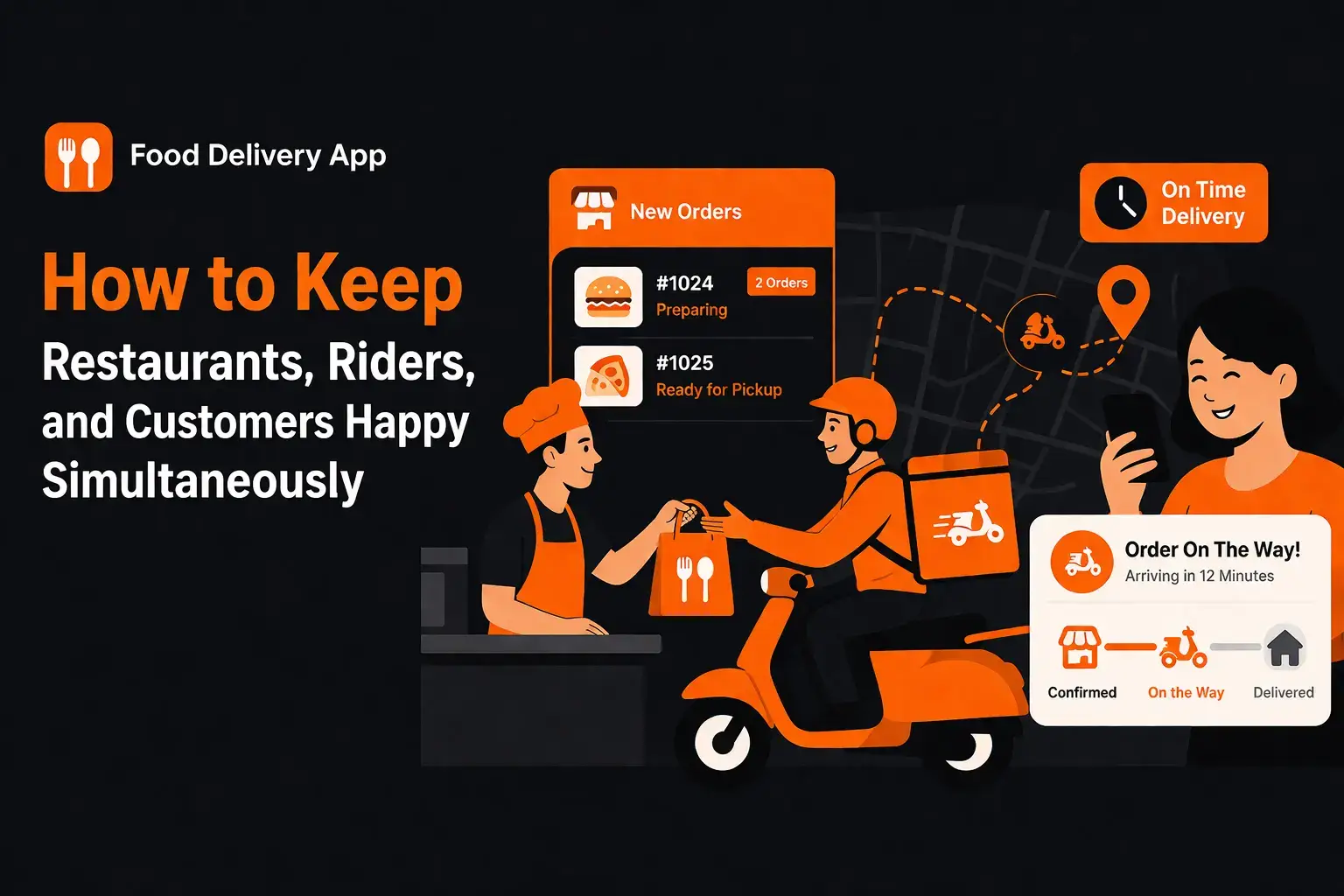
A delivery platform is always coordinating multiple parties at once. The customer wants visibility. The restaurant wants preparation clarity. The rider needs timing accuracy. The admin team needs live exception control.
That is why real-time order synchronization is not an add-on feature. It is one of the most important parts of operational trust.
Why every stakeholder needs the same live order view
When all participants work from different or delayed data, confusion spreads quickly. A restaurant may mark food ready while no rider is assigned. A rider may arrive before preparation is complete. A customer may see an ETA that no longer reflects actual kitchen or delivery conditions.
This breaks confidence fast.
A scalable platform needs to ensure that every live order event is reflected across the system without harmful delay.
What real-time synchronization must include
A serious Food Delivery App should sync the following events clearly:
- Order placed
- Restaurant accepted or rejected
- Preparation started
- Estimated ready time updated
- Rider assigned
- Rider reached pickup point
- Order picked up
- Delivery movement updated
- Delay or issue flagged
- Cancellation recorded
- Delivery completed
A simple order-sync flow
- Customer places the order
- Restaurant receives it instantly
- Kitchen updates expected preparation time
- Platform assigns a rider based on live availability and timing
- Rider gets pickup details and route support
- Customer sees accurate progress and ETA updates
- Admin tracks exceptions, delays, and cancellations from one control layer
What happens when sync quality is poor
When live order sync is weak, support tickets rise quickly and operational pressure increases across the board.
- Riders reach pickup points too early or too late
- Restaurants lose trust in platform coordination
- Customers repeatedly check or complain about order status
- Admin teams spend more time solving preventable issues
- Refunds, cancellations, and poor ratings increase
For founders, this is a core lesson. Real-time sync affects not just technology quality but platform credibility itself.
Commission Logic Decides Food Delivery App ROI
A delivery business may process high order volumes and still struggle financially if its commission and pricing model is weak. Revenue structure matters as much as order flow.
The main revenue layers in a food delivery platform
Most food delivery businesses monetize through multiple layers rather than a single source.
- Restaurant commission
- Delivery fees
- Service or convenience charges
- Surge or peak pricing
- Sponsored placements
- Promotional participation fees
- Subscription benefits
- Margin from owned inventory or dark-store fulfillment
A strong monetization design helps the platform balance growth, competitiveness, and profitability.
Why flexible commission models matter
A fixed commission model may appear simple in the beginning, but serious delivery businesses usually need more flexibility.
Commission logic often varies by:
- City or service region
- Restaurant category
- Chain partner vs local merchant
- Delivery distance
- Order value
- Self-delivery vs platform-delivery setup
- Peak-hour demand
- Campaign participation level
This matters because the same pricing formula does not work equally well across all partners and markets.
Sample commission structure logic by fulfillment type
| Fulfillment Model | Platform Role | Revenue Logic | Margin Impact |
|---|---|---|---|
| Restaurant self-delivery | Marketplace and demand generation | Listing fee + lower commission | Lower control, lighter operational load |
| Platform delivery | Full order and logistics coordination | Higher commission + delivery fee | Stronger execution control |
| Dark store fulfillment | Inventory, fulfillment, and dispatch | Product margin + delivery charge | Higher margin opportunity |
| Hybrid setup | Mixed by partner or zone | Flexible pricing stack | Better expansion flexibility |
What founders should think about
A smart commission engine should support:
- Custom partner rates
- Distance-based fee logic
- Zone-based pricing
- Surge pricing triggers
- Offer and coupon cost sharing
- Service fee configuration
- Profit visibility by fulfillment type
This is where Food Delivery App ROI becomes a design issue, not just a finance issue. The more flexible and transparent the commission logic, the easier it becomes to scale sustainably.
Dark Store Integration Expands the Platform Beyond Restaurants
Modern delivery businesses are growing beyond restaurant meals. Many platforms now move into grocery, essentials, convenience products, and private-label fulfillment. That shift makes dark store integration increasingly important.
What dark stores add to the delivery business model
Dark stores are fulfillment centers built for fast order handling instead of walk-in retail. They allow delivery businesses to support:
- Grocery delivery
- Quick commerce
- High-frequency daily essentials
- Controlled inventory-led fulfillment
- Private-label products
- Hyperlocal commerce expansion
This changes the platform from a restaurant marketplace into a wider commerce infrastructure layer.
Dark store vs restaurant-led fulfillment
| Model | Main Strength | Main Limitation |
|---|---|---|
| Restaurant-led delivery | Large merchant variety | Less inventory and prep-time control |
| Dark store fulfillment | Better speed and stock control | Requires inventory planning and operations management |
Why this improves speed, control, and margin
Dark store integration gives founders more control over important parts of the customer experience.
- Better product availability
- Faster dispatch for repeat-demand items
- Better service consistency
- More control over margins
- Reduced dependence on restaurant-side performance alone
- Easier entry into grocery and convenience delivery
This is especially important for founders thinking beyond meals. A delivery platform built with dark-store readiness can expand into broader hyperlocal commerce much more effectively.
Logistics AI Becomes Critical at High Order Volume
Manual dispatching and static delivery logic may work at small scale, but they become unreliable once the platform starts handling large volumes across many service zones.
Where manual dispatch starts to fail
Operations teams struggle when they have to manage:
- Live order surges
- Changing rider availability
- Traffic disruptions
- Uneven demand across zones
- Frequent delay patterns
- Weak batching decisions
- Poor forecasting during peak periods
At this stage, manual handling becomes reactive rather than strategic.
How AI improves allocation, routing, and delay detection
Logistics AI improves delivery performance by helping the platform make smarter decisions faster.
It can support:
- Demand prediction by area and time window
- Better rider allocation
- Route optimization
- Delivery clustering
- Delay detection
- Dynamic dispatching
- Smarter peak-hour preparation
This does not mean the platform becomes fully automated. It means the system becomes more capable of supporting operations under pressure.
Manual logistics vs AI-supported logistics
| Area | Manual Logic | AI-Supported Logic |
|---|---|---|
| Rider assignment | Basic rule-based | Multi-factor decisioning |
| Route planning | Static map response | Dynamic route optimization |
| Order batching | Reactive | Pattern-based and predictive |
| Delay handling | After issue appears | Early detection and intervention |
| Peak demand planning | Human estimation | Forecast-driven support |
For founders planning long-term scale, AI becomes practical once order density and complexity rise. It helps reduce avoidable delays while protecting delivery quality and customer trust.
What Serious Founders Should Build Into the Platform From Day One
A delivery business should not wait for operational chaos before investing in backend structure. The right architecture should be part of the platform from the beginning.
Key backend capabilities
Founders should think in terms of systems, not only screens.
Important capabilities include:
- Real-time order event management
- Scalable dispatch workflows
- Flexible commission engine
- Zone-based operations logic
- Restaurant and dark-store support
- Inventory sync and availability control
- Accurate live tracking and ETA handling
- Refund and cancellation workflows
- Analytics for merchant, rider, and customer performance
Admin and control-layer essentials
The admin side is just as important as the customer side.
A serious control layer should include:
- Zone-level operations dashboard
- Rider allocation controls
- Restaurant performance visibility
- Commission and fee settings
- Offer and campaign controls
- Delay and issue monitoring
- Demand pattern insights
- Fulfillment model reporting
These systems help founders run the business with visibility and discipline instead of guesswork.
Miracuves Tech Edge for Food Delivery App Development
Founders building a scalable delivery platform need more than a polished user interface. They need strong infrastructure that supports coordination, growth, and operational flexibility.
That is where Miracuves brings practical value.
Why founders need more than a front-end ordering flow
A serious Food Delivery App must support:
- Real-time synchronization across all stakeholders
- Scalable delivery workflows
- Modular support for food, grocery, and hyperlocal commerce
- Configurable commission structures
- Strong admin control layers
- Secure third-party integrations
- Expansion readiness without rebuilding the core system
This matters because a platform only becomes commercially useful when it can operate well under real business pressure.
What Miracuves brings to scalable delivery infrastructure
Miracuves focuses on building delivery systems with real operational thinking behind them.
That includes:
- Scalable architecture for growth-ready platforms
- Real-time order and dispatch workflow design
- Modular customization for multi-vendor and hyperlocal models
- Admin controls for pricing, zones, riders, and partner operations
- Dark store and expansion-ready workflows
- Secure integration readiness for payments, notifications, maps, and inventory systems
- Faster launch capability for founders who want to validate and scale with clarity
For businesses planning a Zomato like app, a Swiggy-inspired platform, or a broader hyperlocal commerce product, this approach matters because success depends on how well the platform performs behind the scenes.
Conclusion
Handling 10k orders per second is not just a traffic challenge. It is a coordination challenge across riders, restaurants, pricing systems, fulfillment models, and operational intelligence layers.
That is what makes delivery platforms difficult to scale. A business may attract users quickly, but long-term performance depends on how well the backend handles movement, timing, sync, dispatch, and margin logic at the same time. The strongest delivery businesses understand that platform design directly shapes execution quality, user trust, partner satisfaction, and Food Delivery App ROI.
If you are planning to build a Food Delivery App, a Zomato clone, or a scalable hyperlocal delivery platform, Miracuves can help you create infrastructure that is designed for real operations, not just basic ordering flow
Build a delivery platform with stronger operations, smarter fulfillment logic, and scalable backend control. Connect with Miracuves to create a food delivery solution designed for performance, flexibility, and long-term growth.
FAQs
What is the biggest challenge in scaling a Food Delivery App?
The biggest challenge is not just increasing order volume. It is managing live operations across restaurants, riders, customers, and admin systems without creating delays, poor coordination, or margin pressure.
Why is fleet management important in a food delivery business?
Fleet management helps improve rider allocation, reduce idle time, support better route planning, and increase delivery efficiency. A well-managed fleet improves delivery speed, customer satisfaction, and overall business performance.
How does real-time order sync improve platform performance?
Real-time order sync keeps customers, restaurants, riders, and admin teams updated with the same live order information. This reduces confusion, improves ETA accuracy, lowers support issues, and builds trust across the platform.
How do food delivery platforms make money?
Most food delivery platforms earn through restaurant commissions, delivery charges, service fees, surge pricing, featured listings, subscriptions, and in some cases dark store or private-label product margins.
Why should commission logic be flexible in a Food Delivery App?
Commission logic should be flexible because pricing often depends on city, restaurant type, order value, fulfillment model, delivery distance, and promotional activity. A flexible system helps protect profitability while supporting partner relationships.
What is dark store integration in a delivery platform?
Dark store integration allows the platform to fulfill orders from dedicated inventory-based locations instead of relying only on restaurants. This helps support grocery delivery, quick commerce, better stock control, and faster dispatch.
How do dark stores help improve delivery operations?
Dark stores improve speed, availability, and margin control. They give the platform more control over inventory, help reduce dependency on restaurant preparation times, and make expansion into hyperlocal commerce easier.
What features should a serious Food Delivery App include?
A serious Food Delivery App should include real-time order sync, rider dispatch logic, fleet controls, flexible commission settings, live tracking, admin dashboards, cancellation and refund workflows, restaurant management tools, and support for expansion models such as dark stores.
Why is backend architecture important for a Food Delivery App?
Backend architecture controls how the platform handles live orders, dispatching, pricing, inventory, ETA updates, partner coordination, and scale. Without strong backend systems, even a good-looking app can fail during high-volume operations.
Why choose Miracuves for food delivery app development?
Miracuves focuses on scalable architecture, real-time workflow design, admin control systems, modular customization, and operationally strong delivery infrastructure. This helps founders build a serious platform rather than just a basic ordering interface.