

Key Takeaways
What You’ll Learn
- Afterpay runs on a merchant-funded BNPL model instead of charging traditional interest to shoppers.
- Merchant fees are the main revenue driver because retailers pay for higher conversions and larger basket sizes.
- Late fees, ads, interchange, and marketplace revenue add secondary monetization layers.
- The model works through consumer convenience and merchant growth at the same time.
- Long-term success depends on repayment discipline, merchant adoption, and transaction volume.
Stats That Matter
- The article explains that merchant transaction fees are the largest share of revenue in Afterpay’s business model.
- Typical merchant charges are shown around 4% to 6% of transaction value plus a fixed processing fee.
- Late fees are presented as a secondary revenue stream, not the primary model.
- Ads, promotions, interchange, and marketplace revenue are listed as added monetization layers.
- Merchant value comes from stronger conversion rates and higher average order value.
Real Insights
- Afterpay grows by acting like a sales channel for merchants, not just a payment tool.
- The model feels attractive to users because the main cost is shifted toward merchants.
- BNPL strength depends on repayment behavior because risk control matters as much as growth.
- Secondary revenue streams improve resilience beyond basic transaction income.
- The strongest BNPL platforms combine convenience, merchant value, and disciplined financial operations.
started in Australia in 2014 grew so fast that by 2021 Block (formerly Square) acquired Afterpay for $29 billion, making it one of the biggest fintech acquisitions ever. By 2026, the platform has tens of millions of active consumers and hundreds of thousands of merchants across markets including the US, UK, Australia, and Europe.
It built an entirely new consumer finance behavior. Instead of credit cards with high interest rates, Afterpay introduced a Buy Now, Pay Later (BNPL) model where shoppers can purchase instantly and pay over time without interest—while merchants pay a fee for increased sales.Today, BNPL has become a core part of the global digital commerce infrastructure, influencing how platforms like Klarna, Affirm, PayPal, and Apple Pay Later operate.
For entrepreneurs and founders exploring fintech apps, marketplace platforms, or embedded finance, studying the business model of Afterpay reveals important lessons about :Platform monetization without direct consumer fees ,Behavioral finance design , Merchant-driven revenue ecosystems , Scaling two-sided fintech marketplaces
And this is exactly where companies like Miracuves come in—helping founders design scalable fintech and platform ecosystems using proven business models like BNPL. In this article, we’ll break down how the Afterpay business model works, how it generates revenue, and what entrepreneurs can learn from its rapid growth.
How the Business Model of Afterpay Works
At its core, Afterpay operates a Buy Now, Pay Later (BNPL) fintech marketplace that connects consumers and merchants through an installment payment system.
Instead of traditional credit cards with interest charges, Afterpay allows shoppers to split purchases into four equal payments over six weeks, while merchants pay a fee for access to higher sales and conversion rates.
This creates a two-sided financial ecosystem where consumers receive flexible payments and merchants gain more customers.
Type of Business Model
Afterpay uses a Hybrid Fintech Platform Model combining several strategies:
- BNPL (Buy Now Pay Later) financing
- Two-sided marketplace
- Merchant monetization platform
- Embedded finance infrastructure
Unlike credit card companies, the majority of Afterpay’s revenue comes from merchants rather than consumers.
This was a key innovation that accelerated adoption.
Evolution of the Model
Afterpay’s strategy evolved significantly since launch.
Phase 1 (2014–2018): BNPL Pioneer
- Focus on fashion and retail
- Simple four-payment installment model
- Expansion in Australia
Phase 2 (2018–2021): Global Fintech Expansion
- Entered US and UK markets
- Rapid merchant partnerships
- IPO and massive user growth
Phase 3 (2021–Present): Embedded Finance
After Block acquired Afterpay, the model expanded into:
- Cash App integration
- In-store BNPL payments
- Financial services ecosystem
- Cross-border shopping
This transformed Afterpay from a payment feature into a global commerce platform.
Why the Model Works in 2026
Several major consumer trends explain why Afterpay continues to thrive:
1. Decline of traditional credit cards
Many young consumers avoid long-term debt.
2. E-commerce growth
BNPL integrates perfectly into digital checkout.
3. Behavioral finance
Breaking payments into smaller amounts reduces purchase hesitation.
4. Merchant demand
Retailers want higher conversions and customer acquisition tools
Target Market & Customer Segmentation Strategy
Understanding who uses Afterpay and why they stay is key to understanding the company’s explosive growth. Unlike traditional lenders, Afterpay doesn’t target high-credit borrowers—it focuses on digitally native consumers and retail brands looking for frictionless payments.
The company’s success comes from identifying behavior-driven customer segments and designing a platform that serves both sides of the marketplace simultaneously.
Primary Customer Segments
1. Gen Z Consumers (Core Growth Engine)
Gen Z represents one of the largest user groups for BNPL services.
Demographic profile
- Age: 18–28
- Digital-first shoppers
- Limited access to traditional credit cards
Behavioral motivations
- Avoid interest-heavy credit cards
- Prefer flexible budgeting tools
- Strong adoption of mobile payment apps
For this group, Afterpay acts as a spending control tool rather than a credit product.
2. Millennials (High Spending Segment)
Millennials represent a major revenue-driving segment due to higher purchasing power.
Demographic profile
- Age: 28–40
- Comfortable with digital payments
- Strong e-commerce adoption
Behavioral motivations
- Manage cash flow across purchases
- Split larger purchases (fashion, electronics, travel)
- Reduce reliance on credit cards
Millennials tend to generate higher average order values (AOV) compared to Gen Z.
3. Retail Merchants (Primary Paying Customers)
While consumers drive transactions, merchants generate most of the revenue.
Typical merchant segments include:
- Fashion & apparel brands
- Beauty and cosmetics retailers
- Electronics and gadgets
- Lifestyle and home products
- Online-first e-commerce startups
For merchants, Afterpay acts as both:
- A payment method
- A customer acquisition platform
Retailers often gain access to millions of active shoppers through the Afterpay app marketplace.
Secondary Customer Segments
1. Small & Mid-sized E-commerce Businesses
Startups and DTC brands integrate Afterpay to compete with larger retailers.
Benefits include:
- Higher conversion rates
- Improved checkout experience
- Access to a younger audience
2. Enterprise Retail Chains
Large global brands integrate Afterpay both online and in physical stores.
Examples include sectors like:
- Fashion retail chains
- Global beauty brands
- Department stores
These retailers leverage BNPL to increase customer lifetime value.
Customer Journey: Discovery → Conversion → Retention
Afterpay’s growth strategy carefully maps the full customer lifecycle.
Discovery
Users typically discover Afterpay through:
- Merchant checkout pages
- Social media marketing
- Influencer partnerships
- App store visibility
- In-store payment signage
Many consumers first encounter Afterpay while shopping online.
Conversion
Conversion happens during checkout.
The process is designed to be extremely frictionless:
- Shopper selects Afterpay as payment option
- Instant approval decision
- Pay 25% upfront
- Remaining payments auto-scheduled
This low-friction onboarding process is critical to high adoption.
Retention
Afterpay’s retention strategy focuses on repeat shopping behavior.
Retention drivers include:
- Merchant discovery inside the app
- Personalized shopping recommendations
- Exclusive brand promotions
- Purchase reminders and budgeting tools
Frequent shoppers often treat Afterpay as a default payment method.
Revenue Streams and Monetization Design
Now comes the most interesting question for entrepreneurs:
How does Afterpay make billions while offering interest-free payments to consumers?
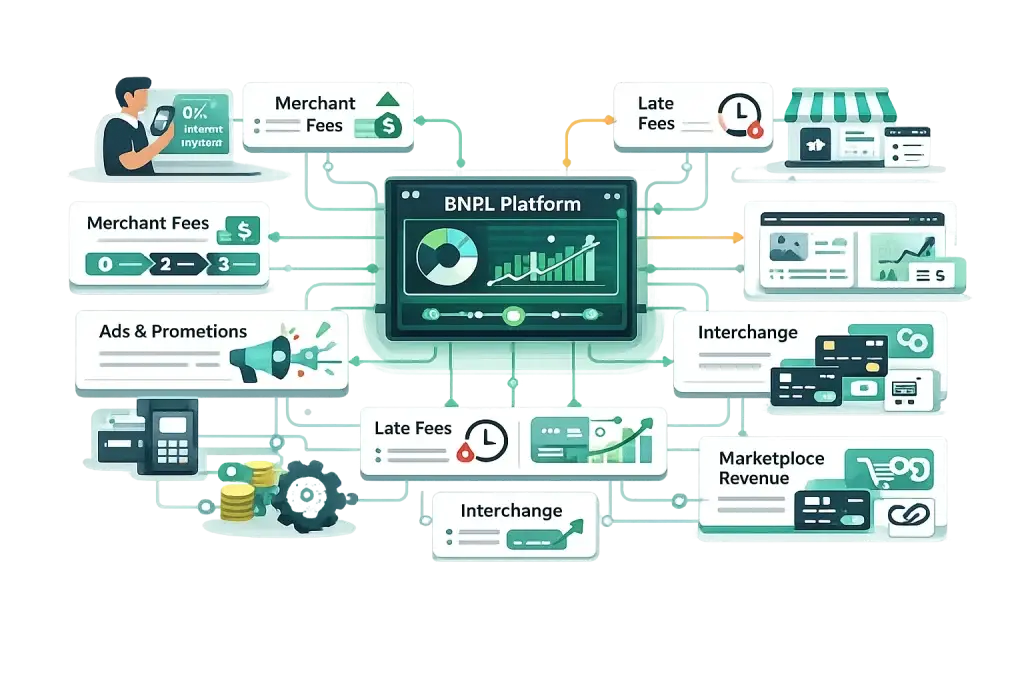
The answer lies in a merchant-funded revenue model combined with secondary monetization streams. Instead of charging users high interest like credit cards, Afterpay primarily earns revenue from retailers that benefit from higher sales and conversions.
This design makes Afterpay’s business model fundamentally different from traditional lending.
Primary Revenue Stream: Merchant Transaction Fees
The largest share of Afterpay’s revenue comes from merchants.
Whenever a customer pays with Afterpay, the merchant pays a percentage of the transaction value plus a fixed fee.
Typical fee structure (varies by region and merchant size):
- 4% – 6% transaction fee
- $0.30 fixed processing fee per transaction
Example:
If a customer buys a $200 product, Afterpay may charge the merchant approximately:
- ~$8–$12 transaction fee
- ~$0.30 processing fee
The merchant still accepts this because BNPL often increases:
- Conversion rates by 20–30%
- Average order value by 30–40%
For many retailers, this makes Afterpay a growth marketing channel rather than just a payment processor.
Merchant fees account for the majority of Afterpay’s total revenue.
Secondary Revenue Streams
Although merchant fees dominate, Afterpay has several additional income sources that strengthen the model.
1. Late Payment Fees
While Afterpay markets itself as interest-free, it charges late fees if installment payments are missed.
Typical structure:
- Small fixed fee for late payment
- Additional capped fee if payment remains overdue
However, these fees are limited to maintain consumer trust and regulatory compliance.
Late fees represent a minor but stable revenue source.
2. Merchant Marketing & Promotion Fees
Afterpay’s app functions as a shopping marketplace where brands can promote their products.
Merchants can pay for:
- Featured placement in the Afterpay app
- Sponsored promotions
- Brand campaigns targeting BNPL shoppers
This creates a retail media revenue stream similar to:
- Amazon Ads
- Klarna marketplace advertising
3. Interchange Revenue
Because Afterpay issues virtual cards for some transactions, it earns interchange fees from payment networks.
These fees come from:
- Visa
- Mastercard
- Other payment rails
Although smaller than merchant fees, interchange revenue adds incremental margin to transactions.
4. Consumer Engagement & Shopping Marketplace
Afterpay has increasingly positioned its app as a shopping discovery platform.
Revenue opportunities include:
- Affiliate partnerships
- Brand campaigns
- Retail discovery advertising
This transforms the platform into a hybrid of payments + commerce marketplace.
Operational Model & Key Activities
Behind Afterpay’s simple “Pay in 4” user experience lies a sophisticated operational machine. The company must manage payments infrastructure, risk assessment, merchant integrations, consumer behavior analytics, and global compliance—all in real time.
Unlike traditional lenders, Afterpay operates as a technology-driven financial platform, where operational efficiency and data-driven risk management determine profitability.
In simple terms, Afterpay’s operations revolve around one key mission:
Approve transactions instantly while minimizing credit risk and maximizing merchant sales.
Core Operational Functions
1. Platform Management
Afterpay operates a global fintech platform that connects consumers, merchants, and payment networks.
Key responsibilities include:
- Processing millions of installment transactions
- Managing user accounts and payment schedules
- Synchronizing with merchant checkout systems
- Supporting both online and in-store payments
The platform must deliver near-instant approval decisions without traditional credit checks.
2. Technology Infrastructure
Technology is the backbone of the Afterpay ecosystem.
The company relies on:
- Cloud-based fintech infrastructure
- AI-driven fraud detection
- Real-time payment processing
- Data analytics for transaction monitoring
- Secure API integrations for merchants
This infrastructure enables the platform to scale globally while maintaining high reliability and security.
Companies like Miracuves specialize in building similar scalable fintech architectures, helping startups launch platforms capable of supporting large user bases and complex payment systems.
3. Risk Management & Credit Modeling
Because Afterpay pays merchants immediately while collecting installments from customers later, risk management is critical.
The company uses proprietary data models to evaluate:
- Transaction behavior
- Repayment history
- Spending patterns
- Account stability
Unlike traditional banks, Afterpay relies more on behavioral data than credit scores.
If a user misses a payment:
- Their account may be temporarily restricted
- New purchases are blocked
- Late fees may apply
This structure discourages defaults while keeping the user experience frictionless.
4. Merchant Integration & Partner Support
Afterpay works with hundreds of thousands of merchants globally, requiring continuous integration and support.
Merchant operations include:
- API and checkout integrations
- Retailer onboarding
- Marketing campaign coordination
- Merchant analytics dashboards
- Customer support for merchants
These integrations allow Afterpay to embed itself directly into the e-commerce checkout flow.
5. Customer Support & Dispute Management
With millions of users across multiple countries, Afterpay must manage large-scale customer support operations.
Typical support tasks include:
- Payment disputes
- Refund processing
- Account management
- Fraud investigation
- Installment schedule adjustments
Efficient support helps maintain consumer trust in the BNPL system.
Strategic Partnerships & Ecosystem Development
Afterpay’s rapid global expansion didn’t happen in isolation. The company built a strong partnership ecosystem that connects retailers, fintech platforms, payment networks, and financial infrastructure providers.
This ecosystem approach transformed Afterpay from a simple payment tool into a commerce enablement platform.
Strategic partnerships allow Afterpay to scale faster, enter new markets, and continuously expand the value of its platform for both merchants and consumers.
Collaboration Philosophy
Afterpay’s partnership strategy is built around a core principle:
Create value for merchants while simplifying payments for consumers.
Instead of competing with retailers or payment networks, Afterpay positions itself as a growth partner.
The platform essentially becomes a sales driver, marketing channel, and payment infrastructure layer for merchants.
This philosophy has helped Afterpay attract thousands of global brand partners.
Key Partnership Categories
1. Technology and API Partners
To scale across global e-commerce platforms, Afterpay integrates with major technology providers.
These partnerships enable merchants to quickly install BNPL functionality into their checkout systems.
Examples of integration platforms include:
- Shopify
- BigCommerce
- Magento
- Salesforce Commerce Cloud
These integrations allow merchants to activate Afterpay with minimal technical effort, accelerating platform adoption.
For startups building similar fintech ecosystems, development firms like Miracuves help create scalable APIs and payment infrastructure integrations that support this type of platform expansion.
2. Payment Networks and Financial Infrastructure
Afterpay relies heavily on existing financial networks to process payments globally.
Key infrastructure partners include:
- Visa
- Mastercard
- Banking partners for settlement and funding
- Payment gateways
These networks ensure that Afterpay transactions work seamlessly across both online and physical retail environments.
3. Retail & Merchant Alliances
Retail partnerships are the foundation of Afterpay’s ecosystem.
The company collaborates with:
- Global fashion brands
- Beauty and cosmetics retailers
- Lifestyle brands
- Electronics stores
- E-commerce startups
Some of the most successful collaborations have been in fashion and beauty, where BNPL adoption is particularly strong.
Retailers benefit from:
- Higher conversion rates
- Access to Afterpay’s consumer marketplace
- Targeted promotional campaigns
4. Marketing & Distribution Partnerships
Afterpay invests heavily in brand partnerships and cultural collaborations.
These include:
- Fashion week sponsorships
- Influencer collaborations
- Retail events and shopping campaigns
- Social media marketing alliances
These partnerships strengthen Afterpay’s lifestyle brand identity, particularly among younger consumers.
Growth Strategy & Scaling Mechanisms
Afterpay’s rise from an Australian startup to a global BNPL powerhouse wasn’t accidental. Its growth strategy combined viral consumer adoption, merchant-driven distribution, aggressive market expansion, and product ecosystem integration.
The company essentially built a growth engine where every new merchant attracts consumers, and every new consumer attracts merchants.
This self-reinforcing cycle allowed Afterpay to scale faster than many traditional fintech companies.
Growth Engines
1. Merchant-Led Organic Growth
One of Afterpay’s most powerful scaling mechanisms is merchant-led user acquisition.
Every merchant that integrates Afterpay effectively becomes a customer acquisition channel.
When shoppers see the option to “Pay in 4 with Afterpay” during checkout, they often:
- Create an Afterpay account instantly
- Complete their purchase
- Continue using the platform for future shopping
This strategy allowed Afterpay to grow without relying heavily on paid advertising in its early years.
2. Viral Consumer Adoption
Afterpay benefits from natural word-of-mouth growth, especially among younger consumers.
Reasons for strong viral adoption include:
- Easy-to-understand payment model
- Interest-free installments
- Strong brand identity in fashion and lifestyle sectors
- Social media exposure
In many markets, users share their experiences with BNPL services across platforms like TikTok, Instagram, and YouTube, creating organic awareness.
3. Mobile App Shopping Ecosystem
Afterpay’s app isn’t just a payment tool—it functions as a shopping discovery platform.
Inside the app, users can:
- Discover new brands
- Browse curated collections
- Access exclusive promotions
- Receive personalized shopping recommendations
This marketplace model encourages repeat engagement and transaction frequency.
4. Paid Marketing & Strategic Campaigns
While organic growth played a major role initially, Afterpay also invests in targeted marketing campaigns.
Key channels include:
- Social media advertising
- Influencer partnerships
- Retail brand collaborations
- Event sponsorships
Afterpay has been particularly successful with fashion-focused campaigns, positioning itself as part of modern shopping culture.
5. Geographic Expansion Strategy
Afterpay’s global growth strategy followed a carefully staged expansion plan.
Stage 1: Australia (Founding Market)
- Validated BNPL concept
- Built merchant partnerships
Stage 2: United States & United Kingdom
- Massive e-commerce markets
- Strong millennial adoption
Stage 3: Europe & Global Expansion
- Integration with global merchants
- Cross-border commerce support
Expanding into high e-commerce adoption regions allowed the platform to scale quickly.
Competitive Strategy & Market Defense
The Buy Now, Pay Later (BNPL) market has become one of the most competitive segments in fintech. Major players such as Klarna, Affirm, PayPal, and Apple Pay Later are all competing for the same merchants and consumers.
Despite this crowded landscape, Afterpay has maintained a strong position by focusing on network effects, merchant relationships, brand identity, and ecosystem integration.
Rather than competing purely on financing terms, Afterpay built a commerce-driven fintech platform.
Core Competitive Advantages
1. Network Effects
Afterpay’s two-sided marketplace creates powerful network effects.
As more merchants join the platform, it attracts more consumers.
As more consumers join, merchants gain access to a larger customer base.
This creates a self-reinforcing ecosystem:
More merchants → more consumer choice
More consumers → more merchant sales
Competitors entering the market face the challenge of replicating this ecosystem at scale.
2. Strong Brand Equity
Afterpay successfully positioned itself as a lifestyle shopping brand, not just a financial product.
This branding strategy helped it resonate particularly well with:
- Gen Z shoppers
- Millennials
- Fashion and lifestyle consumers
Instead of promoting loans or credit, Afterpay markets shopping freedom and financial flexibility.
This emotional brand connection helped it build strong customer loyalty.
3. Merchant-First Strategy
Many BNPL competitors focus on consumer financing features, but Afterpay built its strategy around merchant value creation.
Retailers benefit from:
- Higher conversion rates
- Larger average order values
- Customer acquisition through the Afterpay marketplace
Because merchants directly benefit from increased sales, they are willing to pay higher transaction fees.
This merchant-first strategy strengthens Afterpay’s long-term platform sustainability.
4. Technology & Data Advantage
Afterpay’s growth generated a massive dataset of consumer purchasing behavior.
This data powers:
- Fraud detection models
- Spending limit algorithms
- Personalized shopping recommendations
- Merchant marketing insights
Data-driven decision-making helps Afterpay reduce risk while improving user experience.
5. Integration with Block’s Ecosystem
The acquisition by Block significantly strengthened Afterpay’s competitive position.
Through Block, Afterpay gains access to:
- Cash App’s massive user base
- Square’s merchant network
- Global fintech infrastructure
This integration allows Afterpay to expand beyond BNPL into a broader financial services ecosystem.
Lessons for Entrepreneurs & Implementation
For entrepreneurs and founders building fintech, marketplace, or on-demand platforms, the Afterpay business model offers powerful strategic lessons.
Its success didn’t come from inventing credit—it came from reimagining how payments fit into the shopping experience.
Afterpay redesigned consumer finance by focusing on simplicity, behavioral psychology, and ecosystem-driven growth.
The result was a platform that scaled globally in less than a decade.
Let’s break down the most important lessons founders can apply.
Key Factors Behind Afterpay’s Success
1. Solve a Clear Consumer Pain Point
Traditional credit cards created two major problems:
- High interest rates
- Complicated repayment structures
Afterpay solved this with a simple rule:
Pay in 4 equal installments with no interest.
This clarity made the product instantly understandable.
The lesson for startups:
The most scalable products solve obvious problems with extremely simple solutions.
2. Monetize the Side That Benefits Most
Afterpay’s biggest strategic decision was charging merchants instead of consumers.
Merchants benefit because BNPL:
- Increases sales
- Improves checkout conversion
- Raises average order value
Therefore, merchants are willing to pay transaction fees.
This approach allowed Afterpay to grow quickly because consumers faced zero financial friction.
3. Build a Two-Sided Platform Early
Afterpay didn’t just build a payment feature—it built a marketplace ecosystem.
The platform connects:
- Consumers looking for flexible payments
- Merchants looking for more customers
This two-sided network effect creates exponential growth potential.
4. Use Behavioral Economics
Afterpay leveraged a simple psychological insight:
Breaking payments into smaller pieces reduces buying resistance.
For example:
Instead of paying $200 today, consumers feel more comfortable paying $50 every two weeks.
Designing products around human behavior can significantly increase adoption.
5. Turn Payments Into a Discovery Platform
Afterpay expanded beyond payments by transforming its app into a shopping marketplace.
Users can now:
- Discover new brands
- Browse curated products
- Access promotions
This keeps consumers engaged inside the platform rather than only using it at checkout.
Implementation Roadmap for Startups
Entrepreneurs looking to build BNPL-style platforms should focus on these phases.
Phase 1: Product Validation
- Identify a high-frequency transaction market
- Build a simple installment payment product
- Launch pilot merchant partnerships
Phase 2: Platform Development
- Expand merchant network
- Implement risk assessment models
- Build scalable payment infrastructure
This is where companies like Miracuves help founders develop secure fintech platforms with scalable architecture and payment integrations.
Phase 3: Marketplace Expansion
- Build consumer discovery features
- Introduce brand promotions and partnerships
- Expand into new geographic markets
The Afterpay business model proves that fintech innovation doesn’t always require complex financial products.
Sometimes the biggest opportunities come from simplifying existing systems and aligning incentives across an ecosystem.
Ready to implement Afterpay’s proven business model for your market?
Miracuves builds scalable platforms with tested business models and growth mechanisms.
We’ve served 6,000+ clients and fintech platforms.
Get your free business model consultation today and start building the next generation of digital platforms.
Buy now, pay later platforms are built to requirement at Miracuves by our fintech app development team. FinTech builds start at $12,999 and typically take 15-30 days, extending to 45-60 days for larger scope. Lending licences and funding partners are arranged by you.
Related reading: fintech app revenue model breakdown.
Conclusion
Afterpay’s journey from a small Australian startup to a global BNPL leader demonstrates that simplicity, platform thinking, and ecosystem alignment can create sustainable, scalable growth. By putting merchants and consumers at the center of its strategy and leveraging behavioral finance, Afterpay redefined digital commerce.
In 2026 and beyond, platform economies will continue to reward companies that integrate payments, commerce, and personalized experiences, showing that execution and innovation together drive enduring value.
FAQs
1. What type of business model does Afterpay use?
A hybrid BNPL platform charging merchants while offering interest-free payments to consumers.
2. How does Afterpay’s model create value?
It increases merchant sales and conversion rates while giving consumers flexible payments
3. What are its key success factors?
Merchant-focused monetization, behavioral design, network effects, and brand identity.
4. How scalable is it?
Highly scalable due to global merchant networks, platform infrastructure, and digital adoption.
5. What are the biggest challenges?
Credit risk, regulatory compliance, and competition from other BNPL providers.
6. How can entrepreneurs adapt it to their region?
Focus on local consumer behavior, regulatory requirements, and merchant partnerships.
7. What are alternatives to this model?
Traditional credit cards, microloans, installment financing, and embedded digital wallets.
8. How has it evolved over time?
Expanded from Australian fashion BNPL to global payments ecosystem integrated with Block’s fintech network.
Related Articles
Miracuves is an independent software development company. We are not affiliated with, connected to, sponsored by, or endorsed by any company or product named in this article.
Terms such as “X Clone” are used descriptively. It is how the software industry refers to building a platform with functionality comparable to a known service, and how clients search for it.
The entire design and codebase of our products is built by our own team. Our products contain no code, design, graphics, or content originating from any third-party website or applications.
All third-party names and marks referenced in this article are the property of their respective owners, referenced solely to identify the services discussed.