

Cryptocurrency trading can be complex, but Changelly simplifies the process with its innovative business model. Founded in 2015, Changelly has grown into a global platform that allows millions of users to swap over 1,000 cryptocurrencies quickly and securely. Its business model of Changelly focuses on non-custodial instant exchanges, enabling fast transactions without users ever depositing funds on the platform.
What sets Changelly apart is its ability to aggregate liquidity from multiple exchanges while integrating seamlessly with wallets and fintech apps. This approach reduces operational risk and provides a scalable, high-volume revenue stream.Studying the Changelly business model offers valuable lessons for entrepreneurs building fintech or crypto platforms. By leveraging APIs, strategic partnerships, and transaction-driven revenue, Changelly demonstrates how platform-first design can achieve sustainable growth in a competitive market.
It’s a model that aligns closely with the kind of platform-first architectures companies like Miracuves help build for startups entering Web3, fintech, and digital marketplaces. In this article, we’ll break down exactly how Changelly works, how it makes money, and what entrepreneurs can learn from its strategy.
How the Changelly Business Model Works
Changelly operates on a non-custodial instant crypto exchange model that simplifies cryptocurrency trading for everyday users. Instead of functioning like a traditional exchange that holds funds and maintains large order books, Changelly acts as an aggregator and transaction facilitator.
In simple terms, the platform connects users with liquidity providers across multiple exchanges and executes swaps at the best available rates. Users simply choose the cryptocurrency they want to exchange, input their wallet address, and the system automatically completes the trade.
This model allows Changelly to focus on user experience, integration partnerships, and transaction flow rather than managing complex trading infrastructure.
Core Business Model Framework
1. Type of Business Model
Changelly operates using a Hybrid Fintech Marketplace Model, combining several elements:
- Aggregator model – pulls liquidity and pricing from multiple exchanges.
- Transaction-based monetization – earns a fee on each swap.
- API-driven ecosystem – integrates its exchange service into other wallets and platforms.
- Non-custodial structure – users retain control of their wallets.
This structure enables Changelly to scale globally without the regulatory and security burdens of custodial exchanges.
2. Value Proposition
Changelly delivers value to several user groups within its ecosystem.
For Crypto Users
- Fast cryptocurrency swaps without opening a trading account
- No need to deposit funds into an exchange
- Access to competitive rates aggregated from multiple exchanges
- Simple interface compared with traditional trading platforms
For Crypto Wallets & Platforms
- API access to instant crypto exchange services
- Monetization opportunities through revenue sharing
- Expanded functionality without building their own exchange
For Liquidity Providers
- Increased transaction volume from Changelly’s global user base
- Integration with additional platforms through Changelly’s API network
The result is a multi-sided platform where every participant benefits from transaction volume growth.
3. Key Stakeholders in the Ecosystem
Changelly’s ecosystem works because several groups interact simultaneously.
Primary Stakeholders
• Crypto traders and retail users
• Crypto wallets and fintech apps
• Liquidity providers and exchanges
• Payment processors
• Blockchain networks
Each participant strengthens the ecosystem by increasing liquidity, accessibility, and transaction frequency.
For example:
- More wallets integrating Changelly → more users swapping crypto
- More liquidity providers → better exchange rates
- Better rates → higher user retention
This creates a classic fintech network effect.
4. Evolution of the Model
Changelly’s model has evolved significantly since launch.
2015–2017: Instant Exchange Launch
- Focus on simple crypto-to-crypto swaps
- Targeted beginner crypto users
2018–2021: Fiat On-Ramp Integration
- Added credit card and bank payment options
- Partnered with payment providers
2022–2024: Wallet & Platform Integrations
- API integrations with major wallets
- Embedded exchange infrastructure
2025–2026: Full Crypto Ecosystem Services
- Expanded token coverage
- Improved liquidity aggregation
- Institutional partnerships
Today, Changelly functions less like a simple swap service and more like an infrastructure layer for crypto exchanges embedded across the Web3 ecosystem.
5. Why the Model Works in 2026
Several market trends make Changelly’s approach especially effective today:
Growth of Web3 wallets
Millions of users now interact with crypto through wallets rather than centralized exchanges.
Demand for non-custodial services
After major exchange collapses in past years, users increasingly prefer services where they maintain control of funds.
Platform integration economy
Crypto wallets, DeFi apps, and fintech platforms prefer embedding exchange functionality via APIs instead of building their own.
Global crypto adoption
Emerging markets continue to drive demand for simple crypto access tools.
Because Changelly doesn’t need to build complex trading infrastructure, it can scale integrations quickly and expand across markets with minimal operational overhead.
This type of architecture mirrors the scalable platform models Miracuves helps entrepreneurs build — systems where technology infrastructure supports high transaction volume with low marginal cost.
Read more : How Safe is a White-Label Changelly App? Security Guide 2026
Target Market & Customer Segmentation Strategy
To understand why Changelly has grown steadily in the crypto ecosystem, we need to examine who its users are and how the platform serves different segments simultaneously.
Unlike many crypto exchanges that target professional traders, Changelly focuses on accessibility and simplicity, attracting a broader global audience. Its segmentation strategy is built around ease of use, wallet integrations, and instant transaction convenience.
This positioning allows Changelly to serve both retail users and crypto infrastructure platforms, creating a dual-sided market strategy.
Primary Customer Segments
1. Retail Crypto Users
This is Changelly’s largest segment.
These users typically want to swap one cryptocurrency for another quickly without using complicated trading interfaces.
Typical profile
- Beginner or intermediate crypto investors
- Age range: 20–40
- Global user base (strong adoption in Europe, Asia, and emerging markets)
- Prefer wallet-based crypto management
Key motivations
- Simplicity
- Speed of transactions
- No need to create trading accounts
- Direct wallet-to-wallet swaps
For these users, Changelly behaves like a “crypto conversion tool” rather than a full trading exchange.
2. Crypto Wallet Platforms
Changelly’s second major segment includes wallet providers and crypto apps that integrate its exchange service.
Examples include:
- Web3 wallets
- DeFi applications
- crypto portfolio apps
- fintech platforms offering crypto services
These partners integrate Changelly’s API to provide instant swaps inside their apps.
Why they choose Changelly
- Faster time-to-market
- No need to build exchange infrastructure
- Revenue sharing opportunities
- Access to liquidity aggregation
This segment turns Changelly into a backend infrastructure provider for the Web3 ecosystem.
3. Crypto Projects & Token Communities
Another emerging segment includes blockchain projects that want easy token swap access for users.
Benefits for these communities:
- Easy onboarding for new token holders
- Increased liquidity
- More visibility for their token
Changelly effectively becomes a distribution and liquidity gateway.
Secondary Customer Segments
Institutional Crypto Services
Some fintech companies and crypto service providers use Changelly to:
- power embedded exchange features
- provide fiat-to-crypto conversion
- enable cross-chain swaps
Global Crypto Newcomers
In regions where full exchanges are difficult to access due to regulation or complexity, Changelly serves as an easier entry point into crypto markets.
Customer Journey
Changelly’s customer journey is intentionally streamlined to reduce friction.
1. Discovery
Users discover Changelly through:
- crypto wallet integrations
- search engines
- crypto blogs and tutorials
- affiliate marketing
- partner platforms
2. Conversion
Conversion happens quickly because the onboarding process is minimal.
Typical steps:
- Select crypto pair (e.g., ETH → BTC)
- Enter wallet address
- Confirm exchange rate
- Send funds
- Receive swapped cryptocurrency
No complex trading interface is required.
3. Retention
Changelly focuses on convenience-based retention rather than trading features.
Retention drivers include:
- Reliable exchange rates
- fast transaction completion
- broad cryptocurrency support
- integration with trusted wallets
Users who integrate Changelly into their daily wallet workflows often return repeatedly.
Revenue Streams and Monetization Design
Once Changelly built a simple crypto swap experience, the next challenge was designing a scalable revenue engine.
Instead of relying on complex trading fees like traditional exchanges, Changelly uses a transaction-based monetization model where revenue is generated each time a user completes a crypto exchange.
This approach aligns perfectly with its aggregator structure — the more swaps processed across the ecosystem, the more revenue the platform generates.
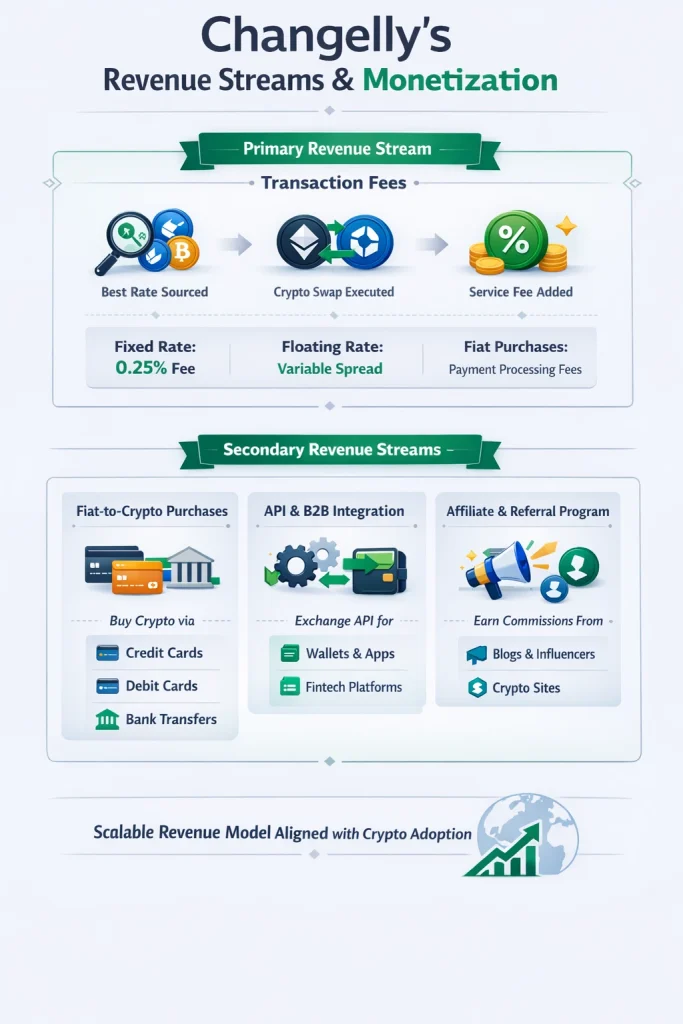
Primary Revenue Stream: Transaction Fees
The core revenue driver for Changelly is a fee charged on every cryptocurrency exchange transaction.
How It Works
When a user swaps one cryptocurrency for another:
- Changelly finds the best rate from liquidity providers.
- The platform executes the swap.
- A small service fee is added to the exchange rate.
Typical fee structure
- Fixed rate exchanges: ~0.25% fee
- Floating rate swaps: variable spread depending on liquidity
- Fiat purchases: additional processing fees through payment partners
Because millions of swaps occur annually, even small fees generate significant revenue at scale.
Why This Model Works
- Predictable revenue tied directly to transaction volume
- Scales automatically with crypto adoption
- No need to maintain complex trading infrastructure
This is similar to how payment platforms like Stripe or PayPal monetize transaction flow.
Secondary Revenue Streams
Changelly diversified its monetization strategy as the crypto ecosystem expanded.
1. Fiat-to-Crypto Purchases
Users can purchase cryptocurrency using:
- credit cards
- debit cards
- bank transfers
These transactions involve payment processor partners, who charge additional fees.
Changelly earns revenue through:
- processing markups
- partner commissions
- transaction spreads
This stream has grown rapidly as new crypto users prefer buying crypto directly with fiat currency.
2. API & B2B Integration Revenue
Changelly’s API services are embedded into many crypto wallets and fintech apps.
Partner platforms integrate the exchange feature and earn a share of transaction fees.
Revenue sources here include:
- API transaction fees
- revenue-sharing agreements
- enterprise integration contracts
This B2B model effectively turns Changelly into crypto infrastructure-as-a-service.
3. Affiliate and Referral Programs
Changelly runs one of the largest affiliate programs in the crypto exchange aggregator space.
Partners include:
- crypto blogs
- YouTube influencers
- educational platforms
- comparison websites
Affiliates promote the platform and earn a percentage of exchange fees generated by referred users.
For Changelly, this creates:
- low-cost customer acquisition
- performance-based marketing
- global reach without large ad budgets
4. Token Listing and Promotion Partnerships
Crypto projects often seek visibility and liquidity.
Changelly offers opportunities such as:
- token swap availability
- featured listings
- promotional campaigns
While not its main revenue source, this stream helps:
- increase platform activity
- strengthen relationships with blockchain projects
- diversify income sources.
Operational Model & Key Activities
Changelly’s operational model is designed for efficiency, scalability, and minimal risk, thanks to its non-custodial, API-driven architecture. The company doesn’t hold user funds, which reduces regulatory burdens, security liabilities, and operational complexity. Instead, operations focus on platform reliability, liquidity aggregation, and partner integration.
Core Operations
1. Platform Management
- Aggregates liquidity and exchange rates from multiple crypto exchanges in real-time
- Monitors for best rates and slippage to ensure optimal user experience
- Maintains uptime and speed for millions of simultaneous transactions
2. Technology Infrastructure
- Non-custodial architecture ensures funds never reside on Changelly wallets
- Cloud-based infrastructure supports global scalability
- Advanced API management for wallet and fintech integrations
- Blockchain monitoring tools to verify transactions across multiple networks
3. Quality Control & Compliance
- Anti-fraud and transaction monitoring systems
- KYC/AML compliance for fiat-to-crypto purchases
- Continuous auditing of API endpoints and partner exchanges
4. Customer Support & Education
- Multilingual support for global users
- Crypto guides and tutorials to simplify adoption
- Ticketing systems for transaction or technical issues
5. Marketing & Growth Operations
- Affiliate and referral program management
- Partnership onboarding for wallets, fintech apps, and crypto projects
- Performance tracking for acquisition campaigns
Resource Allocation
Changelly strategically allocates resources to maintain its lean operational model:
| Resource | Focus / Allocation | Strategic Purpose |
| Technology | ~40% of budget | Maintain uptime, scale API, improve swap engine |
| Marketing | ~25% | Affiliate management, partnerships, organic acquisition |
| HR & Support | ~20% | Customer service, compliance, integration support |
| R&D | ~15% | New crypto listings, API enhancements, new integrations |
| Regional Expansion | Variable | Target emerging markets and regulatory compliance |
By prioritizing technology and partnerships, Changelly maximizes impact per dollar spent, creating a high-leverage operational model.
Operational Highlights
- Non-custodial reduces risk: no major exchange hacks can drain Changelly funds
- API-first approach: allows wallet partners to scale adoption globally
- Automated liquidity sourcing: minimal manual intervention in transactions
- Global compliance focus: localized KYC/AML through partners instead of direct handling
This operational model is a key reason Changelly can process millions of transactions efficiently without expanding headcount proportionally — a classic hallmark of scalable digital platforms.
Strategic Partnerships & Ecosystem Development
Changelly’s success is not just built on technology—it’s also anchored in strategic partnerships. By positioning itself as a backend infrastructure provider, the platform creates value for wallets, exchanges, and crypto projects while simultaneously strengthening its own ecosystem.
Collaboration Philosophy
Changelly follows a partner-first approach:
- Focus on mutual value creation
- Embed services into existing crypto ecosystems rather than competing directly
- Build network effects where each integration amplifies liquidity and user engagement
- Prioritize non-custodial, low-risk collaborations to maintain operational flexibility
This philosophy allows Changelly to grow organically through its partners while keeping operational and regulatory overhead minimal.
Key Partnership Types
1. Technology & API Partners
- Crypto wallets, DeFi apps, and fintech platforms
- Provide API access for instant swaps
- Enable partners to offer white-label exchange functionality
Example: Integration with Trust Wallet or Ledger allows millions of users to swap crypto directly within the wallet interface.
2. Payment & Logistics Alliances
- Payment providers for fiat-to-crypto purchases
- Process credit card, debit card, and bank transactions globally
- Ensure seamless on-ramp for new crypto users
Example: Collaborations with Simplex or MoonPay streamline fiat-to-crypto conversion.
3. Marketing & Distribution Partners
- Affiliate networks and influencer programs
- Crypto content platforms for education and promotion
- Provide low-cost customer acquisition
Example: YouTube crypto channels and comparison websites refer users to Changelly in exchange for revenue share.
4. Regulatory & Expansion Alliances
- Local compliance advisors for KYC/AML regulations
- Legal partnerships to operate in multiple jurisdictions
- Ensure smooth entry into emerging crypto markets
Example: Regional partnerships in LATAM and Southeast Asia help navigate financial regulations.
Ecosystem Strategy Insights
- Network Effects: More wallet and exchange integrations → higher transaction volume → better liquidity → stronger ecosystem
- Monetization: API integrations and fiat partnerships create secondary revenue streams alongside transaction fees
- Competitive Moats: Strategic alliances protect market share by locking in wallet partners and liquidity providers
Changelly’s partnerships turn every collaborator into a growth engine, extending reach globally without requiring heavy direct marketing or infrastructure investment. This mirrors Miracuves’ strategy of designing scalable, partner-driven platform architectures for startups and fintech ventures.
Read more : Best Changelly Clone Script 2026: Instant Crypto Exchange Platform
Growth Strategy & Scaling Mechanisms
Changelly’s growth strategy is a blend of organic network expansion, strategic partnerships, and product innovation. Its operational design and monetization model are built to scale with minimal friction, allowing rapid geographic and market expansion.
Growth Engines
1. Organic Virality & Referral Loops
- Affiliate programs and influencer partnerships generate user-driven promotion
- Users share links to wallets or exchanges integrated with Changelly
- Each transaction creates potential for new referral-driven swaps, creating a viral loop
Impact: Low-cost, scalable user acquisition with high retention rates.
2. Paid Marketing & Acquisition Strategies
- Targeted campaigns on social media and crypto platforms
- Sponsored content and tutorials on crypto education portals
- Retargeting campaigns for users who previously attempted swaps
Objective: Convert casual crypto enthusiasts into repeat users while complementing partner-driven growth.
3. New Product Lines & Market Entries
- Expansion into fiat-to-crypto services increased accessibility for new crypto users
- Introduction of multi-chain support to cater to emerging blockchain ecosystems
- Development of API services for B2B fintech partners
This ensures that existing infrastructure drives new revenue streams without large additional investment.
4. Geographic Expansion Models
- Initially focused on regions with high crypto adoption (Europe, North America, Asia)
- Gradually entered emerging markets like LATAM, Africa, and Southeast Asia via partner wallets
- Local compliance partnerships reduce regulatory risk while enabling global scale
Example: Regional integrations allow Changelly to comply with local KYC/AML laws without directly handling sensitive user data.
Scaling Challenges & Solutions
| Challenge | How Changelly Solved It |
| Operational Complexity | Leveraged non-custodial model to avoid managing user funds and high infrastructure costs |
| Liquidity Management | Built aggregation engine sourcing multiple exchanges for best rates and redundancy |
| Regulatory Compliance | Partnered with local fintech/payment providers and legal advisors for jurisdictional compliance |
| Tech Infrastructure Limits | Adopted scalable cloud infrastructure with automated API monitoring |
| User Trust & Retention | Focused on fast, reliable swaps and educational resources to lower friction for new users |
These solutions highlight Changelly’s scalable, platform-first approach, emphasizing infrastructure that grows with volume rather than headcount.
Lessons for Entrepreneurs & Implementation
Changelly’s story offers a playbook for founders aiming to build scalable, profitable, and resilient platforms. By focusing on user experience, partnerships, and transaction-driven revenue, the company illustrates principles that are highly replicable across fintech, Web3, and marketplace ecosystems.
Key Factors Behind Changelly’s Success
- Non-custodial, risk-minimizing design
- Reduced regulatory and security burden
- Allowed rapid global scaling
- Reduced regulatory and security burden
- Platform-driven revenue model
- Transaction fees scale automatically with volume
- API integrations create secondary revenue streams
- Transaction fees scale automatically with volume
- Partner-first growth strategy
- Wallet and fintech integrations accelerate user acquisition
- Network effects enhance ecosystem stickiness
- Wallet and fintech integrations accelerate user acquisition
- Global accessibility and simplicity
- Intuitive swap process appeals to beginners
- Fiat-on-ramp and multi-chain support expand market reach
- Intuitive swap process appeals to beginners
Replicable Principles for Startups
- Build lightweight, high-leverage platforms
Focus on systems where technology and partners drive growth, not headcount. - Monetize transaction flows
Even small fees can generate substantial revenue at scale if the ecosystem is active. - Embed in existing ecosystems
Integrate via APIs to leverage the user base of established apps or wallets. - Prioritize trust and transparency
Non-custodial designs, clear fees, and fast execution build long-term credibility. - Stay agile with compliance
Partner-based or regional compliance models allow global operations without heavy internal legal overhead.
Common Mistakes to Avoid
- Trying to compete directly with large exchanges without differentiation
- Building complex custody systems too early, increasing operational risk
- Ignoring partner ecosystems, which are crucial for scale
- Over-reliance on paid marketing instead of organic referral loops
Adaptation Strategies for Local or Niche Markets
- Tailor fiat-on-ramp options to local payment methods
- Partner with regional wallets or fintech apps to accelerate adoption
- Focus on educational content for markets with low crypto familiarity
- Offer niche token swaps for specialized crypto communities
Implementation Timeline & Investment Priorities
| Phase | Focus | Investment Priority |
| Phase 1 | Build MVP & core swap engine | Technology & infrastructure |
| Phase 2 | Partner integrations (wallets, APIs) | Partnerships & API development |
| Phase 3 | User acquisition & referral programs | Marketing & education |
| Phase 4 | Geographic expansion & fiat-on-ramp | Compliance & regional partnerships |
| Phase 5 | Continuous scaling & new token support | R&D & infrastructure optimi |
“Ready to implement Changelly’s proven business model for your market? Miracuves builds scalable platforms with tested business models and growth mechanisms. We’ve served 6,000+ clients. Get your free business model consultation today.”
Conclusion
Changelly’s journey demonstrates a powerful lesson for entrepreneurs and platform builders: innovation alone isn’t enough—execution and ecosystem strategy are what create sustainable growth. By combining a user-friendly product, scalable non-custodial infrastructure, and a partner-driven expansion model, Changelly has built a resilient platform that thrives in the competitive crypto exchange market.
In 2026, as digital ecosystems become more interconnected, platforms like Changelly prove that value is created not only through products but through the networks, partnerships, and seamless integrations that surround them. For founders, the bigger takeaway is clear: design systems that scale with transaction flow, embed into broader ecosystems, and leverage network effects to create defensible market positions.
The future of platform economies is bright—and with strategies like Changelly’s, entrepreneurs can turn small ideas into global infrastructure that powers millions of transactions daily.
FAQs
1. What type of business model does Changelly use?
Changelly uses a hybrid aggregator and transaction-based model, combining instant crypto swaps, API integrations, and fiat-on-ramp services without holding user funds.
2. How does Changelly’s model create value?
It provides fast, non-custodial crypto swaps, competitive rates, and seamless wallet integrations, benefiting users, wallets, and liquidity providers alike.
3. What are its key success factors?
Key factors include non-custodial design, API-driven partnerships, network effects, and a scalable transaction-based revenue model.
4. How scalable is it?
Extremely scalable—its non-custodial architecture and API ecosystem allow global expansion without proportionally increasing operational costs.
5. What are the biggest challenges?
Challenges include regulatory compliance across regions, liquidity management, and maintaining competitive swap rates.
6. How can entrepreneurs adapt it to their region?
They can partner with local wallets, integrate fiat-on-ramp services, and comply with local KYC/AML regulations to replicate Changelly’s model.
7. What are alternatives to this model?
Alternatives include centralized exchanges (Binance, Coinbase), decentralized exchanges (Uniswap), or peer-to-peer swap platforms.
8. How has it evolved over time?
Changelly evolved from simple crypto-to-crypto swaps to a global, multi-chain platform with fiat integration and API-powered B2B services.
Miracuves is an independent software development company. We are not affiliated with, connected to, sponsored by, or endorsed by any company or product named in this article.
Terms such as “X Clone” are used descriptively. It is how the software industry refers to building a platform with functionality comparable to a known service, and how clients search for it.
The entire design and codebase of our products is built by our own team. Our products contain no code, design, graphics, or content originating from any third-party website or applications.
All third-party names and marks referenced in this article are the property of their respective owners, referenced solely to identify the services discussed.