


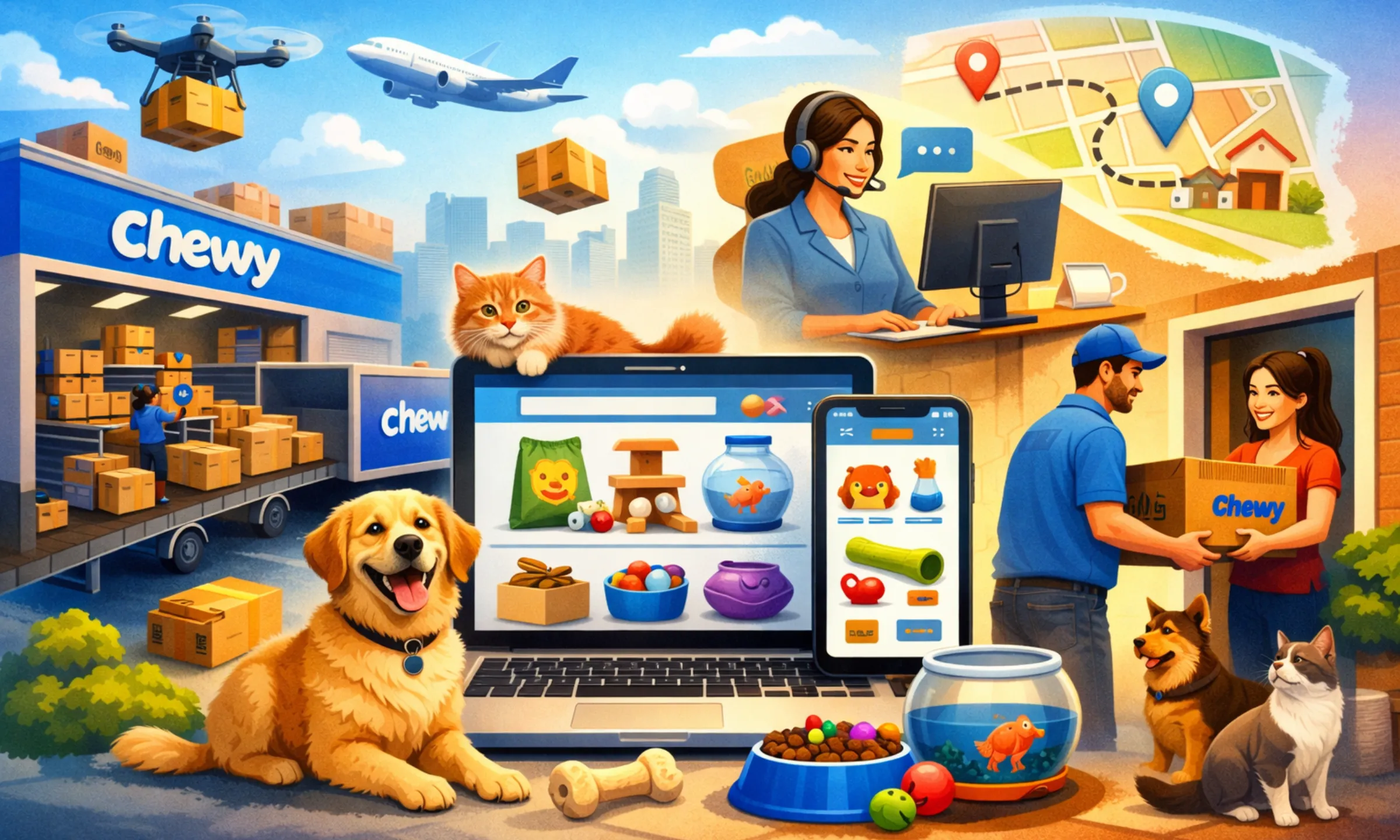
Chewy started with a simple but powerful idea: treat pet parents like family, not transactions. Founded in 2011, Chewy entered a crowded e-commerce market dominated by Amazon and big-box retailers. By obsessing over customer experience, fast delivery, and emotional brand connection, Chewy scaled into one of the most trusted digital pet platforms in the world.
Chewy crossed $11 billion in annual revenue, served over 20 million active customers, and evolved far beyond an online pet store. Today, Chewy operates as a subscription-driven, vertically integrated pet ecosystem, spanning food, supplies, pharmacy, tele-vet services, and private-label products.
What makes business model of Chewy especially relevant in 2025 is its predictable recurring revenue, high customer lifetime value, and defensive moat built on trust and convenience—a playbook that modern founders across D2C, marketplaces, and subscription platforms can learn from.
For entrepreneurs exploring e-commerce, subscription commerce, or vertical marketplaces, Chewy offers a masterclass in how emotional branding, logistics excellence, and data-driven retention can outperform price-led competition.
At Miracuves, we study models like Chewy closely because they demonstrate how scalable platforms win not by features alone—but by designing ecosystems that customers don’t want to leave.
How the Chewy Business Model Works
business model of Chewy looks like “pet e-commerce” on the surface, but the real engine is a retention-first subscription + ecosystem strategy. Instead of chasing one-time orders, Chewy designs the experience so pet parents reorder automatically, add higher-margin services over time (like pharmacy), and stay loyal because switching feels risky for their pet’s routine.
Core Framework Overview
Chewy operates as a hybrid D2C e-commerce + subscription commerce + pet health services platform:
- The storefront drives acquisition (food, treats, toys, accessories)
- Autoship turns customers into recurring revenue
- Pharmacy + health services increase trust and lifetime value
- Private-label brands improve margins and differentiation
- Content + customer experience strengthens emotional loyalty (not just discounts)
Type of Model
Chewy is primarily a:
- D2C e-commerce model (Chewy sells directly to customers)
- With a subscription layer (Autoship)
- And an expanding services layer (pharmacy + vet/telehealth offerings)
In simple terms: Commerce brings them in. Subscription keeps them. Health services and private label expand profit per customer.
Value Proposition by User Segment
1) Pet Parents (Consumers)
What they gain:
- Convenience (reorder essentials without thinking)
- Trust (reliable quality, consistent availability)
- Speed + support (fast delivery, strong customer service)
- Health access (pharmacy + care options inside the same ecosystem)
2) Brands / Manufacturers (Partners)
What they gain:
- A high-intent pet customer base
- Predictable demand from repeat purchasers
- Premium merchandising + placement opportunities
- Data-driven sell-through signals (which products stick and repeat)
3) Service Providers (Ecosystem layer)
(Pharmacy networks, vets/tele-vet infrastructure, etc.)
- Distribution + demand aggregation
- Easier customer acquisition through Chewy’s existing relationship
Key Stakeholders and Their Roles
- Customers: Drive repeat purchasing and subscription stability
- Brand partners: Supply products and co-fund promotions/visibility
- Chewy ops/logistics: Fulfillment reliability (a major retention lever)
- Care/pharmacy partners: Enable higher-trust, higher-LTV services
- Customer support teams: Strengthen loyalty and reduce churn
Chewy’s ecosystem balance depends on one thing: consistency. In pet care, inconsistency breaks trust fast.
How the Model Evolved Over Time
Chewy’s evolution is very “platform-like”:
- Phase 1: Product-led scale
- Win on assortment + dependable delivery for bulky repeat items
- Phase 2: Subscription flywheel
- Autoship becomes the retention backbone (predictable cash flows)
- Phase 3: Health + services expansion
- Pharmacy and care offerings deepen trust and increase switching costs
- Phase 4: Margin + differentiation
- More focus on private label, personalization, and owned customer relationships
Why Chewy’s Model Works in 2025
Chewy aligns perfectly with 2025 consumer behavior:
- People want predictability (subscriptions for essentials)
- They value trust more than endless choice (especially for pets)
- Pet spending remains emotionally protected even when budgets tighten
- Convenience beats discounts when the “user” is a pet with routines
Chewy’s true moat is not just logistics—it’s habit + trust + recurring purchase behavior.
Read more : What is Chewy and How Does It Work?
Target Market & Customer Segmentation Strategy
Chewy doesn’t target “everyone with a pet.” It targets pet parents with recurring needs and emotional attachment—a much more valuable and predictable customer base. This focus allows Chewy to optimize for lifetime value, not one-time order size, which is why its economics work at scale.
Primary Customer Segments
1) Core Segment: High-Frequency Pet Parents
- Dog and cat owners with routine monthly needs (food, treats, litter, meds)
- Urban and suburban households
- Mid to upper-income brackets
- Behavior: repeat purchasing, subscription-friendly, low price sensitivity once trust is built
Why this segment matters
This group drives the majority of Chewy’s revenue and subscription volume. Their pets have non-negotiable routines, making churn expensive emotionally and practically.
2) Secondary Segment: Health-Focused Pet Owners
- Customers using prescription food, medications, supplements
- Long-term condition management (allergies, arthritis, chronic care)
- Higher trust requirement, lower churn probability
Why this segment matters
Pharmacy customers have:
- Higher order frequency
- Longer retention cycles
- Strong switching barriers once prescriptions and vet relationships are embedded
3) Emerging Segment: New & First-Time Pet Owners
- Younger demographics (Gen Z, younger millennials)
- First-time adoption surge post-pandemic
- Still exploring brands, but open to guidance and bundles
Chewy captures this group early using:
- Starter kits
- Educational content
- Autoship onboarding incentives
Customer Journey: From Discovery to Long-Term Retention
1) Discovery
- Organic search (“best dog food for allergies”)
- Paid search and shopping ads
- Referrals and word-of-mouth
- Brand trust built through reviews and service reputation
2) Conversion
- Competitive pricing on first order
- Easy UX for large/bulky items
- Clear Autoship incentives at checkout
3) Retention
- Autoship reminders and flexible scheduling
- Fast, reliable fulfillment
- Proactive customer support
- Personalized recommendations based on pet profile
4) Expansion
- Add pharmacy and health products
- Introduce private-label alternatives
- Cross-sell toys, supplements, and seasonal items
Acquisition Channels & LTV Optimization
Chewy doesn’t just acquire customers—it locks in behavior.
Key channels:
- SEO and intent-driven paid search (high buyer readiness)
- Subscription-first onboarding
- Email + in-app lifecycle marketing
- CRM personalization by pet type, age, and health needs
Lifetime value is optimized by:
- Increasing Autoship adoption
- Reducing fulfillment friction
- Expanding into higher-trust categories like health and pharmacy
Market Positioning & Competitive Edge
Chewy positions itself as:
“The most reliable digital partner in your pet’s life.”
Its differentiation comes from:
- Emotional branding + human support
- Reliability over discounts
- Category depth instead of generalist breadth
- Strong brand recall in pet-only commerce
While Amazon may win on speed and price, Chewy wins on trust, habit, and specialization—three things that are extremely hard to displace once established.
Revenue Streams and Monetization Design
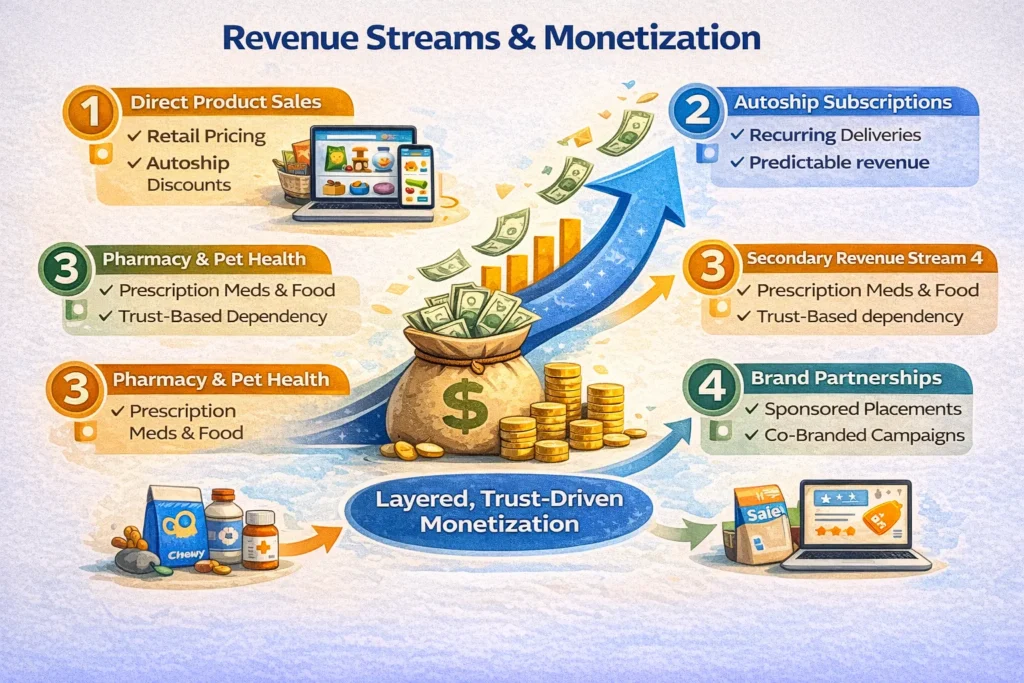
Once Chewy secured repeat behavior through trust and Autoship, monetization became a layered architecture, not a single revenue lever. Chewy’s strength is that most revenue streams reinforce each other—driving both top-line growth and predictability.
Primary Revenue Stream 1: Direct Product Sales (Core Engine)
Mechanism
Chewy sells pet food, treats, toys, accessories, and supplies directly to consumers through its platform.
Pricing Model
- Retail pricing with competitive parity
- Category-based margin control
- Subscription-linked discounts via Autoship
Revenue Contribution
- Largest share of Chewy’s total revenue
- Heavily skewed toward consumables with high repeat rates
Growth Trajectory
- Shift toward higher-frequency consumables
- Optimization of assortment to reduce low-turnover SKUs
- Increased personalization to boost cart size
This stream works because Chewy doesn’t depend on impulse—it depends on routine.
Primary Revenue Stream 2: Autoship Subscriptions (Retention & Predictability Layer)
Mechanism
Autoship allows customers to schedule recurring deliveries with flexible timing and quantity.
Pricing Model
- Percentage discount for subscribers
- No lock-in contracts (psychological trust lever)
Revenue Contribution
- Over 75% of total sales now come from Autoship customers
- Drives stable cash flow and demand forecasting accuracy
Growth Trajectory
- Deeper Autoship penetration per household
- Bundled subscriptions across food + litter + health items
Autoship is not just a discount program—it’s Chewy’s economic backbone.
Secondary Revenue Stream 3: Pharmacy & Pet Health Services (LTV Multiplier)
Mechanism
- Prescription medications
- Prescription food
- Ongoing health supplies
Why It Matters
- Higher margins than general merchandise
- Strong switching costs due to prescriptions
- Long-term recurring usage
Growth Direction
- Expansion into tele-vet and care-related services
- Deeper integration into customer pet profiles
This stream increases trust-based dependency, not just spend.
Secondary Revenue Stream 4: Private-Label Brands (Margin Expansion Layer)
Mechanism
- Chewy-owned brands across food, treats, and accessories
- Exclusively available on the platform
Pricing Model
- Competitive pricing with higher gross margins
- Positioned as trusted alternatives to national brands
Strategic Value
- Margin control
- Reduced reliance on third-party brands
- Strong differentiation vs generalist e-commerce platforms
Secondary Revenue Stream 5: Brand Partnerships & Promotions
Mechanism
- Sponsored placements
- Promotional campaigns
- Co-branded initiatives
Why It Works
- Brands pay for visibility inside a high-intent environment
- Chewy monetizes attention without degrading trust
Monetization Strategy: How It All Connects
Chewy’s monetization works because:
- Product sales drive subscriptions
- Subscriptions drive predictability
- Predictability enables health and private-label expansion
- Higher LTV funds better service and logistics
Pricing psychology is centered on:
- Low friction entry
- Emotional reassurance
- Habit formation over short-term profit
This is a textbook example of value-first monetization, where revenue grows because the customer relationship deepens.
Operational Model & Key Activities
Chewy’s business model works only because its operations are built for scale, consistency, and reliability. In pet care, operational failure doesn’t just lose a sale—it breaks trust. That’s why Chewy treats operations as a strategic advantage, not a cost center.
Core Operational Pillars
1) Platform & Technology Management
- Scalable e-commerce infrastructure
- Personalization engines based on pet profiles
- Subscription scheduling and inventory forecasting systems
- CRM systems tightly integrated with customer support
Technology ensures that recurring orders happen without friction or surprises.
2) Fulfillment & Logistics Operations
- Distributed fulfillment centers across the US
- Heavy-item optimization (pet food, litter)
- Data-driven demand planning via Autoship signals
Chewy’s logistics are optimized for:
- Predictability over speed
- Cost efficiency on bulky shipments
- Reliability in delivery windows
3) Customer Experience & Support
- 24/7 customer support teams
- Proactive issue resolution
- Human-centered service culture
Chewy is known for unexpected delight—refunds, handwritten notes, sympathy gestures—creating emotional loyalty that algorithms alone can’t replicate.
4) Quality Control & Vendor Management
- Product quality assurance
- Supplier performance monitoring
- Category curation to reduce low-value SKUs
This keeps the assortment focused, not bloated.
Resource Allocation Strategy (2024–2025)
Chewy’s investment priorities reflect its retention-led model:
- Technology & Platform Development: ~20–25%
Focus on scalability, personalization, and forecasting - Fulfillment & Operations: ~35–40%
Warehousing, logistics optimization, automation - Marketing & Growth: ~15–20%
Performance marketing, lifecycle campaigns, onboarding - Customer Support & CX: ~10–15%
Service teams, training, experience programs - R&D & New Services: ~5–10%
Health services, tele-vet, ecosystem expansion
Regional Expansion & Scalability
Chewy scales by:
- Densifying fulfillment coverage
- Using subscription data to plan regional demand
- Avoiding over-expansion into markets without logistics efficiency
This disciplined approach protects margins while expanding reach.
Chewy’s operational excellence allows it to promise reliability—and actually deliver it, which is rare in e-commerce at scale.
Strategic Partnerships & Ecosystem Development
Chewy understands that long-term dominance in pet care cannot be built alone. Instead of trying to own every capability internally, Chewy uses strategic partnerships to expand its ecosystem while staying focused on what it does best: customer trust, logistics, and platform experience.
Chewy’s Partnership Philosophy
Chewy partners where:
- Speed-to-market matters more than ownership
- Trust and compliance are critical (especially in health)
- Partners can add value without diluting the customer relationship
The goal is not dependency—but ecosystem leverage
Key Partnership Types
1) Technology & API Partners
- E-commerce infrastructure providers
- Data analytics and personalization tools
- CRM and customer engagement platforms
These partnerships help Chewy scale personalization, forecasting, and subscription management without rebuilding everything in-house.
2) Payment & Financial Service Partners
- Secure payment gateways
- Buy-now-pay-later providers
- Subscription billing infrastructure
Smooth payments reduce churn, especially in recurring purchases.
3) Pharmacy, Vet & Health Alliances
- Licensed pharmacy networks
- Prescription verification partners
- Tele-vet service providers
These partnerships allow Chewy to enter regulated, high-trust categories faster while maintaining compliance and credibility.
4) Logistics & Distribution Partners
- Last-mile carriers
- Regional distribution specialists
- Packaging and supply-chain optimization vendors
This helps Chewy maintain delivery reliability during peak demand and regional expansion.
5) Brand & Manufacturing Partnerships
- Exclusive product launches
- Co-branded promotions
- Data-sharing agreements for demand planning
Brands benefit from Chewy’s repeat customer base; Chewy benefits from stable supply and better margins.
Ecosystem Strategy: Why Partnerships Create a Moat
Chewy’s ecosystem advantages:
- Network effects: More customers → better partners → better experience
- Data flywheel: Subscription data improves planning for all partners
- Monetization leverage: Sponsored visibility without breaking trust
- Defensive positioning: Partners are less likely to support competitors deeply
By embedding partners into its platform, Chewy makes itself harder to replace in the pet commerce value chain.
Growth Strategy & Scaling Mechanisms
Chewy’s growth is not driven by viral gimmicks or deep discount wars. Instead, it scales through behavioral lock-in, category expansion, and operational discipline—a strategy that compounds over time and holds up even in volatile markets.
Primary Growth Engines
1) Organic Retention & Habit Formation
- Autoship creates predictable, recurring usage
- Flexible schedules reduce subscription fatigue
- High service reliability lowers churn
Chewy grows by keeping customers, not endlessly replacing them.
2) Referral & Word-of-Mouth Flywheel
- Emotional brand moments create organic advocacy
- High Net Promoter Scores (NPS) drive referrals
- Trust-driven recommendations outperform ads in pet care
This is slow—but extremely durable—growth.
3) Paid Acquisition with High Intent
- Search-driven ads for problem-specific queries
- Category-level campaigns (food, pharmacy, health)
- Focus on lifetime value, not first-order margin
Chewy only scales paid channels where repeat behavior is proven.
4) Product & Category Expansion
- From food → health → services
- Entry into prescription and care-based products
- Expansion of private-label categories
Each expansion increases customer dependency without increasing acquisition cost.
5) Geographic Scaling Model
- Fulfillment density before aggressive marketing
- Regional demand forecasting using Autoship data
- Controlled rollout to protect service quality
Scaling Challenges & How Chewy Solved Them
Challenge 1: Margin Pressure from Shipping Heavy Items
- Solution: Autoship-based forecasting and bulk optimization
Challenge 2: Rising Customer Acquisition Costs
- Solution: Shift focus to retention and LTV expansion
Challenge 3: Regulatory Complexity in Health Services
- Solution: Partner-first approach with licensed providers
Challenge 4: Operational Complexity at Scale
- Solution: Automation, data-driven inventory, and SKU discipline
Chewy’s growth strategy proves that slow, predictable scaling often outperforms aggressive expansion—especially in trust-sensitive industries.
Competitive Strategy & Market Defense
Chewy operates in a market where competitors can copy prices, products, and even logistics. What they cannot easily copy is trust built through consistency and emotional connection. Chewy’s competitive strategy is designed to defend market share by making switching uncomfortable, not by blocking access.
Core Competitive Advantages
1) Subscription Lock-In via Autoship
- Recurring orders reduce decision fatigue
- Predictable routines increase switching costs
- Flexible terms prevent subscription resentment
Once a pet’s routine is tied to Chewy, alternatives feel risky.
2) Brand Equity & Emotional Loyalty
- Human-first customer support
- Surprise-and-delight gestures
- Strong brand recall in pet-only commerce
Chewy is perceived as a care partner, not a retailer.
3) Category Specialization vs Generalists
- Deep assortment in pet-only categories
- Expertise-driven recommendations
- Better content and guidance than general marketplaces
This specialization beats horizontal platforms on trust.
4) Data-Driven Personalization
- Pet-specific profiles (age, breed, health needs)
- Autoship-driven demand prediction
- Smarter cross-sell and replenishment timing
Data strengthens retention without aggressive selling.
5) Compliance & Health Infrastructure
- Regulated pharmacy operations
- Vet-aligned workflows
- Strong privacy and prescription controls
This creates barriers to entry in high-value categories.
Market Defense Tactics
Handling New Entrants
- Focus on service reliability instead of price wars
- Increase subscription penetration rather than discounts
Defending Against Amazon
- Compete on specialization and service, not speed alone
- Own the emotional relationship with pet parents
Strategic Feature Timing
- Roll out health services only when trust is established
- Avoid premature expansion that could harm reliability
Acquisition & Partnership Moves
- Partner instead of acquiring where regulation is heavy
- Strengthen ecosystem rather than fragment it
Chewy’s defense strategy shows that the strongest moat in e-commerce is not technology—it’s habit, trust, and emotional cost of switching.
Read more : Best Chewy Clone Script 2025: Build a Pet-Care Ecommerce Empire
Lessons for Entrepreneurs & Implementation
This is where Chewy’s story becomes most valuable for founders. Chewy didn’t win by inventing new technology—it won by designing behavior, trust, and repetition into the business model. That makes its lessons highly transferable across industries.
Key Factors Behind Chewy’s Success
- Retention beats acquisition
Chewy optimized for lifetime value before chasing growth. Autoship was not an add-on—it was the foundation. - Trust compounds faster than discounts
In pet care, reliability matters more than price. Chewy invested in service, not promotions. - Ecosystem thinking increases defensibility
Commerce led to subscriptions, which led to health, which led to switching costs. - Operations are strategy
Logistics, customer support, and forecasting were treated as core competencies.
Replicable Principles for Startups
Founders can adapt Chewy’s model by:
- Building subscription into essential use cases
- Designing habit loops around real-world routines
- Expanding into higher-trust services only after credibility is earned
- Using data to personalize timing, not just recommendations
Common Mistakes to Avoid
- Chasing growth before retention stabilizes
- Over-discounting in recurring categories
- Expanding into regulated services without partners
- Treating customer support as a cost center
Adapting the Model for Local or Niche Markets
Chewy’s framework works well for:
- Pet care startups in emerging markets
- Niche vertical commerce platforms
- Health-adjacent subscription businesses
Local adaptations may include:
- Smaller order sizes
- Regional fulfillment partners
- Local vet or pharmacy tie-ups
Ready to implement Chewy’s proven business model for your market?
Miracuves builds scalable platforms with tested business models and growth mechanisms. We’ve helped 200+ entrepreneurs launch profitable apps and digital platforms.
Get your free business model consultation today.
Conclusion :
Chewy’s journey proves that the most powerful business models are not built on speed or scale alone—but on consistency, empathy, and execution. In an industry where the “customer” cannot speak for itself, Chewy became the trusted proxy by removing anxiety from everyday decisions.
The company didn’t try to out-Amazon Amazon. Instead, it out-cared competitors by embedding itself into the daily rhythm of pet life. That decision shaped everything—from Autoship to pharmacy services to customer support culture—and turned a transactional e-commerce site into a long-term relationship platform.
As platform economies evolve in 2025 and beyond, Chewy stands as evidence that vertical focus + recurring behavior + emotional trust can create durable growth even in highly competitive markets. The future of scalable platforms belongs to businesses that design for habit and heart—not just clicks.
FAQ :
What type of business model does Chewy use?
Chewy operates a hybrid D2C e-commerce and subscription business model. It combines direct product sales with a strong recurring revenue layer through Autoship, supported by pet health and pharmacy services.
How does Chewy’s business model create value?
Chewy creates value by removing friction from pet ownership. It ensures reliable access to essential supplies, automates repeat purchases, offers trusted health services, and delivers high-touch customer support that builds long-term loyalty.
What are Chewy’s key success factors?
Recurring revenue via Autoship and strong customer loyalty drive Chewy’s success. Operational excellence and emotional branding create high switching costs.
How scalable is Chewy’s business model?
Chewy’s model is highly scalable because demand is predictable. Autoship data improves inventory planning, reduces waste, and allows regional expansion without proportionally increasing acquisition costs.
What are the biggest challenges Chewy faces?
Key challenges include shipping cost pressure and regulatory complexity in pet health. Chewy offsets these through forecasting, partnerships, and service differentiation.
How can entrepreneurs adapt Chewy’s model to their region?
Entrepreneurs can target essential repeat-use categories with subscriptions. Local logistics partners and phased service expansion improve viability.
What are alternatives to Chewy’s model?
Alternatives include pet marketplaces, subscription boxes, or local aggregators. Each offers faster entry but weaker long-term retention than Chewy’s model.
How has Chewy’s business model evolved over time?
Chewy evolved from a product-led e-commerce store to a subscription-first ecosystem, then expanded into pharmacy and health services, increasing retention and defensibility over time.
Related Article :