
Key Takeaways
What You’ll Learn
- Mint’s business model focused on helping users manage budgets, spending, bills, and financial goals.
- The platform grew by offering free personal finance tools with simple account tracking.
- Revenue came through referrals, financial product recommendations, ads, and partnerships.
- User trust, data security, and personalized insights were key parts of its growth.
- Mint showed how fintech apps can grow by solving everyday money management problems.
Stats That Matter
- Mint became popular by giving users a free way to track spending, budgets, credit, and bills.
- Its revenue model used financial product referrals, credit card offers, loan recommendations, and advertising.
- Personalized recommendations helped connect users with relevant financial products.
- The platform served users looking for budgeting, expense tracking, credit monitoring, and financial planning support.
- Its model shows how fintech platforms can monetize without charging users directly.
Real Insights
- Mint grew because it simplified personal finance, not because it only displayed data.
- Free access helped attract users while referrals created revenue opportunities.
- Trust and security are essential when users connect bank and financial accounts.
- Personalized insights make finance apps more useful and engaging.
- The strongest fintech platforms combine simple UX, secure data handling, smart recommendations, and clear monetization.
Personal finance apps have transformed how people manage money, track spending, and make smarter financial decisions. Among the most recognized platforms in this space, Mint became a major fintech case study by offering free budgeting tools, expense tracking, bill reminders, and personalized financial insights through one centralized platform.
The success of Mint was not just about features; it was built on a smart freemium model, data-driven personalization, and strategic financial partnerships. For fintech startups in 2026, Mint offers valuable lessons on user acquisition, engagement, monetization, and trust-building.
At Miracuves, we help founders understand these proven fintech models and build scalable personal finance apps with secure dashboards, budgeting tools, bank integration, analytics, and revenue-ready platform architecture.
In this article, we’ll break down the Mint business model, revenue streams, growth strategy, and key lessons entrepreneurs can use when building modern fintech applications.
How the Mint Business Model Works
Mint operates on a freemium, data-driven financial marketplace model — where users access powerful financial tools for free, while the platform monetizes through targeted financial product recommendations and partnerships.
At its core, Mint acts as a financial aggregator + recommendation engine, connecting users with banks, credit products, and financial services.
Core Business Model Breakdown
1. Type of Model
Mint uses a Hybrid Model:
- Freemium → Free access to budgeting and tracking tools
- Marketplace → Connects users with financial products
- Data-driven recommendation engine → Monetizes insights
2. Value Proposition
Mint creates value for multiple stakeholders:
For Users (Consumers):
- Free budgeting and expense tracking
- Real-time financial visibility across accounts
- Personalized insights and savings recommendations
- Credit score monitoring and alerts
For Financial Institutions (Partners):
- Access to highly qualified, intent-driven users
- Customer acquisition at lower cost
- Data-backed targeting for better conversion
For Advertisers/Service Providers:
- Precision targeting based on financial behavior
- High ROI due to contextual recommendations
3. Key Stakeholders
Mint’s ecosystem thrives on balance between:
- Users → Provide financial data + engagement
- Banks & Fintech Companies → Offer products
- Credit Providers & Insurers → Monetization partners
- Intuit Ecosystem → Cross-product integration (TurboTax, QuickBooks)
This creates a three-sided marketplace, where data flows continuously between users and providers.
4. Evolution of the Model
Mint’s model has evolved significantly:
- 2006–2010: Free budgeting tool focused on user acquisition
- 2010–2018: Monetization via financial product referrals
- 2018–2023: Deep integration with Intuit ecosystem
- 2024–2026: Shift toward AI-driven financial insights and embedded finance
This evolution reflects a broader fintech trend:
Moving from tools → platforms → intelligent financial assistants
5. Why It Works in 2026
Mint’s model aligns perfectly with modern consumer behavior:
- Users expect free, high-value digital tools
- Financial decisions are increasingly data-driven
- Trust in AI-powered recommendations is growing
- Consumers prefer centralized financial dashboards
Most importantly, Mint capitalizes on:
High-intent financial moments (loans, credit cards, investments)
This makes its monetization highly efficient.
Read : What Is Mint App and How Does It Work?
Target Market & Customer Segmentation Strategy
Mint’s success is deeply rooted in its ability to understand financial behavior at a granular level and tailor its experience to different user needs — from students managing expenses to professionals optimizing wealth.
Primary & Secondary Customer Segments
Primary Segment: Digital-First Individuals (Ages 22–45)
- Urban professionals, freelancers, and young families
- Comfortable with fintech and mobile apps
- Seeking budgeting, saving, and financial planning tools
Behavior Traits:
- Track expenses regularly
- Compare financial products before decisions
- Value automation and insights
Secondary Segment: Financially Emerging Users
- Students and early earners
- First-time credit users
- Individuals building financial literacy
Why They Stay:
- Simplicity of UI
- Free access to premium-like tools
- Education through insights
Tertiary Segment: Credit & Loan Seekers
- Users actively looking for:
- Credit cards
- Personal loans
- Insurance
- High monetization potential for Mint
Customer Journey Mapping
Mint’s growth engine lies in a well-optimized lifecycle:
1. Discovery
- App stores (organic search)
- Content marketing (financial blogs, SEO)
- Word-of-mouth referrals
2. Onboarding
- Easy bank account integration
- Instant dashboard visualization
- Quick wins (spending insights, alerts)
3. Engagement
- Daily/weekly financial updates
- Alerts for unusual spending
- Goal tracking (saving, debt reduction)
4. Conversion (Monetization Moment)
- Personalized financial recommendations
- Contextual offers (credit cards, loans)
- “Pre-qualified” product suggestions
5. Retention
- Habit formation through tracking
- Continuous value via insights
- Increasing switching cost due to data aggregation
Revenue Streams and Monetization Design
Now comes the most fascinating part of Mint’s business model:
How a completely free app generates millions in revenue.
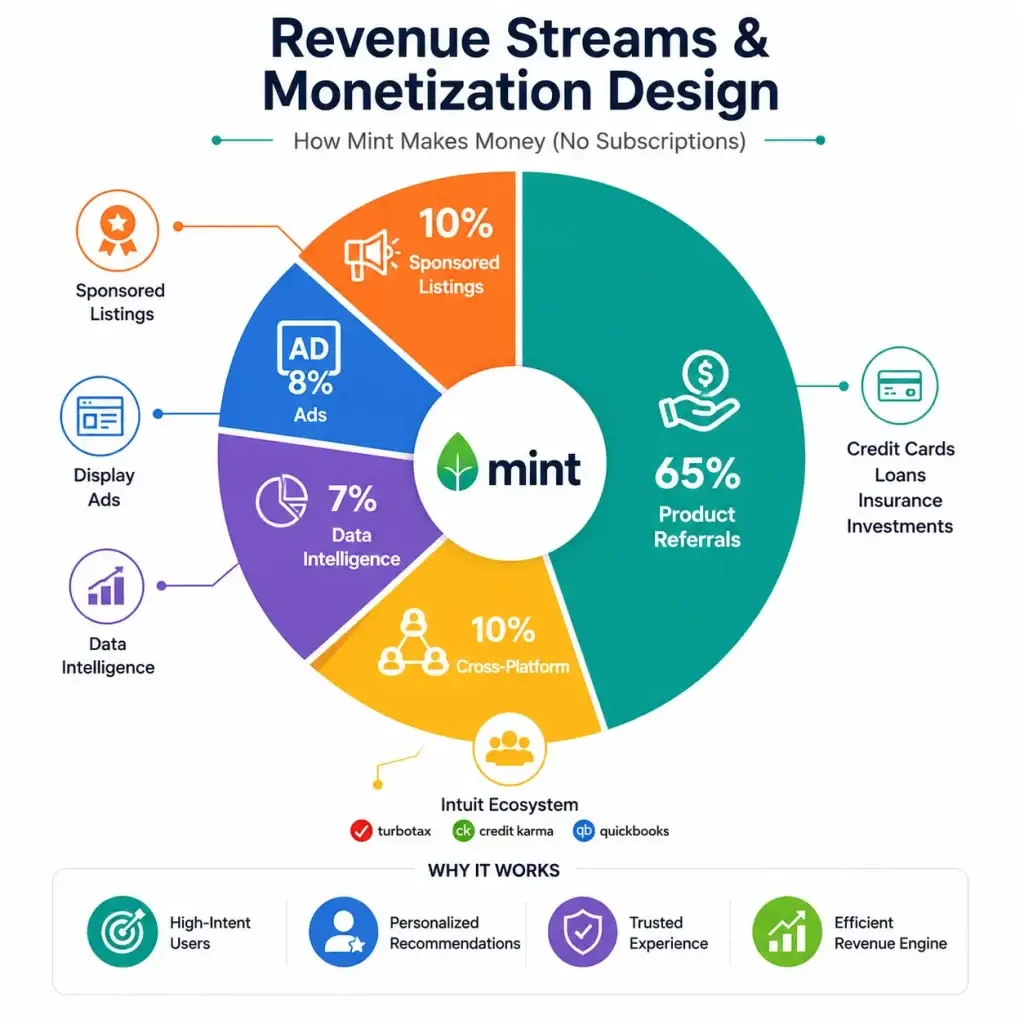
Business model of Mint monetization is not based on subscriptions — it’s built on intent-driven financial recommendations and partnerships, making it one of the most efficient fintech revenue engines.
Primary Revenue Stream
1. Financial Product Referrals (Core Engine)
This is Mint’s dominant revenue driver.
How it works:
- Mint analyzes user financial data (spending, credit score, behavior)
- It recommends relevant financial products:
- Credit cards
- Loans
- Insurance
- Investment tools
Revenue Model:
- Cost-per-acquisition (CPA) or cost-per-click (CPC)
- Partners pay when users sign up or engage
Contribution:
- Accounts for 60–75% of total revenue (industry estimates)
Why it’s powerful:
- High-intent users → higher conversion rates
- Personalized recommendations → better ROI for partners
Secondary Revenue Streams
2. Sponsored Financial Listings
- Financial institutions pay for priority placement
- Appears as “recommended” or “featured” products
Blends seamlessly into user experience
3. Display Advertising (Limited but Strategic)
- Contextual ads inside the app/dashboard
- Focus on financial services only (to maintain relevance & trust)
Unlike traditional apps, Mint avoids ad overload
4. Data Intelligence (Indirect Value)
- Aggregated, anonymized data insights
- Used internally by Intuit for:
- Product development
- Market insights
- Cross-selling (TurboTax, Credit Karma, etc.)
Data becomes a strategic asset, not just a revenue stream
5. Cross-Platform Monetization (Intuit Ecosystem)
Mint feeds users into:
- TurboTax (tax filing)
- Credit Karma (credit marketplace)
- QuickBooks (for freelancers/business owners)
Operational Model & Key Activities
Behind Mint’s seamless user experience lies a highly sophisticated operational engine — one that balances data aggregation, security, personalization, and platform reliability at scale.
Mint isn’t just an app — it’s a real-time financial data processing system.
Core Operations
Mint’s day-to-day operations revolve around maintaining trust, accuracy, and performance:
- Platform Management
- Continuous syncing with thousands of financial institutions
- Dashboard updates in real-time
- Bug fixes and UX improvements
- Data Aggregation & Processing
- Secure APIs to pull banking and transaction data
- Categorization algorithms for spending insights
- AI models for predictive financial recommendations
- Security & Compliance
- Bank-level encryption
- Regulatory compliance (GDPR, financial data laws)
- Fraud detection and anomaly monitoring
- Customer Support
- Issue resolution (account sync, data errors)
- Financial guidance support
- Trust-building through transparency
- Marketing Operations
- Performance marketing campaigns
- SEO-driven content strategy
- Partner promotions and lifecycle marketing
Strategic Partnerships & Ecosystem Development
Mint’s growth and sustainability are heavily driven by its strategic partnerships, which transform it from a simple app into a financial ecosystem hub.
Rather than building everything internally, Mint leverages partnerships to expand capabilities, improve data accuracy, and unlock monetization opportunities.
Collaboration Philosophy
Mint follows a platform-first approach:
“Connect, don’t compete.”
Instead of replacing financial institutions, Mint integrates with them — creating a win-win ecosystem where:
- Users get better financial visibility
- Partners get qualified customers
- Mint earns through intelligent matchmaking
Key Partnership Types
1. Technology & API Partners
- Integration with banking APIs and aggregators (like Plaid-style systems)
- Cloud providers for scalability and performance
- AI/ML tools for financial insights
Enables seamless real-time data syncing
2. Payment & Financial Institutions
- Banks, credit card companies, lenders
- Insurance providers and investment platforms
Role:
- Provide financial products
- Pay Mint for customer acquisition
Core to Mint’s monetization engine
3. Marketing & Distribution Partners
- Content platforms and financial blogs
- App store ecosystems
- Affiliate networks
Drive user acquisition and brand visibility
4. Intuit Ecosystem Integration
One of Mint’s biggest strategic advantages:
- TurboTax → Tax filing integration
- Credit Karma → Credit monitoring + marketplace
- QuickBooks → Small business finance
Creates a closed-loop financial ecosystem
5. Regulatory & Expansion Alliances
- Compliance partnerships with financial authorities
- Regional banking integrations for market entry
Essential for scaling across geographies
Growth Strategy & Scaling Mechanisms
Mint’s rise wasn’t driven by heavy advertising — it was fueled by product-led growth, trust, and intelligent scaling strategies.
Its growth engine is a combination of organic adoption, ecosystem leverage, and continuous product evolution.
Growth Engines
1. Organic Virality & Referral Loops
Mint grows naturally because:
- Users talk about financial wins (saving money, reducing debt)
- Budgeting tools become part of daily life
- Word-of-mouth spreads through trust
Example:
- Users sharing savings insights or credit improvements indirectly promote Mint
Financial success stories become marketing
2. Product-Led Growth (PLG)
Mint’s biggest acquisition tool is its free value proposition:
- No cost → low barrier to entry
- Instant value → high activation rate
- Continuous insights → long-term retention
The product markets itself
3. Content & SEO Strategy
Mint dominates search with:
- Budgeting guides
- Financial planning content
- Credit score education
Result:
- Millions of organic visitors
- High-intent users entering the funnel
4. Ecosystem Expansion (Intuit Flywheel)
Mint leverages Intuit’s ecosystem:
- Cross-promotion with TurboTax and Credit Karma
- Shared user data for personalization
- Unified financial journey across products
This creates a multi-product growth look
5. New Features & AI Integration (2024–2026)
To stay competitive, Mint evolved:
- AI-powered financial insights
- Predictive expense tracking
- Smart alerts and recommendations
Transitioning from tool → financial assistant
6. Geographic & Segment Expansion
- Expansion into digitally mature markets
- Targeting freelancers and gig workers
- Localization of financial advice
Competitive Strategy & Market Defense
Mint operates in one of the most competitive fintech segments — personal finance management — where dozens of apps compete on features, UX, and pricing. Yet, Mint has maintained relevance through strategic advantages and strong defensive mechanisms.
Core Competitive Advantages
1. Network Effects Through Data
- More users → more financial data → better insights
- Better insights → higher engagement and retention
Competitors struggle to match this data depth advantage
2. Zero-Cost Barrier (Freemium Dominance)
- Mint is free, unlike competitors like YNAB (subscription-based)
Impact:
- Faster user acquisition
- Wider market reach
- Lower churn due to no financial commitment
3. Brand Trust & Legacy (Intuit Backing)
- Backed by Intuit — a trusted financial software giant
- Strong credibility in handling sensitive financial data
Trust becomes a competitive moat in fintech
4. Ecosystem Integration
- Seamless connection with:
- TurboTax
- Credit Karma
- QuickBooks
Competitors often operate in silos, while Mint operates in a connected ecosystem
5. Simplicity Over Complexity
- Clean UI vs feature-heavy competitors
- Easy onboarding and automation
Appeals to mass-market users, not just finance enthusiasts
6. Data-Driven Personalization
- Tailored recommendations based on real financial behavior
- AI-driven insights improving over time
Creates high switching costs
Market Defense Strategies
1. Handling New Entrants
- Focus on mass accessibility (free model)
- Continuous feature updates to stay relevant
- Leveraging brand trust to retain users
2. Pricing Wars Avoidance
- Mint avoids direct pricing competition by staying free
- Monetizes indirectly through partnerships
Competitors can’t easily undercut “free”
3. Strategic Feature Rollouts
- Introduces features based on user demand:
- Credit score tracking
- Investment insights
- AI financial coaching
Ensures relevance without overcomplicating UX
4. Acquisition & Ecosystem Defense
- Integration into Intuit ecosystem reduces churn
- Users embedded across multiple products
Creates platform lock-in
Raed more : Best Mint Clone Scripts 2026
Lessons for Entrepreneurs & Implementation
Mint’s journey offers more than just inspiration — it provides a practical blueprint for entrepreneurs looking to build scalable, data-driven platforms in fintech or beyond.
Let’s break this down like a mentor guiding a founder building the next Mint.
Key Factors Behind Mint’s Success
Mint didn’t win by accident — it executed a few critical strategies exceptionally well:
- Free-first strategy
- Removed friction from adoption
- Built massive user base quickly
- Data as a core asset
- Turned user financial data into actionable insights
- Used data to power monetization
- Trust-centric design
- Security and transparency were non-negotiable
- Built credibility through Intuit backing
- Timing-based monetization
- Monetized when users needed financial products
- Avoided aggressive advertising
Replicable Principles for Startups
Entrepreneurs can apply Mint’s model across industries:
1. Solve a Real, Recurring Problem
- Mint solved everyday financial confusion
- Your product should address a daily or frequent pain point
2. Offer Immediate Value (Fast Activation)
- Users saw value within minutes of onboarding
Build products that deliver quick wins
3. Monetize User Intent, Not Just Usage
- Mint earns when users make financial decisions
Identify high-intent moments in your platform
4. Leverage Data for Personalization
- Insights become your differentiation
Build systems that learn and adapt continuously
5. Create an Ecosystem, Not Just a Product
- Mint integrates with multiple services
Think beyond your app — think platform
Implementation Roadmap
Phase 1: Foundation
- Build core product (budgeting / tracking / core value)
- Focus on UX and onboarding
- Ensure strong security architecture
Phase 2: Growth
- Scale user acquisition (SEO, referrals)
- Introduce data analytics and insights
- Begin partnerships with financial providers
Phase 3: Monetization
- Launch recommendation engine
- Add contextual monetization
- Optimize conversion funnels
Phase 4: Expansion
- Integrate ecosystem services
- Add AI-driven personalization
- Expand geographically
Ready to implement Mint’s proven business model for your market?
Miracuves builds scalable platforms with tested business models and growth mechanisms. We’ve served 6,000+ clients.
Get your free business model consultation today and turn your idea into a high-growth digital platform.
Conclusion
Mint’s journey proves a timeless truth in digital business: When you combine real user value with intelligent monetization, scale becomes inevitable.
From a simple budgeting tool to a data-powered fintech platform, Mint didn’t just build features — it built a financial decision engine. Its success lies in understanding that users don’t just want tools; they want clarity, control, and confidence over their money.
By leveraging: A free-first growth strategy ,Data-driven personalization ,Ecosystem integration ,Trust as a foundation
Mint created a model that is not only profitable but also highly defensible and scalable.
For entrepreneurs and builders, especially those working with Miracuves, the bigger lesson is clear.The future belongs to platforms that blend technology, data, and user-centric design into seamless experiences.
FAQs
What type of business model does Mint use?
Mint uses a freemium + marketplace model, offering free financial tools while earning through referrals and partnerships with financial institutions.
How does Mint’s model create value?
It aggregates financial data to provide insights for users and connects them with relevant financial products, creating value for both users and partners.
What are its key success factors?
Key factors include free access, strong user trust, data-driven personalization, and timing-based monetization through high-intent financial recommendations.
How scalable is it?
Highly scalable due to its digital infrastructure, automation, and data-driven model, allowing expansion without significant marginal cost increases.
What are the biggest challenges?
Maintaining data security, user trust, regulatory compliance, and staying competitive in a rapidly evolving fintech landscape.
How can entrepreneurs adapt it to their region?
By localizing financial integrations, partnering with regional institutions, and focusing on specific user needs like SMEs or gig workers.
What are alternatives to this model?
Subscription-based apps (like YNAB), banking-integrated tools (neobanks), or hybrid fintech platforms combining advisory + transactions.
How has it evolved over time?
Mint evolved from a simple budgeting app to a data-driven financial platform, now integrating AI insights and ecosystem-driven monetization.
Related Articles :
Miracuves is an independent software development company. We are not affiliated with, connected to, sponsored by, or endorsed by any company or product named in this article.
Terms such as “X Clone” are used descriptively. It is how the software industry refers to building a platform with functionality comparable to a known service, and how clients search for it.
The entire design and codebase of our products is built by our own team. Our products contain no code, design, graphics, or content originating from any third-party website or applications.
All third-party names and marks referenced in this article are the property of their respective owners, referenced solely to identify the services discussed.