


N26 didn’t just launch another digital bank — it challenged the very foundation of traditional banking. Founded in Berlin in 2013, N26 reimagined financial services as a mobile-first, borderless experience, scaling from a fintech startup into one of Europe’s most recognized neobanks. Today, with millions of users across Europe and beyond, the business model of N26 stands as a blueprint for how software-driven platforms can disrupt regulated, legacy-heavy industries.
What makes N26 fascinating is not just its sleek app or global expansion, but how it built a sustainable, scalable banking ecosystem without physical branches. By combining technology, regulatory licensing, and behavioral data, N26 transformed everyday banking into a low-cost, high-engagement digital product — something traditional banks struggled to achieve even with massive resources.
Studying the N26 business model is essential for modern founders exploring fintech, subscription platforms, or regulated marketplaces. In a 2026 landscape shaped by digital trust, personalization, and efficiency, N26 proves that the future of banking — and platforms — belongs to companies that execute innovation with precision.
How the N26 Business Model Works
N26 operates as a fully licensed, mobile-first digital bank, not just a fintech app layered on top of traditional banks. That distinction is the backbone of its business model. Unlike neobanks that rely heavily on partner institutions, N26 holds its own European banking license, allowing it to control the full customer lifecycle — from onboarding and deposits to lending and premium services.
At its core, N26 follows a hybrid business model that combines freemium banking, subscription revenue, and financial product monetization, all delivered through a single, highly scalable platform.
Core Business Model Overview
N26’s model is built around simplicity for users and efficiency for the company:
- Mobile-only distribution eliminates branch costs
- Digital onboarding reduces acquisition friction
- Modular product layers unlock upsell opportunities over time
- Regulatory-first architecture builds long-term trust and defensibility
This structure allows N26 to scale users rapidly while gradually increasing revenue per customer.
Type of Business Model
N26 operates a Hybrid Fintech Platform Model, combining:
- Freemium: Free basic bank accounts to drive mass adoption
- Subscription (SaaS-like): Monthly paid tiers for premium features
- Transaction-based: Interchange fees and FX margins
- Product-led banking: Insurance, savings, and investment products
This hybrid approach spreads risk and avoids overdependence on any single revenue stream.
Value Proposition by User Segment
For Consumers
- Fast account setup (minutes, not days)
- Transparent fees with no hidden charges
- Smart money management tools (spaces, insights, notifications)
- Premium benefits like travel insurance and metal cards
For Partners (Insurance, Investment, Payments)
- Access to a digitally native, high-LTV customer base
- API-driven integrations inside a trusted banking environment
- Revenue-sharing on embedded financial products
For Regulators & Ecosystem Stakeholders
- Strong KYC/AML compliance
- Centralized risk and transaction monitoring
- Clear governance under EU banking standards
Key Stakeholders & Their Roles
- End Users: Deposit funds, transact, subscribe to premium plans
- N26 Platform: Manages accounts, compliance, UX, and monetization
- Financial Partners: Provide insurance, wealth, and savings products
- Regulators: Ensure systemic stability and consumer protection
Balancing these stakeholders is critical — N26’s success depends on trust as much as technology.
Evolution of the Model
N26’s business model didn’t start as it exists today:
- Early Stage: Focused on free accounts and rapid user growth
- Mid Stage: Introduced premium subscriptions (You, Metal)
- Recent Years: Shift toward profitability, risk controls, and higher ARPU
- 2026 Direction: Fewer geographies, deeper monetization per user
This evolution reflects a broader fintech trend: growth first, sustainability next.
Why the Model Works in 2026
In today’s market conditions, N26’s model remains effective because:
- Consumers expect subscription-based financial services
- Mobile-first UX is now a baseline, not a differentiator
- Regulatory compliance has become a competitive moat
- Cross-selling financial products is cheaper than acquiring new users
For platform builders, this reinforces a key insight Miracuves often emphasizes:
owning the core platform enables flexible monetization without breaking user trust.
Read more : What is N26 App and How Does It Work?
Target Market & Customer Segmentation Strategy
N26 didn’t try to serve everyone at once. Its growth came from laser-focused segmentation, starting with digitally savvy users frustrated by traditional banking — and then expanding outward with premium tiers and localized offerings. This disciplined segmentation strategy is one of the biggest reasons N26 scaled efficiently while keeping acquisition costs under control.
Primary Customer Segments
1. Digital-Native Consumers (Core Segment)
- Age: 18–40
- Profile: Urban professionals, freelancers, remote workers, students
- Behavior: Mobile-first, low tolerance for paperwork, values transparency
- Why they stay: Real-time notifications, fee clarity, intuitive UX
2. International & Cross-Border Users
- Frequent travelers, expats, and digital nomads
- Heavy users of FX, international payments, and travel insurance
- Strong adoption of N26 You and N26 Metal
3. Affluent & Premium Users
- Higher income brackets seeking simplicity, not complexity
- Willing to pay monthly fees for:
- Insurance bundles
- Metal cards & concierge-like perks
- Higher withdrawal and transaction limits
- Insurance bundles
Secondary Segments
- Freelancers & Solo Entrepreneurs: Using N26 for daily business-like banking
- Financial Minimalists: Users consolidating finances into one clean interface
- Early Fintech Adopters: More likely to try new features (crypto, investments)
Customer Journey: From Discovery to Retention
1. Discovery
- App store rankings and reviews
- Word-of-mouth and referral incentives
- Content-led PR around “banking without bureaucracy”
2. Onboarding
- Fully digital KYC
- Account creation in minutes
- Instant virtual card issuance
3. Engagement
- Push notifications on spending
- Budgeting via “Spaces”
- In-app insights that encourage daily usage
4. Monetization & Retention
- Timely upsell to premium tiers
- Contextual offers (insurance before travel, savings tools after salary inflow)
- Continuous feature upgrades for paid users
This journey is designed to maximize lifetime value without aggressive selling.
Acquisition Channels by Segment
- Organic: Referrals, social proof, app-store optimization
- Paid: Performance marketing in core EU markets
- Partnerships: Travel, mobility, and lifestyle brands
- Product-led growth: Free accounts acting as acquisition funnels
Revenue Streams and Monetization Design
Once N26 locked in who its customers were, it built a monetization system that feels almost invisible to users — yet highly effective at scale. Instead of relying on aggressive fees, N26 designed a layered revenue architecture where income grows naturally as customers deepen their engagement.
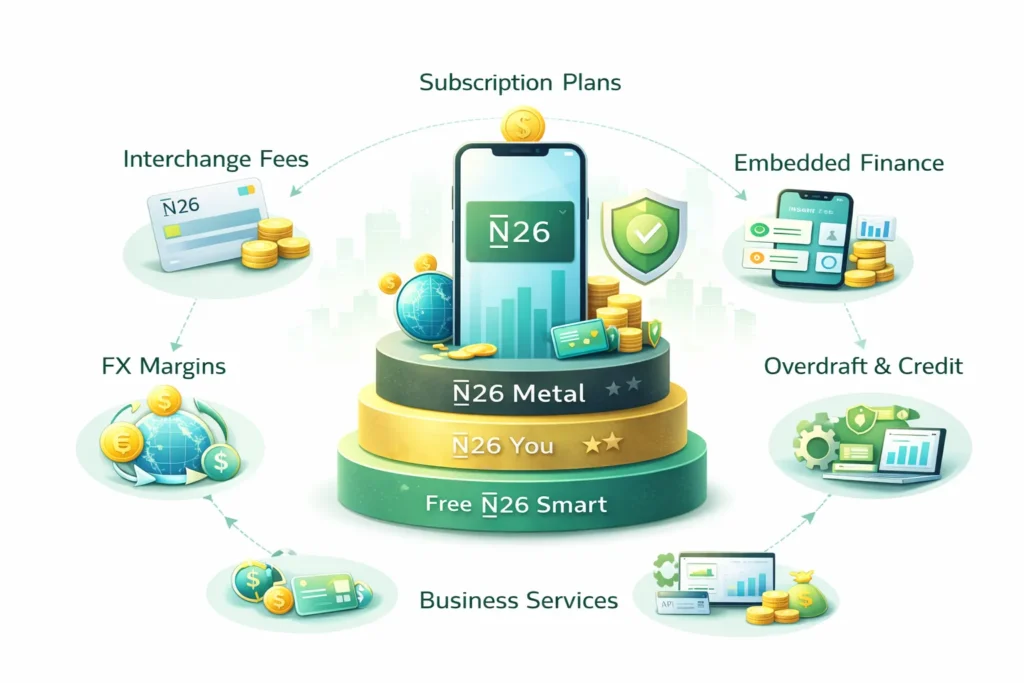
Primary Revenue Stream: Subscription Plans
Subscriptions are the strategic core of N26’s revenue model.
How it works
- Users start with a free Standard account
- As needs grow, they upgrade to paid tiers
Key Plans (2026)
- N26 Smart: Budgeting tools, sub-accounts, premium support
- N26 You: Travel insurance, FX benefits
- N26 Metal: Premium card, insurance bundle, higher limits, exclusivity
Why subscriptions work
- Predictable monthly recurring revenue (MRR)
- High retention due to embedded daily usage
- Clear value-based tiering instead of feature gating
Subscriptions contribute an estimated 35–45% of total revenue, with premium users generating 3–5× higher ARPU than free users.
Secondary Revenue Streams
1. Interchange Fees
- Earned every time users pay with their N26 card
- Small per-transaction margins, massive volume at scale
- Especially strong in daily-spend categories
2. Foreign Exchange (FX) Margins
- Markups on currency conversions for free users
- Zero or reduced FX fees for premium tiers (drives upgrades)
3. Embedded Financial Products
- Insurance (travel, phone, lifestyle)
- Savings & investments via partner integrations
- Revenue via commissions and revenue-sharing
4. Overdraft & Credit Products
- Interest income from overdrafts
- Risk-managed lending tied to transaction behavior
5. Business & Partner Services
- API-based integrations
- White-labeled or co-branded offerings in select markets
How the Monetization System Connects
N26’s revenue design is intentionally interlinked:
- Free accounts → transaction volume → interchange revenue
- Frequent travel → FX usage → subscription upsell
- Salary inflow → savings & investment cross-sell
- Trust + data → safer lending and insurance recommendations
This creates a flywheel where usage fuels monetization without degrading UX.
Pricing Psychology & Tiering Strategy
N26 applies classic behavioral economics:
- Anchoring: Metal tier makes lower plans feel affordable
- Bundling: Insurance packaged cheaper than standalone providers
- Loss aversion: Premium users don’t want to lose benefits once activated
- Status signaling: Physical metal card reinforces perceived value
For entrepreneurs, this is a masterclass in value-based pricing over fee extraction — a principle Miracuves consistently applies when designing scalable fintech and subscription platforms.
Operational Model & Key Activities
Behind N26’s clean interface sits a highly disciplined operational engine. Unlike traditional banks weighed down by branches and legacy systems, N26 runs a lean, software-driven operating model optimized for scale, compliance, and cost efficiency.
This operational clarity is what allows the business model to remain profitable even while offering free accounts.
Core Operations
1. Platform & Product Management
- Continuous app development (weekly feature releases)
- UX optimization based on behavioral data
- Modular architecture enabling fast feature rollout
2. Banking Infrastructure & Technology
- Cloud-native core banking systems
- API-first design for partners and internal services
- Real-time transaction processing and alerts
3. Compliance, Risk & Security
- KYC / AML automation using AI-assisted checks
- Transaction monitoring and fraud detection
- Close coordination with EU regulators
4. Customer Support
- In-app chat support with tier-based SLAs
- Premium users receive faster response times
- AI-assisted support for common issues
5. Marketing & Growth Operations
- Performance marketing in key EU markets
- Referral and incentive program management
- Brand storytelling focused on simplicity and trust
Resource Allocation Strategy
N26’s spending priorities reflect its platform-first mindset:
- Technology & Engineering: ~40–45%
Core banking systems, app development, security - Compliance & Risk: ~15–20%
Regulatory reporting, audits, internal controls - Marketing & Growth: ~15%
Focused on ROI-positive markets only - People & Operations: ~15–20%
Product, support, leadership, and governance - R&D & New Products: Embedded within tech spend
Gradual expansion, not experimental sprawl
This disciplined allocation helped N26 exit unprofitable markets, double down on Europe, and stabilize operations — a strategic reset many fast-growing startups fail to execute.
Partnerships & Ecosystem Development
N26 understands a critical truth of modern fintech: you don’t need to build everything yourself — but you must control the experience. Its partnership strategy is designed to extend functionality, accelerate innovation, and unlock new revenue streams without bloating internal operations.
Rather than acting as a pure marketplace, N26 curates a controlled financial ecosystem where partners plug into its platform under strict UX, compliance, and trust standards.
Partnership Philosophy
N26 partners selectively, guided by three principles:
- Customer trust comes first
- Integration must feel native
- Partnerships must improve ARPU or retention
This ensures partners strengthen the platform instead of diluting the brand.
Key Partnership Types
1. Technology & API Partners
- Core banking infrastructure providers
- Cloud, security, and data analytics platforms
- Identity verification and fraud prevention tools
These partners allow N26 to scale securely while maintaining speed.
2. Payment & Financial Services Partners
- Card networks (Visa, Mastercard)
- Insurance providers (travel, device, lifestyle)
- Investment and savings platforms
Revenue is generated through commission splits and bundled offerings.
3. Marketing & Distribution Alliances
- Travel, mobility, and lifestyle brands
- Co-branded promotions for premium users
- Referral-based acquisition loops
These partnerships reduce CAC while targeting high-LTV users.
4. Regulatory & Expansion Alliances
- Local compliance advisors in each market
- Regulatory technology (RegTech) partners
- Banking-as-a-service collaborators (selective)
This layer enables faster market entry without regulatory missteps.
Ecosystem Strategy: Why It Works
N26’s ecosystem creates compound advantages:
- Network effects: More users attract better partners
- Higher stickiness: Integrated services reduce churn
- Monetization leverage: Each partner interaction generates revenue
- Defensibility: Harder for competitors to replicate fully
Instead of chasing scale at any cost, N26 builds depth per customer — a strategy Miracuves often recommends to founders building fintech, mobility, and subscription ecosystems.
Growth Strategy & Scaling Mechanisms
N26’s growth story is not just about acquiring users fast — it’s about learning when to slow down, refocus, and scale responsibly. That ability to recalibrate has become one of its most underrated competitive strengths in 2026.
Core Growth Engines
1. Organic Virality & Referral Loops
- Simple referral incentives (cash rewards, premium trials)
- Strong word-of-mouth driven by UX satisfaction
- Social proof via app-store reviews and fintech rankings
2. Product-Led Growth
- Free accounts act as the top of the funnel
- Daily usage creates natural upgrade moments
- Features like Spaces and Insights drive habit formation
3. Paid Acquisition (Selective & ROI-Driven)
- Focused on high-conversion EU markets
- Performance marketing over brand-heavy spends
- Constant CAC vs LTV optimization
4. Premium-Led Upselling
- Contextual upgrade prompts (travel, salary inflow, spending limits)
- Time-bound promotions for Metal and You tiers
- Clear feature justification — no dark patterns
New Product & Market Expansion
Instead of launching aggressively everywhere, N26 shifted to:
- Deepening product adoption in core markets
- Enhancing premium tiers with bundled value
- Introducing risk-managed credit and savings features
This “expand vertically before horizontally” strategy improved profitability and compliance.
Geographic Scaling Model
- Initially expanded rapidly across Europe and the US
- Later exited complex or unprofitable markets
- Refocused on regions with strong regulatory alignment
This reset reduced operational risk and improved margins — a hard but necessary decision.
Scaling Challenges & How N26 Solved Them
Challenge: Regulatory pressure and compliance gaps
Solution: Heavy investment in risk, governance, and internal controls
Challenge: Operational complexity at scale
Solution: Modular tech architecture and centralized oversight
Challenge: Rising costs with free users
Solution: Stronger premium conversion and ARPU focus
Competitive Strategy & Market Defense
Operating in one of the most competitive fintech arenas, N26 doesn’t win by price wars alone. Its defense strategy is built around structural advantages that are difficult for both traditional banks and new neobanks to replicate.
Core Competitive Advantages
1. Network Effects & Switching Barriers
- Salary accounts, savings, cards, and subscriptions all in one app
- High friction to move once users embed N26 into daily financial life
- Premium benefits tied to long-term usage
2. Brand Equity & Trust
- Regulated EU banking license = credibility
- Transparent pricing builds long-term trust
- Clean, modern brand voice differentiates from legacy banks
3. Product & UX Innovation
- Minimalist interface reduces cognitive overload
- Continuous micro-iterations instead of risky big launches
- Banking features designed around real user behavior
4. Data-Driven Personalization
- Spending insights and smart nudges
- Personalized upgrade timing
- Safer credit and insurance recommendations
Market Defense Tactics
Against New Entrants
- Faster feature replication backed by scale
- Premium bundling makes undercutting harder
- Regulatory compliance as a moat
Against Traditional Banks
- Lower operating costs
- Faster innovation cycles
- Stronger mobile-first loyalty
Against Price Wars
- Value-based pricing, not race-to-zero fees
- Emotional attachment via design and experience
Strategic Timing & Moves
- Feature releases timed around lifestyle triggers (travel, salary days)
- Strategic exits from markets before costs balloon
- Focused acquisitions and partnerships instead of aggressive M&A
For Miracuves clients, this highlights a critical insight:
true defensibility comes from system-level advantages — not individual features.
Read more : Best N26 Clone Scripts 2026 for Digital Banking Startups
Lessons for Entrepreneurs & Implementation
This is where N26’s story becomes most valuable — not as inspiration, but as instruction. Its journey offers clear, practical lessons for founders building fintech, subscription platforms, or regulated digital ecosystems.
Think of this section as a mentor’s playbook, not a case study recap.
Key Factors Behind N26’s Success
1. Product Before Monetization
N26 focused first on removing friction — fast onboarding, clean UX, real-time insights. Monetization followed naturally once trust and daily usage were established.
2. Hybrid Revenue Architecture
Instead of betting on one stream, N26 combined:
- Subscriptions for predictability
- Transactions for scale
- Embedded products for margin expansion
This diversification insulated the business during market downturns.
3. Regulation as a Competitive Advantage
What slowed others down became N26’s moat. Heavy investment in compliance built long-term defensibility and customer trust.
4. Willingness to Say No
Exiting markets, cutting features, and narrowing focus allowed N26 to stabilize and scale sustainably — a discipline many startups lack.
Replicable Principles for Startups
Entrepreneurs can apply N26’s logic even outside fintech:
- Start with a free core offering that drives habit formation
- Layer subscriptions on top of real value, not artificial limits
- Use data and behavior to time upsells
- Design compliance, governance, and scalability from day one
These principles are especially relevant for:
- Marketplaces
- On-demand platforms
- SaaS + services hybrids
- Fintech and healthtech apps
Common Mistakes to Avoid
- Expanding geographically too fast
- Monetizing before product-market trust
- Treating compliance as an afterthought
- Overbuilding features without clear ARPU impact
Adapting the Model for Local or Niche Markets
Founders don’t need to copy N26 — they need to localize it:
- Focus on one underserved segment first
- Adjust pricing to local purchasing power
- Partner instead of building everything in-house
- Start narrow, then expand vertically
Implementation & Investment Priorities
Phase 1 :
MVP, core UX, regulatory groundwork, user testing
Phase 2 :
Freemium launch, referral loops, data infrastructure
Phase 3 :
Subscriptions, embedded products, ecosystem partnerships
This phased approach mirrors how Miracuves helps founders build scalable, investor-ready platforms without burning capital prematurely.
Ready to implement N26’s proven business model for your market?
Miracuves builds scalable platforms with tested business models and growth mechanisms. We’ve helped 200+ entrepreneurs launch profitable apps.
Get your free business model consultation today.
Conclusion
N26’s business model proves a powerful truth about modern platform companies: innovation alone is not enough — disciplined execution is what creates durable success.
By combining elegant product design, subscription-led monetization, regulatory rigor, and ecosystem partnerships, N26 transformed banking from a slow, trust-deficient service into a daily digital habit. Its willingness to evolve — to retreat from unsustainable growth and double down on operational excellence — is what ultimately positioned it for long-term relevance.
As we move deeper into 2026 and beyond, platform economies will increasingly reward companies that balance speed with stability, growth with governance, and technology with trust. N26 didn’t just build a digital bank — it built a repeatable system for sustainable fintech innovation.
The future belongs to platforms that don’t just scale fast, but scale right.
FAQs
What type of business model does N26 use?
N26 uses a hybrid fintech business model combining freemium banking, subscription plans, transaction-based revenue, and embedded financial products.
How does N26’s model create value?
It removes friction from banking through mobile-first UX, transparent pricing, and real-time insights while offering premium services that enhance convenience and security.
What are N26’s key success factors?
Strong product design, subscription-led monetization, regulatory compliance, data-driven personalization, and disciplined market focus.
How scalable is N26’s business model?
Highly scalable due to its cloud-native infrastructure, subscription revenue, and modular ecosystem — with marginal costs decreasing as users grow.
What are the biggest challenges in this model?
Regulatory pressure, compliance costs, and maintaining trust at scale are the main challenges.
How can entrepreneurs adapt N26’s model locally?
By targeting a specific underserved segment, partnering with local providers, and launching with a freemium core before adding premium layers.
What are alternatives to this business model?
Banking-as-a-service platforms, embedded finance models, or niche financial marketplaces focused on single products.
How has N26’s business model evolved over time?
It evolved from user-growth-focused freemium banking to a profitability-driven, subscription-centric ecosystem with strong governance.
Related Article :
- What is a Revolut App and How Does It Work?
- What is Monzo App and How Does It Work?
- Best Stripe Clone Scripts 2025: Build a Scalable Global Payment Infrastructure for Your Startup
- Best PayPal Clone Scripts 2025 Launch a Secure Global Digital Payment Platform
- Best Worldpay Clone Scripts 2025: Launch Your Own Global Payment Gateway