
Key Takeaways
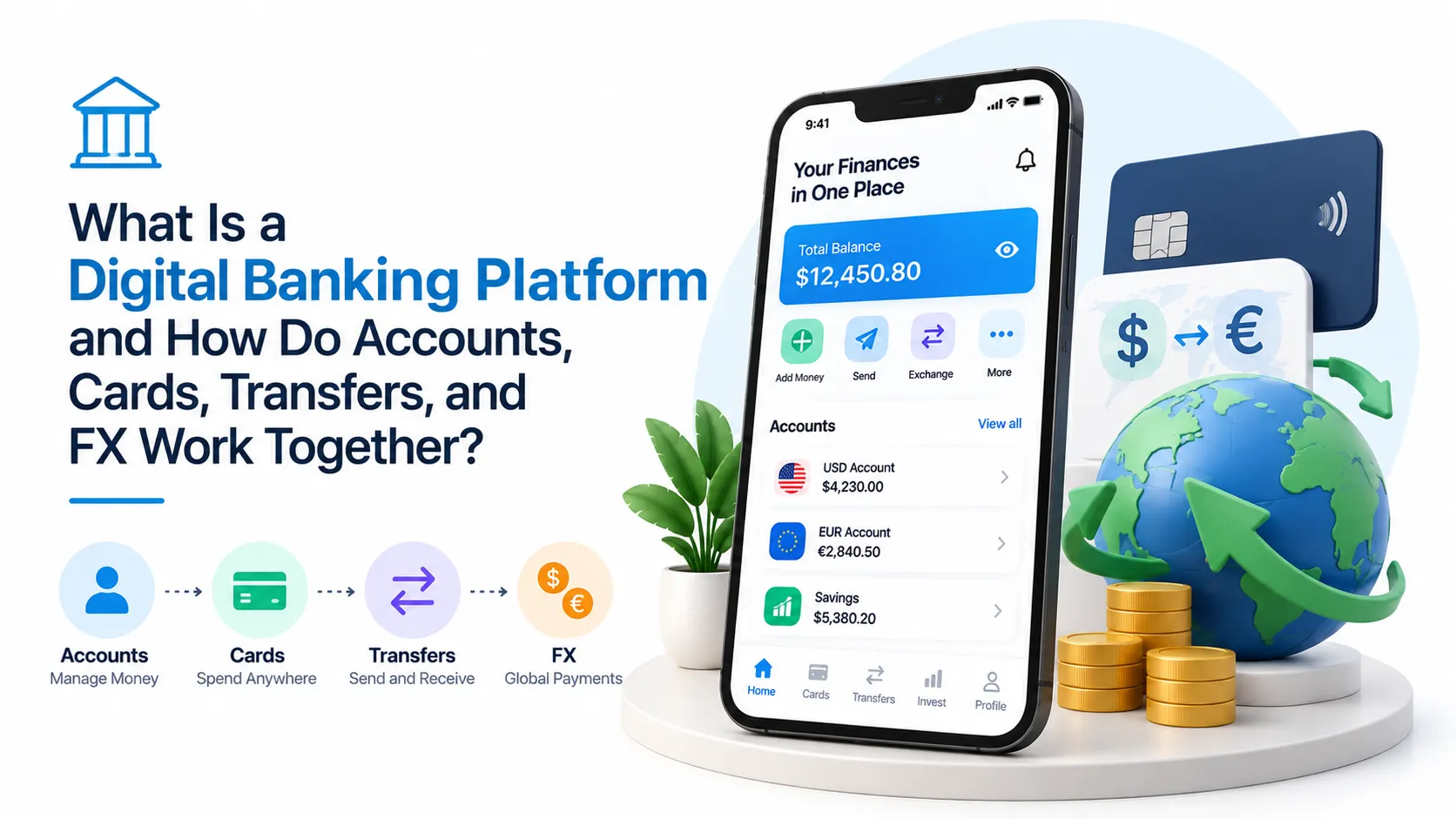
- A digital banking platform connects user accounts, balances, cards, money transfers, foreign exchange, payments, transaction records, security, and administrative operations in one digital system.
- Accounts act as the financial foundation, while cards provide spending access, transfers move funds between parties, and FX enables users to hold or exchange different currencies.
- These modules must share accurate balance data, transaction status, identity information, limits, fees, exchange rates, and risk controls to deliver a consistent banking experience.
Core Banking Workflow Signals
- Account services manage balances, transaction histories, deposits, withdrawals, beneficiaries, user limits, and the ledger entries created by financial activity.
- Card systems connect authorization, spending limits, freezes, online payments, ATM activity, refunds, and settlement events back to the user’s account and available balance.
- Transfer and FX workflows coordinate sender balances, beneficiary details, fees, exchange rates, currency conversion, compliance checks, payment routing, settlement, and final transaction status.
Platform Integration Insights
- A shared ledger, API layer, authentication system, transaction engine, notification service, reconciliation process, and admin dashboard help keep accounts, cards, transfers, and FX synchronized.
- Operators should monitor payment failures, transfer delays, balance mismatches, exchange-rate updates, card authorization errors, reconciliation differences, security alerts, and transaction completion rates.
- Miracuves develops customizable digital banking platforms with account management, cards, transfers, FX, transaction processing, security controls, analytics, notifications, reconciliation, and admin operations.
Many founders look at modern finance apps and think the product is simply a wallet, a card, or a money transfer tool. In reality, a digital banking platform is a connected fintech system where accounts, cards, transfers, currency exchange, onboarding, compliance workflows, and admin controls work together.
For users, the experience feels simple. They open an account, add money, spend with a card, send funds, exchange currencies, and track every transaction from one app. For founders, the real challenge is not creating attractive screens. It is building a reliable financial operating layer where every balance, transaction, fee, user action, and admin decision stays connected.
This guide explains how a digital banking platform works, why its core modules depend on each other, and what founders should understand before building or launching a fintech product.
What Is a Digital Banking Platform?
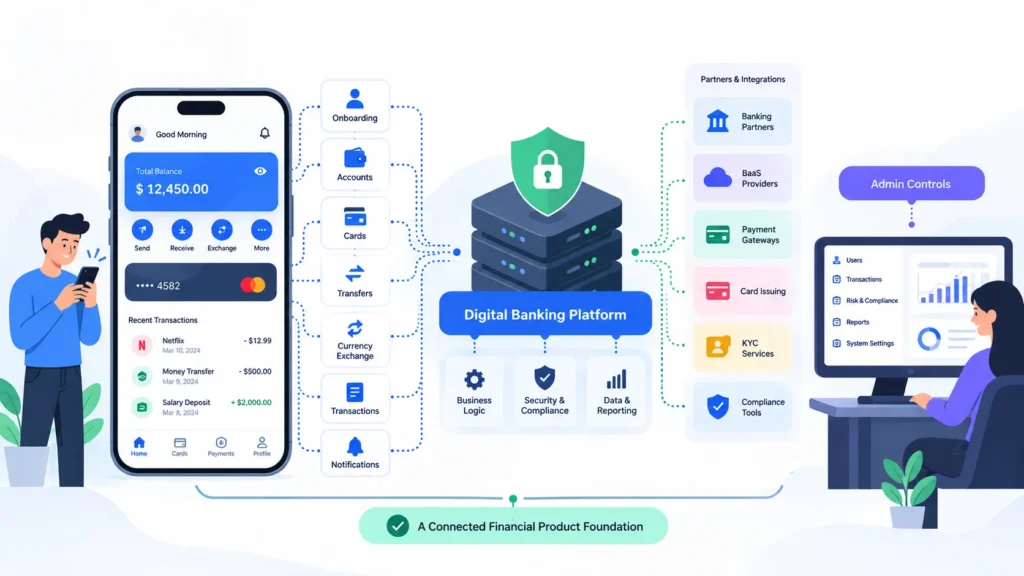
A digital banking platform is a software system that allows users to manage financial activities through a mobile or web application. It can include user onboarding, account creation, wallet balances, virtual or physical cards, domestic transfers, international payments, currency exchange, transaction history, notifications, and admin-level financial controls.
The platform may work with banking partners, Banking-as-a-Service providers, payment gateways, card issuing providers, KYC services, and compliance tools. These integrations allow the fintech product to offer real financial workflows while the app manages the user experience, business logic, and operational control layer.
For a founder, the most important point is this: a digital banking platform is not just a frontend app. It is a connected financial product foundation. The interface helps users take action, but the backend decides whether balances are accurate, transactions are traceable, rules are enforced, and the business can scale safely.
Why Accounts, Cards, Transfers, and FX Must Work Together
A digital banking platform becomes valuable when its modules work as one system.
If a user spends through a card, the account balance must update. If the user sends money to another person, the transaction engine must check balance availability, apply fees if required, create a transaction record, and notify both sides. If the user exchanges currency, the FX engine must apply the conversion rate, calculate any markup, update the multi-currency balance, and store the exchange history.
This is why fintech products cannot treat accounts, cards, transfers, and FX as isolated features. Each module depends on shared logic.
A strong platform needs:
- Account and wallet ledger accuracy
- Real-time transaction status updates
- Card issuing and authorization workflows
- Domestic and cross-border transfer logic
- Currency conversion and FX markup rules
- User verification and risk checks
- Admin dashboards for monitoring and support
- Audit logs for operational transparency
When these layers are connected properly, the product feels simple to users and manageable for the business.
Core Components of a Digital Banking Platform
A digital banking product usually includes several connected layers. Each layer supports a different part of the user journey and business operation.
For a deeper breakdown of modules such as user onboarding, wallet accounts, virtual cards, transfer flows, multi-currency support, reporting, and admin controls, founders can review this digital banking app feature stack before finalizing their product scope.
| Component | What It Does | Why It Matters for Founders |
|---|---|---|
| User onboarding | Registers users and collects required identity details | Helps control access and prepare verification workflows |
| KYC workflow | Supports identity checks and document verification | Reduces risk and supports compliance processes |
| Account system | Creates user accounts, balances, and wallet structures | Forms the foundation for all money movement |
| Card module | Supports virtual or physical card usage through card providers | Adds spending utility and user retention |
| Transfer engine | Handles peer-to-peer, bank, or international transfers | Drives daily financial activity |
| FX engine | Converts one currency into another using rate and fee logic | Supports multi-currency use cases and monetization |
| Transaction ledger | Records all debits, credits, fees, refunds, and adjustments | Protects financial accuracy and trust |
| Admin dashboard | Allows the platform operator to manage users, transactions, disputes, and settings | Gives the business control without depending on developers for every change |
| Reporting layer | Shows transaction activity, revenue, risk flags, and user behaviour | Helps founders make product and business decisions |
How Account Management Works in a Digital Banking Platform
Accounts are the base layer of the platform. Every financial action depends on them.
When a user signs up, the platform creates a user profile and connects it to one or more account balances. Depending on the product model, these balances may represent wallet accounts, multi-currency accounts, business accounts, savings-style sub-accounts, or linked external accounts.
The account system must track:
- Available balance
- Pending balance
- Currency type
- Transaction history
- Deposits and withdrawals
- Fees and adjustments
- Account status
- User verification status
This account layer must be reliable because even small errors can damage user trust. If a card transaction, money transfer, or FX conversion does not update the account correctly, the entire product experience breaks.
For founders, account logic is not just a technical feature. It is the foundation for customer trust, revenue tracking, support operations, and future product expansion.
How Card Workflows Connect to the Platform
Cards add spending utility to a digital banking product. Users may want virtual cards for online payments, physical cards for offline purchases, prepaid cards, business cards, or spending controls for teams.
A card workflow usually connects the platform to a card issuing provider. When the user makes a payment, the card provider sends an authorization request. The platform or connected financial infrastructure checks whether the account has enough balance, whether the card is active, and whether any risk rule should block the transaction.
A good card module should support:
- Virtual card creation
- Physical card request flow
- Card activation and freezing
- Spending limits
- Transaction notifications
- Card status management
- Failed payment handling
- Admin card controls
Cards are important because they increase daily product usage. A user may not transfer money every day, but they may spend through a card frequently. That makes cards a strong retention and monetization layer when implemented with the right account and transaction logic.
How Transfers Work Behind the Scenes
Transfers are one of the most important workflows in a digital banking platform. They can include wallet-to-wallet transfers, bank transfers, international payments, business payouts, peer-to-peer payments, or remittance-style flows.
A transfer may look simple to the user, but the backend must handle several steps.
First, the platform checks whether the sender is verified and has enough balance. Then it validates the recipient details, calculates any applicable fees, creates a transaction record, updates the sender’s balance, moves the transfer into processing, and updates the status when the transfer is completed, failed, reversed, or held for review.
A transfer engine should manage:
- Sender and receiver validation
- Balance checks
- Transfer limits
- Fees
- Payment status
- Failure handling
- Refunds or reversals
- Transaction history
- Risk flags
- Admin review queues
For founders, transfer logic matters because this is where user experience and financial risk meet. Delayed transfers, unclear statuses, or weak dispute workflows can create support pressure and reduce trust.
How FX and Multi-Currency Features Work
FX, or foreign exchange, allows users to convert one currency into another. In a digital banking platform, FX usually connects with multi-currency accounts, transfer flows, card spending, and business payment use cases.
For example, a user may hold USD, convert part of it into EUR, and then send EUR to another user or spend it through a card. The platform must calculate the exchange rate, apply any markup or fee, update both currency balances, and record the transaction clearly.
An FX engine may include:
- Live or provider-based exchange rates
- Currency pair management
- FX markup rules
- Conversion previews
- Confirmed conversion receipts
- Multi-currency wallet balances
- Admin rate and fee settings
- Transaction records for every exchange
FX is also a common revenue layer for fintech products. Instead of charging users only for subscriptions or transfers, the platform can generate revenue through transparent exchange markups, premium currency plans, or business account features.
The important point is that FX should not be added as a standalone feature. It needs to connect with accounts, cards, transfers, pricing rules, transaction history, and support workflows.
How the User Journey Works From Signup to First Transaction
A strong digital banking platform should guide users from registration to first financial action with minimal confusion.
A typical journey looks like this:
- The user signs up with basic details.
- The platform asks for identity verification if required.
- The user gets access to an account or wallet.
- The user adds money or receives funds.
- The user creates a virtual card, sends a transfer, or exchanges currency.
- The transaction engine records the action.
- The user receives a confirmation and can view the transaction history.
- The admin dashboard tracks activity, risk signals, and support needs.
This journey matters because activation is one of the hardest parts of fintech growth. A user who signs up but never adds money, creates a card, or completes a first transfer is not yet an active financial customer.
Founders should therefore design the platform around the first meaningful transaction, not just the first app install.
Admin Controls That Make the Platform Manageable
The admin dashboard is where the business operates the platform. Without strong admin controls, even a well-designed user app can become difficult to manage.
The admin layer should help platform operators manage:
- Users and account status
- KYC review workflows
- Cards and card requests
- Transactions and transfer statuses
- FX rates and markups
- Fees and limits
- Disputes and refunds
- Suspicious activity flags
- Support tickets
- Reports and analytics
- Role-based team access
This matters because fintech products create operational responsibility. Users may contact support about failed transfers, blocked cards, delayed verification, incorrect recipient details, or unclear fees. A strong admin dashboard gives the business the control required to resolve issues quickly and maintain trust.
Security and Compliance-Ready Workflows
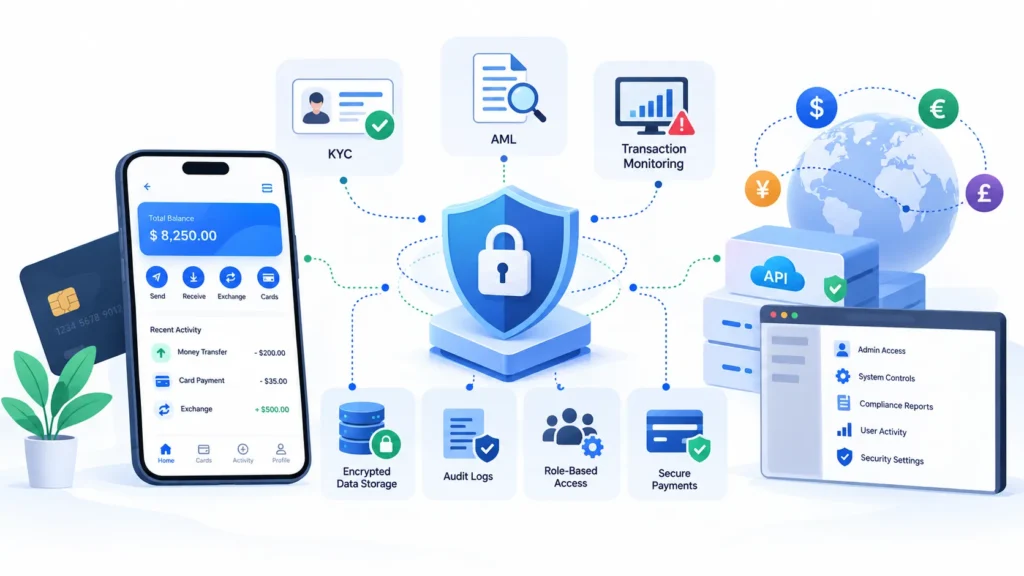
Security should be treated as part of the product foundation, not as a final add-on.
A digital banking platform should support secure authentication, encrypted data transfer, encrypted data storage, role-based access control, audit logs, transaction monitoring, user verification, admin access controls, and secure payment gateway integration.
Before launch, founders should also review white-label fintech security considerations around KYC workflow support, AML processes, audit logs, suspicious activity monitoring, transaction records, and permission-based admin access.
For fintech founders, compliance also depends on jurisdiction, business model, financial partners, legal review, and operating structure. The software can support compliance-ready workflows, but final regulatory readiness must be reviewed based on the target market.
Important security and control layers include:
- KYC workflow support
- AML workflow support
- Transaction monitoring
- Suspicious activity flags
- Audit logs
- Secure API integrations
- Role-based admin access
- Payment gateway security
- Card and transfer controls
- User activity logs
This is especially important for products handling multi-currency accounts, cross-border transfers, card programs, or business finance workflows.
Revenue Models for Digital Banking Platforms
A digital banking platform can create revenue through several layers. The right model depends on the market, user segment, licensing structure, financial partners, and product depth. Founders should define the digital banking business model early so that subscriptions, FX markup, transfer fees, card usage revenue, and business account plans are connected to the product architecture from the beginning.
Common monetization options include:
| Revenue Model | How It Works | Best Fit |
|---|---|---|
| Subscription plans | Users pay for premium accounts, advanced limits, or added features | Consumer neobanking and business finance |
| FX markup | The platform earns from currency conversion margins | Multi-currency and travel-focused products |
| Transfer fees | Users pay fixed or percentage-based fees on selected transfers | Domestic and cross-border money movement |
| Card-related revenue | Revenue may come from card programs, premium cards, or card usage models | Products with strong spending behaviour |
| Business accounts | SMEs pay for team access, expense tools, invoicing, or finance controls | Business banking platforms |
| Partner services | The platform offers third-party financial products or embedded services | Mature fintech ecosystems |
| Withdrawal or payout fees | Fees apply when users move money out through selected rails | Wallet and payout-heavy products |
The strongest revenue strategy is usually not based on one fee. It comes from combining daily utility, transparent pricing, premium value, and strong user retention.
Founder Decision Signals Before Building a Digital Banking Platform
Speed
If the business goal is market validation, a ready-made fintech foundation can reduce the time spent building common account, card, transfer, and admin workflows from scratch.
Control
Founders should look for source-code ownership, admin flexibility, and integration control so the platform can evolve with market requirements.
Compliance Workflow
The product should support KYC, transaction monitoring, audit logs, and risk controls, while legal compliance is reviewed for the selected jurisdiction.
Monetization
Accounts, cards, transfers, and FX should connect to a clear revenue model instead of being added only as disconnected features.
Ready-Made vs Custom Digital Banking Platform Development
Founders usually have two broad choices: build from zero or start with a ready-made foundation.
Budget planning should include feature depth, mobile and web platforms, third-party integrations, compliance workflow scope, infrastructure, branding, admin controls, and post-launch support. A detailed fintech app cost breakdown can help founders compare custom development effort with a ready-made platform foundation.
A ready-made digital banking foundation can be useful when the goal is to launch faster, validate the market, and customize proven fintech workflows around a specific brand and business model. It can already include common modules such as user onboarding, accounts, cards, transfers, multi-currency flows, admin controls, and reporting. Founders comparing development routes can also review how a white-label fintech platform compares with custom development before choosing the right path.
For founders who want a faster path, Miracuves offers a launch-ready fintech platform foundation that can support accounts, cards, transfers, FX workflows, admin control, source-code ownership, and 6-day delivery where the selected scope fits.
The key is not to copy another financial app blindly. The stronger approach is to understand the product model, define the user segment, choose the right features, and launch with a platform that can support future customization.
Mistakes Founders Should Avoid
1. Treating the App as Only a Wallet
A wallet interface alone is not enough. A real digital banking platform needs accounts, cards, transfer logic, FX, reporting, risk workflows, and admin control working together.
2. Ignoring the Ledger Layer
If balances, fees, refunds, and currency conversions are not recorded correctly, support issues and user trust problems can grow quickly.
3. Adding FX Without Clear Pricing Logic
Currency conversion should include transparent rate display, markup control, transaction records, and admin visibility.
4. Launching Without Admin Workflows
Founders need backend tools to manage verification, failed transactions, disputes, limits, users, and suspicious activity.
Many fintech startups struggle because they focus on interface design first and delay decisions around ledger accuracy, verification workflows, transaction monitoring, admin operations, and monetization rules. This guide on common fintech launch mistakes can help founders avoid issues that usually appear after users start transacting.
How Miracuves Helps Founders Launch Faster
Miracuves helps founders move from idea to launch faster with ready-made, white-label fintech solutions that can be customized for branding, workflows, integrations, and business models.
Instead of spending months building every standard fintech module from zero, founders can start with a product foundation that already supports key digital banking workflows. This can include account management, card flows, transfer logic, multi-currency operations, admin dashboards, and source-code ownership.
For fintech teams, agencies, and startup founders, this approach can reduce development risk, improve launch speed, and create a stronger base for market validation. If you are evaluating the right team for execution, this digital banking development partner page explains how Miracuves supports fintech founders with product planning, white-label deployment, customization, and launch execution.
Final Thoughts
A digital banking platform is more than a finance app. It is a connected system where accounts, cards, transfers, FX, onboarding, transaction records, security workflows, and admin controls work together.
For users, this creates convenience. For founders, it creates a product foundation that can support monetization, market validation, and long-term growth.
The best approach is not to chase every fintech feature at once. Start by defining the account model, core transaction flows, card use cases, currency needs, verification process, admin controls, and revenue logic. Once those layers are clear, the platform becomes easier to build, launch, and scale.
Miracuves can help founders take this structured approach with a ready-made fintech product foundation designed for faster deployment, source-code ownership, and custom business workflows.
FAQs
What is a digital banking platform?
A digital banking platform is a software system that lets users manage accounts, cards, transfers, currency exchange, transactions, and financial activity through a mobile or web app.
How do accounts and cards work together in a fintech app?
Accounts hold user balances, while cards allow users to spend from those balances. When a card payment happens, the platform checks the account, authorizes the transaction, and updates the transaction history.
What is FX in a digital banking platform?
FX means foreign exchange. In a digital banking platform, FX allows users to convert one currency into another using exchange rate logic, markup rules, and multi-currency account balances.
Why is the transaction ledger important?
The transaction ledger records every debit, credit, fee, refund, transfer, and currency conversion. It helps maintain balance accuracy, support visibility, and operational trust.
Can startups launch a digital banking platform faster with a ready-made solution?
Yes. A ready-made fintech foundation can help startups reduce development time by starting with existing account, card, transfer, FX, and admin workflows that can be customized for the business model.
Does a digital banking platform need KYC?
Most fintech products need some form of user verification, especially when handling payments, cards, transfers, wallets, or regulated financial services. The exact requirements depend on the target market, financial partners, and legal structure.
How can a digital banking platform make money?
It can generate revenue through subscriptions, transfer fees, FX markups, card-related revenue, business accounts, withdrawal fees, premium features, and partner financial services.
What should founders check before building a digital banking product?
Founders should check account logic, transaction accuracy, card integration needs, transfer workflows, FX rules, KYC requirements, admin controls, security layers, revenue model, and source-code ownership.
Miracuves is an independent software development company. We are not affiliated with, connected to, sponsored by, or endorsed by any company or product named in this article.
Terms such as “X Clone” are used descriptively. It is how the software industry refers to building a platform with functionality comparable to a known service, and how clients search for it.
The entire design and codebase of our products is built by our own team. Our products contain no code, design, graphics, or content originating from any third-party website or applications.
All third-party names and marks referenced in this article are the property of their respective owners, referenced solely to identify the services discussed.