



In the early 2000s, Newegg started as a simple online store for computer hardware at a time when buying PC components online felt risky and unreliable. Fast forward to 2025, Newegg operates as a global technology-focused eCommerce and marketplace platform, serving millions of gamers, IT professionals, and electronics enthusiasts across North America and beyond.
What makes Newegg fascinating is not just its longevity—but how it survived Amazon’s dominance by specializing instead of generalizing .The Business Model of Newegg processes millions of SKUs across first-party retail and third-party sellers, with a business model optimized for high-consideration electronics purchases, not impulse shopping.
For modern founders exploring marketplace platforms, vertical eCommerce, or hybrid retail models, Newegg offers a powerful lesson: you don’t need to be everything—just irreplaceable in one category.
At Miracuves, we often study models like Newegg because they show how vertical focus, operational discipline, and marketplace layering can create sustainable platforms even in hyper-competitive industries.In the next section, we’ll break down how business model of Newegg actually works under the hood—from its structure to why it still works in 2026.
How the Newegg Business Model Works
Newegg operates on a hybrid eCommerce + marketplace business model, combining first-party retail with a curated third-party seller ecosystem. This structure allows Newegg to maintain category authority and trust while scaling inventory without carrying all the risk on its own balance sheet.
At its core, Newegg is not trying to win on convenience like Amazon—it wins on decision confidence.
Business Model Overview
Type of Model
- Hybrid marketplace + direct retail
- Vertical eCommerce (technology & electronics focused)
Value Proposition
- Consumers:
- Detailed specs, comparisons, verified reviews
- Trusted sourcing for high-value electronics
- Competitive pricing for DIY PC builders and gamers
- Sellers & Brands:
- Access to a high-intent, tech-savvy audience
- Category-specific merchandising and search visibility
- Logistics and fulfillment support via Newegg
Key Stakeholders
- End consumers (gamers, IT professionals, enterprises)
- OEMs and electronics brands
- Third-party marketplace sellers
- Logistics and fulfillment partners
- Payment providers and fraud-prevention systems
How the Model Evolved Over Time
Newegg’s model has evolved through three major phases:
- 2001–2010: First-Party Retail Dominance
- Owned inventory
- Focus on PC components and peripherals
- Trust built through reviews and customer service
- 2011–2018: Marketplace Expansion
- Third-party sellers onboarded
- SKU expansion without heavy inventory risk
- Introduction of seller tools and performance controls
- 2019–2025: Platform Optimization & B2B Focus
- Stronger seller compliance and fraud control
- Expansion into enterprise IT, cloud hardware, and B2B procurement
- Monetization through services, ads, and logistics
Why the Newegg Model Works in 2025
In 2025, consumer behavior favors:
- Research-heavy purchases for expensive electronics
- Trust signals over speed alone
- Category experts instead of generic marketplaces
Newegg thrives because it aligns with these behaviors:
- Its audience shops with intent, not impulse
- Content (reviews, specs, comparisons) reduces buyer risk
- Marketplace sellers benefit from a qualified, niche demand pool
For founders, Newegg proves that vertical marketplaces can outperform horizontal ones when trust, data depth, and seller quality are tightly controlled.
Read more : What is Newegg and How Does It Work?
Target Market & Customer Segmentation Strategy
Newegg’s success is rooted in a sharply defined audience. Instead of chasing mass-market shoppers, it deliberately serves high-intent, knowledge-driven buyers who value accuracy, compatibility, and post-purchase reliability.
This focus allows Newegg to optimize for lifetime value and repeat purchase cycles, not one-off transactions.
Primary & Secondary Customer Segments
Primary Customer Segments
- PC Builders & Gamers
- Age: 18–40
- Behavior: Research-heavy, price-comparison driven
- Needs: Compatibility assurance, performance benchmarks, fast replacement cycles
- Why they stay: Trust in specs, reviews, and community validation
- IT Professionals & System Integrators
- B2B and prosumer buyers
- Purchase in bulk or recurring cycles
- Value enterprise pricing, warranties, and predictable fulfillment
Secondary Customer Segments
- General Electronics Consumers
- Buy laptops, peripherals, networking gear, and accessories
- Less frequent buyers, but higher average order value
- Third-Party Sellers & Brands
- Use Newegg as a demand-generation and distribution channel
- Benefit from a tech-focused customer base with high purchase intent
Customer Journey: Discovery to Retention
Discovery
- Organic search for component-level queries (e.g., GPU models, SSD specs)
- YouTube, Reddit, and tech forum referrals
- Brand loyalty from repeat builders
Conversion
- Comparison tools and spec tables
- Verified buyer reviews and Q&A threads
- Time-bound deals and bundle pricing
Retention
- Account-based purchase history
- Upgrade-driven repeat cycles (new GPUs, CPUs, peripherals)
- Business accounts with recurring procurement needs
Newegg optimizes lifetime value by anchoring users into ecosystems, not single purchases—once a user builds or upgrades a PC, they tend to return.
Market Positioning & Competitive Edge
Newegg positions itself as:
- The specialist marketplace for electronics, not a general store
- A trusted advisor, not just a seller
- A bridge between brands and informed buyers
Differentiation Strategy
- Deep category expertise over breadth
- Strong review moderation and fraud control
- Seller accountability stricter than mass marketplaces
In a market dominated by Amazon and Best Buy, Newegg survives by being the default choice when purchase complexity is high.
Revenue Streams and Monetization Design
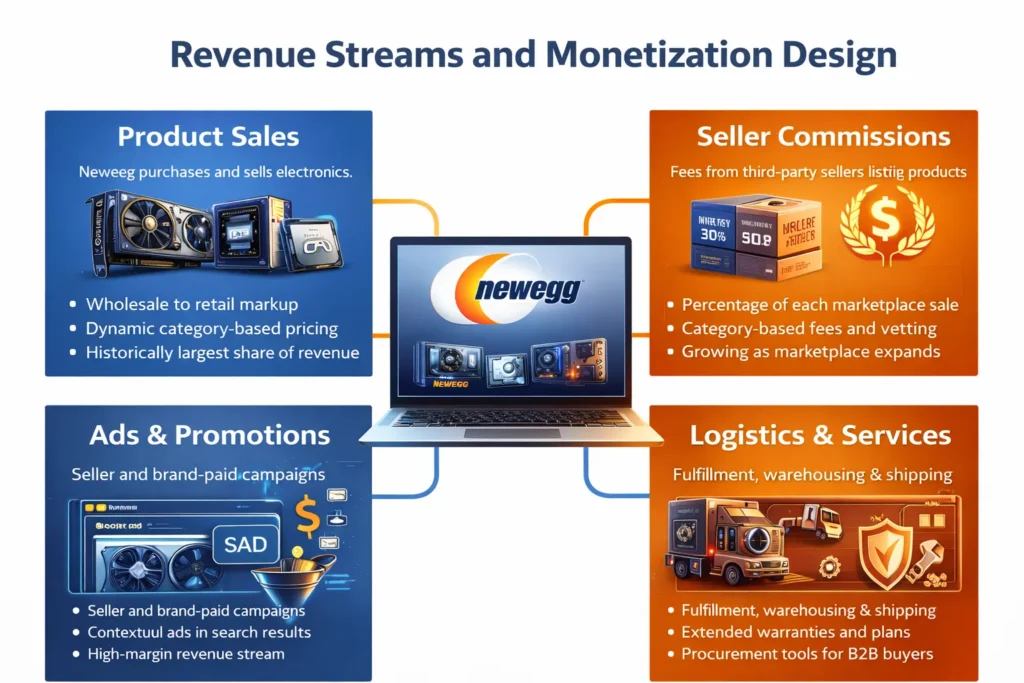
Once Newegg locked in a high-intent, repeat buyer base, its business model shifted from pure retail margins to a layered monetization architecture. Instead of relying on a single revenue lever, Newegg captures value at multiple points across the transaction lifecycle—product sales, seller services, advertising, and logistics.
This diversification is critical in electronics, where margins fluctuate and demand cycles are volatile.
Primary Revenue Stream 1: First-Party Product Sales (Core Engine)
Mechanism
Newegg purchases electronics directly from manufacturers and distributors, holds inventory, and sells to consumers at retail prices.
Pricing Model
- Wholesale procurement → retail markup
- Category-based margin optimization
- Dynamic pricing during product launches and seasonal demand
Revenue Contribution
- Historically the largest share of Newegg’s revenue
- Particularly strong in CPUs, GPUs, motherboards, and peripherals
Growth Trajectory
- Focus on high-turnover SKUs
- Reduction of low-margin long-tail inventory
- Greater emphasis on bundled offers (PC build kits, gaming setups)
This stream gives Newegg control over quality, pricing, and customer experience, especially for premium hardware.
Secondary Revenue Stream 2: Marketplace Seller Commissions
Mechanism
Third-party sellers list products on Newegg’s marketplace and pay a commission on each completed transaction.
Pricing Model
- Percentage-based commission by category
- Higher fees for lower-trust or high-risk product categories
Revenue Contribution
- Growing share as marketplace SKUs expand
- Lower operational risk compared to owned inventory
Growth Levers
- Seller performance incentives
- Category-specific onboarding (networking, storage, accessories)
This stream allows Newegg to scale assortment without inflating inventory risk.
Secondary Revenue Stream 3: Advertising & Sponsored Listings
Mechanism
Brands and sellers pay for increased visibility through sponsored products, banner placements, and search boosts.
Why It Works
- Buyers arrive with clear intent
- Ads are context-driven, not disruptive
Revenue Impact
- High-margin revenue stream
- Increases as marketplace competition intensifies
Secondary Revenue Stream 4: Logistics, Fulfillment & Value-Added Services
Mechanism
- Fulfillment and shipping services for sellers
- Extended warranties and protection plans
- Enterprise procurement tools for B2B buyers
Strategic Value
- Improves seller stickiness
- Enhances buyer trust and delivery reliability
Monetization Strategy: How It All Connects
Newegg’s monetization design works because:
- Retail builds trust, marketplace scales selection
- Ads monetize attention without harming experience
- Services lock in sellers and B2B buyers
Pricing psychology is built around comparison confidence, not impulse. Customers are willing to pay when they feel informed and protected.
For platform builders, Newegg demonstrates that monetization should grow after trust—not before it.
Read more : Newegg Revenue Model: How Newegg Makes Money in 2025
Operational Model & Key Activities
Behind Newegg’s marketplace interface is a tightly orchestrated operational engine designed to handle complex products, high order values, and low tolerance for errors. Unlike impulse-driven commerce, electronics demand precision—from inventory accuracy to post-sale support.
Newegg’s operational model is optimized for trust, reliability, and scale efficiency.
Core Operational Functions
1. Platform & Technology Management
- High-performance product catalog with deep specification mapping
- Advanced search, filters, and comparison engines
- Seller dashboards for inventory, pricing, and performance monitoring
2. Inventory & Quality Control
- First-party inventory planning for high-demand SKUs
- Strict seller vetting and performance scoring
- Ongoing fraud detection and counterfeit prevention
3. Logistics & Fulfillment
- Hybrid fulfillment model (Newegg warehouses + seller fulfillment)
- Regional distribution centers for faster delivery of core SKUs
- Returns and replacement workflows optimized for electronics
4. Customer Support & Experience
- Pre-purchase Q&A and community reviews
- Post-purchase warranty handling and returns
- Dedicated B2B account support for enterprise clients
5. Marketing & Demand Generation
- SEO-driven traffic for component-level searches
- Deal-based campaigns (bundles, launch exclusives)
- Loyalty programs and business accounts
Resource Allocation Strategy
Newegg’s spending priorities reflect its category focus:
- Technology & Platform Development:
- Significant investment in catalog intelligence, fraud prevention, and performance scalability
- Logistics & Operations:
- Warehousing, reverse logistics, and delivery reliability
- Marketing:
- More organic and community-driven than paid mass advertising
- Human Capital:
- Engineers, category managers, seller compliance teams
- Engineers, category managers, seller compliance teams
Operational Advantage in 2025
Electronics eCommerce in 2025 is defined by:
- Lower tolerance for counterfeit risk
- Higher customer expectations for transparency
- Rising logistics and return costs
Newegg stays competitive by engineering operations around product complexity, not convenience shortcuts.For founders, this highlights a critical insight: your operational model must mirror your product’s risk profile.
Strategic Partnerships & Ecosystem Development
Newegg’s ecosystem strategy is built around mutual value creation. Instead of treating partners as vendors, Newegg integrates them into a broader platform where trust, reach, and operational efficiency benefit all sides.
This approach strengthens network effects and creates defensive moats that are difficult for generalist marketplaces to replicate.
Partnership Philosophy
Newegg focuses on partnerships that:
- Enhance product authenticity and quality
- Improve fulfillment reliability
- Increase discovery efficiency for high-intent buyers
Every partnership is evaluated on whether it reduces friction or increases confidence for buyers and sellers.
Key Partnership Types
1. Technology & API Partners
- Cloud infrastructure providers for scalability
- Fraud detection and cybersecurity platforms
- Data analytics tools for demand forecasting and personalization
2. OEMs & Brand Alliances
- Direct relationships with manufacturers (Intel, AMD, NVIDIA, ASUS, MSI, etc.)
- Early-access product launches and exclusive bundles
- Co-marketing during major hardware release cycles
3. Payment & Financial Partners
- Secure payment gateways and installment financing
- B2B invoicing and procurement solutions
- Fraud prevention and chargeback management systems
4. Logistics & Fulfillment Alliances
- Regional carriers and last-mile delivery partners
- Reverse logistics providers for returns and replacements
- Cross-border shipping partners for global expansion
5. Regulatory & Expansion Partnerships
- Compliance consultants for international markets
- Tax and import/export service providers
- Enterprise procurement networks for B2B scaling
Ecosystem Strategy & Competitive Moats
Newegg’s ecosystem creates defensibility through:
- Network effects: More trusted sellers attract better buyers, which attracts more premium brands
- Switching costs: Sellers benefit from tools, reviews, and demand they can’t easily replicate elsewhere
- Monetization depth: Partners contribute through commissions, ads, services, and co-marketing
For platform founders, Newegg shows that ecosystems don’t scale by volume alone—they scale by alignment.
Growth Strategy & Scaling Mechanisms
Newegg’s growth story is not about explosive virality—it’s about compounding relevance. The company scales by deepening trust within its niche, expanding adjacent categories, and layering services that increase lifetime value rather than chasing mass-market volume.
This deliberate growth strategy is what allowed Newegg to remain relevant in 2025.
Core Growth Engines
1. Organic Demand & Community Loyalty
- Strong SEO dominance for component-specific searches
- High repeat purchase rates driven by upgrade cycles
- Community reviews, Q&A, and forums reinforcing trust
2. Referral & Upgrade Loops
- Gamers and PC builders naturally refer peers
- Upgrade cycles (CPU, GPU, storage) create built-in return traffic
- Business accounts create predictable reorder patterns
3. Category Expansion Strategy
- Expansion from PC parts → peripherals → networking → enterprise IT
- Focus on adjacent, high-consideration electronics
- Avoidance of low-margin commodity categories
4. B2B & Enterprise Growth
- Dedicated procurement tools for businesses
- Bulk pricing and account-based discounts
- Long-term contracts with IT resellers and system integrators
5. Geographic Expansion
- Selective international markets where electronics demand is strong
- Localized logistics and compliance-first expansion
- Cross-border marketplace sellers supporting supply depth
Scaling Challenges & How Newegg Addressed Them
Challenge: Amazon Price Pressure
- Solution: Focus on expertise, not speed alone
Challenge: Marketplace Fraud & Counterfeits
- Solution: Stricter seller vetting, penalties, and monitoring
Challenge: Thin Hardware Margins
- Solution: Services, ads, and B2B monetization layers
Challenge: Operational Complexity
- Solution: Investment in automation, data, and seller tooling
Why This Growth Model Works
Newegg scales by owning the buying decision, not just the transaction. Each growth lever reinforces platform trust, making scale sustainable rather than fragile.
For founders, the lesson is clear: growth should strengthen your core, not dilute it.
Competitive Strategy & Market Defense
Newegg operates in one of the most competitive digital markets in the world—electronics eCommerce—yet it continues to defend its position by outthinking rather than outspending larger rivals. Its competitive strategy is built on specialization, data depth, and ecosystem control.
Instead of trying to beat Amazon at convenience, Newegg wins where complexity and trust matter most.
Core Competitive Advantages
1. Category Authority & Network Effects
- Deep specialization in PC hardware and electronics
- Buyers trust Newegg for research-heavy purchases
- Sellers benefit from a knowledgeable, high-intent audience
2. Switching Barriers
- Customer accounts with build histories and preferences
- Seller reviews and performance data tied to the platform
- B2B contracts and procurement integrations
3. Brand Equity & Trust
- Two decades of credibility among tech enthusiasts
- Strong perception as an “expert marketplace”
- Higher tolerance for premium pricing on critical components
4. Data-Driven Personalization
- Behavioral data from searches, builds, and upgrades
- Personalized recommendations based on compatibility
- Inventory forecasting aligned with demand cycles
5. Compliance & Risk Control
- Strict seller policies and counterfeit prevention
- Payment security and buyer protection programs
- Regulatory compliance for cross-border trade
Market Defense Tactics
Handling New Entrants
- High barrier to entry due to trust and catalog complexity
- Community-driven content difficult to replicate quickly
Responding to Pricing Wars
- Selective price matching on core SKUs
- Value bundling instead of margin erosion
Feature Rollout Strategy
- Incremental improvements focused on buyer confidence
- Seller tools rolled out before aggressive marketplace scaling
Strategic Partnerships & Acquisitions
- OEM exclusives during major product launches
- Enterprise partnerships to lock in recurring demand
Defensive Insight for Founders
Newegg proves that defense is not about blocking competitors—it’s about becoming the default choice for a specific job-to-be-done.
If customers trust you with their most complex decisions, competitors must work twice as hard to displace you.
Lessons for Entrepreneurs & Implementation
Newegg’s journey offers some of the most practical lessons for founders building marketplaces, vertical platforms, or hybrid commerce models. Its success was not driven by speed or scale alone—but by discipline, focus, and trust-first execution.
Think of this section as a mentor’s playbook rather than a case study.
Key Factors Behind Newegg’s Success
- Vertical specialization beats horizontal sprawl
Newegg chose depth over breadth, becoming indispensable for electronics rather than average at everything. - Trust compounds faster than discounts
Reviews, specs, seller accountability, and buyer protection built long-term value. - Marketplace expansion after credibility
Newegg added sellers only after it earned buyer confidence through first-party retail. - Services unlock margin in low-margin industries
Ads, logistics, warranties, and B2B services stabilized revenue.
Replicable Principles for Startups
Entrepreneurs can adapt Newegg’s model by:
- Starting with one high-complexity category
- Designing content and tooling that reduces buyer risk
- Layering monetization only after usage and trust are proven
- Using marketplaces to scale supply, not to replace quality control
Common Mistakes to Avoid
- Expanding categories too early
- Onboarding sellers without compliance systems
- Competing solely on price in margin-thin industries
- Treating reviews and data as secondary features
Adapting the Model for Local or Niche Markets
Newegg’s framework can be localized by:
- Focusing on regional electronics demand
- Partnering with local distributors and OEMs
- Offering localized logistics and warranties
- Building language- and region-specific buyer education
At Miracuves, we help founders execute models like Newegg’s by combining tested platform architecture, marketplace controls, and scalable operations—reducing time-to-market and execution risk.
Ready to implement Newegg’s proven business model for your market?
Miracuves builds scalable platforms with tested business models and growth mechanisms. We’ve helped 200+ entrepreneurs launch profitable apps.
Get your free business model consultation today.
Conclusion :
Newegg’s business model is a powerful reminder that scale is not the same as strength. In an era dominated by convenience-first giants, Newegg chose a harder—but more defensible—path: becoming the most trusted platform for complex technology purchases.
Its journey proves that sustainable growth emerges when expertise, operations, and monetization are aligned around a single core promise. Newegg didn’t chase trends; it built systems that respected how customers actually make high-stakes decisions.
For founders in 2025 and beyond, the bigger lesson is this:
Platforms win not by doing more—but by doing the right thing exceptionally well.
As platform economies evolve, vertical-first, trust-driven marketplaces like Newegg will continue to shape the future—especially in industries where accuracy, reliability, and credibility matter more than speed alone.
FAQs :
What type of business model does Newegg use?
Newegg uses a hybrid business model that combines first-party retail with a curated third-party marketplace, focused specifically on electronics and technology products.
How does Newegg’s business model create value?
Newegg creates value by reducing purchase risk through detailed specifications, trusted reviews, seller accountability, and reliable fulfillment for high-consideration electronics.
What are the key success factors behind Newegg?
Category specialization, buyer trust, strong seller controls, layered monetization, and deep product data are the core drivers of Newegg’s long-term success.
How scalable is the Newegg business model?
The model is highly scalable within adjacent electronics and B2B categories, as inventory risk can be reduced through marketplace expansion and service-based monetization.
What are the biggest challenges in Newegg’s model?
Thin hardware margins, marketplace fraud risk, logistics complexity, and competition from mass marketplaces like Amazon are the primary challenges.
How can entrepreneurs adapt Newegg’s model to their region?
Founders can localize the model by focusing on one high-trust category, partnering with regional suppliers, offering localized logistics, and educating buyers through content.
What are alternatives to the Newegg business model?
Alternatives include direct-to-consumer electronics brands, subscription-based hardware services, or pure-play B2B procurement platforms.
How has Newegg’s business model evolved over time?
Newegg evolved from a first-party electronics retailer into a hybrid marketplace and B2B platform by layering sellers, services, and enterprise solutions over time.
Related Article :
- Breaking Down the Cost of Developing an eCommerce Platform in 2025
- Business Model for E-commerce Apps
- What is Amazon App and How Does It Work?
- Best ASOS Clone Script 2025 – Launch Your Fashion Marketplace in Days
- Best Shein Clone Scripts 2025 – Build Your Global Fashion App Fast
- Best Wayfair Clone Scripts 2025: Build Your Own Home Décor Marketplace