
Key Takeaways
What You’ll Learn
- Oscar Health uses technology to make health insurance simpler and more user-friendly.
- Its model focuses on insurance plans, virtual care, member support, and digital health tools.
- Revenue mainly comes from premiums, partnerships, and health plan services.
- Data, care navigation, and customer experience are key parts of its growth.
- Oscar Health shows how digital-first healthcare can improve access and engagement.
Stats That Matter
- Oscar Health serves users through individual, family, small business, and Medicare-focused health plans.
- Its platform combines insurance coverage with virtual care, provider search, claims support, and member guidance.
- The business model depends on premiums, risk management, care efficiency, and technology-driven operations.
- Digital tools help members manage plans, access care, and understand healthcare costs more easily.
- Its growth depends on trust, network quality, pricing, compliance, and strong customer support.
Real Insights
- Oscar Health grew by simplifying a complex insurance experience.
- Virtual care and digital support improve convenience for members.
- Technology helps reduce friction in claims, care access, and plan management.
- Healthcare insurance needs strong compliance, secure data handling, and trusted provider networks.
- The strongest healthtech models combine insurance, care access, digital UX, and reliable support.
In 2012, Oscar Health began with a bold vision: what if health insurance worked like a modern tech platform instead of a bureaucratic system? By 2026, the business model of Oscar Health has scaled to serve over 3.4 million members and is projected to exceed $18 billion in annual revenue, redefining how insurance operates in a digital-first world.
This growth didn’t rely on traditional insurance tactics. Instead, Oscar rebuilt the healthcare experience using technology, data, and user-centric design. With a mobile-first platform, AI-driven care navigation, transparent pricing, and integrated virtual care, it transformed how users interact with healthcare services.
Today, as consumers demand on-demand digital healthcare, governments expand ACA programs, and employers adopt flexible models like ICHRA, Oscar sits at the center of industry transformation. For entrepreneurs building HealthTech platforms or marketplaces, the Oscar Health business model offers a powerful blueprint for scalable innovation.
How the Oscar Health Business Model Works
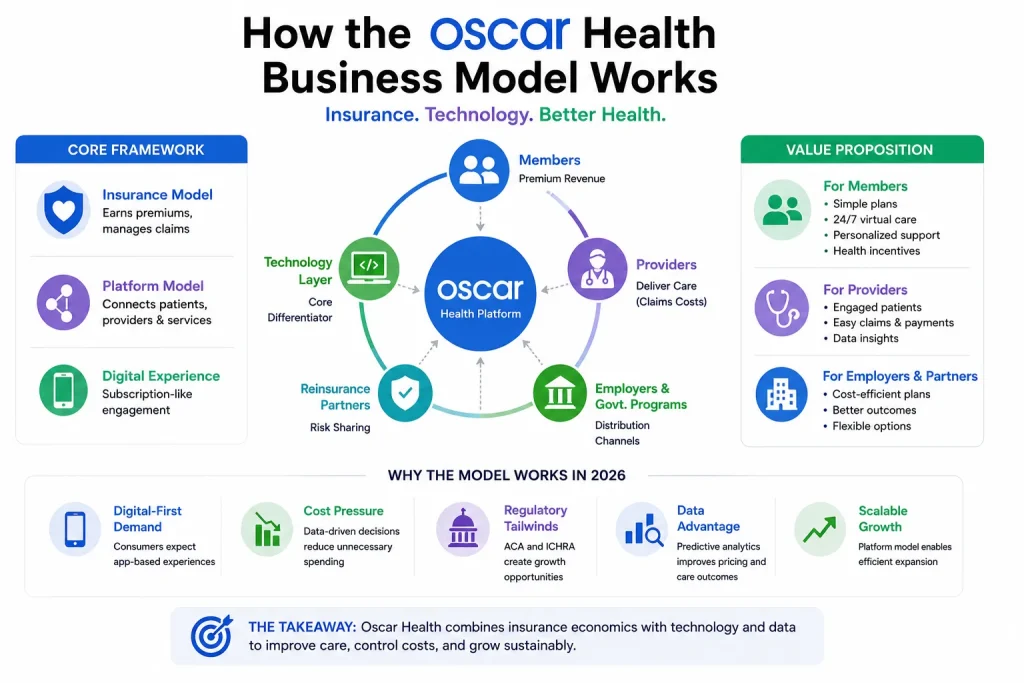
Oscar Health operates at the intersection of insurance, healthcare delivery, and technology, creating a hybrid model that blends traditional insurance economics with modern platform thinking.
At its core, Oscar isn’t just an insurer—it’s a digital health platform that monetizes risk while optimizing care delivery through data and user experience.
Core Framework of the Oscar Health Business Model
Type of Model
Oscar uses a Hybrid Model combining:
- Insurance (Risk-bearing model) → Earns premiums, manages claims
- Platform Model → Connects patients, providers, and services
- Subscription-like Experience → Monthly premiums with ongoing engagement
This hybrid approach allows Oscar to behave both as:
- A regulated financial entity (insurer)
- A scalable tech platform (health ecosystem enabler)
Value Proposition
Oscar creates distinct value for each stakeholder in its ecosystem:
For Consumers (Members):
- Simple, transparent insurance plans
- 24/7 virtual care access
- Personalized care navigation via app
- Incentives for healthy behavior
For Providers (Doctors & Hospitals):
- Access to digitally engaged patients
- Streamlined claims and payments
- Data insights for better care delivery
For Employers & Partners:
- Cost-efficient health plans
- Better employee engagement and outcomes
- Flexible insurance offerings (ICHRA, small group plans)
Key Stakeholders
Oscar’s ecosystem depends on balance between multiple players:
- Members (Patients) → Generate premium revenue
- Healthcare Providers → Deliver services and incur claims costs
- Employers & Government Programs → Distribution channels
- Reinsurance Partners → Risk-sharing mechanism
- Technology Layer (Oscar platform) → Core differentiator
This balance is critical—Oscar’s profitability depends on managing medical costs while improving user experience.
Why the Model Works in 2026
Oscar’s model aligns perfectly with current market dynamics:
- Digital-first healthcare demand → Consumers expect app-based experiences
- Cost pressure in healthcare → Oscar uses data to reduce unnecessary spending
- Regulatory tailwinds → ACA and employer-based innovations (ICHRA)
- Data advantage → Predictive analytics improves pricing and care outcomes
Read more : What is Oscar Health and How Does It Work?
Target Market & Customer Segmentation Strategy
Oscar Health’s growth isn’t accidental—it’s built on precise targeting, smart segmentation, and lifecycle-driven engagement.
Unlike traditional insurers that treat customers as policyholders, Oscar treats them as active users within a digital health ecosystem.
Core Customer Segments
Oscar operates across multiple segments, each with distinct needs and monetization logic:
1. Individual & Family Plans (ACA Marketplace)
- Demographics: Middle-income individuals, gig workers, freelancers
- Behavior: Price-sensitive, digitally savvy, underserved by traditional insurers
- Why they choose Oscar: Simplicity, transparency, app-based care
2. Small Businesses & Employers
- Demographics: SMBs, startups, distributed teams
- Behavior: Cost-conscious, focused on employee satisfaction
- Why they choose Oscar: Flexible plans (ICHRA), lower administrative burden
3. Medicare Advantage (Seniors)
- Demographics: Age 65+, often managing chronic conditions
- Behavior: Value personalized care and accessibility
- Why they choose Oscar: Care navigation, telehealth, simplified experience
4. Platform Clients (B2B – Oscar Platform)
- Demographics: Health systems, insurers, payers
- Behavior: Need tech infrastructure to scale operations
- Why they choose Oscar: White-label tech, claims processing, engagement tools
Customer Journey: From Discovery to Retention
Oscar has engineered a high-touch, data-driven lifecycle funnel:
1. Discovery
- Digital marketing (SEO, paid ads, ACA enrollment campaigns)
- Partnerships with brokers and employers
- Word-of-mouth via strong UX
2. Conversion
- Simple onboarding via mobile/web
- Transparent pricing and plan comparison
- Fast enrollment during ACA windows
3. Engagement
- Mobile app as central hub
- 24/7 virtual care access
- Health tracking and nudges
4. Retention
- Personalized care teams
- Preventive care incentives
- Continuous communication (alerts, reminders, insights)
Customer Acquisition Channels
Oscar uses a mix of direct and partner-driven growth channels:
- Direct-to-consumer (D2C):
- Search ads during enrollment periods
- Content marketing (education-based)
- Broker networks:
- Insurance agents recommending Oscar plans
- Employer partnerships:
- ICHRA and group plans
- Platform licensing (B2B):
- Other insurers using Oscar’s infrastructure
Customer Segment Analysis
| Segment | Key Need | Revenue Impact | Growth Potential |
| ACA Individuals | Affordable, simple plans | High volume | Very High |
| Employers (ICHRA) | Cost control + flexibility | High value | Rapid Growth |
| Medicare Advantage | Care management | Stable recurring | Moderate |
| Platform Clients (B2B) | Tech infrastructure | High margin | Strategic Growth |
Revenue Streams and Monetization Design
Now that we understand who Oscar serves, let’s break down how money actually flows through the system—and why its monetization model is more sophisticated than traditional insurers.
Oscar’s revenue model is built on a risk-based insurance engine layered with platform monetization, allowing it to generate income from both health coverage and technology services.
Primary Revenue Stream: Insurance Premiums
This is the backbone of Oscar’s business.
How It Works:
- Members pay monthly premiums for health coverage
- Oscar assumes financial risk for medical costs
- Profitability depends on managing the Medical Loss Ratio (MLR)
Key Insights:
- Accounts for ~85–90% of total revenue (2025–2026 estimates)
- Pricing is dynamically adjusted using predictive analytics and claims data
- Strong focus on preventive care reduces long-term costs
Growth Trajectory:
- Expansion in ACA markets and employer-based plans
- Increased enrollment via digital channels
- Improved underwriting → moving closer to sustained profitability
Secondary Revenue Streams
Oscar has strategically diversified beyond premiums to build a multi-layered revenue architecture:
1. Oscar Platform (B2B Technology Licensing)
Oscar licenses its tech infrastructure to:
- Health systems
- Insurance companies
- Payers
Revenue Model:
- SaaS-style fees
- Implementation + ongoing usage charges
High-margin, scalable, and less risk-heavy than insurance.
2. Employer-Based Plans (ICHRA & Small Group)
- Employers fund or subsidize employee insurance
- Oscar earns premiums + administrative fees
Faster-growing segment in 2026 due to:
- Shift toward flexible benefits
- Remote workforce expansion
3. Care Navigation & Virtual Care Services
- Integrated telehealth and care coordination
- Reduces claim costs while improving engagement
Indirect Monetization:
- Lower claims = higher margins
- Increased retention = higher lifetime value
4. Reinsurance & Risk Adjustment Programs
- Oscar participates in federal ACA risk adjustment systems
- Shares risk with reinsurance partners
Helps stabilize revenue and reduce volatility.
Read more : Oscar Health Revenue Model: How Oscar Health Makes Money in 2026
Operational Model & Key Activities
Behind Oscar Health’s sleek app and user-friendly experience lies a highly complex operational engine—one that blends insurance operations, healthcare coordination, and technology infrastructure into a single system.
This is where Oscar truly differentiates itself:
It operates like a tech company on the front end and a risk-management engine on the back end.
Core Operations
Oscar’s day-to-day business revolves around managing both healthcare delivery and financial risk.
1. Platform Management
- Mobile app and web platform maintenance
- Real-time user engagement (appointments, claims, support)
- Continuous UX improvements
The app acts as the central operating system for the entire business.
2. Insurance & Claims Processing
- Premium collection and policy management
- Claims validation and payouts
- Fraud detection and compliance
This is the financial core, where profitability is determined.
3. Care Delivery & Coordination
- Telehealth services (24/7 virtual care)
- Care teams guiding members through treatment
- Preventive care programs
Reduces unnecessary hospital visits and lowers costs.
4. Data & Analytics Engine
- Predictive modeling for risk assessment
- Personalized health recommendations
- Cost optimization algorithms
Data is continuously fed back into pricing and care decisions.
5. Customer Support & Engagement
- In-app chat and concierge-style support
- Health reminders and nudges
- Issue resolution and retention management
Oscar treats support as a growth lever, not just a service function.
6. Marketing & Enrollment Operations
- ACA enrollment campaigns
- Broker and employer onboarding
- Performance marketing during peak seasons
Resource Allocation Strategy
Oscar’s operational strength comes from strategic allocation of resources across tech, risk, and growth.
Estimated Allocation (2025–2026 Trends):
- Technology & Product Development (~25–30%)
- Platform engineering
- AI and data infrastructure
- UX/UI innovation
- Medical Costs (Largest Expense – ~75–80% of premiums)
- Provider payments
- Hospital and treatment costs
- Sales & Marketing (~10–15%)
- Customer acquisition
- Broker commissions
- Brand positioning
- Operations & Customer Support (~10%)
- Call centers
- Care teams
- Claims processing
- R&D & Innovation (~5–8%)
- New product lines
- Platform expansion (B2B tech)
Strategic Partnerships & Ecosystem Development
Oscar Health’s growth isn’t built in isolation—it’s powered by a carefully constructed ecosystem of partners that extend its capabilities, reduce risk, and accelerate scale.
In a highly regulated and complex industry like healthcare, partnerships aren’t optional—they are the foundation of sustainable growth.
Key Partnership Types
1. Technology & API Partners
- Cloud providers (AWS, Google Cloud)
- Health data platforms and EHR integrations
- AI and analytics tools
These partnerships power Oscar’s:
- Scalable infrastructure
- Real-time data processing
- Personalization capabilities
2. Payment & Financial Infrastructure
- Payment gateways for premium collection
- Claims processing systems
- Financial compliance partners
Ensures:
- Smooth transactions
- Regulatory compliance
- Faster reimbursements
3. Healthcare Providers & Networks
- Hospitals, clinics, and doctor networks
- Telehealth providers
- Specialty care partners
This is one of Oscar’s most critical partnerships:
- Determines care quality
- Directly impacts cost structure
4. Marketing & Distribution Partners
- Insurance brokers and agents
- Employer networks
- Digital acquisition platforms
These partners:
- Drive customer acquisition
- Expand reach across regions
Growth Strategy & Scaling Mechanisms
Oscar Health’s growth story is not about rapid expansion at all costs—it’s about controlled, data-driven scaling in a highly regulated environment.
Unlike typical startups, Oscar had to balance:
- Growth
- Risk exposure
- Regulatory compliance
And yet, it still managed to scale into a multi-billion-dollar digital insurer.
Growth Engines
Oscar uses a combination of organic, paid, and structural growth levers to expand its user base and revenue.
1. Organic Growth & Referral Loops
Oscar leverages its user experience as a growth channel:
- Seamless app experience → higher satisfaction
- Positive healthcare outcomes → trust-building
- Word-of-mouth referrals
In healthcare, trust = growth.
A better experience naturally drives organic acquisition.
2. Paid Marketing & Seasonal Acquisition
Oscar’s acquisition strategy is highly time-sensitive and targeted:
- Heavy investment during ACA enrollment periods
- Performance marketing (Google, social ads)
- Broker incentives and partnerships
Unlike typical apps, Oscar’s growth is seasonal but high-impact.
3. New Product Lines & Market Expansion
Oscar expands by layering new offerings:
- Medicare Advantage plans
- Employer-based insurance (ICHRA)
- Oscar Platform (B2B tech services)
This creates multiple growth vectors without relying on a single market.
4. Geographic Expansion Strategy
Oscar scales regionally with precision:
- Enters states with favorable ACA dynamics
- Builds localized provider networks
- Tests pricing models before full rollout
This minimizes risk while ensuring sustainable expansion.
Competitive Strategy & Market Defense
Oscar Health operates in one of the most competitive and entrenched industries—health insurance, dominated by giants like UnitedHealth, Aetna (CVS), and Humana.
Yet, Oscar carved out a strong position by competing differently, not directly.
Core Competitive Advantages
Oscar’s edge comes from combining technology, user experience, and data intelligence in ways traditional insurers struggle to replicate.
1. Network Effects & Switching Barriers
- More users → richer health data
- Better data → improved care recommendations
- Better outcomes → stronger retention
Over time, Oscar creates behavioral lock-in:
- Users get used to app-based care
- Switching back to traditional insurers feels outdated
2. Brand Equity & Customer Trust
Oscar positioned itself as:
“The health insurer that actually cares about users.”
Key drivers of trust:
- Transparent pricing
- Simple communication
- Digital-first experience
In healthcare, trust is a massive competitive moat.
3. Technology & Platform Innovation
Unlike legacy insurers relying on outdated systems, Oscar built:
- A modern, API-driven platform
- Real-time data processing capabilities
- Integrated telehealth and care navigation
This allows faster innovation cycles and better user experiences.
4. Data-Driven Personalization
Oscar uses data to:
- Predict health risks
- Recommend preventive care
- Optimize pricing and claims
This leads to:
- Lower costs
- Higher satisfaction
- Better retention
5. Compliance & Regulatory Strength
In healthcare, compliance is a competitive advantage.
Oscar has built:
- Strong regulatory relationships
- Scalable compliance systems
- Market-specific strategies
This creates barriers to entry for new startups.
Lessons for Entrepreneurs & Implementation
Oscar Health’s journey offers far more than inspiration—it provides a practical blueprint for building scalable, tech-driven businesses in complex industries.
If you’re a founder, this is where insight turns into action.
Key Factors Behind Oscar Health’s Success
1. Reimagining a Broken Industry
Oscar didn’t invent insurance—it reinvented the experience around it.
Lesson:
- Look for industries where users are frustrated
- Build a better interface + smarter system, not just a new product
2. Technology as a Core, Not a Layer
Oscar isn’t a traditional company “using tech”—it’s a tech company delivering insurance.
Lesson:
- Build your platform with technology at the center
- Avoid patching tech onto legacy processes
3. Data-Driven Decision Making
Every part of Oscar’s business—from pricing to care—is powered by data.
Lesson:
- Treat data as a strategic asset, not a byproduct
- Use it to optimize both user experience and profitability
4. Multi-Segment Expansion Strategy
Oscar didn’t stay limited to one segment:
- ACA → Employers → Medicare → Platform (B2B)
Lesson:
- Start focused, then expand into adjacent revenue streams
- Build an ecosystem, not a single product
5. Balancing Growth with Sustainability
Oscar shifted from “growth at all costs” to efficiency-first scaling.
Lesson:
- Prioritize unit economics early
- Scale only when your model is stable
Implementation Roadmap
Phase 1: Foundation
- Identify market gap and user pain
- Define core value proposition
- Build MVP with strong UX focus
Phase 2: Validation
- Acquire early users
- Collect behavioral and operational data
- Refine pricing and engagement strategies
Phase 3: Expansion
- Add new customer segments
- Introduce additional revenue streams
- Strengthen partnerships
Phase 4: Scale
- Optimize operations and margins
- Expand geographically
- Build ecosystem and platform layer
Ready to implement Oscar Health’s proven business model for your market?
Miracuves builds scalable platforms with tested business models and growth mechanisms.
We’ve helped 1500+ entrepreneurs launch profitable apps. Get your free business model consultation today.
Conclusion
Oscar Health’s business model proves that even the most traditional and complex industries can be transformed through technology, data, and user-first thinking. By reimagining insurance as a digital platform, Oscar didn’t just improve healthcare access—it created a scalable, efficient system that aligns user experience with profitability.
What makes the model truly powerful is its integration of insurance, care delivery, and technology into a single ecosystem. This allows Oscar to continuously optimize outcomes, reduce costs, and build long-term customer trust—something legacy players struggle to achieve.
For entrepreneurs, the takeaway is clear .The future belongs to platforms that simplify complexity, leverage data, and deliver seamless user experiences.
As platform economies continue to evolve in 2026 and beyond, businesses like Oscar Health highlight a critical shift—success will come not from disruption alone, but from rebuilding entire systems with smarter, scalable models.
FAQs
What type of business model does Oscar Health use?
Oscar Health uses a hybrid model combining insurance (risk-based) with a digital platform approach, integrating care delivery and technology.
How does Oscar Health’s model create value?
It simplifies healthcare through technology, transparency, and personalized care, improving user experience while reducing costs through data-driven decisions.
What are its key success factors?
Strong UX, data analytics, preventive care focus, and a multi-segment expansion strategy across ACA, employers, and B2B platforms.
How scalable is it?
Highly scalable due to its platform layer (Oscar Platform), allowing expansion beyond insurance into SaaS-like healthcare infrastructure.
What are the biggest challenges?
Managing medical costs, regulatory complexity, and balancing growth with profitability in a risk-heavy industry.
How can entrepreneurs adapt it to their region?
By digitizing traditional services, focusing on user experience + data optimization, and building partnerships in regulated markets.
What are alternatives to this model?
Traditional insurance models, healthcare marketplaces, or pure SaaS health platforms without risk-bearing components.
How has it evolved over time?
From a loss-heavy ACA insurer to a multi-revenue digital health platform, focusing on efficiency, partnerships, and B2B expansion.
Related Articles :-
Miracuves is an independent software development company. We are not affiliated with, connected to, sponsored by, or endorsed by any company or product named in this article.
Terms such as “X Clone” are used descriptively. It is how the software industry refers to building a platform with functionality comparable to a known service, and how clients search for it.
The entire design and codebase of our products is built by our own team. Our products contain no code, design, graphics, or content originating from any third-party website or applications.
All third-party names and marks referenced in this article are the property of their respective owners, referenced solely to identify the services discussed.