

Business model of Root Insurance has redefined how modern insurance platforms operate by challenging a century-old pricing system. Founded in 2015, Root scaled rapidly to generate over $1.52 billion in revenue by 2025, not by competing traditionally—but by transforming how risk is calculated in auto insurance. Instead of relying on outdated factors like age, credit score, or ZIP code, Root introduced a bold idea: pricing insurance based on actual driving behavior.
This shift toward data-driven underwriting turned Root into a leading InsurTech platform. By leveraging smartphone sensors, machine learning, and a fully digital experience, the company created a system that rewards safe drivers and filters high-risk users. The result is a smarter, fairer, and more efficient insurance model that aligns pricing with real-world behavior.
In 2026, business model of Root Insurance stands at the center of key trends like hyper-personalization, app-first ecosystems, and embedded finance. For founders building FinTech or AI-driven platforms, it offers a powerful blueprint—combining data, UX, and pricing innovation to achieve scalable growth.
How the Root Insurance Business Model Works
Root Insurance operates at the intersection of insurance, data science, and mobile-first platforms. At its core, it transforms a traditionally rigid industry into a dynamic, behavior-based pricing ecosystem.
Instead of asking who you are, Root focuses on how you behave. That single shift defines its entire business model.
Core Framework Overview
Root is best described as a hybrid InsurTech model combining:
- Usage-Based Insurance (UBI)
- Mobile-first platform
- Data-driven underwriting
- Direct-to-consumer (D2C) distribution
Unlike traditional insurers that rely on agents and static risk factors, Root uses real-time driving data collected via smartphone sensors to price policies.
Key Business Model Insights
1. Type of Model
Root operates on a Hybrid Model, blending:
- Subscription (Insurance Premiums) → Recurring monthly payments
- Data-Driven Personalization → Pricing based on driving behavior
- Direct Digital Platform → No intermediaries
This reduces overhead while improving pricing accuracy.
2. Value Proposition
Root delivers tailored value to each participant in its ecosystem:
For Customers (Drivers):
- Fair pricing based on actual driving habits
- Lower premiums for safe drivers
- Seamless mobile experience (quote → test drive → policy)
For the Company:
- Lower risk exposure through better underwriting
- Reduced fraud and claims volatility
- Higher retention from personalized pricing
For Partners (Reinsurers, Data Providers):
- Access to high-quality behavioral risk data
- More predictable loss ratios
3. Key Stakeholders
Root’s ecosystem is tightly interconnected:
- Drivers (Users) → Provide behavioral data + pay premiums
- Root Platform (Core Engine) → AI underwriting + pricing
- Reinsurance Partners → Absorb part of the financial risk
- Regulators → Ensure compliance across states
- Investors → Fuel growth and expansion
4. Evolution of the Model
Root’s model has evolved significantly since launch:
- 2015–2018: Focus on auto insurance + telematics testing
- 2019–2021: Rapid scaling + IPO phase + national expansion
- 2022–2024: Profitability focus, tighter underwriting, cost optimization
- 2025–2026: Expansion into embedded insurance, renters insurance, and financial services
5. Why It Works in 2026
Root’s model aligns perfectly with current market dynamics:
- Consumers demand fair, transparent pricing
- Smartphones enable continuous behavioral data collection
- AI allows real-time risk assessment
- Digital-first users prefer no-agent, app-based experiences
This creates a powerful combination:
Lower costs + better pricing + higher customer satisfaction
Read more : What Is Root Insurance and How Does It Work?
Target Market & Customer Segmentation Strategy
To truly understand Root Insurance’s success, you need to look beyond the product—and into who it serves and how it retains them.
Root doesn’t target everyone. Instead, it deliberately focuses on a high-value behavioral segment: safe, tech-savvy drivers who are underserved by traditional insurers.
Customer Segments Breakdown
1. Primary Segment: Safe, Digital-First Drivers
Root’s core audience includes:
- Drivers aged 25–45
- Urban and suburban smartphone users
- Individuals frustrated with unfair insurance pricing
- Customers comfortable with app-based financial services
These users are highly valuable because:
- They present lower risk
- They are more likely to complete the test drive onboarding
- They respond well to data-driven pricing incentives
2. Secondary Segment: Cost-Conscious & Underserved Drivers
Root also appeals to:
- Young drivers penalized by traditional models
- Drivers with limited credit history
- Gig economy workers (Uber, DoorDash, etc.)
- Price-sensitive customers switching providers
Root wins them by offering fairness over legacy bias.
Customer Journey: From Discovery to Retention
Root has engineered a frictionless, data-led journey:
1. Discovery
- Digital ads (social media, YouTube, app stores)
- Word-of-mouth from cost savings
- App store visibility (strong mobile-first positioning)
2. Conversion
- Users download the app
- Receive a personalized quote
This step acts as both:
- A qualification filter (only good drivers get offers)
- A data acquisition engine
3. Purchase
- Instant policy issuance within the app
- Transparent pricing breakdown
- No agent friction
4. Retention
- Continuous monitoring + dynamic pricing
- Rewards for safe driving behavior
- Easy claims and policy management
Retention is driven by perceived fairness + control.
Revenue Streams and Monetization Design
Now that we understand who Root targets, the next critical question is:
How does Root Insurance actually make money—and why is its monetization model so effective?
Root’s revenue model is deceptively simple on the surface, but highly sophisticated underneath, driven by data precision, risk selection, and layered monetization streams.
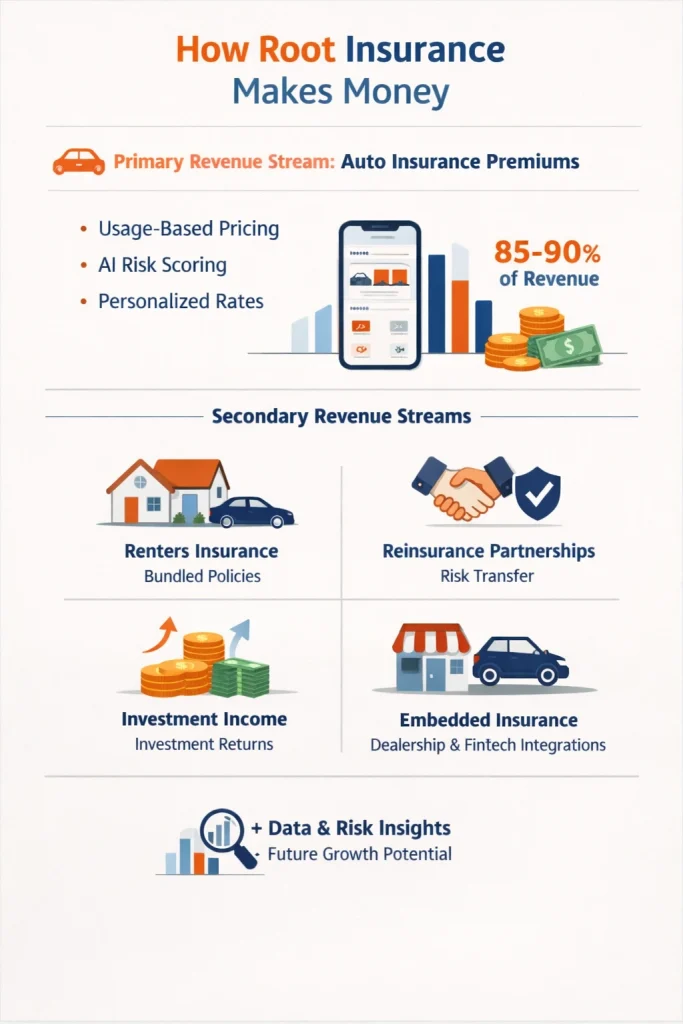
Primary Revenue Stream: Insurance Premiums
At its core, Root generates the majority of its revenue through auto insurance premiums.
Mechanism
- Customers pay monthly or semi-annual premiums
- Pricing is dynamically calculated based on:
- Driving behavior (speed, braking, turning, phone usage)
- Historical claims data
- AI-powered risk scoring
Pricing Model
- Personalized pricing (not pooled risk like traditional insurers)
- Safer drivers → lower premiums → higher retention
- Risky drivers are often filtered out during onboarding
Contribution
- Accounts for ~85–90% of total revenue (2025–2026 estimates)
- Core driver of long-term profitability
Growth Trajectory
- Revenue growth tied to:
- Expansion into new states
- Improved underwriting accuracy
- Higher policyholder retention
Unlike legacy insurers, Root grows by improving risk selection—not just increasing policy count.
Secondary Revenue Streams
1. Renters Insurance
- Cross-sold to existing auto customers
- Bundled discounts increase adoption
- Low-risk, high-margin product
Strengthens customer lifetime value (LTV)
2. Reinsurance Partnerships
- Root transfers part of its risk to reinsurers
- Earns revenue through structured agreements
This stabilizes earnings and reduces volatility.
3. Investment Income
- Premiums are invested in financial instruments
- Generates additional yield over time
A traditional insurance revenue layer enhanced by Root’s efficient capital allocation.
4. Embedded Insurance
- Integration with:
- Car dealerships
- Mobility platforms
- FinTech ecosystems
Insurance offered at the point of purchase or service usage
Read more : Root Insurance Revenue Model: How Root Insurance Makes Money in 2026
Operational Model & Key Activities
Behind Root Insurance’s sleek mobile experience lies a highly optimized operational engine—one that blends insurance fundamentals with cutting-edge technology and data science.
Unlike traditional insurers with heavy agent networks and manual processes, Root operates as a lean, tech-first organization, where automation and algorithms drive efficiency.
Core Operations
Root’s day-to-day operations revolve around five critical pillars:
1. Platform & App Management
- Continuous improvement of the mobile app (UX/UI)
- Real-time driving data collection via smartphone sensors
- Policy management, billing, and claims processing
The app is not just a channel—it’s the core operating system of the business.
2. AI Underwriting & Risk Modeling
- Machine learning models assess driver risk
- Telematics data feeds into dynamic pricing algorithms
- Continuous refinement of underwriting accuracy
This replaces traditional actuarial models with real-time intelligence.
3. Claims Management & Fraud Prevention
- Automated claims processing workflows
- AI-driven fraud detection systems
- Faster claim settlements → higher customer satisfaction
Efficiency here directly impacts profitability and trust.
4. Customer Support & Engagement
- In-app support and chat systems
- Minimal reliance on call centers
- Data-driven customer engagement (alerts, insights, rewards)
Lower support costs + better user experience.
5. Digital Marketing & Growth Operations
- Performance marketing campaigns (Google, Meta, TikTok)
- App install optimization
- Data-driven CAC (Customer Acquisition Cost) tracking
Marketing is tightly linked to unit economics and ROI.
Resource Allocation Strategy
Root allocates resources very differently compared to legacy insurers:
Technology & Data (30–40%)
- AI/ML infrastructure
- Mobile app development
- Cloud and data pipelines
Tech is the primary competitive advantage.
Marketing & Customer Acquisition (25–35%)
- Paid ads
- Brand campaigns
- Referral incentives
Highly optimized to acquire profitable users only.
Claims & Risk Management (15–25%)
- Claims payouts
- Fraud systems
- Risk mitigation tools
Directly tied to financial performance.
HR & Talent (10–15%)
- Data scientists
- Engineers
- Insurance experts
Strategic Partnerships & Ecosystem Development
Root Insurance doesn’t operate in isolation—it thrives as part of a broader InsurTech ecosystem. Its partnership strategy is designed to enhance data intelligence, reduce risk, and expand distribution channels without heavy infrastructure costs.
At its core, Root believes:
“The stronger the ecosystem, the smarter and more scalable the platform becomes.”
Collaboration Philosophy
Root builds partnerships that serve three strategic goals:
- Improve underwriting accuracy (better data)
- Expand distribution (more customers, lower CAC)
- Reduce financial risk (shared liability models)
Every partnership is evaluated based on how it strengthens data, distribution, or risk management.
Key Partnership Types
1. Technology & API Partners
- Telematics and mobile sensor technology providers
- Cloud infrastructure platforms (AWS, data pipelines)
- AI/ML tooling integrations
These partnerships enable real-time data processing and scalable infrastructure.
2. Payment & Financial Ecosystem Alliances
- Payment gateways for seamless premium collection
- Banking and FinTech integrations
- Embedded finance platforms
Supports frictionless transactions and recurring billing models.
3. Reinsurance & Risk-Sharing Partners
- Global reinsurers absorb part of underwriting risk
- Structured agreements to stabilize loss ratios
This is critical for capital efficiency and long-term sustainability.
4. Marketing & Distribution Partners
- Affiliate marketing networks
- App marketplaces and digital ad platforms
- Referral and influencer ecosystems
Helps reduce customer acquisition costs (CAC) while scaling reach.
Competitive Strategy & Market Defense
Root Insurance operates in one of the most competitive industries—insurance—where giants like GEICO, Progressive, and State Farm dominate with massive budgets and decades of brand trust.
Yet Root has carved out a strong position by rewriting the rules of competition itself.
Core Competitive Advantages
1. Data-Driven Network Effects
- More users → more driving data
- More data → better underwriting models
- Better models → more competitive pricing
This creates a self-reinforcing advantage that improves over time.
Unlike traditional insurers, Root’s edge compounds with every new customer.
2. Behavioral Switching Barriers
Root doesn’t just sell insurance—it builds a behavior-linked relationship:
- Users invest time in the “test drive” onboarding
- Pricing is personalized and dynamic
- Customers feel rewarded for safe driving
Switching to another insurer means losing personalized benefits
This creates a psychological and functional lock-in.
3. Brand Equity Around Fairness
Root’s brand is built on a simple but powerful promise:
“You pay for how you drive—not who you are.”
This resonates strongly with:
- Younger users
- Tech-savvy consumers
- Customers frustrated with legacy pricing models
Brand trust becomes a competitive moat, not just a marketing message.
4. Technology & Algorithmic Advantage
- AI-powered underwriting models
- Real-time telematics data processing
- Continuous learning systems
Traditional insurers struggle to replicate this due to:
- Legacy systems
- Organizational inertia
- Lack of behavioral data infrastructure
Lessons for Entrepreneurs & Implementation
Root Insurance isn’t just an InsurTech success—it’s a playbook for building modern, data-first platforms.
If you strip away the industry specifics, what remains are powerful, repeatable principles that any founder can apply—whether you’re building in FinTech, mobility, SaaS, or marketplaces.
Key Factors Behind Root’s Success
1. Redefining the Core Metric
Root didn’t optimize existing insurance models—it replaced them.
- Traditional insurers: Demographics-based risk
- Root: Behavior-based risk
This unlocked a completely new pricing logic.
2. Data as the Foundation (Not an Add-On)
- Real-time data collection from day one
- Continuous feedback loop (user → data → pricing → retention)
Data isn’t a feature—it’s the engine of the business.
3. Selective Customer Acquisition
- Root doesn’t target everyone
- It filters users during onboarding
This ensures profitability from the start, not after scaling.
4. Seamless Mobile-First Experience
- Entire journey inside the app
- No agents, no paperwork, no friction
UX becomes a competitive advantage, not just design.
5. Continuous Model Improvement
- AI models evolve with every user interaction
- Better data → better decisions → better margins
Implementation Timeline for Founders
Phase 1: Foundation
- Define your core value metric (what behavior matters?)
- Design a data collection system
- Build MVP with basic analytics
Phase 2: Validation
- Test pricing models
- Optimize onboarding funnel
- Identify high-value user segments
Phase 3: Scaling
- Automate decision-making systems
- Expand acquisition channels
- Introduce secondary revenue streams
Phase 4: Expansion
- Build partnerships
- Launch new products
- Enter new markets
Ready to implement Root Insurance’s proven business model for your market?
Miracuves builds scalable, data-driven platforms with tested business models and growth mechanisms.
We’ve helped 1500+ entrepreneurs launch profitable apps across industries. Get your free business model consultation today and turn your idea into a scalable digital ecosystem.
Conclusion
Root Insurance proves that true innovation happens when you challenge industry fundamentals—not just improve them. By shifting from static, demographic-based pricing to dynamic, behavior-driven intelligence, Root has built a model that is not only scalable but also sustainable in the long run.
Its journey highlights a bigger truth for 2026 and beyond:
The most successful platforms will be those that combine data, personalization, and seamless digital experiences into a self-improving system.
As platform economies evolve, the winners won’t just be the fastest—they’ll be the ones that learn, adapt, and price value more intelligently than anyone else.
FAQs
What type of business model does Root Insurance use?
Root uses a hybrid InsurTech model combining usage-based insurance, mobile-first distribution, and AI-driven underwriting. It focuses on behavioral data instead of traditional demographic factors.
How does Root Insurance’s model create value?
It creates value by offering fair, personalized pricing based on real driving behavior. This benefits safe drivers with lower premiums while improving risk accuracy for the company.
What are its key success factors?
Root’s success comes from data-driven decision-making, selective customer acquisition, and a seamless mobile experience. Its ability to continuously improve underwriting models is a major advantage.
How scalable is it?
Highly scalable, as the model improves with more data and users. Its digital-first infrastructure allows expansion without heavy operational costs like traditional insurers.
What are the biggest challenges?
Key challenges include regulatory complexity, high customer acquisition costs, and maintaining accurate data models. Early-stage loss ratios were also a hurdle.
How can entrepreneurs adapt it to their region?
Entrepreneurs can use behavior-based data and mobile platforms tailored to local markets. Adapting to regional regulations and data availability is crucial for success.
What are alternatives to this model?
Alternatives include traditional insurance models, subscription-based insurance, and peer-to-peer insurance platforms. However, most lack Root’s level of personalization.
How has it evolved over time?
Root evolved from a growth-focused startup to a profitability-driven platform, expanding into renters and embedded insurance while refining its underwriting models.
Related Articles
Miracuves is an independent software development company. We are not affiliated with, connected to, sponsored by, or endorsed by any company or product named in this article.
Terms such as “X Clone” are used descriptively. It is how the software industry refers to building a platform with functionality comparable to a known service, and how clients search for it.
The entire design and codebase of our products is built by our own team. Our products contain no code, design, graphics, or content originating from any third-party website or applications.
All third-party names and marks referenced in this article are the property of their respective owners, referenced solely to identify the services discussed.