


Tipalti didn’t just build a payments platform—it built the financial backbone for the global digital economy. The business model of Tipalti has transformed what started as a niche payables automation solution into a $8+ billion fintech powerhouse, processing over $40 billion annually in global payments.
At a time when businesses are expanding globally faster than ever, managing cross-border payments, tax compliance, and supplier onboarding has become a major bottleneck. Understanding how Tipalti works reveals how it solved this challenge by turning a fragmented, manual process into a seamless, automated ecosystem.
For modern founders, especially those building marketplaces, SaaS platforms, and global-first startups, analyzing the Tipalti revenue model is critical. It’s not just about payments—it’s about building infrastructure that scales with complexity. This is exactly the kind of scalable, compliance-driven platform architecture that Miracuves specializes in—helping entrepreneurs build systems that don’t break as they grow.
How the Tipalti Business Model Works
Tipalti operates as a B2B fintech SaaS platform that automates the entire accounts payable lifecycle—from supplier onboarding to global payouts and compliance. At its core, it transforms complex financial operations into a single, scalable system for businesses operating across borders.
Core Framework Overview
Tipalti isn’t just a payments processor—it’s an end-to-end financial operations platform designed for high-growth companies. It integrates deeply into a company’s financial stack, becoming a critical layer between finance teams, suppliers, and global banking systems.
Key Insights
1. Type of Model: Hybrid SaaS + Transaction-Based Fintech
- Subscription SaaS Model → Businesses pay for access to the platform (tiered pricing based on features and scale)
- Transaction Fees → Charges per payment, FX conversions, and processing
- Value-Added Services → Compliance, tax automation, and reporting modules
This hybrid structure ensures predictable recurring revenue + scalable transaction upside.
2. Value Proposition
For Businesses (Clients):
- Automates accounts payable workflows
- Reduces manual errors and compliance risks
- Enables global payments in 190+ countries
- Saves time and operational costs
For Suppliers / Payees:
- Self-service onboarding portal
- Multiple payment options (ACH, wire, PayPal, etc.)
- Faster, more reliable payments
- Built-in tax compliance (W-8, W-9, VAT, etc.)
For Finance Teams:
- Real-time visibility into cash flow
- Automated reconciliation and reporting
- ERP integrations (NetSuite, QuickBooks, SAP)
3. Stakeholders in the Ecosystem
- Businesses (Customers) → Use Tipalti to manage payouts
- Suppliers / Vendors → Receive payments globally
- Banks & Payment Networks → Execute transactions
- Regulatory Bodies → Compliance layer (tax + AML/KYC)
- Integration Partners → ERP/accounting platforms
Tipalti acts as the central orchestrator, ensuring all these stakeholders interact seamlessly.
4. Evolution of the Model
- Phase 1 (Early Years): Focused on mass payouts for digital businesses (ad networks, affiliate platforms)
- Phase 2: Expanded into full accounts payable automation
- Phase 3 (2023–2026):
- Added procurement and expense management
- Strengthened compliance and AI-driven financial workflows
- Positioned itself as a “Finance Automation Suite”
- Added procurement and expense management
5. Why It Works in 2026
- Globalization → Businesses operate across borders by default
- Compliance complexity → Increasing regulations demand automation
- SaaS adoption → Companies prefer integrated financial stacks
- Marketplace economy → Platforms need mass payout infrastructure
Read more : What Is Tipalti and How Does It Work
Target Market & Customer Segmentation Strategy
Tipalti’s growth is deeply rooted in its ability to identify high-friction financial workflows across industries and position itself as the default solution for scaling businesses. Instead of targeting everyone, it focuses on companies where payment complexity grows exponentially with scale.
Who Uses Tipalti — And Why They Stay
Tipalti primarily serves mid-sized to enterprise-level businesses, especially those operating globally or managing large volumes of payouts.
Primary Customer Segments
1. Digital Economy Platforms
- Ad networks (e.g., affiliate marketing platforms)
- Creator economy platforms
- Gaming and app monetization companies
These businesses handle thousands of micro-payments globally, making automation essential.
2. Marketplaces & On-Demand Platforms
- E-commerce marketplaces
- Freelance platforms
- SaaS platforms with partner ecosystems
Tipalti enables mass payouts + compliance at scale, a core requirement for marketplace success.
3. SaaS & High-Growth Tech Companies
- Scaling startups moving toward global operations
- Companies adopting ERP systems like NetSuite
They need financial infrastructure that grows with them, not spreadsheets.
Secondary Customer Segments
- Traditional enterprises digitizing finance operations
- Fintech platforms needing embedded payout infrastructure
- Global agencies managing vendor payments
Customer Journey: From Discovery to Retention
1. Discovery
- Content marketing (fintech insights, compliance guides)
- Partnerships with ERP platforms (NetSuite, Sage, etc.)
- Industry events and fintech communities
2. Conversion
- Demo-driven sales approach
- ROI-focused pitch (cost savings + efficiency gains)
- Integration feasibility (key decision factor)
3. Onboarding
- Guided implementation with ERP integration
- Supplier onboarding automation
- Compliance setup (tax + regulatory workflows)
4. Retention
- Deep system integration → high switching costs
- Continuous feature expansion (procurement, expenses)
- Data-driven insights improving financial decision-making
Revenue Streams and Monetization Design
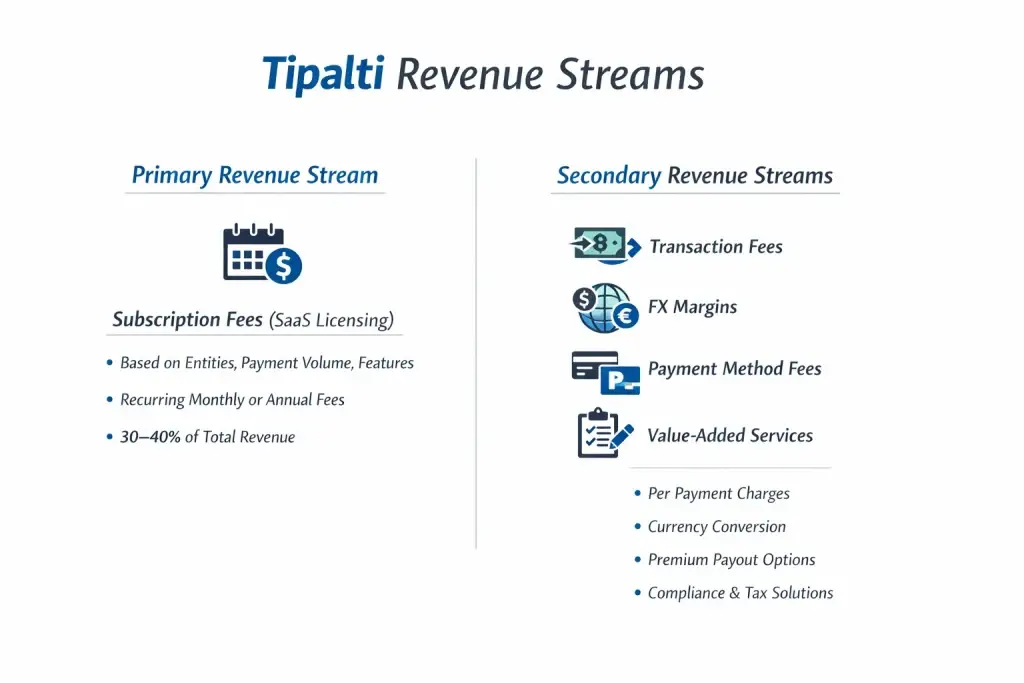
Now that we understand who Tipalti serves, the next layer is how it monetizes this ecosystem. Tipalti’s revenue model is a well-balanced hybrid of SaaS predictability and fintech transaction scalability—a structure that compounds revenue as customers grow.
Primary Revenue Stream
1. Subscription (SaaS Licensing Fees)
- Businesses pay a monthly or annual subscription
- Pricing varies based on:
- Number of entities
- Payment volume
- Features (AP automation, procurement, expenses, etc.)
- Number of entities
Why it matters:
- Provides predictable recurring revenue
- Anchors customer commitment to the platform
Estimated contribution: 30–40% of total revenue
Secondary Revenue Streams
2. Transaction Fees
- Charged per payment processed
- Includes:
- ACH transfers
- Wire transfers
- Global payout processing
High-volume clients generate significant transaction-based revenue
- ACH transfers
3. Foreign Exchange (FX) Margins
- Tipalti earns a spread on currency conversions
- Critical for cross-border payments
One of the highest-margin components of the model
4. Payment Method Fees
- Premium charges for specific payout methods:
- PayPal
- Prepaid debit cards
- Faster payouts
- PayPal
5. Value-Added Services
- Tax compliance automation (W-8/W-9 handling)
- Regulatory compliance (AML/KYC checks)
- Advanced reporting and analytics
- Supplier onboarding solutions
Read more : Tipalti Revenue Model: How Tipalti Makes Money in 2026
Operational Model & Key Activities
Behind Tipalti’s polished interface lies a highly sophisticated operational engine. This is where the real competitive advantage is built—not just in what the platform does, but how efficiently and reliably it delivers at scale.
The Operational Backbone
Tipalti operates as a financial infrastructure layer, meaning its daily operations must be:
- Highly secure
- Globally compliant
- Always available (near-zero downtime)
This requires a balance between technology, compliance, and customer experience.
Core Operations
1. Platform Management & Infrastructure
- Cloud-based SaaS architecture (high scalability)
- Real-time payment processing systems
- API integrations with ERP systems and banking networks
- Data security and encryption protocols
Ensures seamless financial operations across borders
2. Global Payment Execution
- Supports payments in 190+ countries and 120+ currencies
- Manages multiple payment rails:
- ACH
- Wire transfers
- eWallets (PayPal, etc.)
- ACH
- Handles settlement, reconciliation, and tracking
3. Compliance & Risk Management
- Tax compliance automation (W-8, W-9, VAT)
- AML (Anti-Money Laundering) checks
- KYC (Know Your Customer) verification
- Regulatory reporting across jurisdictions
This is a core differentiator, not just a support function
4. Supplier Onboarding & Experience
- Self-service onboarding portals
- Automated document collection and validation
- Payment preference management
Reduces friction while scaling supplier networks
5. Customer Support & Success
- Dedicated account management for enterprise clients
- Technical onboarding teams
- Continuous optimization and upselling support
6. Sales & Marketing Operations
- Enterprise sales teams handling long deal cycles
- Content-driven inbound strategy (finance automation thought leadership)
- Partner-led distribution via ERP ecosystems
Strategic Partnerships & Ecosystem Development
Tipalti’s growth isn’t just driven by its product—it’s powered by a carefully constructed ecosystem of partners that amplify its reach, credibility, and functionality. In fintech, no company scales alone, and Tipalti exemplifies this through a deeply interconnected partnership strategy.
Collaboration Philosophy
Tipalti operates on a simple but powerful principle:
“Embed into existing financial workflows instead of replacing them.”
Rather than forcing businesses to change systems, Tipalti integrates with the tools they already trust—making adoption faster and stickier.
Key Partnership Types
1. Technology & API Partners
- ERP systems: NetSuite, QuickBooks, Sage, SAP
- Accounting and financial software providers
- Open APIs for custom integrations
These partnerships place Tipalti at the center of financial operations
2. Payment & Banking Alliances
- Global banking partners for fund transfers
- Payment networks (ACH, SEPA, SWIFT)
- Digital wallets (PayPal and others)
Enables seamless cross-border transactions and currency handling
3. Compliance & Regulatory Partners
- Tax authorities and compliance databases
- Identity verification and KYC providers
- AML monitoring systems
Strengthens trust and ensures global regulatory alignment
4. Marketing & Distribution Partners
- ERP vendors acting as channel partners
- Fintech consultants and system integrators
- Industry-specific platforms (marketplaces, ad networks)
Drives high-quality inbound leads with lower acquisition costs
5. Strategic Expansion Alliances
- Regional partners for entering new markets
- Legal and financial advisory firms
- Enterprise solution providers
Helps Tipalti scale globally without building everything in-house
Ecosystem Strategy: The Bigger Picture
Tipalti doesn’t just build features—it builds infrastructure ecosystems.
Key Strategic Advantages:
- Network Effects: More integrations → more customers → more partners
- Partner Value Creation: Each partner enhances platform utility
- Embedded Monetization: Revenue flows through every integrated layer
- Switching Barriers: Deep ecosystem integration makes replacement difficult
Growth Strategy & Scaling Mechanisms
Tipalti’s rise to a multi-billion-dollar fintech leader didn’t come from rapid user acquisition alone—it came from strategic, compounding growth loops built around high-value customers and expanding financial needs.
The Growth Philosophy
Tipalti doesn’t chase virality like consumer apps. Instead, it focuses on:
“High-value, high-retention growth over high-volume acquisition.”
This results in:
- Longer sales cycles
- Higher deal sizes
- Stronger lifetime value (LTV)
Growth Engines
1. Partnership-Led Growth (Primary Engine)
- Deep integrations with ERP systems like NetSuite, Sage, QuickBooks
- Co-marketing and co-selling with partners
- Embedded positioning inside financial workflows
This creates a steady pipeline of qualified, high-intent customers
2. Enterprise Sales Strategy
- Dedicated sales teams targeting mid-market and enterprise clients
- ROI-driven sales pitches (cost savings, compliance reduction)
- Custom onboarding and integration support
Focus on quality over quantity
3. Content & Thought Leadership
- Finance automation reports and compliance guides
- SEO-driven inbound marketing
- Webinars, fintech insights, and CFO-focused content
Positions Tipalti as a trusted authority in financial operations
4. Product Expansion (Land & Expand Model)
- Entry point: Accounts payable automation
- Expansion into:
- Procurement
- Expense management
- Financial reporting
Each new module increases customer dependency and revenue
- Procurement
5. Geographic Expansion
- Focus on regions with high cross-border payment demand:
- North America (core market)
- Europe (regulatory-driven adoption)
- APAC (rapid digital growth)
- North America (core market)
Expansion is driven by compliance readiness + partner ecosystems
Scaling Challenges & How Tipalti Solved Them
1. Regulatory Complexity
Challenge: Different tax laws, payment regulations, and compliance requirements globally
Solution:
- Built automated compliance engines
- Partnered with local regulatory experts
- Continuously updated tax and AML systems
2. Infrastructure Scalability
Challenge: Handling billions in transactions with zero downtime
Solution:
- Cloud-native architecture
- Distributed payment processing systems
- Real-time monitoring and failover systems
3. Long Sales Cycles
Challenge: Enterprise deals take months to close
Solution:
- Strong ROI-based sales narrative
- Partner-driven lead generation
- Customer success teams accelerating onboarding
Competitive Strategy & Market Defense
In a crowded fintech landscape, Tipalti doesn’t compete on price—it competes on depth, reliability, and ecosystem control. Its strategy is not just to win customers, but to become irreplaceable infrastructure within their financial operations.
Core Competitive Advantages
1. High Switching Costs (Infrastructure Lock-In)
- Deep ERP integrations (NetSuite, SAP, QuickBooks)
- Embedded workflows across finance teams
- Supplier onboarding systems tied to payment processes
Once implemented, replacing Tipalti would require rebuilding entire financial operations
2. Network Effects in Financial Ecosystems
- More businesses → more suppliers onboarded
- More suppliers → more value for new clients
- More integrations → stronger ecosystem
This creates a self-reinforcing growth loop
3. Compliance as a Competitive Weapon
- Built-in global tax compliance (W-8, W-9, VAT)
- AML/KYC automation across jurisdictions
- Continuous regulatory updates
While competitors treat compliance as a feature, Tipalti makes it a core product pillar
4. Enterprise-Grade Trust & Brand Equity
- Trusted by high-growth and public companies
- Handles billions in annual transactions
- Strong reputation in CFO and finance communities
Trust is critical in fintech—and Tipalti has positioned itself as a safe, reliable choice
5. Data-Driven Financial Intelligence
- Real-time reporting and analytics
- Cash flow visibility across global operations
- Insights for better financial decision-making
Lessons for Entrepreneurs & Implementation
Tipalti’s journey offers a powerful blueprint for founders building in fintech, SaaS, or marketplace ecosystems. But the real value lies not in copying the model—but in understanding the principles behind its success and adapting them intelligently.
Key Factors Behind Tipalti’s Success
1. Solving a High-Friction, High-Stakes Problem
- Payments + compliance = mission-critical operations
- Errors can lead to financial loss or legal issues
Tipalti positioned itself where pain + risk = willingness to pay
2. Building for Scale from Day One
- Designed for global payments early
- Built compliance into the core product
- Created infrastructure, not just features
This allowed seamless expansion without rebuilding systems
3. Hybrid Monetization Model
- SaaS subscription + transaction-based revenue
- Monetization increases as customers grow
Aligns revenue with customer success
4. Deep Ecosystem Integration
- ERP integrations make Tipalti indispensable
- Embedded into workflows, not used as a standalone tool
Creates long-term retention and high switching costs
5. Land-and-Expand Strategy
- Start with one core solution (AP automation)
- Expand into adjacent financial products
Maximizes customer lifetime value (LTV)
Replicable Principles for Startups
If you’re building a platform today, here’s what you can take from Tipalti:
- Focus on complex problems others avoid
- Design your product as infrastructure, not a feature
- Build multiple revenue layers early
- Integrate with existing ecosystems instead of replacing them
- Create natural expansion paths within your product
Ready to implement Tipalti’s proven business model for your market?
Miracuves builds scalable platforms with tested business models and growth mechanisms.
We’ve served 6,000+ clients. Get your free business model consultation today.
Conclusion
Tipalti’s business model is a powerful reminder that true innovation doesn’t always mean creating something entirely new—it often means reimagining complex, broken systems and making them seamless at scale.
By combining SaaS predictability with fintech transaction scalability, Tipalti has built more than a product—it has created mission-critical infrastructure for the global digital economy. Its success lies in solving high-stakes problems, embedding deeply into workflows, and continuously expanding its ecosystem.
For entrepreneurs, the bigger lesson is clear: Sustainable growth comes from aligning your product with real operational needs, not just user convenience . As we move deeper into 2026, platform economies are evolving toward integrated, ecosystem-driven models—where the winners won’t just offer features, but own entire workflows and value chains.
FAQs
What type of business model does Tipalti use?
Tipalti uses a hybrid model combining SaaS subscriptions with transaction-based fintech revenue. This ensures recurring income plus scalable earnings as payment volumes grow.
How does Tipalti’s model create value?
It automates complex global payment workflows, reducing manual effort, errors, and compliance risks. Businesses save time and operate more efficiently at scale.
What are its key success factors?
Strong compliance infrastructure, deep ERP integrations, and a scalable global payment system. These make Tipalti reliable and hard to replace.
How scalable is it?
Highly scalable due to its cloud-based SaaS architecture and global payment network. Revenue grows naturally with customer expansion and transaction volume.
What are the biggest challenges?
Managing global regulations, maintaining infrastructure reliability, and handling long enterprise sales cycles. Tipalti addresses these through automation and partnerships.
How can entrepreneurs adapt it to their region?
Focus on a niche market with payment or compliance challenges, then build a simplified version. Start local and expand as demand grows.
What are alternatives to this model?
Alternatives include pure SaaS tools (like Bill.com) or payment processors (like Stripe). However, they often lack Tipalti’s full automation and compliance depth.
How has it evolved over time?
Tipalti started as a mass payout solution and expanded into a full finance automation suite. Today, it includes procurement, expenses, and advanced analytics.
Related Articles
Miracuves is an independent software development company. We are not affiliated with, connected to, sponsored by, or endorsed by any company or product named in this article.
Terms such as “X Clone” are used descriptively. It is how the software industry refers to building a platform with functionality comparable to a known service, and how clients search for it.
The entire design and codebase of our products is built by our own team. Our products contain no code, design, graphics, or content originating from any third-party website or applications.
All third-party names and marks referenced in this article are the property of their respective owners, referenced solely to identify the services discussed.