


When Alibaba launched Tmall (originally Taobao Mall), the goal was not to compete on price—it was to engineer trust, brand credibility, and premium commerce at scale. In a market flooded with C2C sellers and counterfeit concerns, Tmall positioned itself as the destination for verified brands, official stores, and quality assurance. That strategic choice reshaped China’s e-commerce landscape.
By 2025, Tmall sits at the center of Alibaba’s digital commerce empire, acting as the primary growth engine for global and domestic brands targeting China’s middle and upper-income consumers. Its business model blends brand-controlled storefronts, data-driven advertising, logistics integration, and ecosystem leverage—making it far more than a simple marketplace.
For entrepreneurs building marketplaces, D2C platforms, or brand-led commerce apps, the business model of Tmall offers powerful lessons in monetization design, ecosystem orchestration, and scalable trust infrastructure. It shows how platforms win not by owning inventory, but by owning demand, data, and distribution intelligence.
How the Tmall Business Model Works
Tmall is best understood as a premium B2C marketplace layer inside Alibaba’s commerce ecosystem. It doesn’t mainly “sell products” itself—instead, it hosts official brand storefronts and uses Alibaba’s traffic, data, and logistics rails to help brands convert demand into repeat purchases. The platform’s job is to keep the ecosystem balanced: buyers get authenticity + fast delivery, brands get trusted distribution + performance marketing, and Alibaba monetizes the attention and tools that make it all work.
Type of Model
- B2C Marketplace (Platform Model)
- Advertising-led monetization (attention → revenue)
- Ecosystem hybrid: marketplace + brand services + logistics + payments + data intelligence
Value Proposition
For consumers (buyers)
- Verified brands and official stores → higher trust
- Better product quality signals (flagships, reviews, authenticity programs)
- Faster, more reliable delivery via Alibaba logistics integrations
- A “premium shopping mall” experience vs price-chaos marketplaces
For brands and merchants (sellers)
- Massive demand concentration (high-intent shoppers)
- Full-funnel performance marketing tools (search + discovery + live commerce)
- Data and insights to optimize products, pricing, and campaigns
- Scalable storefront + customer engagement features (membership, CRM-style targeting)
For partners (ecosystem players)
- Logistics partners: consistent volume + SLA-driven fulfillment
- Payment and fintech rails: Alipay-based conversion + consumer finance options
- Influencers/creators: monetization via affiliate + live shopping formats
Stakeholders and Their Roles
- Consumers: attention + purchasing power (the demand engine)
- Brands/authorized merchants: supply quality + assortment depth
- Alibaba platform: traffic allocation, rules, trust systems, ad marketplace, tooling
- Logistics networks: delivery speed + reliability (critical to retention)
- Creators/affiliates: demand generation + conversion acceleration (especially in campaigns)
Evolution Over Time
- Phase 1: Build trust and separate “brand commerce” from C2C chaos
- Phase 2: Scale brand onboarding + standardize store governance
- Phase 3: Shift growth from “more listings” to better conversion using ads, data, and content formats
- Phase 4 : Stronger content-commerce (live shopping, short video), smarter personalization, deeper CRM/membership mechanics, and more brand-first tools
Why It Works Today (2025 Context)
- Consumers want trust + speed (authenticity and dependable fulfillment are non-negotiable)
- Brands need measurable ROI marketing, not just “a place to list products”
- Platform competition rewards ecosystems that can combine:
- Traffic (demand)
- Data (precision targeting)
- Tools (merchant growth stack)
- Infrastructure (payments + logistics)
Read more : What is Tmall and How Does It Work?
Target Market & Customer Segmentation Strategy
Tmall’s scale is impressive, but its real strength lies in how precisely it segments users and aligns each segment with monetization levers. Unlike mass marketplaces that chase everyone, Tmall is optimized for brand-conscious, quality-driven consumers and merchants willing to pay for performance, data, and trust.
Primary Customer Segments
1. Urban, middle-to-high income consumers
- Demographics: Tier 1–3 Chinese cities, digitally native, brand-aware
- Behavior:
- Prefer official brand stores over resellers
- Value authenticity, warranties, and post-sale support
- Respond strongly to promotions, festivals, and live commerce
- Retention drivers:
- Fast delivery
- Membership benefits
- Personalized recommendations
2. Global and domestic brands (core revenue drivers)
- Large FMCG, electronics, fashion, beauty, and luxury brands
- Motivations:
- Immediate access to China’s demand
- Lower market-entry friction vs physical retail
- Data-driven insight into consumer behavior
- Willingness to pay:
- Platform fees
- Advertising spend
- Campaign participation fees
Secondary Customer Segments
3. Emerging and digital-native brands
- D2C brands testing China market entry
- Use Tmall as:
- A validation channel
- A scalable alternative to offline distribution
- Often start with lower visibility, then scale via ads and influencer partnerships
4. Content creators and live-commerce hosts
- Influencers, KOLs, and affiliate sellers
- Drive discovery and conversion through:
- Live streaming
- Short-form video
- Product storytelling
- Monetize through commissions and brand partnerships
Customer Journey Mapping
Discovery
- Search ads
- Algorithmic recommendations
- Live-stream events and mega shopping festivals
Conversion
- Trust signals (flagship badges, reviews, guarantees)
- Time-bound promotions and influencer endorsements
- Seamless checkout via Alipay
Retention
- Membership tiers and brand loyalty programs
- Personalized offers using first-party data
- Fast returns and consistent delivery experiences
Acquisition Channels by Segment
- Consumers: search, recommendations, festivals, influencer content
- Brands: Alibaba sales teams, ecosystem onboarding programs
- Creators: affiliate programs, platform incentives
Market Positioning Analysis
Tmall positions itself as:
- The default premium B2C channel in China
- A “digital shopping mall” rather than a discount bazaar
- The safest route for international brands entering China
Competitive Edge
- Strong trust infrastructure
- Deep data + ad tooling integration
- Ecosystem lock-in with payments, logistics, and marketing
Differentiation Strategy
- Quality control over quantity
- Monetizing visibility and performance—not just transactions
- Blending commerce with content at scale
Revenue Streams and Monetization Design
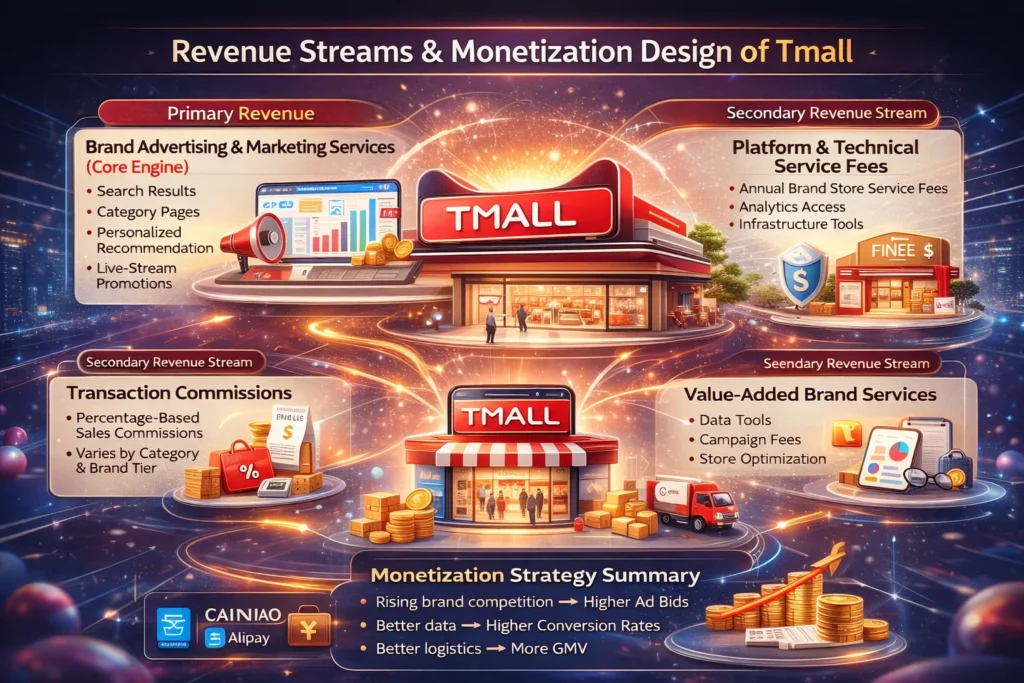
Tmall’s monetization engine is deliberately designed to scale with brand success, not consumer friction. Instead of maximizing commissions alone, Tmall turns traffic, data, and competition for visibility into high-margin revenue streams. This is why its model remains resilient even when consumer spending cycles fluctuate.
Primary Revenue Stream: Brand Advertising & Marketing Services (Core Engine)
This is Tmall’s largest and fastest-growing revenue driver.
Mechanism
- Brands bid for visibility across:
- Search results
- Category pages
- Personalized recommendation feeds
- Live-stream and content placements
- Ad delivery is performance-optimized using Alibaba’s data stack.
Pricing Model
- Cost-per-click (CPC)
- Cost-per-impression (CPM)
- Auction-based bidding for premium placements
Revenue Contribution
- Represents the majority of Tmall’s direct revenue
- Extremely high-margin due to digital delivery
Growth Trajectory
- Rising brand competition
- Increased dependence on paid visibility
- Expansion of AI-driven ad formats
Secondary Revenue Stream 1: Platform & Technical Service Fees
Mechanism
- Annual service fees charged to brands for operating official stores
- Includes access to analytics, storefront tools, and infrastructure
Pricing Model
- Fixed yearly fees (category and brand dependent)
Why It Matters
- Predictable recurring revenue
- Acts as a quality filter, keeping out low-commitment sellers
Secondary Revenue Stream 2: Transaction Commissions
Mechanism
- Percentage fee on completed sales
- Varies by category and brand tier
Contribution
- Smaller share compared to ads
- Scales directly with GMV growth
Secondary Revenue Stream 3: Value-Added Brand Services
Examples
- Data analytics and consumer insight tools
- Campaign participation fees (Singles’ Day, brand festivals)
- Store design, optimization, and consulting services
Why Brands Pay
- Direct link between spend and conversion uplift
- Access to Alibaba’s demand intelligence
Secondary Revenue Stream 4: Ecosystem Cross-Monetization
Includes
- Payment processing via Alipay
- Logistics fees through Cainiao partners
- Financing, insurance, and merchant credit tools
Monetization Strategy Summary
Tmall’s revenue streams are interconnected and reinforcing:
- More brands → more competition → higher ad bids
- Better data → higher conversion → higher ad ROI
- Better logistics → better retention → more GMV
Pricing Psychology
- Pay-for-performance reduces risk perception for brands
- Tiered tools encourage gradual upselling
- Visibility scarcity drives competitive spending
Operational Model & Key Activities
Behind Tmall’s massive GMV numbers is a highly systemized operational machine. The platform itself stays asset-light, while orchestrating technology, data, governance, and partner execution at scale. Tmall’s operational excellence lies in coordination, automation, and rule enforcement, not inventory ownership.
Core Operations
Platform Management
- Merchant onboarding and verification
- Store governance and quality scoring
- Policy enforcement for counterfeit prevention and service SLAs
Technology Infrastructure
- High-availability marketplace platform
- AI-driven recommendation and search engines
- Real-time bidding systems for advertising
- Data pipelines integrating behavior, conversion, and logistics signals
Quality Control & Trust Systems
- Brand authentication programs
- Review and rating moderation
- Anti-fraud and counterfeit detection
- Seller performance scoring tied to visibility
Customer & Merchant Support
- Dispute resolution frameworks
- Brand account management teams
- Automated support via AI + human escalation
Marketing & Demand Generation
- Mega shopping festivals (Singles’ Day, 618)
- Influencer and live-commerce campaigns
- Cross-platform traffic from Alibaba ecosystem
Resource Allocation Strategy (2025 View)
- Technology & Data: Heavy investment in AI, personalization, ad systems
- Marketing: Concentrated spending around major festivals
- Human Capital: Product, data science, merchant success, policy teams
- R&D: Continuous experimentation in content-commerce formats
- Geographic Focus: City-tier penetration and cross-border enablement
Operational Philosophy
- Stay asset-light, scale coordination
- Automate decision-making wherever possible
- Use data to reward quality and consistency
- Let partners handle execution, but control standards
Strategic Partnerships & Ecosystem Development
Tmall’s dominance is not built in isolation. Its true power comes from ecosystem orchestration—strategically aligning partners so that each participant strengthens the platform’s value for everyone else. Rather than vertically integrating everything, Tmall focuses on controlling standards, data, and traffic, while partners execute specialized functions.
Collaboration Philosophy
Tmall partners where partners can move faster or operate more efficiently—while Alibaba retains control over:
- Consumer access
- Data intelligence
- Platform rules
- Monetization levers
This creates a win–win structure: partners gain scale and predictability, and Tmall gains flexibility and speed .
Key Partnership Types
1. Technology & API Partners
- CRM, analytics, and marketing automation providers
- AI and data tools integrated into merchant dashboards
- Enable brands to optimize conversion and retention
2. Payment & Fintech Alliances
- Deep integration with Alipay
- Consumer credit, BNPL, and installment products
- Merchant financing and working capital tools
3. Logistics & Fulfillment Partners
- Cainiao network orchestration
- Third-party warehouses and last-mile carriers
- SLA-based delivery performance tied to store ranking
4. Marketing & Distribution Partners
- Influencers, MCNs, and live-stream studios
- Affiliate networks and content creators
- Offline-to-online retail integrations
5. Regulatory & Expansion Alliances
- Cross-border trade facilitators
- Customs, compliance, and tax partners
- Local governments for infrastructure support
Ecosystem Strategy Insights
- Network effects: More brands → more content → more buyers → more data → better ads
- Partner value creation: Partners earn through volume and specialization
- Monetization: Tmall monetizes access, data, and performance—not execution labor
- Competitive moat: High switching costs due to deep operational integration
This ecosystem-first approach makes Tmall extremely difficult to replicate without massive capital, data scale, and trust infrastructure.
Read more : Best Tmall Clone Scripts 2025: Build Your Scalable E-commerce Empire
Growth Strategy & Scaling Mechanisms
Tmall’s growth has never relied on a single lever. Instead, it combines traffic concentration, data leverage, ecosystem expansion, and brand dependency into a compounding growth engine. By 2025, its focus has shifted from raw user growth to higher monetization per user and per brand.
Core Growth Engines
1. Organic Virality & Habit Formation
- Shopping festivals (Singles’ Day, 618) create recurring demand spikes
- Personalized feeds drive daily engagement
- Membership programs increase repeat purchase frequency
2. Paid Acquisition & Brand-Led Growth
- Brands fund their own growth via advertising
- Performance-based ads reduce wasted spend
- Higher ROI leads to increasing brand budgets
3. Content-Commerce Expansion
- Live streaming and short-form video
- Influencer-driven discovery
- Entertainment → impulse → conversion loop
4. New Product & Service Lines
- Advanced CRM and data products for brands
- Cross-border commerce tooling
- Deeper integration with Alibaba’s cloud and AI stack
5. Geographic Scaling
- Penetration into lower-tier cities
- Enabling global brands to enter China digitally
- Supporting Chinese brands’ overseas expansion
Scaling Challenges & Solutions
Challenge: Operational Complexity
- Millions of SKUs, brands, and campaigns
Solution: Automation, AI moderation, standardized tooling
Challenge: Rising Customer Acquisition Costs
- Increased competition for attention
Solution: Algorithmic personalization and content-driven discovery
Challenge: Regulatory & Compliance Pressure
- Data protection, consumer rights
Solution: Platform governance, compliance tooling, proactive partnerships
Why the Model Scales
- Costs grow sub-linearly compared to GMV
- Monetization grows with competition, not inventory
- Data compounds with usage
Competitive Strategy & Market Defense
Tmall operates in one of the most competitive digital commerce environments in the world. Its ability to defend market leadership comes from layering multiple advantages—technical, economic, and behavioral—into a resilient competitive moat.
Core Competitive Advantages
1. Network Effects
- More brands attract more consumers
- More consumers generate better data
- Better data improves targeting and conversion
- Higher ROI pulls in more brand spend
2. High Switching Costs
- Brands build:
- Custom storefronts
- CRM data
- Advertising history
- Logistics workflows
- Leaving Tmall means losing accumulated demand intelligence
3. Brand Equity & Trust
- Strong consumer perception of authenticity
- Official brand verification and enforcement
- Premium positioning vs price-driven platforms
4. Technology & Algorithmic Advantage
- Advanced recommendation engines
- Real-time ad auctions
- Conversion-optimized search and feeds
5. Data-Driven Personalization
- First-party data across browsing, purchase, and content
- Enables precise segmentation and pricing experiments
Market Defense Tactics
Handling New Entrants
- Rapid feature replication
- Preferential traffic allocation to high-quality brands
- Lock-in via exclusive campaigns and tools
Managing Pricing Wars
- Compete on value, not discounts alone
- Shift focus to brand storytelling and experience
- Promote premium categories and loyalty
Strategic Moves
- Partnerships with top brands and creators
- Ecosystem expansion instead of price undercutting
- Continuous innovation in content formats
Tmall doesn’t try to win by being cheapest—it wins by being most dependable, most data-rich, and most integrated.
Lessons for Entrepreneurs & Implementation
This is where Tmall’s story becomes most valuable for founders. Its success isn’t about scale alone—it’s about designing incentives, trust, and monetization so they reinforce each other over time. Entrepreneurs can’t copy Tmall’s scale, but they can replicate its principles.
Key Factors Behind Tmall’s Success
- Trust-first positioning before monetization
- Monetizing visibility and performance, not just transactions
- Keeping the platform asset-light while partners execute
- Using data as the core competitive asset
- Building an ecosystem, not a single product
Replicable Principles for Startups
1. Segment Your Market Ruthlessly
- Don’t serve everyone
- Choose high-value users and optimize for them
2. Monetize Where Value Is Created
- Charge sellers when they win (ads, leads, conversions)
- Reduce upfront friction to increase participation
3. Build Trust as Infrastructure
- Verification, ratings, and governance systems
- Trust compounds like a network effect
4. Design for Ecosystem Lock-In
- CRM, analytics, and workflow tools
- Make your platform “hard to leave”
Common Mistakes to Avoid
- Over-reliance on commissions
- Scaling supply before demand
- Ignoring quality control
- Treating marketing as a cost instead of a revenue driver
Adapting Tmall’s Model for Local or Niche Markets
- Focus on a single category first (fashion, food, services)
- Start with curated sellers instead of open listings
- Introduce paid visibility only after liquidity is achieved
- Use content (video, live) early to reduce CAC
Ready to implement Tmall’s proven business model for your market?
Miracuves builds scalable platforms with tested business models and growth mechanisms. We’ve helped 200+ entrepreneurs launch profitable apps.
Get your free business model consultation today.
Conclusion :
Tmall proves that the most powerful platforms are not built by chasing transactions, but by engineering ecosystems where trust, data, and incentives compound over time. Its business model shows how marketplaces can evolve beyond simple buyer–seller matching into intelligent commerce engines that monetize attention, performance, and long-term relationships.
For founders in 2025, the deeper lesson is this: scale alone is not a strategy. Sustainable growth comes from aligning user success with platform revenue, designing for quality before quantity, and treating data as a strategic asset rather than a byproduct.
As platform economies mature, the winners will not be the cheapest or the loudest—but the ones that execute with discipline, foresight, and ecosystem thinking. Tmall’s journey offers a clear blueprint for what the next generation of digital marketplaces must become.
FAQs :
What type of business model does Tmall use?
Tmall operates a B2C marketplace business model focused on official brand stores. It combines marketplace infrastructure with advertising-led monetization, data services, and ecosystem partnerships.
How does Tmall’s business model create value?
Tmall creates value by connecting brand-trusted supply with high-intent consumers, then amplifying conversion through data-driven ads, logistics integration, and content commerce.
What are Tmall’s key success factors?
Trust infrastructure, massive demand concentration, advanced data and advertising systems, strong ecosystem partnerships, and an asset-light operating model.
How scalable is Tmall’s business model?
Highly scalable. Costs grow sub-linearly compared to GMV, while monetization increases with brand competition and data depth.
What are the biggest challenges in Tmall’s model?
Rising competition for attention, regulatory compliance, and maintaining quality control at massive scale.
How can entrepreneurs adapt Tmall’s model to their region?
By focusing on a niche category, curating sellers, building trust systems early, and monetizing visibility after liquidity is achieved.
What resources and timeframe are needed to launch a similar model?
An MVP can be built in 6–9 months, with full monetization layers developing over 18–24 months depending on scale and category.
What are alternatives to Tmall’s business model?
Open marketplaces (like Taobao), D2C platforms, subscription commerce models, or social commerce-first platforms.
How has Tmall’s business model evolved over time?
It evolved from a brand-verification layer into a data-driven, content-powered commerce ecosystem monetizing performance rather than listings.
Related Article :