



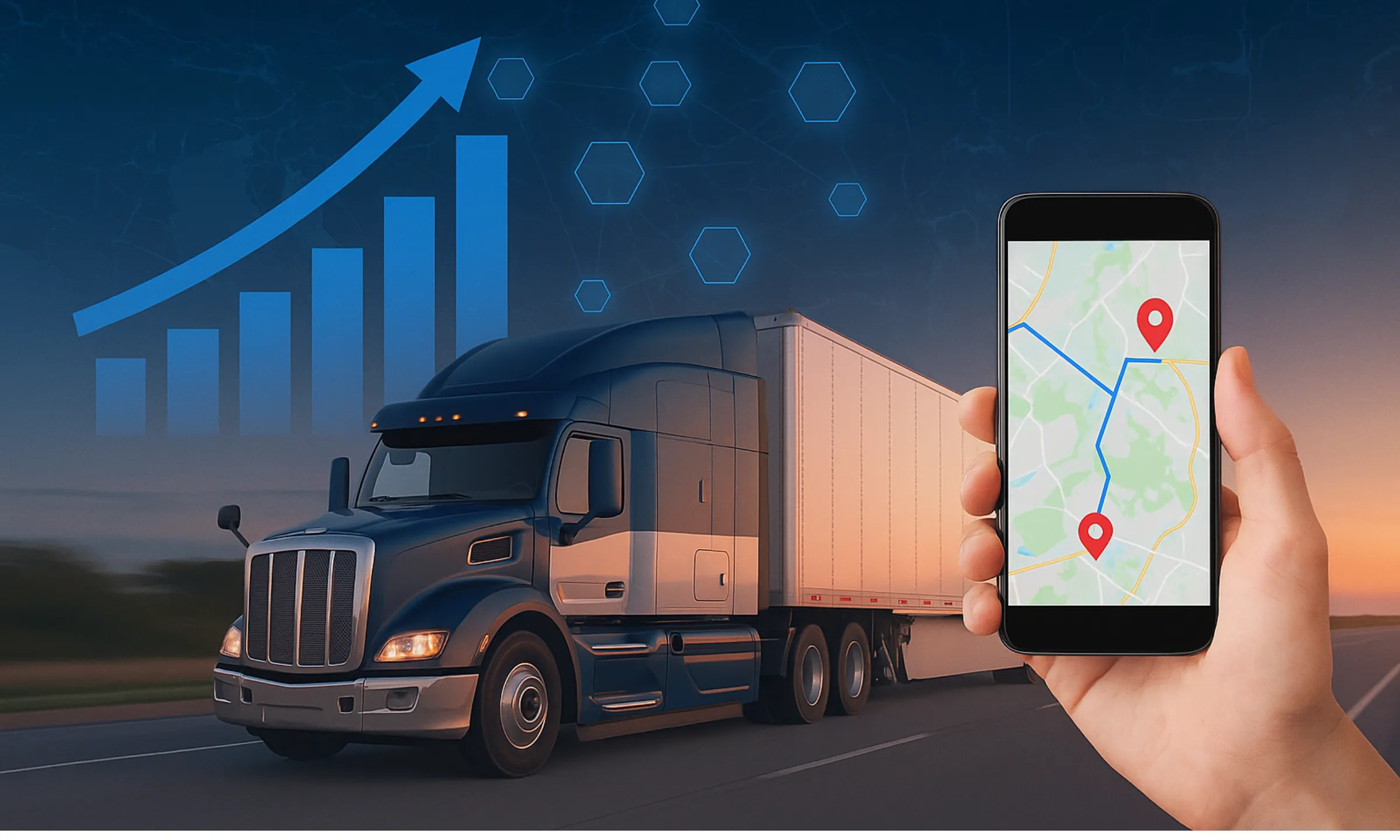
In an industry where every mile costs money and every delay erodes margins, Trucker Path transformed how professional drivers navigate, refuel, park, and plan routes. It didn’t grow through flashy consumer marketing or venture-fueled burn—it scaled by embedding itself directly into the daily survival workflow of truck drivers.
Today in 2025, Trucker Path is no longer just a mobile app. It operates as a data-driven logistics intelligence platform, feeding real-time insights into parking availability, fuel pricing, route hazards, weigh stations, and freight visibility. Its evolution represents one of the most powerful examples of utility-first platform growth in the logistics tech ecosystem.
Studying the Business Model of Trucker Path is essential for modern founders building These solutions span logistics and mobility platforms, data-powered marketplaces, SaaS tools for blue-collar industries, and location-based, network-effect–driven applications.
In the sections ahead, we’ll break down how Trucker Path works as a business, how it monetizes its ecosystem, how it defends its market, and what entrepreneurs can directly replicate from its strategy using scalable white-label platforms built by Miracuves.
How the Trucker Path Business Model Works
At its core, Trucker Path operates as a hybrid digital platform combining a freemium mobility app, a data intelligence SaaS layer, and a logistics marketplace connector. What makes its model powerful is that it doesn’t sell “technology” first—it sells daily operational survival for truck drivers, and then monetizes the intelligence generated from that behavior.
Instead of acting like a traditional freight marketplace, Trucker Path positions itself as a driver-first navigation and planning utility, which naturally generates massive real-time logistics data. This data then becomes the foundation for monetization, partnerships, and premium intelligence services.
Type of Business Model
- Freemium Platform Model – Core app features are free for mass adoption.
- Subscription Intelligence Model – Advanced features unlocked via paid plans.
- Data Monetization & Partner Network Model – Fuel stops, parking operators, advertisers, and service providers monetize traffic.
- Logistics Enablement Platform – Integrates parking, fueling, routing, and freight signals into a unified ecosystem.
This hybrid structure allows Trucker Path to scale users first, then systematically layer revenue without degrading the core experience.
Value Proposition by User Segment
For Truck Drivers
- Real-time truck parking availability
- Live fuel prices and route optimization
- Dynamic weigh station and hazard alerts
- Trip planning with restrictions and compliance
- Community-generated road intelligence
For Truck Stops & Parking Operators
- Guaranteed digital foot traffic
- Real-time space visibility
- Targeted promotions to nearby drivers
- Data insights on traffic patterns
For Advertisers & Service Partners
- Hyper-local, location-based targeting
- Verified commercial driver audience
- High-intent engagement near purchase decision points
For Logistics Ecosystem (Indirect)
- Smarter load coordination
- Reduced idle miles
- Improved time-to-delivery accuracy
Key Stakeholders Powering the Ecosystem
- Truck Drivers – Primary data generators and core demand side.
- Truck Stops & Parking Providers – Supply-side monetization partners.
- Fuel Stations & Service Vendors – Localized commerce partners.
- Technology & Map API Providers – Infrastructure enablers.
- Advertisers & Logistics Brands – Revenue-driving sponsors.
Each stakeholder benefits differently, but all depend on the same live driver activity loop, which continuously refreshes platform data.
Why the Trucker Path Model Works in 2025
- Freight volatility and fuel price instability demand real-time intelligence
- Parking shortages have worsened due to infrastructure constraints
- Compliance regulations require route-level precision
- Drivers increasingly depend on single-stack super-apps
- Logistics brands crave verified, location-based B2B ad channels
Trucker Path sits precisely at the intersection of mobility + commerce + intelligence, making it structurally aligned with modern freight behavior in 2025.
Read more : What Is Trucker Path Loadboard and How Does It Work?
Target Market & Customer Segmentation Strategy
Trucker Path’s growth is rooted in a laser-focused understanding of one primary user: the professional truck driver. Instead of chasing broad logistics audiences early, the platform mastered one narrow but high-impact segment, then expanded outward into adjacent commercial ecosystems.
Its segmentation strategy follows a bottom-up adoption → top-down monetization pattern, where daily driver usage creates data gravity that attracts enterprise partners.
Primary Customer Segment: Professional Truck Drivers
This is Trucker Path’s backbone and largest user base.
Demographics & Behavior
- Long-haul and regional CDL drivers
- Independent owner-operators and fleet drivers
- Heavy interstate and cross-border route usage
- Mobile-first, utility-driven app consumption
- High sensitivity to fuel, time, and parking availability
Why They Stay
- Saves real money through fuel pricing and route optimization
- Reduces stress via confirmed parking visibility
- Improves safety with live road condition alerts
- Enhances time efficiency and compliance
Customer Journey
- Discovery – App store search, word-of-mouth in driver communities, rest stop referrals
- Activation – Free access to parking, fuel, route tools
- Habit Formation – Daily use on every route
- Monetization – Upgrade to premium routing, predictive parking, or ad-free plans
- Retention – Locked in through saved routes, history, and personalized intelligence
Acquisition Channels
- App store optimization
- Driver forums and trucking communities
- Partnerships with truck stops
- Fleet word-of-mouth
Secondary Customer Segment: Truck Stops & Parking Operators
This is the supply-side monetization layer.
What They Gain
- Verified inbound traffic
- Real-time lot visibility
- Digital promotion to nearby drivers
- Performance analytics on footfall and dwell time
Acquisition Channels
- Direct B2B sales teams
- Enterprise partnerships
- Regional logistics associations
They pay to be visible exactly at the moment of parking intent, making this one of the highest-ROI advertising channels in trucking.
Tertiary Segment: Advertisers & Service Brands
Includes:
- Fuel brands
- Insurance providers
- Maintenance and repair services
- Financing, factoring, and fleet services
- Driver recruitment companies
These partners value Trucker Path for:
- Verified commercial driver targeting
- Location-based intent marketing
- Conversion proximity to point of need
Customer Lifetime Value (LTV) Optimization
Trucker Path maximizes LTV through:
- Daily usage frequency (habit-forming utility)
- Gradual premium feature upsells
- High switching friction due to saved data and preferences
- Personalization through behavioral data
Once a driver integrates Trucker Path into daily planning, churn becomes structurally low
Market Positioning & Competitive Edge
Trucker Path positions itself as the “driver’s digital co-pilot”, not a generic routing app.
Key Positioning Elements
- Community-powered data over static databases
- Driver-first UX over enterprise complexity
- Real-time intelligence over generic maps
- Neutral marketplace over broker-biased platforms
Market Differentiation Strategy
- Deep specialization in trucking constraints (height limits, hazmat routing, axle weight)
- Live crowd validation instead of delayed backend updates
- Trust built through community accuracy
In 2025, Trucker Path holds a dominant share of the driver-utility intelligence layer of the North American trucking market—an invisible but incredibly powerful segment in the freight value chain.
Revenue Streams and Monetization Design
Once Trucker Path secured daily habitual usage from millions of drivers, it engineered monetization around intent, not interruption. Instead of forcing aggressive ads early, it allowed real-world logistics behavior to naturally create high-value commercial moments—fueling, parking, repairs, and routing decisions. These moments now power a sophisticated multi-stream revenue architecture.
Primary Revenue Stream: Driver Subscriptions (Premium Intelligence)
This is Trucker Path’s most stable and predictable revenue engine.
Mechanism
Drivers upgrade from the free version to paid plans to unlock:
- Predictive parking availability
- Advanced truck-specific GPS routing
- Ad-free navigation
- Compliance and restriction-aware routing
- Historical data and route optimization
Pricing Model
- Monthly and annual subscription tiers
- Freemium-to-paid conversion driven by daily utility
- Tiered based on feature depth
Why It Scales
- High frequency of daily use
- Mission-critical value for long-haul drivers
- Low churn once integrated into work routines
By 2025, subscription revenue forms the financial backbone of Trucker Path’s operating cash flow, protecting the company from volatility in advertising markets.
Secondary Revenue Streams
1. Location-Based Advertising & Sponsored Listings
Truck stops, fuel stations, and service shops pay to appear as priority locations near real-time driver routes.
- Pay-per-click and pay-per-visit models
- Geo-fenced promotions at high-intent zones
- Premium map visibility placements
This channel monetizes physical foot traffic through digital discovery.
2. Enterprise & Fleet Intelligence Services
Trucker Path licenses anonymized traffic, parking, and movement data to:
- Fleet managers
- Logistics analytics firms
- Infrastructure planners
- Smart mobility partners
This transforms community-generated behavior into enterprise-grade logistics intelligence.
3. Partner Integrations & API Access
Third-party platforms and logistics software vendors pay to:
- Integrate Trucker Path routing
- Access parking and fuel intelligence
- Embed navigation and alert systems
This converts Trucker Path into infrastructure, not just an app.
4. Recruitment & Driver Marketplace Promotions
Trucking companies pay to:
- Run targeted recruitment ads
- Reach verified drivers by geography and driving pattern
- Promote fleet opportunities to high-demand routes
It monetizes driver attention at career decision points.
Operational Model & Key Activities
Behind Trucker Path’s simple interface lies a high-availability, data-intensive operational engine that runs 24/7. Because its users depend on the platform for real-world, income-impacting decisions, uptime, accuracy, and speed are mission-critical. Unlike content apps that tolerate occasional delays, Trucker Path operates like infrastructure.
Its operational model is built around three pillars: real-time data ingestion, platform stability at scale, and trust-driven quality control.
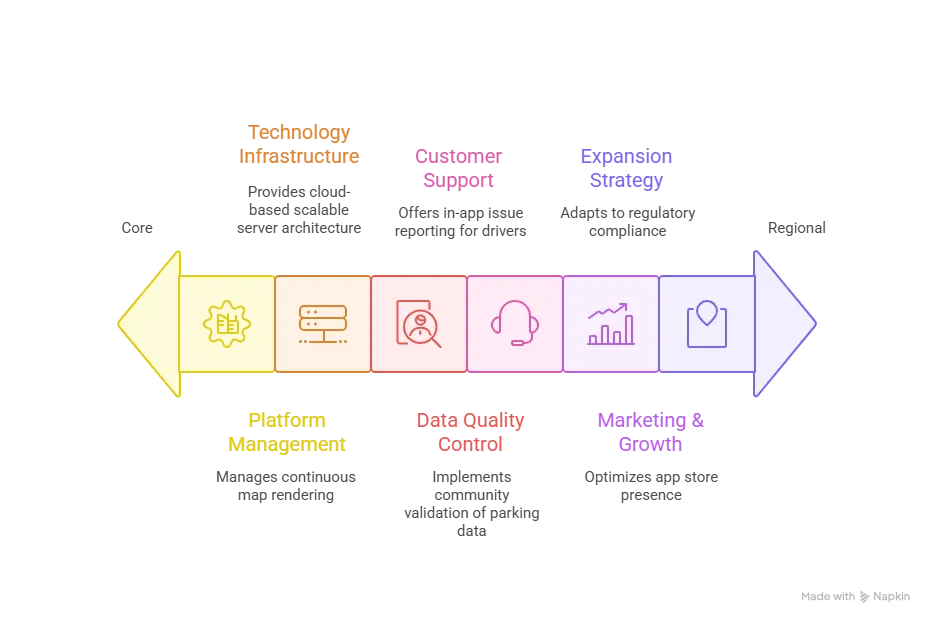
Core Operations
1. Platform Management
- Continuous map rendering and route computation
- Live parking availability updates
- Real-time fuel price synchronization
- Traffic, weather, and hazard alert processing
- High-frequency push notification engine
2. Technology Infrastructure
- Cloud-based scalable server architecture
- Real-time data pipelines for crowd and partner feeds
- High-availability GPS and routing engines
- API layers for partners, fleets, and enterprise platforms
- Redundancy systems to avoid single-point failures
3. Data Quality Control & Trust Systems
- Community validation of parking and hazard data
- Automated anomaly detection in user submissions
- Reputation scoring of crowd contributors
- Fraud and manipulation filtering for sponsored listings
4. Customer Support & Success
- In-app issue reporting for drivers
- Subscription billing and account management
- Fleet and enterprise onboarding
- Partner and advertiser support operations
5. Marketing & Growth Operations
- App store optimization (ASO)
- Driver community outreach
- Truck stop and fleet partnerships
- Performance-based B2B sales for sponsored locations
Every operational layer is designed to protect reliability, because even a few minutes of downtime can translate into real economic loss for thousands of drivers.
Regional Operations & Expansion Strategy
- Market-by-market data densification before monetization
- Localized parking and fuel partner onboarding
- Regulatory adaptation for state-by-state compliance
- Scaling only after driver data density reaches commercial thresholds
This prevents premature monetization and protects long-term ecosystem trust.
Strategic Partnerships & Ecosystem Development
Trucker Path’s growth has never been purely app-driven—it has been ecosystem-driven. From the beginning, the company understood that trucking is not a single-product industry but a network of interdependent services: parking, fuel, maintenance, navigation, compliance, freight, and financing. Instead of trying to own all of these vertically, Trucker Path built a strategic partnership web that multiplies its value without multiplying fixed costs.
Its collaboration philosophy is simple:
“Own the driver relationship, partner for everything else.”
Key Partnership Types
1. Technology & API Partners
These partners strengthen the technical backbone of Trucker Path.
- Map and geospatial data providers
- Weather and traffic intelligence services
- Telematics and fleet software integrations
- AI routing and predictive analytics vendors
Strategic Role:
They allow Trucker Path to stay technologically advanced without rebuilding commodity infrastructure.
2. Payment, Fuel & Logistics Alliances
These partners monetize daily driver behavior.
- Fuel station chains
- Truck stop networks
- Toll and parking payment processors
- Maintenance and roadside assistance providers
Strategic Role:
They connect digital discovery to real-world transactions, turning navigation intent into commercial revenue.
3. Marketing & Distribution Partners
These alliances scale user acquisition and monetization.
- Carrier fleets and driver networks
- CDL schools and training institutes
- Industry associations and trade groups
- Hardware providers (ELDs, GPS devices)
Strategic Role:
They embed Trucker Path into the onboarding journey of new drivers, locking in early adoption.
4. Regulatory & Expansion Alliances
These partnerships enable geographic and compliance-scale.
- State transportation departments
- Smart city and infrastructure planning bodies
- Freight policy and safety regulators
- Cross-border logistics authorities
Strategic Role:
They ensure that Trucker Path’s data, routing, and compliance tools stay aligned with rapidly changing transport regulations.
Ecosystem Strategy & Network Effects
Trucker Path’s ecosystem strategy is built on three compounding loops:
- More Drivers → Better Real-Time Data
- Better Data → Higher Partner ROI
- Higher Partner ROI → More Partner Investment
- More Partner Investment → Better Driver Features
This creates two powerful competitive moats:
- Data Moat: Competitors can copy features, not years of live driver behavior.
- Distribution Moat: Physical presence via tens of thousands of partnered locations.
Monetization Within the Ecosystem
- Partners pay for access to validated commercial intent
- Enterprises pay for macro-level movement intelligence
- Drivers pay for micro-level personal optimization
Trucker Path doesn’t sell “ads” or “software”—it sells certainty inside an uncertain supply chain.
Read more : Best Trucker Path Clone Scripts 2025: Launch a Scalable Freight & Trucking Platform
Growth Strategy & Scaling Mechanisms
Trucker Path’s growth story is not fueled by viral marketing or consumer hype—it is driven by compounding utility, deep network effects, and infrastructure-level expansion. The company grows the same way logistics networks grow: density first, scale second, monetization third.
Instead of expanding everywhere at once, Trucker Path follows a market-by-market densification strategy, ensuring that each region reaches high data accuracy and partner participation before scaling further.
Primary Growth Engines
1. Organic Virality & Referral Loops
Trucker Path grows through worker-to-worker trust, not influencer marketing.
- Drivers recommend the app at truck stops and within fleets
- High word-of-mouth inside CDL communities
- App store growth driven by real-world utility
- Viral effect triggered by daily problem-solving, not entertainment
Because the product solves operational pain, sharing happens naturally without incentives.
2. Paid Marketing & Performance Acquisition
Used selectively to accelerate regional density.
- App store search ads for parking and routing keywords
- Geo-targeted promotions near major freight corridors
- Industry media advertising in trucking publications
- Retargeting for premium subscription upgrades
Paid acquisition is optimized for lifetime value, not downloads.
3. Product-Led Growth Through Feature Expansion
New features unlock new user segments and upsell paths:
- Predictive parking powered by AI
- Advanced hazmat and weight-restricted routing
- Fleet-level dashboards and analytics
- Compliance and inspection alerts
Each feature:
- Increases daily usage frequency
- Expands monetization layers
- Deepens switching barriers
4. Geographic Expansion Model
Trucker Path scales geographically through:
- Corridor-based rollout (high-freight-density routes first)
- Data seeding using early driver clusters
- Local partner onboarding before ad monetization
- Regulatory alignment per state and cross-border regions
This phased model prevents empty marketplaces and protects trust.
Scaling Challenges & How Trucker Path Solved Them
1. Real-Time Data Accuracy at Massive Scale
Challenge: Millions of mixed-quality crowd inputs
Solution:
- Machine learning-based anomaly detection
- Contributor reputation scoring
- Automated cross-validation with partner sensors
2. Infrastructure Load During Peak Freight Hours
Challenge: Traffic spikes during national freight surges
Solution:
- Dynamic cloud auto-scaling
- Traffic load balancing by geographic region
- Edge caching for routing signals
3. Regulatory Fragmentation
Challenge: Different routing, weight, and compliance laws across regions
Solution:
- Modular compliance rule engines
- State-by-state data rule ingestion
- Live updates from transportation authorities
4. Monetization Without Breaking Driver Trust
Challenge: Introducing ads into a critical navigation experience
Solution:
- Clear separation between organic listings and sponsored pins
- Optional premium ad-free plans
- Sponsored content limited to high-intent decision zones only
Trust was never compromised for short-term revenue.
Why Trucker Path’s Scaling Model Is Structurally Strong
- Growth is powered by daily livelihood dependency
- Data density improves product quality continuously
- Monetization increases with usage instead of fighting it
- Physical-world integration prevents digital-only competition
By 2025, Trucker Path operates less like an app and more like a digital freight utility layer for North America.
Competitive Strategy & Market Defense
Trucker Path operates in a market filled with navigation apps, freight platforms, and fleet tools—but it dominates a very specific layer of the ecosystem: driver-first real-time operational intelligence. Its competitive strategy is not based on price wars or feature races alone ; it is built on structural advantages that compound over time. Rather than competing head-to-head with generic GPS apps or freight marketplaces, Trucker Path defends a deeply specialized niche that blends navigation, parking logistics, commerce, and crowd-sourced intelligence into one indispensable workflow.
Core Competitive Advantages
1. Network Effects & Switching Barriers
- Millions of drivers continuously update parking, hazards, fuel, and routes
- More users = more accurate data = better user experience
- Competitors cannot replicate this live data density quickly
- Drivers save routes, preferences, and history → high switching friction
This creates a classic data-network effect moat.
2. Brand Trust in a High-Risk Industry
In trucking, bad data doesn’t cause inconvenience—it causes financial loss and safety risks.
- Trucker Path is perceived as a “reliability brand,” not just a tool
- Trust has been built over years of consistent accuracy
- Community validation strengthens credibility faster than paid marketing
Trust becomes an intangible asset that competitors struggle to buy.
3. Specialized Truck-Level Technology
Unlike consumer navigation apps, Trucker Path is built specifically for:
- Vehicle height, weight, axle count
- Hazardous material routing
- Bridge, tunnel, and state compliance rules
- Commercial parking limitations
This deep specialization creates a technical differentiation moat that generic map platforms rarely prioritize.
4. Data-Driven Personalization & Compliance Strength
- Personalized routing based on driver behavior and vehicle profile
- Region-specific compliance updates
- Predictive parking models using historical demand
By 2025, Trucker Path’s AI-driven decision layer enables anticipatory logistics, not just reactive routing.
Lessons for Entrepreneurs & Implementation
Trucker Path’s success was not built on hype, massive ad budgets, or viral entertainment loops. It was built on something far more powerful and replicable for serious founders: deep operational utility, community-generated intelligence, and trust-based monetization.
For entrepreneurs building the next generation of logistics, mobility, marketplace, or SaaS platforms, the Business Model of Trucker Path offers a blueprint grounded in real-world economics, not vanity metrics.
Key Factors Behind Trucker Path’s Success
- Utility Before Monetization:
It solved daily survival problems first (parking, fuel, routing), then layered revenue later. - Community as a Data Engine:
Users didn’t just consume the product—they powered it with live intelligence. - Habit-Forming Daily Use:
Trucker Path integrated into the driver’s daily workflow, not occasional tasks. - Trust as a Growth Asset:
Accuracy and reliability became its strongest marketing channel. - Layered Revenue Design:
Subscriptions, advertising, enterprise data, and partnerships reinforced each other.
Replicable Principles for Startups
Founders can adapt Trucker Path’s strategy by focusing on:
- Building single-purpose utility first, not multi-feature platforms
- Using freemium adoption to seed data density
- Designing monetization around intent, not disruption
- Creating network effects through user-generated operational data
- Prioritizing reliability and uptime as revenue drivers
These principles apply directly to:
- Logistics and freight platforms
- On-demand marketplaces
- Location-based commerce apps
- Fleet management and mobility SaaS
- Industrial and blue-collar digital ecosystems
Common Mistakes to Avoid
- Monetizing too early before trust is built
- Launching in too many regions without data density
- Ignoring compliance and operational constraints
- Treating blue-collar users like consumer app users
- Building features without daily usage dependency
Adapting the Model for Local or Niche Markets
Entrepreneurs can localize the Trucker Path model by:
- Starting with a single high-pain use case (parking, dispatch, routing, compliance
- Targeting one narrow user segment (regional carriers, last-mile fleets, port logistics
- Building localized data partnerships first
- Expanding only after achieving behavioral lock-in
This localization-first strategy reduces capital risk and accelerates product-market fit.
Implementation Timeline & Investment Priorities
For founders planning to replicate a Trucker Path–style platform:
Phase 1 – MVP Utility (0–3 months)
- Core navigation or marketplace feature
- Real-time updates
- Free adoption strategy
Phase 2 – Data Densification (3–9 months)
- Community validation
- Partner onboarding
- Reliability and scaling
Phase 3 – Monetization Layer (9–15 months)
- Subscriptions
- Sponsored listings
- Enterprise analytics
Phase 4 – Platform Expansion (15+ months)
- APIs
- Ecosystem partnerships
- Geographic scaling
Ready to implement Trucker Path’s proven business model for your market?
Miracuves builds scalable platforms with tested business models and growth mechanisms. We’ve helped 200+ entrepreneurs launch profitable logistics, marketplace, and intelligence-driven platforms. Get your free business model consultation today.
Conclusion :
Trucker Path’s journey proves that in the platform economy, the deepest competitive advantages are built not through loud branding, but through quiet reliability. By embedding itself into the everyday decision-making of professional drivers, Trucker Path transformed from a simple utility into a critical infrastructure layer of North American logistics.
Its real innovation was not just in code or design—it was in understanding behavior, respecting trust, and monetizing only after becoming indispensable. In doing so, Trucker Path showed that the strongest digital platforms of 2025 are not always the flashiest—they are the ones that remove friction from real-world livelihoods.
As platform economies continue to mature beyond social and consumer apps into industrial, logistics, and workforce ecosystems, the Trucker Path business model stands as a powerful reminder When technology aligns perfectly with daily economic survival, sustainable growth becomes inevitable.
FAQs :
1. What type of business model does Trucker Path use?
Trucker Path uses a hybrid freemium + subscription + data monetization + location-based advertising business model. It offers core features for free to drive mass adoption, while premium intelligence, enterprise data services, and sponsored location listings generate revenue.
2. How does the Trucker Path business model create value?
It saves drivers time, fuel, and parking stress while increasing safety and earnings. For businesses, it drives high-intent traffic and delivers real-time logistics intelligence and advertising value.
3. What are the key success factors behind Trucker Path?
Daily-use utility, community-powered data, and high trust fuel strong network effects. Its layered monetization and truck-specific compliance tools ensure long-term defensibility.
4. How scalable is the Trucker Path business model?
The model scales digitally with minimal marginal cost as data value increases with each new user. It supports both geographic expansion and enterprise-grade API growth.
5. What are the biggest challenges in the Trucker Path model?
Key challenges include maintaining real-time data accuracy, handling peak-load infrastructure, and managing regulations. Trust-first monetization and AI validation help overcome these issues.
6. How can entrepreneurs adapt the Trucker Path model to their region?
Start by solving one high-friction logistics problem for a focused audience. Use freemium adoption to build data density, then add monetization after user lock-in.
7. What resources and timeframe are needed to launch a similar platform?
A similar platform requires mobile apps, real-time data pipelines, maps, partner systems, and analytics. With Miracuves, it can launch in 3– 9 days with pricing starting at $12999.
8. What are the alternatives to the Trucker Path business model?
Alternatives include freight marketplaces, fleet TMS platforms, and fuel or parking apps. However, most lack Trucker Path’s unified navigation, commerce, and intelligence ecosystem.
9. How has the Trucker Path business model evolved over time?
It evolved from a basic parking locator into a full logistics intelligence platform. Each phase added monetization layers while preserving strong user trust through 2025.
Related Article :
- Best Direct Freight Clone Scripts 2025 for Logistics Startups & Freight Marketplaces
- Business Model of Direct Freight : Complete Strategy Breakdown 2025
- Best DAT Load Board Clone Scripts 2025 — Build Your Freight Load Marketplace Fast
- Best Truckstop Clone Scripts 2025 — Build a High-Revenue Freight & Load Board Marketplace