



What makes the Business Model of Uber Freight especially significant in 2025 is its unique hybrid structure—combining marketplace dynamics, SaaS logistics tooling, data intelligence, and enterprise-grade supply chain services. While legacy freight brokers rely on human-heavy operations, Uber Freight scales through automation, AI-driven pricing, and network effects across shippers, carriers, and logistics partners.
For modern founders exploring logistics marketplaces, B2B platforms, and real-time matching ecosystems, studying Uber Freight’s model offers a masterclass in:Uber Freight built its success by focusing on building strong liquidity in two-sided markets, monetizing transaction data at scale, defending its market position through advanced technology rather than just relationships
In this breakdown, we’ll decode how Uber Freight works as a business, how it makes money, how it scales globally, and how entrepreneurs can adapt this exact model using scalable white-label infrastructure from Miracuves.
How the Uber Freight Business Model Works
Uber Freight operates on a hybrid digital freight marketplace + logistics SaaS + managed services model. At its core, it connects shippers who need to move goods with carriers who have available truck capacity—but unlike traditional brokers, it does this through automation, real-time pricing, and data intelligence.
Instead of depending on phone calls, emails, and manual rate negotiations, Uber Freight replaces friction with:
- Instant digital load booking
- Algorithmic pricing
- End-to-end shipment visibility
- Integrated payments and compliance
This transforms freight brokerage into a scalable technology business rather than a people-heavy service.
Type of Model
Uber Freight follows a Hybrid Business Model, blending:
- Marketplace Model – Matching supply (carriers) with demand (shippers)
- Transaction-Based Revenue Model – Commission per load
- SaaS + Enterprise Services Model – Advanced logistics tools for large shippers
- Data & Intelligence Platform – Predictive pricing, routing, and demand forecasts
This hybrid structure allows Uber Freight to monetize both volume and software value, giving it higher lifetime enterprise revenue than pure brokers.
Value Proposition by User Segment
For Shippers (Enterprises, Retailers, Manufacturers):
- Instant access to thousands of verified carriers
- Transparent, algorithm-driven pricing
- Real-time shipment tracking
- Reduced dependence on unreliable brokers
- Enterprise-grade integrations with ERP and TMS systems
For Carriers (Owner-Operators & Fleets):
- Guaranteed access to consistent freight demand
- Faster booking with zero negotiation delay
- Automated payments and compliance handling
- Reduced deadhead miles through optimized matching
- Mobile-first carrier app for load management
For Uber Freight (Platform Owner):
- Commission on every successful freight transaction
- Deep visibility into freight pricing and supply-demand data
- Scalable revenue without proportional headcount growth
- Strong network effects as liquidity increases
Key Stakeholders in the Ecosystem
- Shippers: Generate freight demand
- Carriers: Supply transportation capacity
- Uber Freight: Platform operator, pricing engine, trust intermediary
- Enterprise Clients: High-volume long-term revenue drivers
- Technology & Payment Partners: Enable automation and settlement
- Regulatory Bodies: Compliance gatekeepers for cross-border logistics
Each stakeholder strengthens the ecosystem by increasing transaction velocity and data depth.
Target Market & Customer Segmentation Strategy
Uber Freight’s growth is powered by a precisely segmented two-sided market strategy. Unlike consumer apps that scale primarily on volume, Uber Freight scales on transaction value, contract stability, and enterprise trust. Its segmentation is engineered to maximize liquidity, retention, and long-term revenue per account.
At its core, Uber Freight serves:
- Freight demand generators (Shippers)
- Freight capacity providers (Carriers)
- Enterprise logistics operators (High-volume customers)
Each segment is monetized and retained through a different but interconnected journey.
Primary & Secondary Customer Segments
Primary Segment 1: Large & Mid-Market Shippers
- Retail chains
- E-commerce brands
- Manufacturers
- FMCG and CPG companies
What they want:
- Price transparency
- Delivery reliability
- Contract freight stability
- End-to-end shipment visibility
- Enterprise system integrations
They drive high-volume, repeat revenue and form the backbone of Uber Freight’s enterprise contracts.
Primary Segment 2: Carriers (Owner-Operators & Fleets)
- Independent truck drivers
- Small fleets (5–50 trucks)
- Large commercial fleets
What they want:
- Consistent freight demand
- Guaranteed payments
- Load optimization to reduce empty miles
- Mobile-first operations
Carriers are the liquidity engine of the marketplace. Without supply density, shippers churn quickly.
Secondary Segment 3: Enterprise Supply Chain Teams
- Logistics managers
- Procurement teams
- Transportation planners
These users don’t just book loads—they manage:
- Route optimization
- Cost benchmarking
- Carbon footprint reporting
- Predictive demand planning
This segment drives adoption of SaaS tools and long-term platform contracts.
Customer Journey Mapping: Discovery → Conversion → Retention
1. Discovery
- Shippers: Industry events, B2B sales teams, enterprise partnerships, logistics word-of-mouth
- Carriers: Mobile app stores, driver communities, referrals, YouTube logistics influencers
2. Conversion
- Shippers convert through:
- Free freight quotes
- Pilot contract programs
- API integrations with existing TMS
- Carriers convert through:
- Instant load access
- Simple onboarding
- Fast payment promises
3. Retention
Retention is built through:
- Service reliability
- Price competitiveness
- Predictable demand
- Enterprise account management
- Data-driven performance reporting
In freight marketplaces, retention = profitability. Uber Freight prioritizes long-term contracts over one-off loads.
Market Positioning & Competitive Edge
Uber Freight positions itself as:
- A technology-first logistics company
- Not just a broker, but a freight operating system
- A trusted enterprise logistics partner, not only a spot-market player
Its competitive differentiation is built on:
- Algorithmic pricing, not broker intuition
- Real-time visibility, not delayed reporting
- Platform scalability, not manual coordination
By 2025, Uber Freight commands a significant share of the U.S. digital freight brokerage market, especially in contracted freight and enterprise-managed transportation.
Revenue Streams and Monetization Design
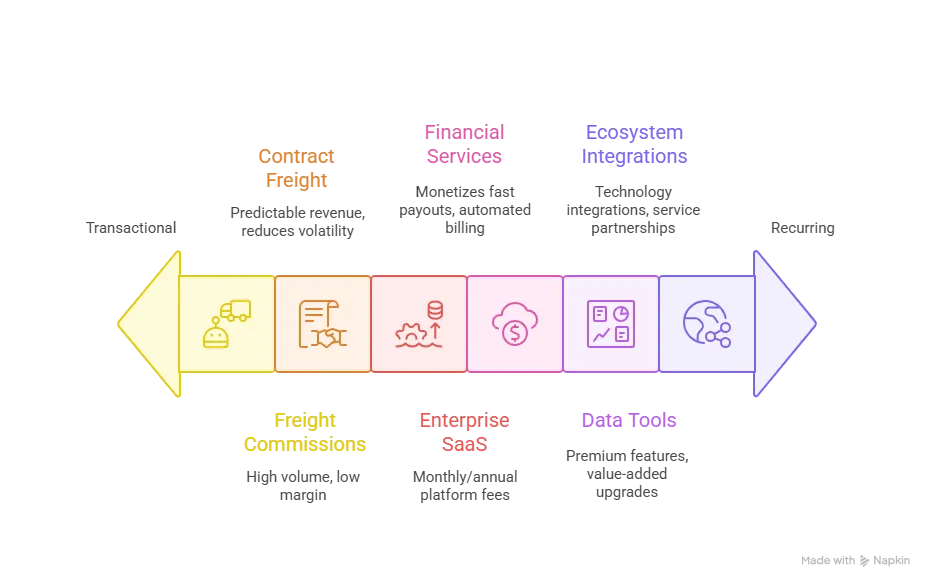
Once Uber Freight perfected who its customers are, the next strategic layer was designing how money flows through the ecosystem. Unlike traditional brokers that rely on a single margin per load, Uber Freight operates a multi-layered monetization architecture—blending transaction income with enterprise SaaS-style recurring revenue.
This diversified revenue design makes the Business Model of Uber Freight far more resilient to freight rate cycles.
Primary Revenue Stream: Freight Transaction Commissions
This is Uber Freight’s core monetization engine.
How it works:
- Uber Freight charges shippers a market-based freight rate.
- It pays carriers a slightly lower amount.
- The difference becomes Uber Freight’s commission margin per load.
Key Characteristics:
- Dynamic pricing via AI and supply-demand signals
- Works across spot freight and contracted freight
- Scales directly with shipment volume
Revenue Impact:
- Forms the largest share of total revenue
- Highly sensitive to freight market conditions
- Strengthens network effects: more loads → more carriers → better pricing → more shippers
Secondary Revenue Streams
1. Enterprise SaaS & Managed Transportation Fees
Large shippers pay:
- Monthly or annual platform fees
- API and TMS integration charges
- Managed transportation service fees
This converts Uber Freight from a margin-only broker into a recurring SaaS logistics provider.
2. Contracted Freight Margins
Unlike spot freight, contracted freight:
- Locks in long-term pricing agreements
- Delivers predictable revenue
- Reduces volatility caused by seasonal freight demand
This stabilizes cash flow and improves enterprise stickiness.
3. Payment Acceleration & Financial Services
Uber Freight monetizes:
- Fast carrier payouts
- Automated billing
- Credit services for carriers and shippers
These financial rails turn logistics volume into fintech-style revenue.
4. Data & Visibility Tools
Premium features include:
- Real-time tracking dashboards
- Lane performance analytics
- Cost benchmarking
- Carbon and sustainability reporting
These tools are sold as value-added enterprise upgrades.
5. Ecosystem Integrations & Partnerships
Revenue from:
- Technology integrations
- Third-party logistics tools
- Insurance and compliance service partnerships
This turns the platform into a logistics services marketplace rather than a single-product company.
Overall Monetization Strategy (How It All Connects)
Uber Freight’s monetization is designed like a layered revenue stack:
- Bottom layer: High-volume, low-margin transaction commissions
- Middle layer: Contract freight and enterprise SaaS subscriptions
- Top layer: Financial services, analytics, and ecosystem integrations
This structure enables:
- Cross-selling: Carriers using fast payouts, shippers adopting analytics
- Upselling: Spot users converting to contracts and managed services
- Margin expansion: Software and services generate higher profit than brokerage alone
Operational Model & Key Activities
Behind the seamless user experience of Uber Freight lies a high-availability, data-intensive operating engine. Unlike traditional freight brokers that depend on large call centers and manual coordination, Uber Freight runs as a technology-first logistics operation, where automation, AI, and real-time systems replace human bottlenecks.
In the Business Model of Uber Freight, operations are designed for:
- National scale
- 24/7 uptime
- High transaction velocity
- Enterprise-grade reliability
Core Operations
1. Platform Management
- 24/7 load ingestion and verification
- Real-time pricing and matching algorithms
- Duplicate load detection and fraud filtering
- Performance monitoring and uptime management
This ensures that every load listed on the platform is accurate, compliant, and instantly matchable.
2. Technology Infrastructure
- Cloud-native, microservices-based architecture
- High-speed data pipelines for real-time pricing signals
- Scalable matching engines for lane optimization
- API layers for ERP, WMS, and TMS integration
- AI-based forecasting for lane demand and pricing volatility
Technology is Uber Freight’s true operational backbone—not brokers.
3. Quality Control & Trust Systems
- Carrier verification and compliance screening
- Broker and shipper legitimacy checks
- Historical performance scoring
- Dispute management and incident resolution
Trust is the currency of freight marketplaces. Without risk control, liquidity collapsesn .
4. Payments, Billing & Financial Operations
- Automated carrier payments
- Invoice processing and reconciliation
- Credit risk assessment
- Financial compliance and audit management
These systems transform freight volume into structured, enterprise-grade revenue pipelines.
5. Customer Support & Account Management
- Carrier onboarding support
- Enterprise shipper success teams
- Contract management and SLA monitoring
- Technical troubleshooting and integrations
Uber Freight balances automation with high-touch support for enterprise clients.
6. Marketing & User Acquisition Operations
- B2B enterprise sales teams
- SEO and content-driven inbound traffic
- Carrier referral programs
- Industry conferences and logistics trade shows
- Strategic partnerships for distribution
Growth is operationalized, not left to viral chance.
Strategic Partnerships & Ecosystem Development
Uber Freight’s rise into a full-scale digital logistics powerhouse is not driven by technology alone—it is powered by a deep, strategic partnership ecosystem. Instead of building every capability in-house, Uber Freight follows a collaboration-first philosophy, where partners extend platform reach, reduce operational friction, and unlock new revenue layers.
In the Business Model of Uber Freight, partnerships function as growth multipliers and competitive moats.
Collaboration Philosophy
Uber Freight designs partnerships with three core objectives:
- Expand platform functionality
- Accelerate enterprise adoption
- Embed itself deeply into supply chain workflows
By integrating directly into how shippers and carriers already operate, Uber Freight becomes infrastructure, not just a vendor.
Key Partnership Types
1. Technology & API Partners
These partners enhance automation and data intelligence:
- Transportation Management Systems (TMS)
- Warehouse Management Systems (WMS)
- ERP platforms
- Telematics and GPS providers
Impact:
- Seamless shipper onboarding
- Reduced integration friction
- Higher enterprise switching costs
2. Payment & Financial Services Alliances
Includes partnerships with:
- Digital payment processors
- Banking institutions
- Credit and factoring providers
Impact:
- Faster carrier payouts
- Embedded financial services
- New fintech-style revenue streams
3. Logistics, Fleet & Equipment Partners
- Fleet management platforms
- Trailer tracking providers
- Fuel card networks
- Maintenance and compliance systems
Impact:
- Reduced operational risk
- Improved carrier retention
- Higher supply-side loyalty
4. Marketing & Distribution Partners
- Enterprise logistics consultants
- 3PL networks
- Industry associations
- Supply chain software vendors
Impact:
- Accelerated shipper acquisition
- Access to large-volume freight contracts
- Brand credibility in conservative enterprise markets
5. Regulatory & Expansion Alliances
- Customs authorities (for cross-border freight)
- Government compliance bodies
- Sustainability and emissions reporting agencies
Impact:
- Faster international expansion
- Regulatory risk reduction
- Enterprise compliance assurance
Ecosystem Strategy: How Partnerships Create Network Power
Uber Freight’s ecosystem strategy creates value in three powerful ways:
- Network Effects:
More partners → more integrations → more enterprise users → more freight volume → more carrier demand. - Ecosystem Monetization:
Partners contribute to:- Revenue-sharing services
- Premium integrations
- Compliance and analytics tools
- Strategic Moats via Tie-ups:
Once deeply embedded into TMS, ERP, and financial workflows, replacing Uber Freight becomes operationally painful and commercially risky for enterprises.
This turns Uber Freight from a replaceable freight broker into a mission-critical logistics operating layer.
Growth Strategy & Scaling Mechanisms
Uber Freight’s growth is not accidental—it is engineered through a multi-engine scaling framework that blends marketplace liquidity, enterprise sales, technology expansion, and geographic replication. While many freight startups struggle to move beyond regional adoption, Uber Freight built a repeatable national scaling playbook that continues to work in 2025.
In the Business Model of Uber Freight, growth is driven by both volume expansion and value expansion.
Core Growth Engines
1. Organic Network Effects & Referral Loops
Growth compounds naturally as:
- More shippers post loads → more carriers join for demand
- More carriers onboard → better pricing → attracts larger shippers
Additional organic drivers:
- Carrier referral incentives
- Fleet onboarding programs
- Enterprise word-of-mouth within logistics networks
This creates a self-fueling liquidity engine.
2. Enterprise Sales & Account-Based Growth
Uber Freight runs dedicated:
- Industry-specific sales teams (retail, CPG, manufacturing, pharma)
- Strategic account management for Fortune 500 clients
- Long-term contract negotiation units
Growth here comes from:
- Multi-year freight contracts
- Expansion inside existing clients (more lanes, more regions)
- Managed transportation outsourcing
This engine delivers high-revenue, low-churn growth.
3. Technology-Led Product Expansion
New products continuously open fresh revenue doors:
- Predictive pricing tools
- Carbon & sustainability analytics
- Automated routing & backhaul optimization
- Compliance and risk intelligence dashboards
Each new product:
- Increases ARPU
- Strengthens enterprise lock-in
- Expands total addressable marker
4. Geographic Expansion Strategy
Uber Freight follows a phased rollout:
- Start with high-density freight corridors
- Expand to secondary logistics hubs
- Then move into cross-border and international freight
This reduces:
- Market entry risk
- Carrier acquisition cost
- Regulatory friction
Technology allows Uber Freight to replicate operations with speed and consistency across regions.
Scaling Challenges & How Uber Freight Solved Them
1. Marketplace Liquidity Imbalance
Challenge:
Early imbalance between shipper demand and carrier supply.
Solution:
- Subsidized carrier onboarding
- Guaranteed minimum loads
- Dynamic pricing incentives to stabilize supply
2. Operational Complexity at Scale
Challenge:
Millions of shipments create billing, compliance, and support bottlenecks.
Solution:
- Heavy automation of invoicing and settlements
- AI-driven dispute resolution workflows
- Tiered enterprise support teams
3. Technology Infrastructure Limits
Challenge:
Real-time pricing and tracking requires extreme system reliability.
Solution:
- Cloud-native microservices
- Continuous data pipeline optimization
- Redundancy and failover architecture
4. Regulatory & Cross-Border Barriers
Challenge:
Different regions demand different compliance frameworks.
Solution:
- Local regulatory partnerships
- Pre-compliance automation systems
- Regional legal advisory alliances
Competitive Strategy & Market Defense
Uber Freight operates in one of the most competitive and margin-sensitive industries in the world—freight brokerage. Yet, despite intense pressure from legacy brokers, digital freight startups, and enterprise logistics giants, Uber Freight has built a durable competitive position through technology, data, and ecosystem lock-in.
Its defense strategy is not based on price wars alone—it is based on structural advantages that competitors find hard to replicate.
Core Competitive Advantages
1. Network Effects & Switching Barriers
Uber Freight benefits directly from two-sided marketplace network effects:
- More shippers → more freight volume → attracts more carriers
- More carriers → better pricing and availability → attracts more shippers
As liquidity increases:
- Matching becomes faster
- Pricing becomes more accurate
- Platform reliability improves
This creates high switching costs:
- Shippers risk service disruptions if they leave
- Carriers lose access to consistent income streams
2. Brand Equity & Enterprise Trust
Backed by Uber’s global brand legacy, Uber Freight enjoys:
- Faster enterprise adoption
- Higher initial trust in regulated industries
- Strong credibility in conservative logistics markets
In B2B logistics, trust reduces sales friction more than advertising ever could.
3. Technology & Algorithmic Advantage
Uber Freight’s real moat lies in:
- AI-driven dynamic pricing
- Automated freight matching
- Predictive lane demand forecasting
- Real-time visibility and exception management
These capabilities convert raw freight volume into proprietary intelligence, which continuously improves output quality.
4. Data-Driven Personalization & Compliance Depth
With millions of freight data points, Uber Freight personalizes:
- Pricing by route, time, and demand pattern
- Carrier recommendations
- Risk scoring and ETA forecasting
Its compliance automation reduces:
- Regulatory risks for shippers
- Insurance friction
- Audit complexity
This level of data maturity is difficult for smaller competitors to match.
Market Defense Tactics
Handling New Entrants & Pricing Wars
- Uses dynamic margin optimization, not flat pricing
- Absorbs short-term margin pressure to protect long-term market control
- Focuses on high-value contracted freight over low-margin spot rates
Strategic Feature Rollouts
Uber Freight times feature releases based on:
- Regulatory changes
- Fuel price volatility
- E-commerce peak cycles
This keeps competitors reacting rather than leading.
Partnerships & Acquisitions as Defense
Uber Freight defends market share by:
- Partnering with enterprise TMS providers
- Acquiring logistics technology companies
- Integrating upstream and downstream services
This shrinks the competitive surface area available to rivals.
Read more : Best Uber Freight Clone Scripts 2025: Build a Scalable Load Board Success
Lessons for Entrepreneurs & Implementation
Studying the Business Model of Uber Freight is not just about understanding a logistics giant—it’s about extracting deployable principles that founders can adapt into their own marketplaces, SaaS platforms, and on-demand ecosystems. Uber Freight proves that in B2B marketplaces, execution discipline and data intelligence matter more than flashy branding.
Let’s break this into actionable founder lessons.
Key Factors Behind Uber Freight’s Success
- Liquidity First, Monetization Later
Uber Freight focused first on:
- Building carrier supply
- Ensuring shipper demand
- Stabilizing marketplace balance
Only after liquidity was achieved did monetization layers scale aggressively.
- Automation Over Human Dependency
Instead of scaling call centers, Uber Freight scaled:
- Algorithms
- Data pipelines
- Predictive systems
This is why it can grow without proportional headcount expansion.
- Enterprise Trust as a Growth Lever
Freight is a trust-driven industry offering:
- Compliance automation
- SLA-backed reliability
- Transparent pricing
Uber Freight turned trust into a competitive growth engine.
- Data as a Strategic Asset, Not a Byproduct
Every shipment strengthens:
- Pricing models
- Demand forecasts
- Risk scoring
- Route optimization
Data is not support—it is the core product intelligence layer.
Replicable Principles for Startups
Entrepreneurs can replicate Uber Freight’s core mechanics by focusing on:
- Building a two-sided marketplace with strong supply density
- Designing real-time matching systems
- Embedding payments and compliance into the platform
- Using data to drive pricing and predictability
- Layering SaaS subscriptions on top of transactions
- Locking in clients through workflow integrations
These principles apply far beyond logistics—to:
- Food delivery
- Mobility
- Healthcare marketplaces
- B2B procurement platforms
- Fintech ecosystems
Common Mistakes to Avoid
Founders attempting Uber Freight–style platforms often fail because they:
- Scale marketing before stabilizing liquidity
- Rely too heavily on manual operations
- Underestimate compliance complexity
- Ignore retention in favor of acquisition
- Build features before validating transaction flow
Uber Freight succeeded because it fixed operations before optimizing growth optics.
Adaptation Strategies for Local & Niche Markets
You don’t need Uber-scale capital to implement this model. Startups can:
- Launch in one logistics corridor or single industry niche
- Focus on one shipment type (FMCG, construction, pharma, cold chain)
- Start with spot freight before contracting
- Use regional compliance automation instead of national complexity
- Expand only after achieving consistent weekly transaction velocity
This reduces burn while preserving scalability.
Implementation Timeline & Investment Priorities
A phased rollout typically looks like:
- Phase 1: Supply onboarding + basic marketplace MVP
- Phase 2: Payments, invoices, and compliance automation
- Phase 3: Enterprise onboarding + SaaS tools
- Phase 4: Data intelligence + optimization + expansion
Investment priority order:
- Technology & security
- Liquidity incentives
- Compliance & financial automation
- Sales & enterprise onboarding
- Analytics and optimization
Ready to implement Uber Freight’s proven business model for your market?
Miracuves builds scalable platforms with tested business models and growth mechanisms. We’ve helped 200+ entrepreneurs launch profitable logistics, marketplace, and SaaS platforms worldwide.Get your free business model consultation today.
Conclusion :
The Business Model of Uber Freight proves a powerful truth about the platform economy in 2025: innovation alone doesn’t create billion-dollar companies—execution at scale does. Uber Freight didn’t win by being the first digital freight platform. It won by systematically removing friction from every layer of logistics—pricing, matching, visibility, payments, and compliance—until freight movement became as seamless as tapping a screen.
For founders, the deeper lesson is clear: Platforms that own the workflow, the data, and the trust will always outgrow platforms that only mediate transactions.
As global supply chains become smarter, greener, and more automated, business models like Uber Freight’s will define the next decade of B2B platform innovation—where logistics is no longer a cost center, but a strategic digital asset.
FAQs
1. What type of business model does Uber Freight use?
Uber Freight follows a hybrid business model combining a digital freight marketplace, transaction commissions, enterprise SaaS subscriptions, and managed transportation services. This allows it to monetize both shipment volume and software value.
2. How does Uber Freight’s model create value?
Uber Freight creates value through instant shipper–carrier matching, AI-driven transparent pricing, real-time visibility, and fast carrier payments. It converts logistics uncertainty into predictable, data-driven operations.
3. What are Uber Freight’s key success factors?
Its success is driven by strong network effects, deep automation with AI pricing, enterprise trust through compliance, technology-first scaling, and end-to-end digital workflow ownership.
4. How scalable is Uber Freight’s business model?
Uber Freight is highly scalable due to cloud infrastructure, automated pricing and settlement, and data-driven optimization. It can expand nationally and across borders with minimal additional human operations.
5. What are the biggest challenges in Uber Freight’s model?
Major challenges include supply-demand balance, regulatory compliance, freight price volatility, and platform reliability at scale. These are managed through automation, AI forecasting, and regional partnerships.
6. How can entrepreneurs adapt Uber Freight’s model to their region ?
Entrepreneurs can start with one corridor or niche, focus on spot freight first, automate payments and compliance early, and expand only after achieving stable liquidity.
7. What resources and timeframe are needed to launch a similar platform?
A similar platform needs a core marketplace system, onboarding tools, automated payments, and real-time tracking. With Miracuves’ white-label infrastructure, it can launch in 3– 9 days with pricing starting at $12999.
8. What are alternatives to the Uber Freight model?
Alternatives include traditional freight brokers, subscription load boards, asset-based trucking firms, and pure logistics SaaS platforms. However, none integrate marketplace, SaaS, fintech, and data intelligence as deeply.
9. How has Uber Freight’s business model evolved over time?
Uber Freight evolved from a spot freight digital broker to contracted freight, then added enterprise SaaS and AI-driven financial tools. In 2025, it operates as a full-stack logistics operating system.
Related Article :