


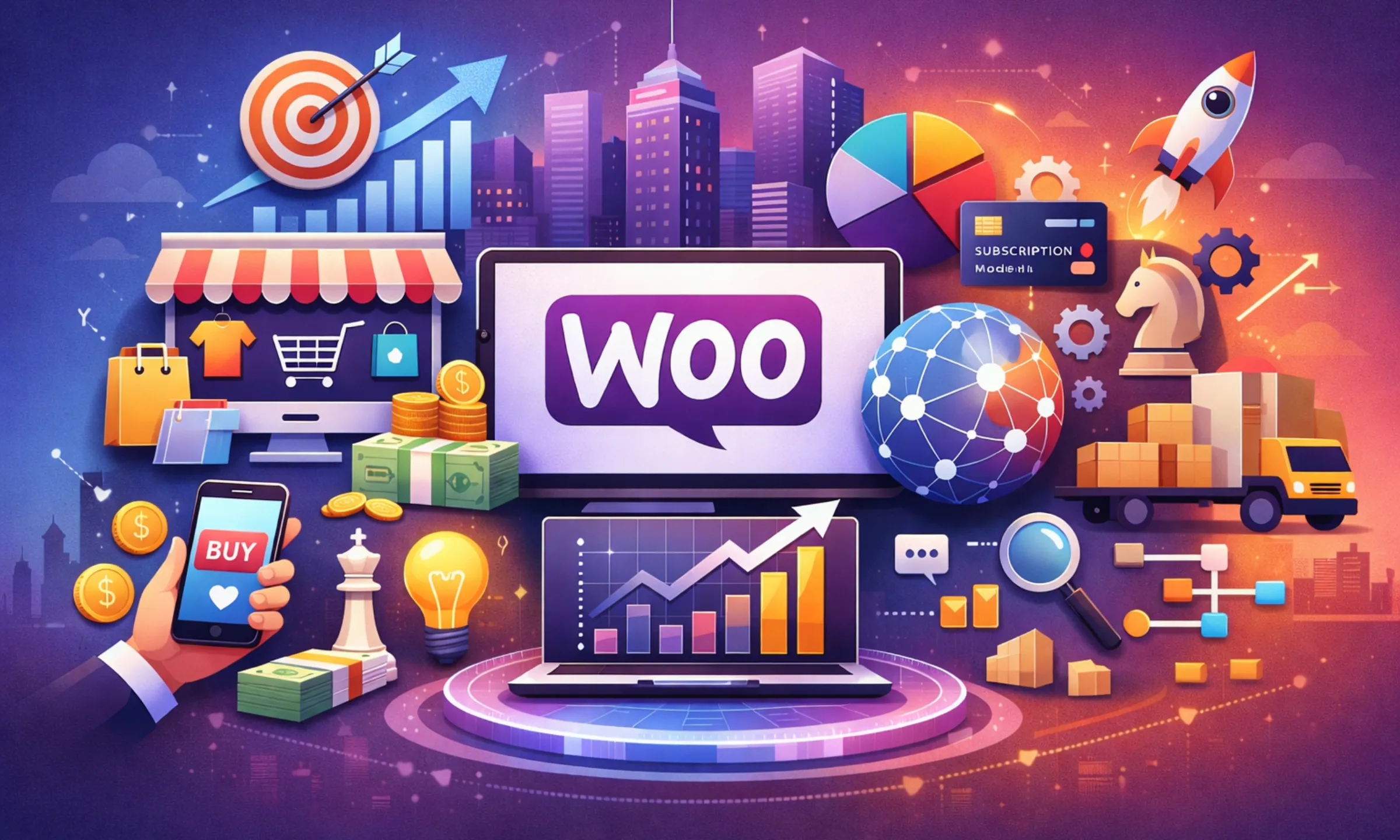
In 2026, WooCommerce is no longer just an ecommerce plugin—it is the economic backbone of a large share of the global online retail ecosystem. What began in 2011 as a simple WordPress extension has evolved into the world’s most widely used ecommerce infrastructure, powering over 5 million active stores and influencing nearly 30–35% of ecommerce websites worldwide. Studying the business model of WooCommerce helps founders understand how open platforms can scale without traditional SaaS lock-ins.
A fascinating aspect of the business model of WooCommerce is how it monetizes at scale. The platform grew from a bootstrapped open-source project into a business generating hundreds of millions of dollars annually for Automattic, while enabling merchants to process hundreds of billions in GMV—all without mandatory subscriptions or commissions. This sharply contrasts with Shopify or Amazon, which monetize merchants upfront.
For founders building SaaS products, open marketplaces, or developer-first ecosystems, the business model of WooCommerce offers a highly replicable and capital-efficient blueprint. At Miracuves, we see it validate a clear principle: open foundations combined with paid value layers can outperform closed systems when executed with discipline.
How the WooCommerce Business Model Works
WooCommerce operates on a platform-as-infrastructure model rather than a traditional ecommerce SaaS model. At its core, WooCommerce is open-source commerce software that becomes powerful only when combined with an ecosystem of themes, plugins, services, and partners.
This design choice is the foundation of its long-term scalability.
Instead of controlling merchants, WooCommerce empowers them, while monetizing the ecosystem layers around that empowerment.
Core Business Model Overview
WooCommerce follows a Hybrid Open-Source + Ecosystem Monetization Model.
It combines:
- Free core software to maximize adoption
- Paid extensions and services to generate revenue
- Partner-led distribution to scale without heavy sales costs
This creates a low-friction entry point with high lifetime value expansion.
Type of Business Model
- Primary Model: Open-source platform ecosystem
- Secondary Models:
- Plugin marketplace monetization
- SaaS-style recurring licenses (extensions)
- Infrastructure-adjacent services (payments, hosting, subscriptions)
- Plugin marketplace monetization
WooCommerce does not earn when a merchant launches. It earns when a merchant grows.
Value Proposition by User Segment
For Merchants
- Full ownership of store, data, and customer relationships
- No mandatory monthly fees or revenue commissions
- Unlimited customization via plugins and code access
- Global scalability with local flexibility
For Developers & Agencies
- Open APIs and extensibility
- Revenue from themes, plugins, and services
- Long-term client relationships through maintenance and upgrades
For Automattic (Parent Company)
- Massive distribution through WordPress
- Recurring revenue from extensions and services
- Control over strategic infrastructure touchpoints
Key Stakeholders & Their Roles
- Merchants: Drive transaction volume and demand for paid features
- Developers: Build extensions that expand functionality
- Agencies: Implement, customize, and maintain stores
- Payment & Hosting Partners: Enable monetizable infrastructure
- WooCommerce Core Team: Maintains trust, security, and roadmap
Each stakeholder benefits independently—yet the ecosystem strengthens as a whole.
Evolution of the Model (2011 → 2026)
- 2011–2014: Free plugin focused on adoption and WordPress synergy
- 2015–2018: Launch of paid extensions and official marketplace
- 2019–2022: Payments, subscriptions, and deeper Automattic integration
- 2023–2026: Commerce infrastructure layer for global SMBs and D2C brands
WooCommerce gradually shifted from “plugin” to commerce operating system.
Why This Model Works in 2026
- Merchants demand platform ownership, not lock-in
- Businesses prefer modular tools over rigid SaaS stacks
- Developers seek ecosystems, not one-off tools
- Open-source trust outperforms proprietary black boxes
- AI, headless commerce, and composable stacks favor flexibility
WooCommerce aligns perfectly with 2026’s composable commerce movement.
At Miracuves, we see this same pattern when building scalable platforms: open cores drive adoption, while value layers drive revenue—the exact principle WooCommerce mastered.
Read more : What is WooCommerce and How Does It Work?
Target Market & Customer Segmentation Strategy
WooCommerce’s dominance is not the result of targeting a single customer type. Its real strength lies in how it serves multiple segments simultaneously—each with different needs, spending power, and growth trajectories—without fragmenting the core platform.
This multi-segment design is why WooCommerce scales horizontally across industries, geographies, and business sizes.
Primary Customer Segments
1. Small & Medium Businesses (SMBs)
- First-time online sellers
- Local retailers moving to digital
- Budget-sensitive but growth-oriented
- Heavy reliance on plugins and themes
Why they stay:
Low upfront cost, no platform lock-in, and the ability to start simple and expand gradually.
2. Growing D2C & Mid-Market Brands
- Annual revenues from six to eight figures
- Require advanced payments, subscriptions, shipping, and analytics
- Use multiple paid extensions and integrations
Why they stay:
WooCommerce scales without forcing platform migration, unlike rigid SaaS tools.
3. Enterprise & Custom Commerce Builds
- Complex catalogs, regional pricing, ERP integrations
- Headless or API-driven storefronts
- High customization requirements
Why they stay:
Full code ownership, composable architecture, and developer freedom.
Secondary Customer Segments
Developers & Plugin Creators
- Monetize extensions and custom features
- Benefit from WooCommerce’s massive distribution
Agencies & Implementation Partners
- Build, optimize, and maintain stores
- Long-term revenue from retainers and upgrades
Hosting, Payment, and SaaS Partners
- Infrastructure providers embedding WooCommerce into their offerings
Customer Journey: Discovery → Conversion → Retention
Discovery
- WordPress.org plugin directory
- Content marketing and tutorials
- Community referrals and developer recommendations
Conversion
- Free core plugin installation
- Early need-based upgrades (payments, shipping, themes)
Retention
- Gradual addition of paid extensions
- Platform stability and data ownership
- Long-term dependence on ecosystem tools
WooCommerce optimizes lifetime value through expansion, not forced upgrades.
Acquisition Channels by Segment
- SMBs: Organic search, WordPress ecosystem, YouTube tutorials
- Mid-market brands: Agencies, solution partners, case studies
- Enterprise: Custom development firms, headless commerce partners
- Developers: Open-source contribution and revenue opportunity
This distributed acquisition model keeps customer acquisition costs extremely low.
Market Positioning & Competitive Edge
WooCommerce positions itself as:
- “Your store, your rules”
- The antithesis of closed SaaS platforms
- A neutral infrastructure layer rather than a gatekeeper
Differentiation Strategies
- No mandatory commissions
- No forced subscription tiers
- Full data and code ownership
- Unlimited extensibility
In 2026, this positioning resonates strongly as merchants push back against platform dependency.
At Miracuves, we apply similar segmentation logic when building marketplace and SaaS ecosystems—designing platforms that scale across customer maturity levels without forcing churn.
Revenue Streams and Monetization Design
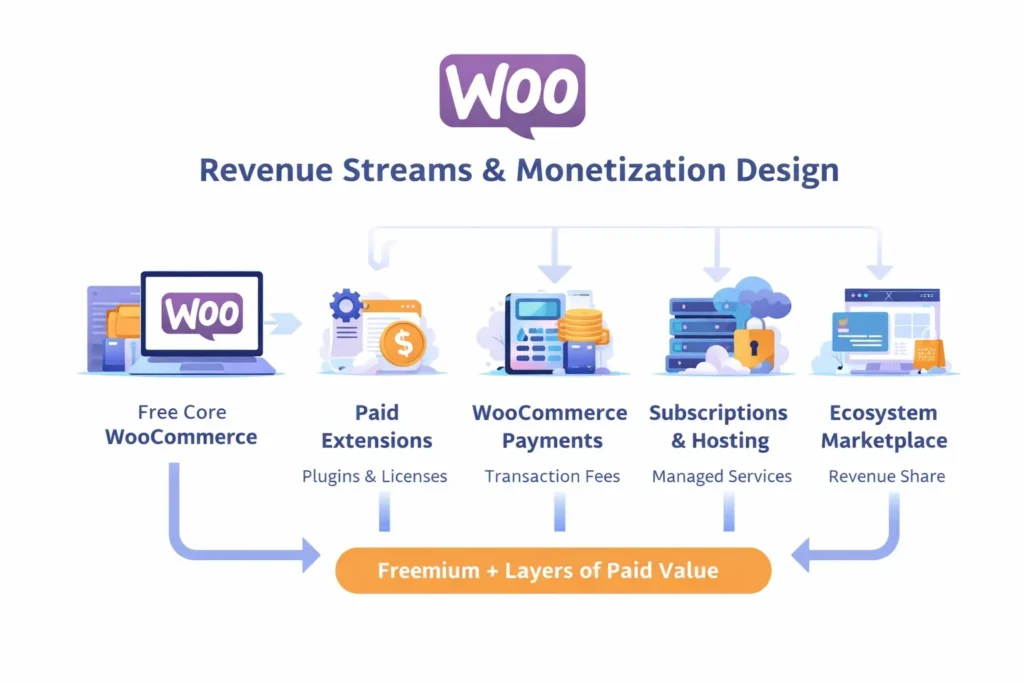
Once WooCommerce solved mass adoption through a free, open-source core, monetization followed a layered value-capture strategy rather than a single revenue lever. This is where many founders misunderstand WooCommerce—it does not monetize transactions; it monetizes capability, scale, and infrastructure dependency.
Instead of asking merchants to pay to “exist,” WooCommerce earns when merchants need more power.
Primary Revenue Stream 1: Paid Extensions & Plugin Licenses (Core Engine)
Mechanism
WooCommerce sells official extensions that add critical functionality—payments, subscriptions, memberships, bookings, shipping logic, tax automation, and advanced analytics.
Pricing Model (2026)
- Annual recurring licenses
- Tiered pricing based on site count (1 site, 5 sites, 25 sites)
- Renewal-driven revenue with auto-updates and support access
Revenue Contribution
- Largest and most predictable revenue stream
- High-margin, software-led income
- Strong renewal rates due to operational dependency
Growth Trajectory
- Merchants add more extensions as stores mature
- Advanced use cases (subscriptions, B2B pricing) drive higher ARPU
- Renewals compound annually without heavy sales effort
This works because once an extension becomes operationally embedded, churn is extremely low.
Secondary Revenue Stream 2: WooCommerce Payments
Mechanism
WooCommerce offers its own native payment solution, powered by Stripe infrastructure, tightly integrated into the platform.
Pricing Model
- Transaction-based processing fees
- No setup or monthly costs
- Geographic expansion unlocks new revenue pools
Revenue Contribution
- Fast-growing share of monetization
- Scales directly with merchant GMV
- Strategic control over checkout experience
This is a classic example of monetizing infrastructure touchpoints without forcing adoption.
Secondary Revenue Stream 3: Subscriptions, Hosting & Services
Mechanism
Through Automattic’s ecosystem, WooCommerce indirectly monetizes:
- Managed hosting
- Backup, security, and performance services
- Commerce-focused SaaS add-ons
Pricing Model
- Monthly and annual subscriptions
- Bundled plans for growing merchants
Revenue Contribution
- Expands lifetime value beyond plugins
- Stabilizes revenue with recurring SaaS income
Secondary Revenue Stream 4: Ecosystem Marketplace Share
Mechanism
Third-party developers sell themes and plugins via WooCommerce-compatible marketplaces.
Monetization Logic
- Revenue sharing or partnership fees
- Indirect monetization through platform dominance
While not always direct, this strengthens ecosystem lock-in and long-term value capture.
How the Monetization System Works Together
WooCommerce’s monetization design is non-intrusive but inevitable:
- Free core drives adoption
- Growth creates complexity
- Complexity demands paid solutions
Cross-selling happens naturally:
- Payments unlock subscriptions
- Subscriptions require advanced analytics
- Scale increases hosting and security needs
The psychology is simple: pay only when value is obvious.
For founders, this is a powerful lesson. At Miracuves, we consistently apply this principle when designing scalable platforms—delay monetization until dependency is created, then layer revenue without harming trust.
Read more : WooCommerce Revenue Model: How WooCommerce Makes Money in 2026
Operational Model & Key Activities
WooCommerce’s operational strength lies in what it does not do. It does not manage inventory, logistics, or merchant operations. Instead, it runs a lean, software-centric operation focused on platform reliability, ecosystem growth, and long-term trust.
This asset-light structure is a major reason WooCommerce scales globally without operational bottlenecks.
Core Operational Activities
1. Platform & Core Software Management
- Maintaining the open-source WooCommerce core
- Regular updates for security, performance, and compatibility
- Ensuring seamless integration with WordPress updates
2. Extension Development & Lifecycle Management
- Building and maintaining high-value paid extensions
- Managing versioning, renewals, and backward compatibility
- Ensuring extensions remain reliable at scale
3. Ecosystem Governance
- Setting developer standards and guidelines
- Reviewing extensions for quality and security
- Balancing innovation with platform stability
4. Merchant Enablement & Support
- Documentation, onboarding guides, and tutorials
- Tiered support for paid products
- Community forums and partner-led support
5. Growth & Product Marketing
- Content-led education (docs, blogs, webinars)
- Partner and agency amplification
- Product-led growth rather than sales-led growth
Technology Infrastructure Focus
WooCommerce invests heavily in:
- Plugin performance optimization
- Security patching and compliance readiness
- Scalability for high-traffic stores
- API reliability for headless and composable builds
AI-driven tools (recommendations, fraud detection, analytics) are increasingly embedded into extensions rather than the core—keeping the base lightweight.
Resource Allocation Strategy (2026)
While exact figures are private, industry estimates and Automattic disclosures suggest:
- Technology & Engineering: ~45–50%
- Product & R&D: ~20%
- Community & Ecosystem Programs: ~15%
- Marketing & Education: ~10%
- Operations & Support: ~5–10%
This reflects a product-first, ecosystem-second mindset.
Operational Advantages of This Model
- Minimal fixed costs compared to full-stack SaaS platforms
- No regional logistics or compliance overhead
- Global scalability without local teams in every market
- Community-driven innovation reduces internal build pressure
For Miracuves, this mirrors how we architect marketplace and SaaS platforms—centralized tech excellence with decentralized execution.
WooCommerce proves that in 2026, the strongest platforms are those that coordinate ecosystems rather than control them.
Strategic Partnerships & Ecosystem Development
WooCommerce’s long-term power does not come from aggressive acquisitions or exclusive contracts. It comes from a deliberate ecosystem-first partnership philosophy—one that turns external companies into growth multipliers instead of dependencies.
In 2026, WooCommerce operates less like a company and more like a commerce coordination layer connecting thousands of independent businesses.
Partnership Philosophy
WooCommerce partners where:
- It does not need to build internally
- Partners can innovate faster than a central team
- Network effects increase value for everyone involved
The result is an ecosystem where partners grow because of WooCommerce, not in spite of it.
Key Partnership Types
1. Technology & API Partners
- CRM, ERP, analytics, marketing automation tools
- Headless frontend frameworks and composable commerce stacks
- AI tools for personalization, pricing, and fraud prevention
These integrations make WooCommerce viable for complex, enterprise-grade builds.
2. Payment & Financial Service Partners
- Payment gateways (Stripe, PayPal, regional processors)
- Buy-now-pay-later services
- Tax, invoicing, and compliance platforms
This ensures global reach without WooCommerce managing financial regulations directly.
3. Hosting & Infrastructure Alliances
- Managed WordPress and WooCommerce hosting providers
- CDN, security, and performance optimization partners
- Cloud infrastructure specialists
These partners monetize scale while WooCommerce focuses on software reliability.
4. Marketing & Distribution Partners
- Digital agencies and implementation firms
- Theme designers and UX specialists
- Content creators and educators
They act as WooCommerce’s distributed sales and support force.
5. Regulatory & Expansion Alliances
- Regional compliance tools (VAT, GST, invoicing)
- Local payment and logistics connectors
- Country-specific ecommerce integrations
This allows WooCommerce to enter new markets without heavy localization costs.
Ecosystem Strategy Insights
WooCommerce’s ecosystem creates powerful network effects:
- More merchants attract more developers
- More developers build better tools
- Better tools attract larger merchants
Monetization happens within the ecosystem:
- Extensions grow in value as the merchant base grows
- Payment volume scales with GMV
- Hosting and services expand with store complexity
This creates a durable competitive moat that is extremely difficult to replicate without open-source trust.
At Miracuves, we design platform ecosystems using the same principle—partners should profit when the platform profits. That alignment is what makes ecosystems self-sustaining.
Read more : Best WooCommerce Clone Scripts 2025: Build a Scalable Ecommerce Platform from Day One
Growth Strategy & Scaling Mechanisms
WooCommerce’s growth has never been driven by aggressive advertising or enterprise sales teams. Instead, it scales through embedded distribution, ecosystem leverage, and compounding adoption loops—a strategy that aligns perfectly with platform economics in 2026.
This is growth by presence, not persuasion.
Primary Growth Engines
1. WordPress Distribution Advantage
- Bundled visibility inside the WordPress ecosystem
- Discovery through the WordPress plugin directory
- Automatic exposure to millions of new websites annually
Every new WordPress installation is a potential WooCommerce store.
2. Organic Virality & Referral Loops
- Developers recommend WooCommerce to clients
- Agencies standardize on WooCommerce for builds
- Merchants share tools through communities and tutorials
Growth is peer-driven, not sales-driven.
3. Content, Education & Community
- Extensive documentation and tutorials
- Community forums and events
- Thought leadership around open commerce
Education reduces friction and increases long-term retention.
4. Product-Led Expansion
- Free core lowers adoption barriers
- Merchants unlock paid features as complexity grows
- No forced upgrades or sudden pricing shocks
This creates a self-paced scaling journey.
Geographic Expansion Model
WooCommerce expands internationally by:
- Supporting multiple currencies and languages
- Relying on local payment and tax partners
- Allowing regional agencies to lead market penetration
This avoids heavy localization investment while maintaining global reach.
Scaling Challenges & How WooCommerce Overcame Them
Challenge 1: Performance at Scale
- Solution: Continuous optimization, caching strategies, and hosting partnerships
Challenge 2: Security & Trust
- Solution: Rigorous code reviews, rapid patching, and community audits
Challenge 3: Ecosystem Fragmentation
- Solution: Governance standards and official extension certifications
Challenge 4: Enterprise Credibility
- Solution: Headless commerce support, API-first architecture, and case studies
Why This Growth Strategy Works in 2026
- Founders trust platforms with proven longevity
- Developers influence platform decisions more than ads
- Modular growth matches modern business unpredictability
- Ecosystems outperform closed funnels
Miracuves applies similar growth mechanics when scaling marketplace and SaaS platforms—embed where users already exist, then grow with them.
Competitive Strategy & Market Defense
WooCommerce competes in one of the most crowded markets in technology—ecommerce platforms. Yet, even in 2026, it continues to hold a dominant global position. This is not because it outspends competitors, but because it defends its market through structural advantages that are difficult to attack head-on.
Core Competitive Advantages
1. Open-Source Network Effects
- Developers continuously improve and extend the platform
- Innovation happens in parallel, not sequentially
- No single company bottlenecks progress
This creates an innovation velocity closed platforms struggle to match.
2. Zero Lock-In Positioning
- Merchants own their data, code, and hosting
- No forced migrations or pricing traps
- Freedom becomes a trust-based competitive weapon
In 2026, this is a powerful differentiator as merchants grow wary of platform dependency.
3. WordPress Ecosystem Gravity
- Deep integration with the world’s largest CMS
- Content, SEO, and commerce unified in one stack
- High switching costs due to familiarity and ecosystem depth
4. Modular & Composable Architecture
- Supports headless commerce
- Integrates easily with modern frontend frameworks
- Future-proof against changing commerce trends
5. Community Trust & Longevity
- Over a decade of continuous development
- Transparent roadmap and open governance
- Strong security credibility through community auditing
Trust compounds over time and acts as a moat.
Market Defense Tactics
Against SaaS Platforms (Shopify, BigCommerce)
- WooCommerce counters rigidity with flexibility
- Appeals to businesses outgrowing subscription tiers
Against Marketplaces (Amazon, Etsy)
- Emphasizes brand ownership and margin control
- Positions itself as infrastructure, not competition
Against New Entrants
- Relies on ecosystem depth and developer loyalty
- Continuous incremental improvement rather than risky pivots
Strategic Feature & Timing Defense
WooCommerce avoids reactive feature races. Instead, it:
- Watches ecosystem demand signals
- Allows partners to experiment first
- Standardizes only proven innovations
This reduces risk while keeping the platform relevant.
Acquisitions & Strategic Moves
Rather than buying competitors, WooCommerce (via Automattic) acquires:
- Talent
- Infrastructure capabilities
- Developer tools
These moves quietly strengthen the core without disrupting trust.
At Miracuves, we design competitive strategies using the same logic—defend through architecture and ecosystem, not price wars.
Lessons for Entrepreneurs & Implementation
This is where WooCommerce’s story becomes most valuable—not as a case study to admire, but as a framework to apply. WooCommerce did not win by being the fastest, flashiest, or most heavily funded platform. It won by making a series of strategic architectural decisions that compounded over time. For founders building apps, SaaS products, or marketplaces in 2026, these lessons are highly actionable.
Key Factors Behind WooCommerce’s Success
1. Open Core Before Monetization
WooCommerce focused first on distribution and trust, not revenue. Monetization came only after dependency was established.
2. Ecosystem Over Control
Instead of building everything in-house, WooCommerce let developers, agencies, and partners grow alongside the platform.
3. Ownership as a Value Proposition
By giving merchants full control over data and code, WooCommerce turned freedom into its strongest differentiator.
4. Expansion-Led Revenue, Not Entry Fees
Revenue scales when customers grow—not when they sign up.
Replicable Principles for Startups
Entrepreneurs can adapt WooCommerce’s logic even without open-source software:
- Offer a free or low-friction core to accelerate adoption
- Design paid layers that unlock only when users scale
- Build APIs and integrations early to attract partners
- Let third parties monetize on top of your platform
- Optimize for lifetime value, not upfront revenue
This approach works especially well for:
- Marketplaces
- Vertical SaaS platforms
- Creator and community-driven apps
- B2B tools with long adoption cycles
Common Mistakes to Avoid
- Monetizing too early and slowing adoption
- Locking users into rigid pricing tiers
- Treating partners as vendors instead of stakeholders
- Overbuilding features instead of enabling extensions
- Ignoring developer experience
WooCommerce avoided these traps by design, not luck.
Adapting the Model for Local or Niche Markets
You do not need WordPress-scale reach to apply this model.
Founders can:
- Launch region-specific platforms with modular add-ons
- Build niche ecosystems (logistics, education, healthcare, services)
- Allow local partners to customize and monetize
- Add compliance, payments, or analytics as paid layers
This is exactly how Miracuves helps entrepreneurs implement proven platform models—localized, scalable, and ecosystem-ready.
Implementation Timeline & Investment Priorities
Phase 1 :
- Build a strong core product
- Prioritize adoption and usability
Phase 2 :
- Introduce paid extensions or services
- Enable third-party integrations
Phase 3 :
- Monetize infrastructure touchpoints
- Expand ecosystem and partnerships
Ready to implement WooCommerce’s proven business model for your market?
Miracuves builds scalable platforms with tested business models and growth mechanisms. We’ve helped 200+ entrepreneurs launch profitable apps. Get your free business model consultation today.
Conclusion :
WooCommerce’s business model proves a powerful truth about platform economies in 2026: sustainable growth is not built by controlling users, but by enabling them.
By choosing openness over lock-in, ecosystems over exclusivity, and long-term trust over short-term revenue, WooCommerce transformed from a simple WordPress plugin into one of the most influential commerce infrastructures in the world.
For founders, the deeper lesson is this: the strongest platforms do not compete on features alone—they compete on philosophy and architecture.
As digital ecosystems continue to evolve beyond single apps into interconnected platforms, WooCommerce stands as a blueprint for how innovation and execution—when aligned—create compounding, defensible growth.
FAQs :
What type of business model does WooCommerce use?
WooCommerce follows an open-source ecosystem business model. The core platform is free, while revenue comes from paid extensions, payments, and infrastructure services.
How does the WooCommerce business model create value?
It creates value by giving merchants full ownership of their store and data while enabling customization through plugins. Developers and partners add value by building extensions within the ecosystem.
What are the key success factors behind WooCommerce’s growth?
Deep WordPress integration, open-source trust, expansion-led monetization, and a large developer ecosystem are the main drivers of WooCommerce’s success.
How scalable is the WooCommerce business model?
The model is highly scalable because it is asset-light. Growth happens through software, partners, and infrastructure services rather than direct operational expansion.
What are the biggest challenges in the WooCommerce model?
Key challenges include performance optimization, plugin security, and ecosystem governance. WooCommerce addresses these through strict development standards and regular updates.
How can entrepreneurs adapt the WooCommerce model for their region?
Founders can launch a free core platform and monetize through local add-ons like payments, compliance, or logistics integrations tailored to regional needs.
What are alternatives to the WooCommerce business model?
Alternatives include subscription-based SaaS platforms like Shopify, marketplace-led models like Amazon, or hybrid SaaS–marketplace approaches.
How has WooCommerce’s business model evolved over time?
WooCommerce evolved from a simple plugin into a full commerce infrastructure by adding payments, subscriptions, and headless capabilities while keeping the core free.
Related Article :
- Best Wish Clone Scripts 2025: Build a High-Profit Social Commerce App
- Best DHgate Clone Scripts 2025: Build a Global B2B Wholesale Marketplace Faster
- Best BigCommerce Clone Scripts 2025: Build a Scalable SaaS Ecommerce Platform
- What is Shopify and How Does It Work?
- What is BigCommerce and How Does It Work?