In 2025, AI chat platforms crossed $4.8 billion in global revenue, fueled by explosive user adoption, enterprise integrations, and the shift toward AI-powered automation across every industry. What began as simple chatbots has now evolved into full-scale AI ecosystems — powering customer support, content creation, research, coding, business intelligence, and end-to-end workflow automation.
Why it matters:
Entrepreneurs now have a major advantage. You no longer need millions of users or massive infrastructure to build a profitable AI platform. With the right revenue model, even niche ChatGPT-style apps can generate high-margin recurring income through subscriptions, API usage, and enterprise deals. The opportunity is wide open — and growing faster than any digital market in the last decade.
ChatGPT Clone Revenue Overview – The Big Picture
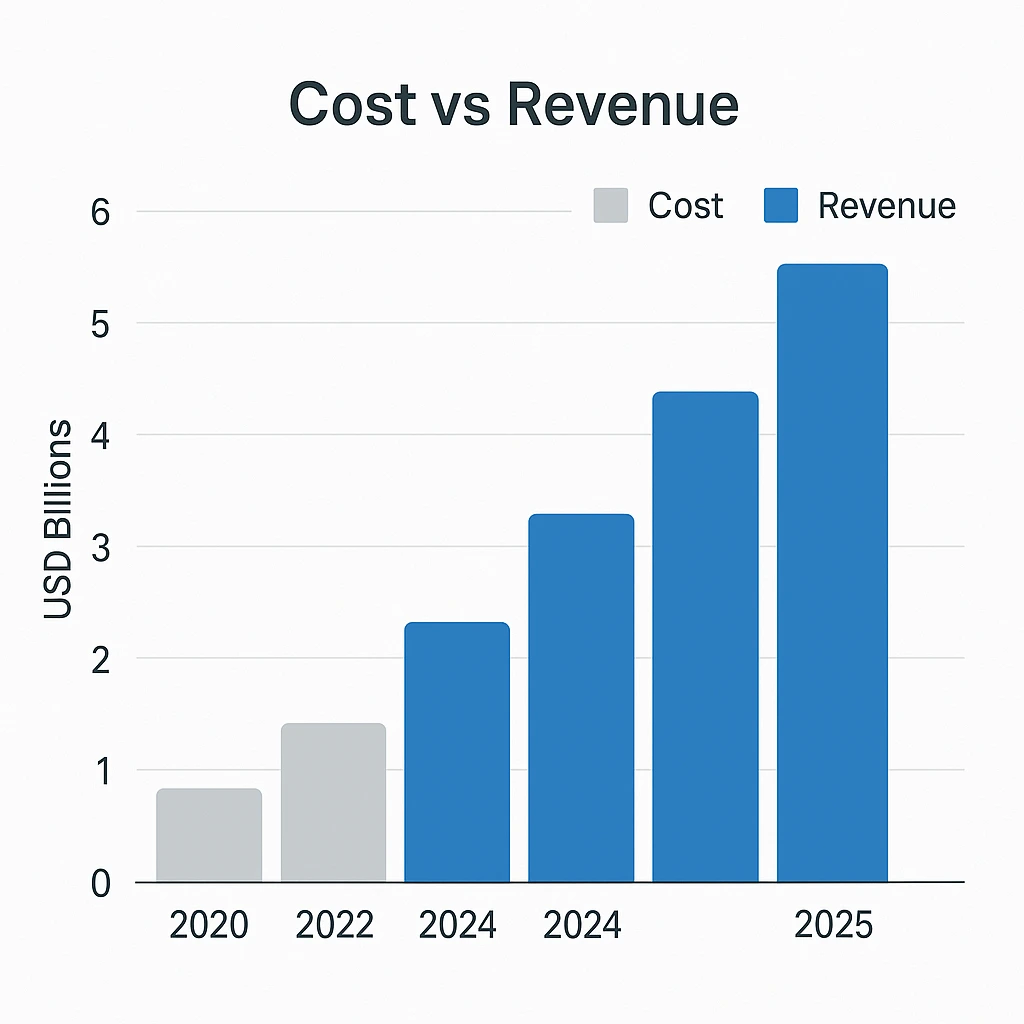
- 2025 estimated revenue: $4.8B+ (41% YoY growth)
- Current valuation: Expected to cross $95B by end of 2025
- Revenue breakdown by region:
North America – 44%
Europe – 29%
Asia-Pacific – 22%
Others – 5% - Average profit margin across AI chat platforms: 31%
- Market position: Dominating the AI-assistant market with higher retention than SaaS tools
- Competitors: Gemini, Claude, Perplexity, Copilot
Read More: Inside the ChatGPT App: How It Works & Why Everyone’s Obsessed

Primary Revenue Streams – Deep Dive
1. Subscription Plans (38%)
Premium tiers like Plus, Pro & Business plans. Pricing ranges from $20 to $200/month/user.
Enterprises pay up to $50,000/year for internal deployment.
2. API Usage – Pay per Token (32%)
Businesses integrate AI into their products.
Average revenue per business: $3,200/month.
Highly scalable revenue stream.
3. Enterprise Licensing (14%)
Custom deployment, security compliance, private hosting.
Used by banks, hospitals & government agencies.
4. AI Marketplace Plugins (10%)
Third-party plugins & automation tools. AI takes commission per transaction.
5. Data Training & Fine-Tuning Services (6%)
Companies pay to train AI on their proprietary data.
Read More: Business Model of ChatGPT : Features, Revenue, and Strategy
Revenue streams percentage breakdown
| Revenue Stream | Share % |
|---|---|
| Subscriptions | 38% |
| API Usage | 32% |
| Enterprise Licensing | 14% |
| Plugin/Marketplace Commission | 10% |
| Data Training Services | 6% |
The Fee Structure Explained
User-Side Fees
- Free tier with usage limits
- Plus plan – $20/month
- Business plan – $200/user/month
- Custom enterprise pricing
Provider-Side Fees
- Plugin developers pay 10–25% commission
- API overage charges
Hidden Revenue Layers
- Data processing fees
- Third-party integrations
- AI automation upsells
Regional Pricing
- Lower pricing in India & Southeast Asia for rapid adoption
Complete fee structure by user type
| User Type | Pricing Model | Commission / Fees |
|---|---|---|
| Individual | Monthly subscription | $20 |
| Business/Teams | Per user | $50–$200/user |
| Enterprise | Custom licensing | $10K–$50K/year |
| Plugin Makers | Revenue share | 10–25% |
| Developers | API usage | Pay-per-token |
How ChatGPT Clone Maximizes Revenue Per User
| Strategy | How It Works |
|---|---|
| Segmentation | Custom plans for students, enterprises & developers |
| Upselling | Advanced models (GPT-4/5) locked behind paywalls |
| Cross-selling | AI tools – email writing, code gen, data research |
| Dynamic Pricing | Higher rates during peak API demand |
| Retention Monetization | Auto-renewal plans with loyalty discounts |
| LTV Optimization | AI learns user behavior & suggests paid features |
| Psychological Pricing | $20/month instead of $19.99 = premium branding |
Real Example:
An average enterprise using AI for customer service saves $120K/year while paying only $50K/year in AI usage — making it a no-brainer investment.
Cost Structure & Profit Margins
| Cost Area | % Share in Total Cost |
|---|---|
| Cloud Hosting (GPU) | 42% |
| R&D | 21% |
| Marketing & CAC | 14% |
| Operations | 13% |
| Compliance & Security | 10% |
- Profit Margin 2025: ~31%
- Break-even point: 7–9 months for SaaS AI tools
- Key profitability driver: API usage + subscription bundling
Read More: Build an App Like ChatGPT – Full-Stack Developer Guide
Future Revenue Opportunities (2025–2027)
- Industry-specific AI agents (Legal, Healthcare, Finance)
- AI-powered SaaS automation tools
- Voice-based assistants
- AI CRM systems
- Multilingual AI bots
- Smart AI dashboards for analytics & insights
Major Risks:
Regulations, high GPU costs, weak data security, dependency on cloud providers.
Major Opportunities:
Niche AI solutions – lawyers, real estate agents, fitness trainers & educators.
Lessons for Entrepreneurs & Your Opportunity
What Works:
Recurring revenue, API monetization, tier-based pricing.
What to Replicate:
Freemium → Paywall progression with smart upsells.
Market Gaps Right Now:
Industry-specific AI bots — lawyers, SMEs, educators, sales teams.
Entrepreneur Opportunity:
Build small but high-value AI tools. They do NOT require millions of users to be profitable.
Want to build a platform with ChatGPT’s proven revenue model? Miracuves helps entrepreneurs launch revenue-generating AI platforms with built-in monetization features. Our ChatGPT clone scripts come with flexible revenue models you can customize. In fact, some clients see revenue within 30 days of launch, and Miracuves delivers ready-to-launch solutions in 30–90 days. Get a free consultation to map out your revenue strategy. If you want it in advanced language models or enterprise-level architecture, Miracuves will provide that also.
Final Thought
AI chat platforms are no longer experimental — they are already profitable, predictable, and rapidly becoming the backbone of modern digital businesses. The real opportunity now belongs to those who build specialized AI products that solve real-world problems faster than competitors. You don’t need to recreate Big Tech — you only need the right niche, the right features, and the right launch strategy.
That’s where Miracuves becomes your advantage.
With ready-to-launch AI solutions delivered in just 3–9 days, Miracuves helps founders skip the 6–12 month development cycle and go straight to revenue. Whether you want subscription-driven AI tools, enterprise-ready assistants, or a full ChatGPT-style ecosystem, Miracuves provides the architecture, monetization framework, and scalability to grow from day one.
In a market evolving at lightning speed, the winners will be those who launch fast, iterate fast, and monetize smarter — and Miracuves is built to make that happen.
FAQs
1. How much does ChatGPT make per transaction?
API-based usage typically earns $0.002–$0.03 per request depending on model.
2. What’s its most profitable revenue stream?
Subscriptions + enterprise API usage.
3. How does pricing compare to competitors?
Competitors offer cheaper plans, but ChatGPT leads in accuracy and enterprise trust — while Miracuves provides high-value, production-ready solutions starting at just $3299.
4. What percentage does it take from providers?
10–25% commission on plugins & marketplace integrations.
5. How has the revenue model evolved?
From simple chatbot to enterprise SaaS AI with diversified income.
6. Can small platforms use similar models?
Yes — especially API reselling or niche use-case AI tools.
7. What’s the minimum scale for profitability?
Even 1,000 paid users at $20/month can build a profitable AI SaaS business.
8. How to implement similar revenue models?
Start with subscription tiers + usage-based billing + industry niche targeting.
9. What are alternatives to this model?
Ad-supported AI, white-label licensing, enterprise on-prem deployment.
10. How quickly can similar platforms monetize?
Miracuves’ ready-to-launch AI scripts, with a guaranteed delivery timeline of just 30–90 days.