
Key Takeaways
What You’ll Learn
- Descript’s revenue model is built around AI-powered SaaS monetization where subscriptions, AI usage fees, enterprise plans, APIs, and add-ons work together.
- Subscriptions are the core revenue stream because creators, podcasters, marketers, and teams pay monthly or annually for editing, transcription, and collaboration tools.
- AI usage-based billing increases revenue per user through transcription minutes, overdub voice cloning, video generation credits, and advanced automation features.
- Enterprise licensing creates high-value contracts by offering team collaboration, security controls, API access, and custom media workflows for larger organizations.
- The biggest takeaway for founders is that an AI editing platform becomes stronger when recurring SaaS revenue is paired with usage-based AI monetization.
Stats That Matter
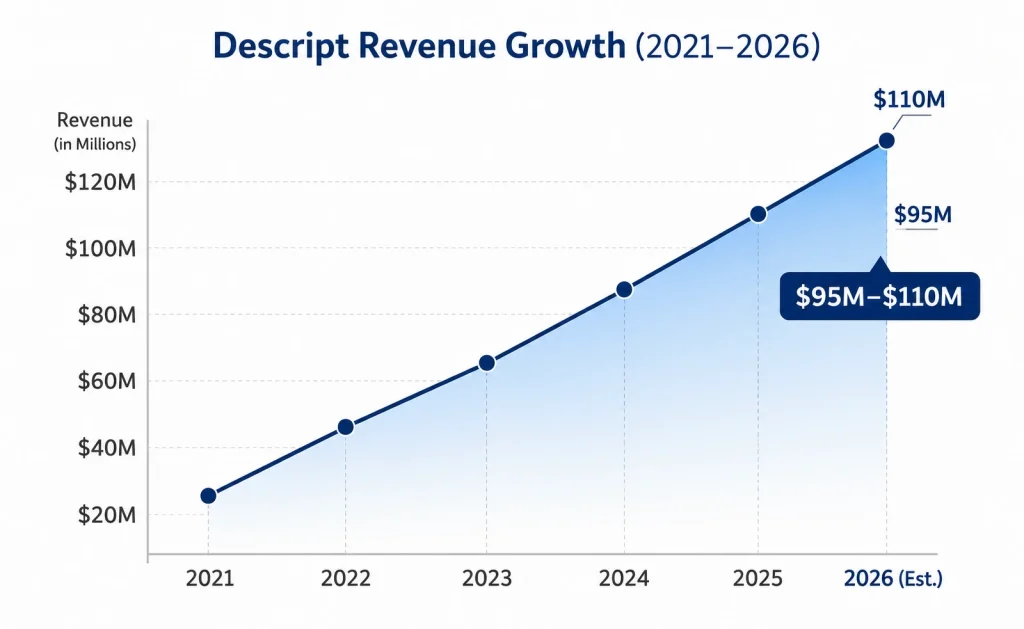
- The article estimates Descript’s 2025 revenue at $95–110 million ARR with projected 2026 momentum crossing around $100 million in annual recurring revenue.
- Subscription plans contribute around 65% of total revenue through creator, professional, and enterprise SaaS pricing tiers.
- AI usage-based billing contributes around 18% through transcription credits, AI generation packs, overdub features, and advanced automation usage.
- Enterprise licensing contributes around 10% with annual contract sizes ranging from approximately $3,000 to $25,000 per client.
- API access and add-ons create extra monetization layers through speech-to-text APIs, video processing, cloud storage upgrades, and premium voice packs.
Real Insights
- Descript is not just an editing tool because its real business strength comes from turning AI-powered workflows into repeatable SaaS revenue.
- The freemium model works because it lowers adoption friction and then moves active users toward paid plans, AI credits, and team-based upgrades.
- AI features create stronger upsell moments because power users who need transcription, voice cloning, and video automation naturally spend more over time.
- Enterprise growth improves long-term stability by adding larger contracts, collaboration workflows, compliance needs, and higher retention from teams.
- For entrepreneurs, the biggest lesson is to build a Descript Clone around subscriptions, AI usage credits, enterprise licensing, API monetization, and scalable media automation from the beginning.
In 2026, Descript crossed an estimated $100 million in annual recurring revenue, positioning itself as one of the most commercially successful AI-powered audio and video editing platforms in the creator economy.
This milestone reflects how AI-driven creative tools have evolved from simple editing utilities into essential business infrastructure for podcasters, marketing teams, and digital-first brands around the world. Descript’s growth highlights the power of combining freemium access with premium automation features that convert casual users into long-term, high-value subscribers. For entrepreneurs, the platform’s success serves as a practical case study in building predictable SaaS revenue through subscriptions, enterprise licensing, and usage-based AI monetization. Its revenue trajectory also signals a broader shift in the creator economy, where speed, collaboration, and intelligent workflows now directly influence customer lifetime value and long-term retention.
Why Founders Must Study This Model
Descript’s ability to convert free creators into long-term, high-value subscribers offers a blueprint for building predictable SaaS revenue in AI-driven platforms.
Its blend of usage-based AI pricing and team subscriptions reveals how modern platforms maximize lifetime value without aggressive customer acquisition spending.
Descript Revenue Overview – The Big Picture
2026 Revenue: Estimated $95–110 million ARR
Valuation: Estimated $550–650 million (private SaaS multiple range 5–6x ARR)
YoY Growth: 32–38% (2024–2026)
Revenue by Region:
- North America: 52%
- Europe: 28%
- Asia-Pacific: 15%
- Rest of World: 5%
Profit Margins:
- Gross Margin: 72–78%
- Net Margin (Reinvesting Phase): 12–18%
Competition Benchmark:
- Adobe Premiere Rush (Adobe ecosystem-driven, enterprise-focused)
- Riverside.fm (podcast-first monetization model)
- VEED.io (freemium creator platform with lower ARPU)
Read More: Descript Explained: AI-Powered Audio and Video Editing Made Simple
Primary Revenue Streams Deep Dive
Revenue Stream #1: Subscription Plans (Core SaaS Revenue)
Descript monetizes primarily through monthly and annual subscriptions across creator, professional, and enterprise tiers.
Share of Total Revenue: ~65%
Pricing (2026): $15–40 per user/month, Enterprise custom pricing
2026 Data: Over 1.5 million active users, with 12–15% conversion to paid plans
Revenue Stream #2: AI Usage-Based Billing
Advanced AI tools like overdub voice cloning, transcription minutes, and video generation credits are charged on usage.
Share: ~18%
Pricing: Per-hour transcription credits and AI generation packs
2026 Insight: Power users generate 3–4x higher ARPU than standard subscribers
Revenue Stream #3: Enterprise Licensing
Team-based collaboration tools, security compliance, and API access for media companies.
Share: ~10%
Deal Size: $3,000–25,000 annually per client
2026 Clients: Media agencies, SaaS marketing teams, podcast networks
Revenue Stream #4: API Monetization
Speech-to-text and video processing APIs sold to third-party platforms.
Share: ~5%
Growth Rate: 40% YoY driven by SaaS integrations
Revenue Stream #5: Add-On Marketplace & Storage
Cloud storage expansions and premium voice packs.
Share: ~2%
Revenue Streams Percentage Breakdown Table
| Revenue Stream | % Share | Monetization Type | ARPU Impact |
|---|---|---|---|
| Subscriptions | 65% | Monthly/Annual SaaS | High |
| AI Usage Fees | 18% | Pay-as-you-go | Very High |
| Enterprise Plans | 10% | Contract-based | High |
| API Access | 5% | Usage-based | Medium |
| Add-ons & Storage | 2% | Microtransactions | Low |
The Fee Structure Explained
User-Side Fees
- Monthly subscription tiers
- AI credit packs for transcription and generation
- Cloud storage upgrades
Provider-Side Fees
- Enterprise seat licensing
- API integration charges
Hidden Revenue Layers
- Overage charges on AI usage
- Premium feature unlocks
- Annual prepayment discounts that improve cash flow
Regional Pricing Variation
- Asia-Pacific plans priced 20–25% lower
- Enterprise pricing standardized globally
Complete Fee Structure Table
| User Type | Fee Type | Pricing Model | Monetization Logic |
|---|---|---|---|
| Free User | Freemium | $0 | Lead generation |
| Creator | Subscription | $15–20/month | Volume-based ARPU |
| Pro User | Subscription + AI Credits | $30–40/month | Feature upsell |
| Enterprise | Contract | Custom | Retention-based |
| Developer | API Usage | Per request/minute | Scale-driven |
How Descript Maximizes Revenue Per User
Segmentation: Creators, podcasters, marketing teams, and media enterprises each receive tailored feature sets.
Upselling: AI voice cloning and advanced collaboration tools drive plan upgrades.
Cross-Selling: API access bundled into enterprise packages.
Dynamic Pricing: Discounts tied to usage patterns and team size.
Retention Monetization: Annual contracts with feature-based renewals.
LTV Optimization: Average paid user lifetime exceeds 28 months.
Psychological Pricing: Tier gaps designed to push users toward mid-tier plans.
Real Data Example: Teams using AI overdub features spend 2.7x more annually than standard creators.
Cost Structure & Profit Margins
Infrastructure Cost:
- Cloud computing and AI model hosting (22–26% of revenue)
CAC & Marketing:
- Content-driven acquisition and influencer partnerships (12–15%)
Operations:
- Support, compliance, and administration (8–10%)
R&D:
- AI model training, platform upgrades (18–22%)
Unit Economics:
- CAC Payback Period: 5–7 months
- LTV:CAC Ratio: 4.5:1
Margin Optimization:
- Annual billing incentives
- AI usage caps for lower tiers
Profitability Path:
Expected net profitability above 20% by 2027 with enterprise growth.
Miracuves Descript-Like Platform Solution Cost and Tech Stack
Miracuves pricing for a Descript-like AI-powered audio and video editing platform built with JavaScript architecture is available on request. The final cost depends on AI modules, transcription capabilities, media processing workflows, collaboration features, cloud infrastructure, and deployment scope. Estimated delivery timeline: 30 to 90 days.
Build a modern AI-driven content creation platform designed for creators, podcasters, video editors, media agencies, online educators, marketing teams, and digital content businesses.
Core Workflows: Audio editing, video editing, AI transcription, screen recording, subtitle generation, voice cloning, collaborative editing, project management, media exporting, and cloud-based content workflows.
AI Editing Logic: Speech-to-text processing, AI-powered transcription correction, filler word removal, voice enhancement, text-based editing workflows, subtitle synchronization, content summarization, AI dubbing, and media automation systems.
Management Hub: Admin dashboards, creator management, project controls, AI usage monitoring, subscription management, export tracking, collaboration permissions, storage management, analytics reporting, and centralized operational controls.
Enterprise Readiness: Customizable architecture for secure scaling, AI-powered processing pipelines, high-volume media handling, cloud rendering workflows, multi-user collaboration, and long-term platform growth.
Why a Descript-Like Platform Requires JavaScript Architecture
A Descript-like platform handles AI-powered media editing, transcription processing, real-time collaboration, cloud rendering, voice technology, and large-scale content workflows. It requires scalable backend logic, high-speed media processing, responsive editing experiences, and strong infrastructure for handling audio and video data efficiently.
We recommend a modern JavaScript-based architecture for this type of platform because:
Built for AI-Powered Media Operations
JavaScript-based backend systems support real-time editing workflows, AI transcription processing, media rendering, cloud synchronization, and scalable content delivery operations.
Advanced Editing Dashboard Experience
React.js or other JavaScript frontend frameworks can power highly interactive dashboards for video timelines, audio waveforms, AI transcription editing, collaboration tools, export management, and creator workflows.
Content Platform Scalability
This architecture is suitable for handling multiple creators, growing media libraries, AI processing queues, collaborative editing sessions, transcription workloads, and large-scale content operations.
Flexible Integration Layer
The platform can connect with AI transcription engines, cloud storage providers, video rendering systems, voice AI tools, payment gateways, collaboration software, analytics platforms, and content distribution services.
You get a scalable, secure, AI-first media editing platform designed for long-term creator economy growth, content automation, and modern digital media operations.
Note: Final pricing depends on selected AI modules, transcription engines, media processing requirements, cloud infrastructure, collaboration features, storage capacity, deployment architecture, and custom workflow development.
Future Revenue Opportunities & Innovations
New Streams: AI-generated content marketplaces, voice licensing models
AI/ML-Based Monetization: Custom brand voices for enterprise marketing teams
Market Expansions: Latin America and Southeast Asia SaaS markets
Predicted Trends 2025–2027: AI-assisted content production as a standard enterprise tool
Risks & Threats: Open-source AI tools lowering entry barriers
Opportunities for New Founders: Vertical-specific AI editing platforms for education, legal, and healthcare content
Lessons for Entrepreneurs & Your Opportunity
What Works:
Recurring subscriptions combined with usage-based AI billing
What to Replicate:
Freemium funnel paired with enterprise contracts
Market Gaps:
Industry-specific content automation tools
Improvements Founders Can Use:
Localized AI models and compliance-focused SaaS offerings
Final Thought
Descript’s success proves that AI-driven SaaS platforms thrive when recurring revenue is paired with scalable, usage-based monetization. Its ability to convert creators into long-term enterprise clients demonstrates how value perception evolves with platform maturity.
For founders, the model highlights how combining free access with premium automation features can build predictable cash flow. Strategic pricing psychology and AI-powered upsells transform casual users into high-margin subscribers.
FAQs
1. How much does Descript make per transaction?
Descript earns an average of $22–35 per paid user per month, with enterprise clients generating significantly higher annual contract values.
2. What’s Descript’s most profitable revenue stream?
Subscription plans combined with AI usage fees deliver the highest margins and recurring cash flow.
3. How does Descript’s pricing compare to competitors?
Descript offers lower entry pricing than Adobe while monetizing heavily through AI feature upsells.
4. What percentage does Descript take from providers?
Descript does not take commissions; it operates on a SaaS subscription and usage-based pricing model.
5. How has Descript’s revenue model evolved?
It shifted from flat subscriptions to AI-based usage billing to increase ARPU and enterprise appeal.
6. Can small platforms use similar models?
Yes, freemium funnels paired with premium automation features work well at small and mid-scale levels.
7. What’s the minimum scale for profitability?
Around 10,000–15,000 active paying users typically cover infrastructure and operational costs.
8. How to implement similar revenue models?
Combine free access, tiered subscriptions, AI usage credits, and enterprise licensing.
9. What are alternatives to Descript’s model?
Transaction-based pricing, ad-supported platforms, or one-time software licensing.
Miracuves is an independent software development company. We are not affiliated with, connected to, sponsored by, or endorsed by any company or product named in this article.
Terms such as “X Clone” are used descriptively. It is how the software industry refers to building a platform with functionality comparable to a known service, and how clients search for it.
The entire design and codebase of our products is built by our own team. Our products contain no code, design, graphics, or content originating from any third-party website or applications.
All third-party names and marks referenced in this article are the property of their respective owners, referenced solely to identify the services discussed.