




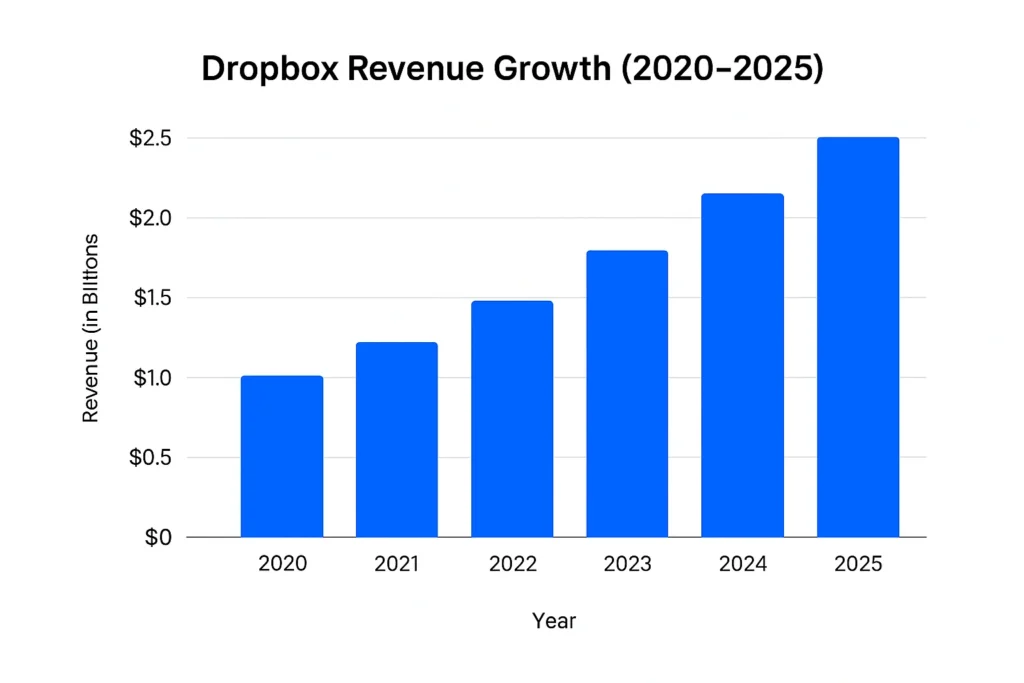
Dropbox earned nearly $2.55 billion in 2024 and is projected to reach $2.51 billion in 2025. Its journey from a simple file-storage service to a global SaaS powerhouse demonstrates how a clear freemium-to-paid conversion model can turn massive user acquisition into sustainable, recurring revenue.
What started as a basic utility for personal file syncing has evolved into a platform central to business collaboration, cloud productivity, and secure data management. With millions of paying users across individuals and enterprises, Dropbox has perfected the art of converting convenience into commitment—where ease of use meets deep product integration.
The company’s focus on subscription-based pricing, high customer retention, and scalable infrastructure ensures steady profitability even in a competitive market dominated by giants like Google and Microsoft. Its strategy of layering new services such as AI-powered tools, team dashboards, and enhanced security features keeps ARPU rising despite slow overall user growth.
Dropbox Revenue Overview – The Big Picture
Valuation & Revenue:
Dropbox’s market value stands at approximately $8–9 billion, backed by annual revenue of $2.51 billion as of 2025.
Growth:
Year-over-year growth has been modest, around 1–2 %, showing a mature but steady business model with strong profitability.
Regional Breakdown:
- United States: ~57 % of total revenue
- International Markets: ~43 %
Profit Margins:
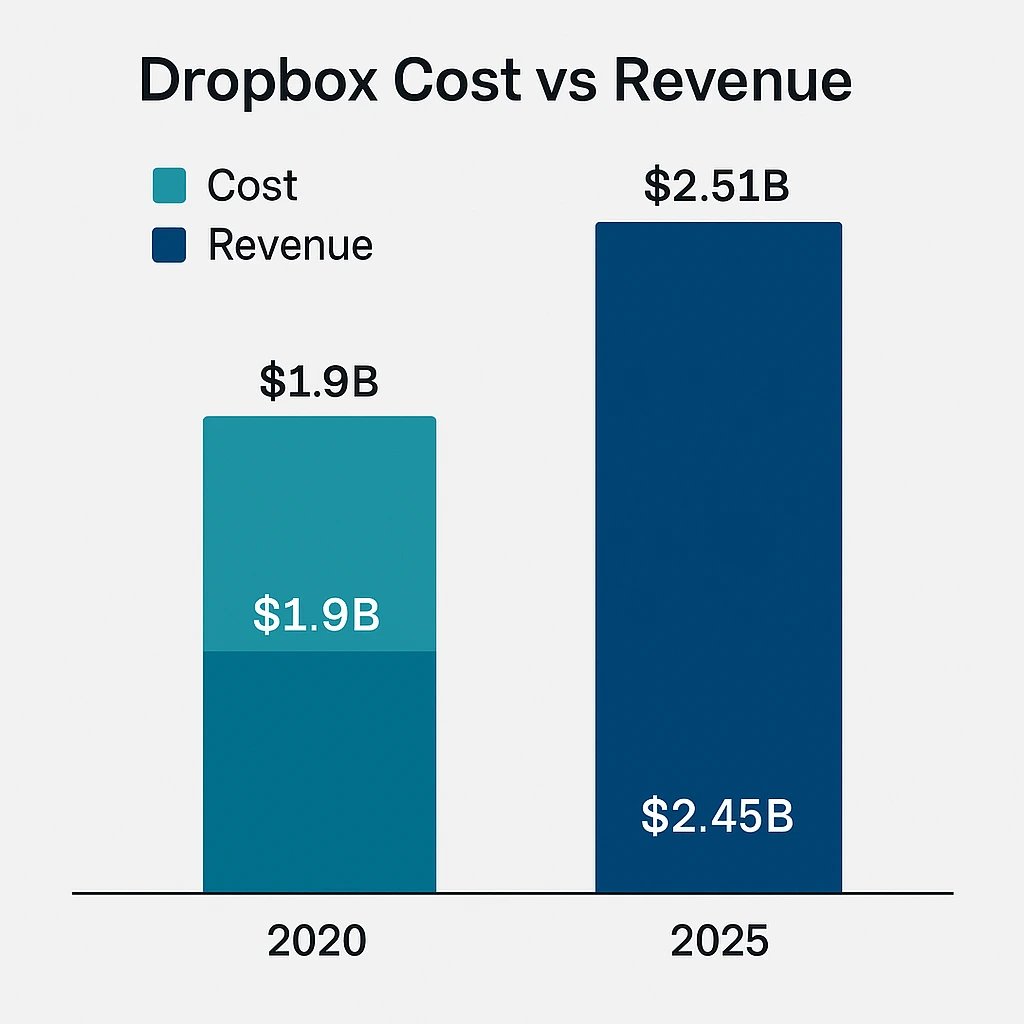
Gross margins average around 80–82 %, while operating margins exceed 40 %, reflecting efficient cost management.
Market Position:
Dropbox remains a top-tier cloud-storage provider alongside Google Drive, OneDrive, and Box, serving over 700 million users globally.
Read More: Dropbox App: How It Works and Why It’s Trusted for Cloud Storage
Primary Revenue Streams Deep Dive
Revenue Stream #1 – Paid Subscriptions
Dropbox’s core revenue comes from individual and business subscriptions. Free users can upgrade to paid plans for additional storage and collaboration tools.
- Share of total revenue: ≈ 90 %
- Average ARPU: ≈ $139 per year
- Trend: Stable base, rising ARPU through premium upgrades.
Revenue Stream #2 – Business & Team Plans
Dropbox Business targets companies needing secure collaboration and admin features.
- Share of total revenue: ≈ 8–10 %
- Growth: Driven by enterprise adoption and team management tools.
Revenue Stream #3 – Add-on Features & AI Integrations
Premium add-ons like AI-driven search, smart sync, and productivity tools bring incremental revenue.
- Share: ≈ 3–5 %
- Growth: High-potential area through innovation.
Revenue Stream #4 – Partner Integrations
Dropbox partners with developers and enterprise ecosystems for API integrations and co-marketing.
- Share: ≈ 2–3 %
Revenue Stream #5 – Storage Over-Usage & Add-ons
Users exceeding their plan limits pay for extra capacity or upgrades.
- Share: ≈ 1–2 %
Read More: Business Model of Dropbox: Complete Strategy Breakdown 2025
Revenue Streams Percentage Breakdown
| Revenue Stream | Approx. Share of Total Revenue |
|---|---|
| Paid Subscriptions | 90 % + |
| Business & Team Plans | 8–10 % |
| Add-on Features & AI Integrations | 3–5 % |
| Partner Integrations | 2–3 % |
| Storage Over-Usage & Add-ons | 1–2 % |
The Fee Structure Explained
User-side Fees
- Free Tier: Basic storage (entry point for acquisition)
- Plus / Pro Tiers: Monthly or annual fees for expanded storage and advanced tools
- Business Plans: Per-seat licensing with admin controls and security features
- Add-ons: AI features and integrations at extra cost
Provider-side Fees
Dropbox doesn’t take commissions. Businesses pay per user seat and feature tier.
Hidden Revenue Tactics
- Freemium conversion funnel
- Storage limits forcing upgrades
- Bundled premium tiers with AI and collaboration tools
Regional Pricing Variations
Pricing adjusts by country based on local purchasing power.
Complete Fee Structure by User Type
| User Type | Fee Structure | Notes |
|---|---|---|
| Individual – Free Tier | $0 | Limited storage and sharing |
| Individual – Paid Plans | Monthly / annual subscription | Main revenue source |
| Business / Team Plans | Per-seat licence fees | Higher ARPU segment |
| Premium Add-ons | Additional charges | AI & productivity tools |
| Storage Over-usage | Extra charges or forced upgrade | Incremental revenue |
How Dropbox Maximizes Revenue Per User
- Segmentation: Free, individual paid, business, and enterprise tiers.
- Upselling: Users upgrade for storage or collaboration tools.
- Cross-selling: Business users add AI features or extra storage.
- Dynamic Pricing: Annual plans offer discounts; multi-seat licenses get bulk rates.
- Retention Monetization: High stickiness due to data storage; low churn.
- Lifetime Value: ~ $140 ARPU × millions of users = strong recurring revenue.
- Psychological Pricing: Free entry, tier gaps, and discounted annual plans boost conversions.
Cost Structure & Profit Margins
Major Costs: Infrastructure, R&D, marketing, and operations.
Unit Economics: ~ 80 % gross margin → ~ $113 gross profit per user per year.
Profitability: Dropbox maintains over 40 % operating margin.
Margin Improvement Strategies: cost optimisation, data-centre efficiency, AI-driven automation, and higher ARPU focus.
Read More: Best Dropbox Clone Script 2025 | Launch Your Cloud Storage App
Future Revenue Opportunities & Innovations
- AI & Machine Learning Monetisation: Premium AI assistants, auto-summarisation tools.
- New Markets: Localized pricing for emerging regions.
- Enterprise Integrations: Expanded API ecosystem.
- Future Streams: Data security add-ons, video collaboration, backup as a service.
- Threats: Competition from Google Drive and OneDrive; pricing pressures.
- Opportunity: Niche storage platforms in specific industries (e.g., creative, legal, medical).
Lessons for Entrepreneurs & Your Opportunity
What Works:
- Freemium model for mass user base.
- Subscription revenue for predictable cash flow.
- Upselling and cross-selling for ARPU growth.
What to Replicate:
- Clear tiered plans.
- Business and enterprise offerings.
- Data-driven retention strategy.
What to Improve:
- Localisation and niche focus.
- Early integration of AI and automation.
Want to build a platform with Dropbox’s proven revenue model? Miracuves helps entrepreneurs launch ready-made platforms with built-in monetisation features. Our Dropbox Clone Scripts come with flexible revenue models that you can customise and scale. Some clients start earning within 30 days of launch. Get a free consultation to map your revenue strategy today.
Final Thought
Dropbox’s model proves that a simple subscription-driven product can grow into a multi-billion-dollar enterprise when combined with smart pricing, frictionless onboarding, and long-term customer retention. Its success is rooted not in complexity, but in clarity—clear value, clear upgrades, and clear monetisation pathways that scale effortlessly across individuals, teams, and global enterprises.
For new entrepreneurs and SaaS founders, this model offers a powerful blueprint. With the right architecture, strong UX, and a well-designed freemium ladder, even a small platform can accelerate growth and turn free users into reliable recurring revenue.
By adopting similar monetisation mechanics through Miracuves’ Dropbox Clone solutions, businesses can replicate the fundamentals that made Dropbox a global leader—subscription-first revenue, scalable storage infrastructure, business-tier upselling, and retention-focused product design. It’s a direct, fast, and proven path to launching a revenue-generating digital platform that can grow sustainably from day one.
FAQs
Q 1. How much does Dropbox make per user?
Around $139 per year on average from each paying user.
Q 2. What is Dropbox’s main source of income?
Paid subscriptions from individual and business plans.
Q 3. How profitable is Dropbox in 2025?
Operating margins are around 40 %, showing healthy profitability.
Q 4. Does Dropbox charge commission from providers?
No, it earns from subscription fees only.
Q 5. Can a small startup use a similar model?
Yes, freemium plus paid tiers can work well for niche apps.
Q 6. What helps Dropbox retain users?
High storage stickiness and AI tools that increase value over time.
Q 7. What’s the minimum scale for profitability?
A few thousand paying users can cover costs if ARPU is high and churn low.
Q 8. How fast can a Dropbox-style platform start earning?
With Miracuves’ Dropbox Clone solutions, entrepreneurs can start monetizing in just 3–9 days with guaranteed delivery, thanks to its full integration and launch-ready system.