

Key Takeaways
What You’ll Learn
- Forsage clone platforms use blockchain-based referral systems and smart contract automation.
- Revenue models often depend on member participation, transaction flow, and platform-level service charges.
- Smart contracts automate payouts, wallet transactions, and referral-based reward distribution.
- Monetization may include setup fees, platform commissions, upgrade plans, and transaction-based charges.
- Long-term sustainability depends on compliance, transparency, and secure smart contract execution.
Stats That Matter
- Revenue is usually connected to user activity, wallet transactions, and referral-based participation.
- Smart contract automation reduces manual payout handling and improves transaction transparency.
- Platform owners can monetize through admin fees, membership plans, and service-based charges.
- Multi-chain support can expand reach but also increases development and security requirements.
- Audit-ready infrastructure is important for reducing technical and compliance risks.
Real Insights
- A Forsage clone revenue model should not rely only on continuous recruitment or user deposits.
- Transparent fees and compliant monetization structures are important for long-term trust.
- Smart contract audits help prevent payout errors, vulnerabilities, and transaction failures.
- Sustainable blockchain platforms need real utility beyond referral-based growth.
- Success depends on balancing automation, security, compliance, and ethical monetization.
At its peak, Forsage processed hundreds of millions of dollars in crypto transactions globally, positioning itself as one of the most controversial decentralized smart-contract platforms in the blockchain space. Even in 2026, matrix-based decentralized programs continue to generate significant transaction volumes across emerging crypto markets.
Forsage operates on a blockchain-based smart contract system that distributes funds directly between participants without traditional corporate intermediaries. Unlike SaaS or marketplace businesses, it does not rely on subscriptions, ads, or commissions in a centralized sense.
For founders, studying the Forsage model is less about copying structure blindly and more about understanding how decentralized revenue flows, peer-based incentives, and blockchain automation create monetization loops.
Forsage Revenue Overview – The Big Picture
Unlike traditional startups, Forsage does not publish audited corporate financials because revenue flows through smart contracts rather than a centralized balance sheet. However, blockchain data and enforcement reports estimate that the protocol processed over $300M+ in cumulative transaction volume historically, with continued forks and clones operating in 2025 across BSC, TRON, and Ethereum ecosystems.
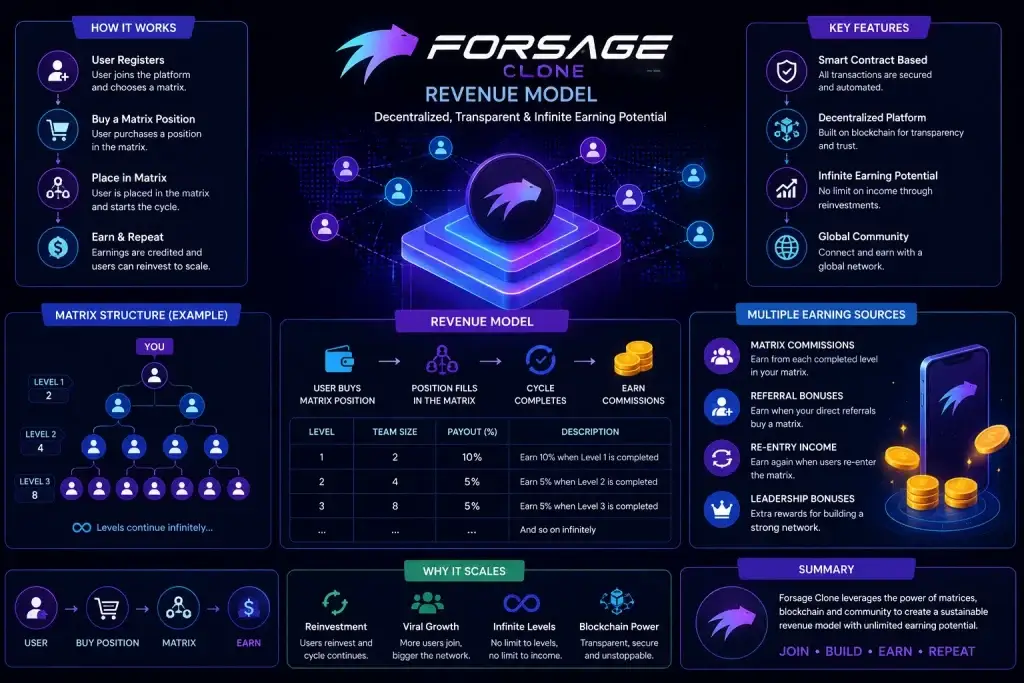
2026 Snapshot (Ecosystem Estimate)
| Metric | 2026 Estimate |
|---|---|
| Cumulative Transaction Volume | $300M+ (historic ecosystem volume) |
| Active Wallet Participation | 100K–250K (across forks) |
| Revenue Model | Peer-to-peer smart contract matrix |
| Platform Margin | Smart contract deployment fees only |
| Geographic Concentration | Asia, Africa, Eastern Europe |
| YoY Ecosystem Activity | Volatile (crypto cycle dependent) |
Revenue growth historically followed crypto bull cycles , slowed during regulatory crackdowns (2022–2023), and stabilized via clone deployments in smaller markets .
Primary Revenue Streams Deep Dive
Forsage does not generate “corporate revenue” like Uber or Airbnb. Instead, its monetization flows are embedded within smart contract participation.
Revenue Stream #1: Matrix Slot Purchases
Participants buy levels (e.g., X3, X4 matrices) using cryptocurrency. Payments are automatically routed to upline wallets.
Estimated Share: 70–80% of transaction volume
Typical Pricing: $50–$500 per level depending on blockchain and clone version
Revenue Stream #2: Reinvest Cycles
When matrices fill, automatic reinvestment triggers repeat payments, increasing overall transaction throughput.
Estimated Share: 10–15%
Revenue Stream #3: Smart Contract Deployment Fees
Clone creators or developers collect initial contract launch and administrative fees.
Estimated Share: 5–10%
Revenue Stream #4: Gas Fees & Network Costs
While not platform revenue, blockchain validators earn from transaction validation, indirectly tied to activity volume.
Revenue Stream #5: Fork Licensing & Clone Launch Services
Developers offer white-label Forsage clone scripts for emerging markets.
Estimated Share: 5–10% (external developer revenue)
Revenue Streams Percentage Breakdown
| Revenue Component | Estimated % of Total Transaction Flow |
|---|---|
| Matrix Level Purchases | 75% |
| Reinvest Cycles | 12% |
| Deployment/Admin Fees | 8% |
| Clone Launch Services | 5% |
The Fee Structure Explained
Unlike centralized platforms, Forsage uses direct wallet-to-wallet transfers.
User-Side Fees
- Initial level purchase payment
- Blockchain gas fees
- Upgrade payments for higher matrices
Provider-Side Fees
- No traditional providers (peer-to-peer system)
- Developers may charge smart contract deployment fees
Hidden Revenue Layers
- Reinvestment triggers
- Auto-upgrade mechanics
- Multi-level spillover positioning
Regional Pricing Variation
Entry levels are often adjusted in clone versions depending on local crypto adoption and average income levels.
Complete Fee Structure by User Type
| User Type | Fee Type | Payment Nature |
|---|---|---|
| New Participant | Matrix Entry Fee | One-time per level |
| Existing Member | Upgrade Fee | Recurring per level |
| All Users | Gas Fee | Per transaction |
| Clone Owner | Deployment Fee | One-time development cost |
How Forsage Maximizes Revenue Per User
Segmentation
Different matrix tiers target varying spending capacities.
Upselling
Users are encouraged to unlock higher levels for larger payout eligibility.
Cross-Chain Expansion
Clone versions expand to cheaper blockchains to increase participation.
Dynamic Reinvestment
Auto-reentry increases transaction cycles per user.
Retention Monetization
Reinvestment structures keep users engaged longer.
LTV Optimization
Instead of subscriptions, lifetime value depends on how many matrix levels a user purchases and how long they remain active.
Psychological triggers include scarcity of positions, visual matrix dashboards, and tiered earning promises.
Cost Structure & Profit Margins
Forsage’s operational cost differs radically from traditional startups.
Infrastructure Cost
Minimal — smart contracts run on blockchain networks.
CAC & Marketing
Heavy reliance on referral marketing and community-driven promotion.
Operations
Low centralized staffing requirement.
R&D
Initial smart contract development and auditing.
Unit Economics
Profitability for developers depends on:
- Smart contract deployment fees
- Early participation positioning
- Volume of clone launches
Margin Optimization
Because there are no delivery fleets or warehouses, overhead is significantly lower than marketplace platforms.
Future Revenue Opportunities & Innovations (2025–2027)
- Integration with DeFi staking layers
- NFT-based matrix positions
- AI-driven referral optimization
- Cross-chain interoperability
- Smart contract auditing monetization
Risks & Threats
- Regulatory enforcement
- Securities law violations
- Blockchain volatility
- Reputation damage
Opportunities for New Founders
- Build transparent, compliant smart contract platforms
- Create utility-backed matrix systems
- Develop blockchain-based referral SaaS tools
Lessons for Entrepreneurs & Your Opportunity
What Works
- Automated smart contract logic
- Referral-driven growth
- Low infrastructure cost
What to Replicate Carefully
- Transparent payout mechanisms
- Clear documentation
- Smart contract auditing
Market Gaps
- Compliance-first decentralized platforms
- Hybrid referral + SaaS revenue systems
- Blockchain subscription-based communities
Miracuves Forsage-Like Decentralized Networking Platform Solution Cost and Tech Stack
Miracuves Pricing for a Forsage-Like Decentralized Networking Platform developed using Node.js / React.js Architecture starts at $3,999. Contact Miracuves for custom pricing based on platform features, blockchain integrations, scalability requirements, and deployment scope. Estimated delivery timeline: 15-30 days, extending to 45-60 days for larger scope.
Build a powerful blockchain-based networking and decentralized platform designed for startups, crypto businesses, Web3 companies, blockchain entrepreneurs, and enterprise decentralized operations.
Core Workflows: Smart contract-based networking, decentralized referral systems, crypto wallet integration, blockchain transaction management, user onboarding, commission distribution, and decentralized ecosystem workflows.
Built-in Blockchain Operations: Smart contract execution, blockchain synchronization, crypto transaction tracking, decentralized payment workflows, wallet authentication systems, referral reward management, and blockchain analytics reporting.
Management Hub: Admin dashboards, smart contract monitoring systems, blockchain analytics, user management controls, audit logs, reporting dashboards, transaction oversight tools, and centralized decentralized operations management.
Enterprise-Ready: Fully customizable architecture prepared for secure scaling, high-volume blockchain transactions, Web3 integrations, decentralized infrastructure expansion, enterprise crypto operations, and long-term platform growth.
Why does a Forsage-Like Platform require Node.js / React.js architecture?
Decentralized networking platforms process blockchain transactions, smart contract interactions, crypto wallet operations, and high-volume decentralized workflows. These platforms require scalable infrastructure, secure blockchain communication, and highly responsive interfaces for seamless Web3 experiences.
We recommend a modern JavaScript-based architecture for this type of platform because:
Built for Real-Time Operations: Node.js enables scalable backend operations for blockchain synchronization, smart contract execution, crypto transaction processing, referral tracking, and concurrent user activities.
Advanced Dashboard Experience: React.js supports highly interactive interfaces for wallet management, blockchain analytics, decentralized dashboards, transaction histories, and user-friendly Web3 experiences.
Enterprise Scalability: This architecture is well-suited for handling large decentralized ecosystems, high transaction volumes, multi-user blockchain operations, and growing Web3 platforms.
Flexible Integration Layer: Easily integrates with blockchain networks, crypto wallets, smart contract systems, Web3 APIs, analytics platforms, payment gateways, and decentralized infrastructure tools.
You get a scalable, enterprise-grade decentralized networking platform designed for long-term operational growth.
Note: Final pricing depends on blockchain integrations, smart contract complexity, deployment infrastructure, security systems, Web3 requirements, and custom workflow development.
Final Thought
Forsage represents a radical shift from centralized revenue models to automated smart-contract-based monetization. Its structure eliminates corporate intermediaries and pushes financial logic directly into blockchain code.
However, sustainability depends heavily on participant inflow and regulatory environment. Without utility-based backing, transaction-driven systems face volatility risks.
For founders, the deeper lesson is this: automation reduces cost, but long-term value requires compliance, transparency, and real utility.
FAQs
1. How much does Forsage make per transaction?
There is no centralized company revenue; funds are distributed peer-to-peer minus gas fees.
2. What’s Forsage’s most profitable revenue stream?
Matrix level purchases generate the highest transaction volume.
3. How does Forsage’s pricing compare to competitors?
Entry levels are generally lower than traditional MLM programs but higher than most SaaS subscriptions.
4. What percentage does Forsage take from providers?
There is no provider commission in the traditional sense.
5. How has Forsage’s revenue model evolved?
It expanded across blockchains and added multiple matrix tiers.
6. Can small platforms use similar models?
Yes, but legal compliance and auditing are critical.
7. What’s the minimum scale for profitability?
Scale depends on active wallet participation and referral velocity.
8. How to implement similar revenue models?
Through audited smart contracts and structured referral matrices.
9. What are alternatives to Forsage’s model?
Tokenized SaaS subscriptions, DAO-based platforms, and DeFi yield models.
Miracuves is an independent software development company. We are not affiliated with, connected to, sponsored by, or endorsed by any company or product named in this article.
Terms such as “X Clone” are used descriptively. It is how the software industry refers to building a platform with functionality comparable to a known service, and how clients search for it.
The entire design and codebase of our products is built by our own team. Our products contain no code, design, graphics, or content originating from any third-party website or applications.
All third-party names and marks referenced in this article are the property of their respective owners, referenced solely to identify the services discussed.