

Key Takeaways
What You’ll Learn
- IKEA’s revenue model is built around affordable furniture at global scale where product design, flat-pack logistics, store experience, and digital commerce work together.
- The company earns through multiple retail layers including furniture sales, home accessories, food courts, delivery, assembly, planning services, and online orders.
- Flat-pack design is a major business advantage because it reduces storage, transportation, and handling costs while supporting IKEA’s low-price positioning.
- The in-store experience drives higher basket value through showroom layouts, self-service warehouses, product discovery, restaurant visits, and impulse purchases.
- The biggest takeaway for founders is that IKEA succeeds by combining cost efficiency, brand trust, supply-chain control, and customer experience into one scalable retail system.
Stats That Matter
- The article positions IKEA as a global home furnishing giant built on affordable design, large-scale sourcing, standardized products, and efficient retail operations.
- Core revenue comes from furniture and home goods sales across categories like beds, sofas, tables, wardrobes, kitchens, storage, lighting, and decor.
- Additional revenue streams include food courts, delivery, furniture assembly, kitchen planning, interior design support, and online marketplace sales.
- IKEA’s warehouse-style retail model lowers operating complexity by combining showrooms, self-pickup inventory, flat-pack packaging, and centralized logistics.
- Digital transformation is becoming more important as IKEA expands eCommerce, app-based shopping, delivery coordination, AR room planning, and omnichannel customer journeys.
Real Insights
- IKEA succeeds because it sells both products and an experience where customers explore rooms, compare styles, eat, plan, and purchase in one controlled environment.
- The real strength of IKEA’s model is operational discipline because low pricing depends on design efficiency, supply-chain planning, packaging control, and inventory optimization.
- Furniture assembly shifts part of the value chain to customers allowing IKEA to reduce costs while keeping products accessible and easy to transport.
- Food and services support the core retail journey by increasing store time, improving customer comfort, and creating extra revenue beyond furniture sales.
- For entrepreneurs, the biggest lesson is to build an IKEA-style retail platform around affordability, product standardization, logistics efficiency, omnichannel shopping, and experience-led customer retention.
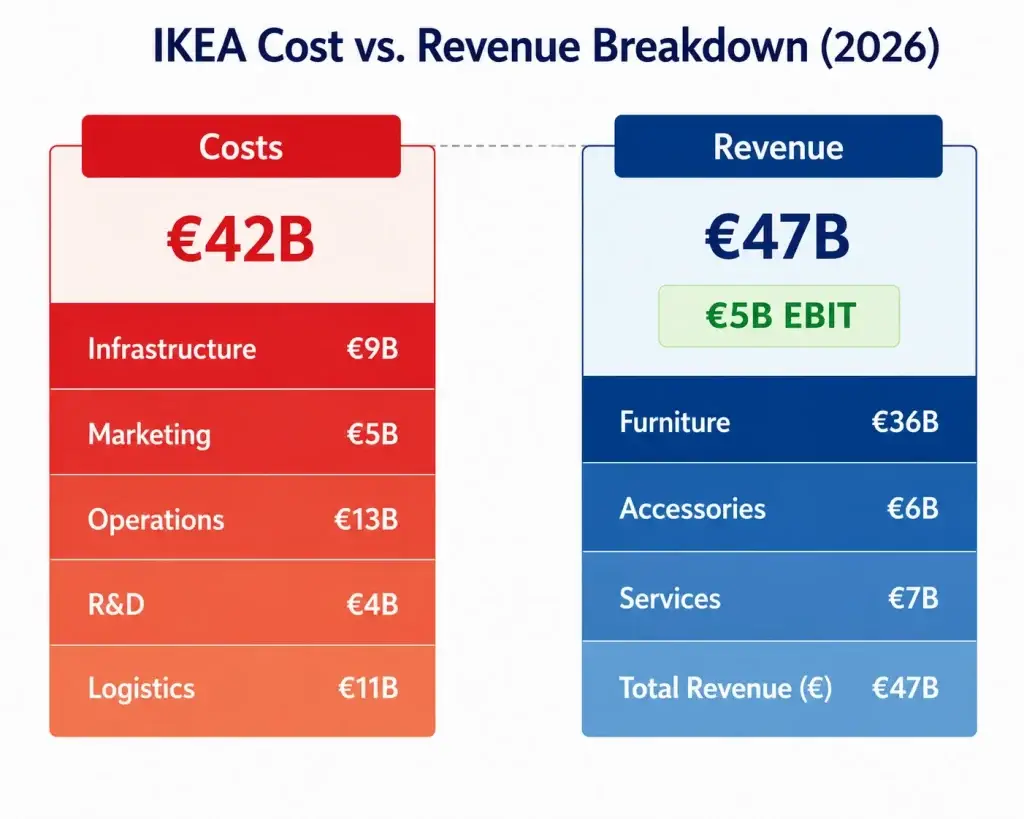
In 2026, IKEA continues to generate approximately €45 billion ($48–49B) in annual revenue, making it the world’s largest home-furnishing retailer. This scale is powered by high inventory turnover, standardized global sourcing, vertically integrated supply chains, and a cost-first product design philosophy that allows IKEA to maintain strong margins while keeping prices accessible across markets.
What makes IKEA remarkable isn’t luxury pricing or premium positioning—it’s radical cost efficiency, operational discipline, and logistics mastery. From flat-pack engineering that slashes shipping volume, to warehouse-style stores that reduce staffing costs, to long-term supplier contracts that lock in production economics, every part of the system is designed to maximize profit per square foot and per shipment.
For founders, IKEA’s revenue model is a masterclass in building a defensible, high-volume business engine. The real lesson lies in modular product design, service-based upselling, loyalty-driven repeat purchases, and psychological pricing strategies that increase lifetime value while keeping customer acquisition costs low—principles that can be replicated in both digital and physical marketplaces.
IKEA Revenue Overview – The Big Picture
- 2026 Revenue: ~€45B
- Valuation (Private est.): €80–90B
- YoY Growth: ~2–3% (stable, mature market)
- Revenue by Region:
- Europe: ~65%
- North America: ~20%
- Asia-Pacific & others: ~15%
- Average Gross Margin: 36–38%
- Net Profit Margin: ~10%
- Competition Benchmark:
- Wayfair: Lower margins, higher logistics costs
- Home Depot: Higher ticket size, less vertical integration
Primary Revenue Streams Deep Dive
Revenue Stream #1: Furniture Sales (≈75%)
Core revenue comes from self-assembled furniture—beds, sofas, wardrobes, tables.
- How it works: Mass-produced, modular designs
- Pricing: Low unit price, high volume
- 2026 contribution: ~€34B
Revenue Stream #2: Home Accessories & Décor (≈12%)
Lighting, kitchenware, storage, textiles.
- Higher impulse buying
- Strong cross-sell with furniture
Revenue Stream #3: In-Store & Online Services (≈5%)
Delivery, installation, assembly, extended warranties.
- High-margin add-ons
- Growing faster than core furniture sales
Revenue Stream #4: Food & Restaurants (≈4%)
IKEA food courts and packaged food retail.
- Loss leader + brand engagement
- Drives longer store visits
Revenue Stream #5: B2B, Licensing & Real Estate (≈4%)
Office furniture, franchise licensing, and shopping-center assets.
Revenue Streams Percentage Breakdown
| Revenue Source | % Share |
|---|---|
| Furniture | 75% |
| Home Accessories | 12% |
| Services | 5% |
| Food & Beverage | 4% |
| B2B & Licensing | 4% |
The Fee Structure Explained
User-Side Costs
- Product price
- Delivery fee
- Assembly & installation fee
Provider-Side Costs
- Suppliers operate on long-term, volume-based contracts
- Strict cost targets set by IKEA
Hidden Revenue Layers
- Packaging optimization
- Shelf-ready logistics
- Store-owned real estate value
Regional Pricing Variation
- Local sourcing adjusts cost
- Purchasing power parity pricing by country
Complete Fee Structure by User Type
| User Type | Fees Paid |
|---|---|
| Retail customer | Product + delivery + service |
| Business client | Contract pricing + logistics |
| Franchise partner | Licensing & supply chain fees |
How IKEA Maximizes Revenue Per User
- Segmentation: Students, families, renters, businesses
- Upselling: Accessories bundled with furniture
- Cross-selling: Room-based layouts increase cart size
- Dynamic pricing: Seasonal promotions & regional pricing
- Retention monetization: IKEA Family loyalty program
- LTV optimization: Repeat purchases across life stages
- Psychological pricing: “Under €99” anchor strategy
Example: A €199 sofa often leads to €80–120 in accessory add-ons.
Cost Structure & Profit Margins
- Infrastructure: Warehousing, mega-stores, IT systems
- Customer acquisition: Very low CAC due to brand dominance
- Operations: Self-service stores reduce staffing costs
- R&D: Product design, materials, sustainability
- Unit economics: Flat-pack reduces shipping volume by ~60%
- Margin optimization: Design-to-cost discipline
- Profitability path: High volume offsets low unit margins
Read More: Best IKEA Clone Scripts 2025 | A Furniture E-Commerce Platform
Miracuves IKEA-Like Retail Platform Solution Cost and Tech Stack
Miracuves pricing for an IKEA-like furniture ecommerce and retail management platform built with JavaScript architecture is available on request. The final cost depends on ecommerce modules, inventory workflows, warehouse integrations, logistics systems, omnichannel requirements, scalability needs, and deployment scope. Estimated delivery timeline: 30 to 90 days.
Build a scalable retail commerce platform designed for furniture businesses, home decor brands, ecommerce startups, warehouse retailers, interior marketplace platforms, and omnichannel retail companies.
Core Workflows: Product catalog management, furniture listings, customer accounts, cart and checkout systems, order management, inventory synchronization, warehouse operations, delivery scheduling, and omnichannel retail workflows.
Retail Commerce Logic: Dynamic pricing systems, inventory forecasting, warehouse optimization, product recommendation engines, customer analytics, delivery route workflows, subscription memberships, and multi-location retail management.
Management Hub: Admin dashboards, inventory controls, warehouse management, supplier tracking, order monitoring, logistics coordination, customer support systems, analytics reporting, and centralized retail platform operations.
Enterprise Readiness: Customizable architecture for global retail scaling, multi-warehouse support, ecommerce expansion, retail analytics, supply chain workflows, API integrations, and long-term commerce growth.
Why an IKEA-Like Platform Requires JavaScript Architecture
An IKEA-like platform handles massive product catalogs, warehouse operations, ecommerce traffic, delivery coordination, customer behavior tracking, omnichannel retail experiences, and real-time inventory workflows. It requires scalable backend systems, smooth customer interfaces, fast search experiences, secure payment handling, and enterprise-grade operational management.
We recommend a modern JavaScript-based architecture for this type of platform because:
Built for Large Ecommerce Operations
JavaScript backend systems can efficiently manage high-volume product data, customer sessions, inventory syncing, warehouse workflows, order processing, and real-time ecommerce operations.
Advanced Shopping Experience
React.js or other JavaScript frontend frameworks can power modern retail interfaces including smart product discovery, room visualization experiences, personalized recommendations, interactive shopping carts, and seamless checkout journeys.
Retail Scalability
This architecture is suitable for handling global ecommerce growth, multi-location inventory systems, increasing customer traffic, logistics coordination, and expanding retail product ecosystems.
Flexible Integration Layer
The platform can integrate with payment gateways, warehouse systems, ERP tools, shipping providers, customer loyalty systems, AI recommendation engines, inventory management software, and retail analytics platforms.
You get a scalable, secure, ecommerce-first retail platform designed for long-term business operations, customer growth, and modern retail expansion.
Note: Final pricing depends on selected ecommerce modules, warehouse integrations, logistics systems, inventory workflows, enterprise requirements, deployment infrastructure, and custom retail feature development.
Future Revenue Opportunities & Innovations
- Subscription-based furniture leasing
- AI-driven home planning tools
- Smart furniture integrations
- Urban micro-stores & faster delivery
- Asia & Middle East expansion
Risks:
- Logistics disruptions
- Sustainability compliance costs
- DTC competition
Opportunities for founders:
- Vertical niche furniture platforms
- Localized fast-delivery models
- AR/AI-powered home commerce
Lessons for Entrepreneurs & Your Opportunity
What works
- Vertical integration
- Cost-first design
- High inventory turnover
What to replicate
- Modular products
- Add-on services
- Experience-driven commerce
Market gaps
- Faster customization
- Premium assembly services
- AI-assisted buying journeys
Final Thought
IKEA proves that profitability doesn’t require premium pricing—it requires operational excellence, cost-engineered product design, and relentless process optimization. By focusing on high inventory velocity, supplier consolidation, and standardized global workflows, IKEA turns thin margins into massive cumulative profits through sheer scale and efficiency.
Its revenue model is a blend of logistics intelligence, psychological pricing, and platform-like scale effects. Flat-pack shipping reduces freight costs, room-based merchandising increases average order value, and add-on services like delivery, assembly, and accessories create high-margin revenue layers on top of low-cost core products.
For founders, the lesson is clear: design the business system before the product. Build pricing frameworks, upsell paths, retention loops, and operational moats into your platform from day one—because when the system is engineered for efficiency and growth, revenue becomes a predictable outcome rather than a hopeful target.
FAQs
1. How much does IKEA make per transaction?
On average, €70–90 per retail transaction globally.
2. What’s IKEA’s most profitable revenue stream?
Furniture accessories and add-on services.
3. How does IKEA’s pricing compare to competitors?
Lower base price with higher volume and lower logistics cost.
4. What percentage margin does IKEA earn?
Gross margins average around 36–38%.
5. How has IKEA’s revenue model evolved?
From pure retail to services, food, B2B, and digital tools.
6. Can small platforms use similar models?
Yes, at niche or regional scale.
7. What’s the minimum scale for profitability?
Usually after consistent monthly inventory turnover.
8. How to implement similar revenue models?
Combine modular products, services, and logistics control.
9. What are alternatives to IKEA’s model?
DTC premium furniture or rental-based platforms.
Miracuves is an independent software development company. We are not affiliated with, connected to, sponsored by, or endorsed by any company or product named in this article.
Terms such as “X Clone” are used descriptively. It is how the software industry refers to building a platform with functionality comparable to a known service, and how clients search for it.
The entire design and codebase of our products is built by our own team. Our products contain no code, design, graphics, or content originating from any third-party website or applications.
All third-party names and marks referenced in this article are the property of their respective owners, referenced solely to identify the services discussed.