
Key Takeaways
What You’ll Learn
- Analytics has become a core infrastructure layer for logistics and delivery apps because operational decisions now depend heavily on real-time data visibility and forecasting.
- Delivery app analytics helps businesses optimize operations by tracking delivery timing, driver efficiency, route performance, customer behavior, and order completion patterns.
- Predictive insights improve scalability by helping platforms forecast demand spikes, allocate drivers efficiently, reduce delays, and improve fulfillment planning.
- Analytics directly impacts profitability because better operational visibility reduces failed deliveries, fuel waste, idle time, and inefficient dispatch decisions.
- The biggest takeaway for founders is that modern logistics platforms must be designed around data-driven operations from the beginning.
Stats That Matter
- The article positions logistics analytics as a critical operational advantage for delivery businesses handling high order volumes, route complexity, and real-time dispatch management.
- Key analytics metrics include ETA accuracy, delivery completion rate, driver productivity, route optimization efficiency, customer retention, and order fulfillment timing.
- Modern delivery platforms process large amounts of operational data including GPS movement, traffic conditions, customer locations, order timing, driver activity, and delivery performance patterns.
- Predictive analytics improves operational forecasting by helping businesses anticipate delays, optimize delivery windows, and prepare for regional demand fluctuations.
- Analytics dashboards are essential for scaling logistics operations because businesses need centralized visibility across fleets, orders, drivers, fulfillment zones, and customer activity.
Real Insights
- The real challenge in logistics is operational coordination at scale because delivery platforms must manage drivers, routes, timing, customer expectations, and fulfillment quality simultaneously.
- Better analytics creates better customer experience since accurate ETAs, fewer delays, and smoother delivery communication improve trust and repeat usage.
- Data-driven dispatching reduces operational inefficiency by helping businesses assign deliveries more intelligently and reduce unnecessary travel or idle driver time.
- Scalable delivery platforms require predictive infrastructure because reactive systems alone cannot handle rapid order growth and complex logistics networks efficiently.
- For entrepreneurs, the biggest lesson is to build Logistics and Delivery Apps around analytics dashboards, predictive forecasting, intelligent dispatch systems, operational automation, and scalable real-time logistics visibility.
Logistics and Delivery Apps used to be judged by simple features like order booking, GPS tracking, driver assignment, delivery status, and payment updates. Those features still matter, but they are no longer enough for delivery businesses that need speed, reliability, and operational control.
Modern logistics app development is moving toward predictive intelligence. Instead of only showing what is happening right now, delivery app analytics helps businesses understand what is likely to happen next. Which delivery zone will be overloaded tomorrow? Which route may cause delays? Which delivery partner is at risk of missing assigned orders? Which products may need higher inventory before peak demand? Which customer segment may churn after repeated late deliveries?
That is where predictive analytics becomes a serious product advantage.
For founders building food delivery, grocery delivery, pharmacy delivery, courier, quick commerce, or last-mile logistics platforms, predictive analytics is not just a reporting feature. It is the decision layer that connects data, operations, customer experience, and profitability. A scalable delivery platform needs more than real-time visibility. It needs the ability to forecast demand, improve dispatch decisions, estimate delivery times, reduce delays, and give the admin team better control.
Miracuves helps founders build ready-made and white-label delivery app solutions that can support customer, merchant, delivery partner, and admin workflows. When predictive analytics is planned correctly, it can turn a delivery app from a basic transaction system into a smarter logistics operating platform.
What Predictive Analytics Means in Logistics App Development
Predictive analytics in logistics means using historical and real-time data to estimate future outcomes. In a delivery app, that may include expected order volume, likely delivery delays, route congestion, driver availability, inventory demand, cancellation risk, or customer support load.
A basic logistics dashboard tells the admin team what happened. A predictive analytics layer helps the team decide what to do before a problem becomes expensive.
For example, a traditional dashboard may show that Zone A had 300 orders yesterday and 18 late deliveries. A predictive analytics system can go further and suggest that Zone A may face high demand between 7 PM and 10 PM today because of historical order patterns, weather, weekday behavior, driver availability, and restaurant preparation delays.
This difference matters because delivery operations are time-sensitive. A late insight is often useless. The value of delivery app analytics comes from giving the platform operator enough time to act.
Why Delivery App Analytics Has Become a Core Product Layer
Delivery businesses operate across several moving parts at once: customers, merchants, warehouses, delivery partners, vehicles, routes, payments, support teams, and admin operations. If the app only records transactions, the business still depends heavily on manual judgment.
Delivery app analytics gives the platform operator a clearer view of performance. Predictive analytics makes that view forward-looking.
In practical terms, analytics can help answer questions such as:
- How many delivery partners are needed in each zone tomorrow?
- Which routes are most likely to cause missed delivery windows?
- Which merchants or warehouses regularly cause preparation delays?
- Which products or categories may see demand spikes?
- Which delivery partners need performance review or route support?
- Which customers are likely to cancel or complain because of repeated delays?
- Which delivery zones are becoming unprofitable due to distance, fuel, or low order density?
For founders, this is not only a technology question. It is a business model question. A delivery platform with better analytics can make smarter decisions around fees, commissions, incentives, inventory, and service coverage.
Core Predictive Analytics Use Cases in Modern Delivery Apps
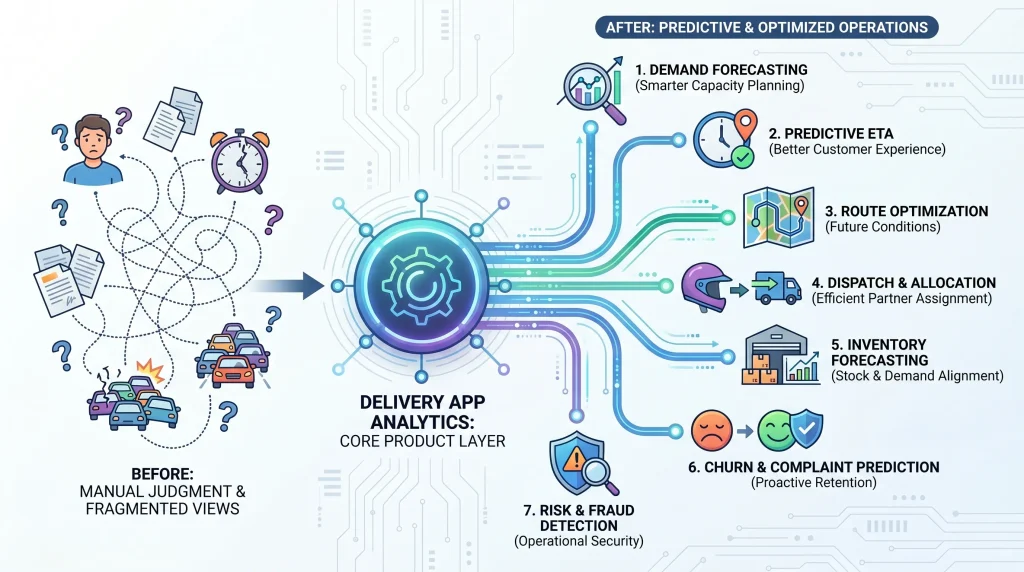
1. Demand Forecasting for Smarter Capacity Planning
Demand forecasting helps estimate future order volume based on previous orders, seasonality, time of day, location, product category, campaigns, weather, holidays, and local events.
For food delivery, demand may spike during lunch, dinner, weekends, or festival periods. For grocery delivery, demand may increase before holidays or during heavy rain. For pharmacy delivery, demand may vary by prescription patterns, recurring purchases, or local health trends.
A logistics app with demand forecasting can help the admin team prepare delivery partner allocation, merchant readiness, inventory planning, and support staffing.
Without demand forecasting, founders may discover demand only after the system is already overloaded.
2. Predictive ETA for Better Customer Experience
Estimated time of arrival is one of the most visible parts of a delivery app. Customers may forgive a long delivery window if the estimate is realistic. They are less forgiving when the app promises 25 minutes and the order arrives in 55.
Predictive ETA can use location data, route history, driver speed patterns, merchant preparation time, weather, traffic, order batching, and delivery partner availability to create more realistic delivery estimates.
This improves customer trust and reduces support tickets. It also helps the admin team identify where delays are actually happening. Sometimes the issue is not the driver. It may be warehouse picking, restaurant preparation, poor route batching, or insufficient zone coverage.
3. Route Optimization Based on Future Conditions
Route optimization is not only about finding the shortest route. A short route may still be slow if it passes through congested roads, restricted zones, bad weather areas, or high-delay pickup points.
Predictive route optimization can account for likely traffic, driver location, delivery density, fuel usage, delivery windows, and service priority. For multi-stop deliveries, the system can suggest the most practical order sequence.
This is especially important for courier delivery, grocery delivery, pharmacy delivery, and quick commerce platforms where delivery windows directly affect customer satisfaction.
4. Dispatch Prediction and Delivery Partner Allocation
Manual dispatch works only when order volume is small. As the business grows, delivery partner allocation becomes harder. A predictive dispatch layer can estimate which delivery partner is most likely to complete an order efficiently based on distance, availability, performance history, vehicle type, current workload, route familiarity, and delivery zone.
The goal is not to replace human operations completely. The goal is to help the admin team make faster and better decisions.
For a platform operator, predictive dispatch can reduce idle time, prevent overloaded delivery partners, and improve order completion rates.
5. Inventory and Warehouse Forecasting
In grocery, pharmacy, quick commerce, and retail delivery apps, analytics must connect delivery operations with inventory planning. If demand increases but stock is unavailable, the delivery app creates frustration instead of convenience.
Predictive analytics can help estimate product demand by location, category, season, customer segment, and previous purchase behavior. This allows the business to plan stock movement, warehouse replenishment, dark store allocation, and vendor coordination.
Inventory forecasting becomes even more valuable when delivery speed is part of the brand promise.
6. Customer Churn and Complaint Prediction
Delivery businesses often lose customers quietly. A customer may stop ordering after repeated late deliveries, missing items, poor support, or inaccurate ETA promises.
Delivery app analytics can identify churn signals such as declining order frequency, abandoned carts, repeated complaints, refund requests, long delivery times, or poor rating patterns.
A predictive system can flag at-risk customers so the business can improve service recovery, offer targeted support, or adjust operational issues in specific zones.
7. Fraud, Abuse, and Operational Risk Detection
Logistics platforms can face multiple types of operational risk: fake orders, repeated refund abuse, suspicious delivery updates, location spoofing, payment issues, merchant manipulation, and unusual cancellation patterns.
Predictive analytics can support anomaly detection by identifying behavior that does not match normal patterns. This does not mean every flagged action is fraud. It means the admin team gets a signal that something needs review.
For marketplace-style delivery apps, this layer can protect platform trust and reduce avoidable losses.
Predictive Analytics Architecture for Logistics and Delivery Apps
A predictive logistics app is not built by adding a few charts to an admin panel. It needs a structured data and decision architecture.
At a practical level, the architecture includes four layers.
1. Data Collection Layer
This layer collects raw operational data from the app ecosystem. Important data sources include:
- Customer orders
- Delivery partner location
- Merchant preparation time
- Warehouse inventory
- Route and traffic data
- Payment status
- Cancellation and refund history
- Customer ratings
- Delivery timestamps
- Support tickets
- Promotions and campaign activity
The quality of predictive analytics depends heavily on how consistently this data is captured.
2. Data Processing Layer
Raw data is rarely ready for prediction. It must be cleaned, structured, normalized, and connected across different app modules.
For example, order data alone does not explain delays. The system may need to combine order creation time, merchant acceptance time, preparation time, driver assignment time, pickup time, route duration, and delivery completion time.
This processing layer helps convert scattered events into usable logistics intelligence.
3. Prediction and Model Layer
This is where statistical models, machine learning models, or rule-based prediction systems generate forecasts. Depending on the use case, the app may use models for ETA prediction, demand forecasting, risk scoring, route recommendations, inventory forecasting, or driver allocation.
Not every delivery app needs complex AI from day one. A first market version can begin with rules, thresholds, and historical pattern analysis. As data volume grows, the platform can move toward more advanced predictive models.
4. Admin Decision Layer
Predictions only matter when they improve decisions. The admin dashboard should translate analytics into action.
Instead of showing only “high demand expected,” the system should help answer:
- Which zone needs more delivery partners?
- Which route should be avoided?
- Which merchant needs operational attention?
- Which inventory category requires restocking?
- Which customer segment needs retention action?
- Which order should be escalated before it becomes a complaint?
This is where logistics app development becomes business-critical. The dashboard should not overwhelm the admin team. It should guide practical decisions.
Predictive Analytics Features and Business Value in Delivery Apps
| Predictive Feature | Business Value | Founder Impact |
|---|---|---|
| Demand forecasting | Predicts order volume by location, time, and category | Helps plan delivery partner capacity, inventory, and support staffing |
| Predictive ETA | Improves delivery time accuracy using route, traffic, preparation, and driver data | Reduces customer frustration and support pressure |
| Route optimization | Suggests efficient routes based on likely delays and delivery density | Improves delivery reliability and cost control |
| Dispatch intelligence | Recommends delivery partner allocation based on availability and performance | Reduces idle time and improves order completion speed |
| Inventory forecasting | Predicts stock demand for grocery, pharmacy, retail, or quick commerce operations | Improves availability and reduces missed sales opportunities |
| Risk detection | Flags unusual cancellation, refund, or delivery behavior | Protects platform trust and reduces manual review load |
How Predictive Analytics Improves Last-Mile Delivery
Last-mile delivery is usually the most complex and customer-visible part of logistics. It involves live routes, unpredictable delays, human behavior, local geography, traffic, customer availability, and delivery partner performance.
Predictive analytics improves last-mile delivery by helping the platform operator move from reactive control to proactive planning.
For example, if the system predicts a delivery surge in a specific zone, the admin team can increase delivery partner availability before orders pile up. If a route is likely to be delayed, the app can adjust ETA or recommend a better path. If a merchant regularly delays preparation during peak hours, the platform can adjust pickup timing or show a more accurate estimate to customers.
The strongest delivery apps do not simply track drivers. They use delivery app analytics to understand why delays happen and how to prevent them.
Founder Decision Signals: What Should You Build First?
Founder Decision Signals
Speed
If your business needs faster launch, start with essential delivery workflows, real-time tracking, admin reporting, and basic forecasting before investing in complex machine learning.
Cost
Predictive analytics should be phased. Build the data foundation first, then add advanced models once enough operational data exists.
Scalability
If you plan to operate across multiple zones, cities, vendors, or warehouses, analytics architecture should be planned early so data does not become fragmented.
Market Fit
If customers mainly complain about late deliveries, inaccurate ETAs, poor availability, or cancellation issues, predictive analytics can directly support retention and service quality.
Ready-Made vs Custom Predictive Analytics in Logistics App Development
Not every founder needs a fully custom AI logistics system on day one. The right decision depends on the business model, data availability, launch urgency, budget, and operational complexity.
| Build Option | What It Includes | Best For | Decision Logic |
|---|---|---|---|
| Ready-made delivery app foundation | Core customer, merchant, delivery partner, and admin workflows with scope for analytics extensions | Founders who want faster market entry | Helps validate demand before investing in advanced predictive layers |
| Custom analytics module | Custom dashboards, forecasting rules, operational KPIs, and reporting workflows | Businesses with specific logistics operations | Useful when the business has unique routing, inventory, or dispatch needs |
| Advanced predictive intelligence | Machine learning models, automated recommendations, anomaly detection, and forecasting engines | Scaling platforms with meaningful operational data | Stronger when the platform already has enough clean historical data |
| Full custom logistics platform | Deeply tailored workflows, integrations, data architecture, and predictive systems | Enterprises or complex logistics networks | Higher control, but requires more planning, budget, and development time |
Miracuves’ ready-made approach can help founders launch faster because the foundation already includes core app flows, admin control, and essential modules. Final pricing depends on selected features, integrations, branding, and customization scope.
What Data Should a Delivery App Track for Predictive Analytics?
Predictive analytics depends on data discipline. If the app does not track the right events, future predictions become weak.
A delivery platform should ideally track:
- Order created, accepted, prepared, picked up, and delivered timestamps
- Driver assignment and reassignment events
- Route distance and actual travel time
- Merchant or warehouse preparation time
- Customer cancellation reason
- Refund and complaint categories
- Delivery partner acceptance, rejection, and completion behavior
- Zone-level order density
- Peak hour performance
- Inventory availability
- Promotion and discount usage
- Customer repeat order frequency
- Support ticket resolution time
This data should be available to the admin dashboard in a way that supports decisions, not just reporting.
Mistakes Founders Should Avoid While Adding Predictive Analytics
Mistakes Founders Should Avoid
Building advanced AI before fixing data quality
Predictive models depend on clean and consistent data. If order, route, inventory, and delivery timestamps are incomplete, the system may produce unreliable insights.
Treating analytics as only a dashboard
Dashboards are useful, but predictive analytics should help the admin team act. The goal is better dispatch, routing, inventory, pricing, and customer support decisions.
Ignoring operational users
A logistics analytics system should be designed for dispatchers, managers, merchants, warehouse teams, and platform operators. If the insight is too complex to use, it will not improve operations.
Over-customizing too early
Founders should avoid building expensive predictive systems before validating the delivery model. Start with the analytics that supports the biggest operational pain point.
Where Predictive Analytics Fits Inside the Admin Dashboard
The admin dashboard is where predictive insights become operational decisions.
A strong logistics admin panel should include:
- Live order and delivery status
- Zone-level demand forecast
- Delivery partner availability
- Predicted delay alerts
- Route performance reports
- Merchant or warehouse delay insights
- Inventory demand signals
- Customer complaint and refund trends
- Delivery partner performance analytics
- Revenue, commission, and delivery fee reports
- Risk and anomaly alerts
The admin panel should not only show numbers. It should help the platform operator decide what to do next.
For example, if Zone B has a predicted demand spike and low delivery partner availability, the admin team should see that signal before the surge begins. If certain delivery partners are repeatedly delayed on specific routes, the system should help identify whether the issue is route complexity, order batching, pickup delays, or partner performance.
How Predictive Analytics Supports Delivery App Monetization
Predictive analytics can also improve monetization. Better forecasting helps delivery businesses manage costs, pricing, and revenue opportunities.
Common monetization improvements include:
| Monetization Area | How Predictive Analytics Helps |
|---|---|
| Delivery fees | Adjust delivery fee logic based on distance, demand, time, and operational load |
| Merchant commissions | Identify high-performing merchants and optimize commission strategies |
| Premium listings | Help merchants promote products during high-demand periods |
| Subscription plans | Identify frequent customers who may benefit from delivery passes |
| Driver incentives | Allocate incentives based on actual zone demand and shortage predictions |
| Inventory planning | Reduce missed revenue from out-of-stock products |
| Advertising | Target promotions based on location, category, and predicted demand |
For founders, this is where delivery app analytics becomes more than operational reporting. It can support business model clarity.
Miracuves Perspective: Build the Foundation Before the Prediction Engine
Predictive analytics is powerful, but it should be built on the right product foundation. A delivery app first needs stable order flows, user roles, merchant or vendor management, delivery partner workflows, payment integrations, admin control, and accurate event tracking.
Once the foundation is stable, predictive analytics can be added in practical layers:
- Basic operational dashboards
- Historical reports and KPI tracking
- Rule-based alerts and thresholds
- Demand and ETA forecasting
- Route and dispatch recommendations
- Advanced predictive models
This phased approach helps founders avoid unnecessary complexity while still building toward a smarter logistics platform.
Miracuves helps founders create white-label delivery app solutions with source-code ownership, branded design, admin dashboards, and scalable workflows. For food, grocery, pharmacy, courier, or last-mile delivery businesses, this gives the product a launch-ready foundation that can be customized around analytics, routing, dispatch, and monetization needs.
Final Thoughts: Predictive Analytics Turns Delivery Apps Into Decision Systems
The role of predictive analytics in modern logistics and delivery apps is not limited to forecasting. It changes how the business operates.
A delivery platform with strong analytics can plan demand, improve ETA accuracy, assign delivery partners more efficiently, reduce delays, manage inventory, detect operational risks, and protect customer trust. For founders, this means the app becomes more than just a digital ordering channel. It evolves into a decision system that supports long-term logistics growth and operational efficiency.
The smarter approach is to build the right foundation first, capture clean operational data, and gradually introduce predictive intelligence in layers as the platform scales. Founders looking to move faster can Talk to Miracuves experts to explore ready-made, white-label delivery app solutions designed for admin control, monetization, scalability, and future analytics expansion.
FAQs
What is predictive analytics in logistics app development?
Predictive analytics in logistics app development means using historical and real-time delivery data to forecast future events such as demand, delays, ETA, route performance, inventory needs, and operational risk.
How does delivery app analytics improve last-mile delivery?
Delivery app analytics improves last-mile delivery by helping platform operators understand delays, delivery partner availability, route performance, customer complaints, and zone-level demand. Predictive analytics adds a forward-looking layer so teams can act before problems grow.
Is predictive analytics necessary for every delivery app?
Not every delivery app needs advanced predictive analytics from day one. However, every scalable delivery platform should collect clean operational data early so forecasting, route optimization, and performance analytics can be added as the business grows.
What data is needed for predictive ETA in delivery apps?
Predictive ETA usually depends on order timestamps, merchant or warehouse preparation time, delivery partner location, route distance, traffic patterns, weather conditions, historical delivery duration, and current order load.
How does predictive analytics help logistics app monetization?
Predictive analytics can support monetization by improving delivery fee logic, driver incentive planning, merchant promotion timing, subscription targeting, inventory availability, and customer retention.
Can predictive analytics reduce delivery costs?
Predictive analytics can help reduce avoidable costs by improving route planning, reducing idle time, forecasting demand, improving inventory planning, and identifying operational bottlenecks. Actual savings depend on the business model, data quality, and implementation.
Should founders build custom predictive analytics or use a ready-made delivery app foundation?
Founders who need faster market entry can start with a ready-made delivery app foundation and add predictive analytics in phases. A fully custom analytics system is better suited for businesses with complex logistics workflows or large volumes of historical data.
How can Miracuves help with logistics and delivery app development?
Miracuves helps founders launch ready-made and white-label delivery app solutions with customer, merchant, delivery partner, and admin workflows. The platform can be customized based on delivery model, analytics needs, routing logic, branding, and operational scope.
Miracuves is an independent software development company. We are not affiliated with, connected to, sponsored by, or endorsed by any company or product named in this article.
Terms such as “X Clone” are used descriptively. It is how the software industry refers to building a platform with functionality comparable to a known service, and how clients search for it.
The entire design and codebase of our products is built by our own team. Our products contain no code, design, graphics, or content originating from any third-party website or applications.
All third-party names and marks referenced in this article are the property of their respective owners, referenced solely to identify the services discussed.