


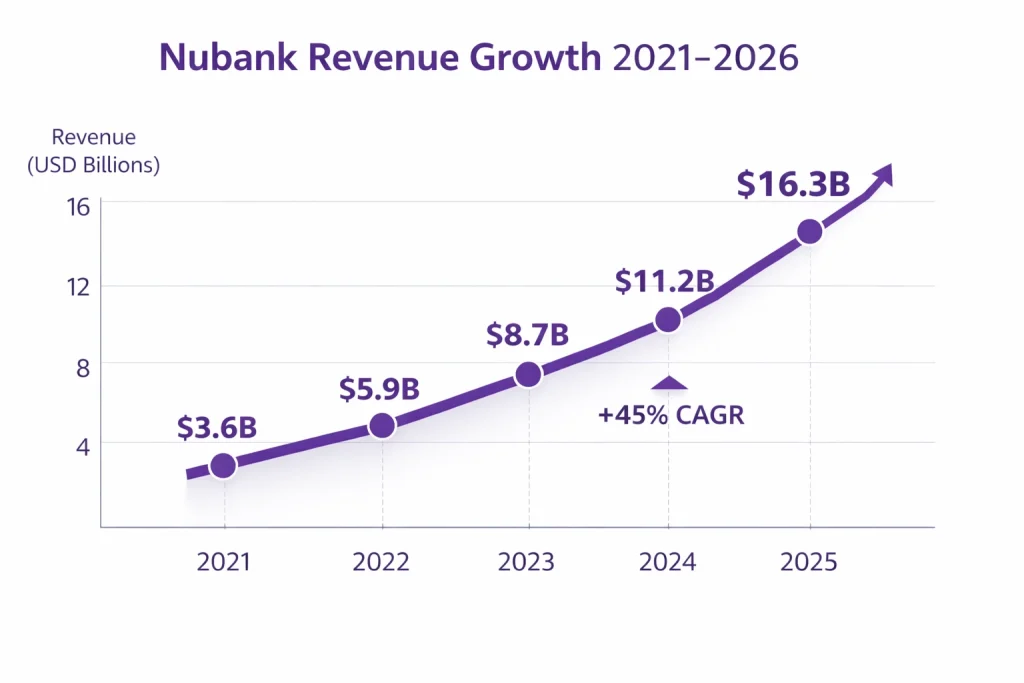
In 2026, Nubank generated roughly $16.3 billion in revenue, growing about 45% year-over-year while serving over 120 million customers across Latin America.
That scale makes Nubank one of the most successful fintech startups in the world.
For founders and product builders, Nubank is a masterclass in digital banking economics, customer acquisition, and multi-product monetization. The company turned a simple no-fee credit card into a multi-billion-dollar fintech ecosystem.
Understanding Nubank’s revenue engine reveals how modern fintech platforms build high-margin financial ecosystems around a single mobile app.
Nubank Revenue Overview – The Big Picture
Nubank’s growth has been driven by a simple but powerful strategy: start with a single financial product, then expand into a full digital banking platform.
The company initially launched a no-fee credit card in Brazil, targeting millions of consumers underserved by traditional banks.
Today it operates as a multi-product financial super-app offering:
- Credit cards
- Personal loans
- Digital bank accounts
- Investments
- Insurance
- SME financial services
Key Financial Snapshot
| Metric | Latest Data |
|---|---|
| Latest Annual Revenue | $16.3 Billion (2025) |
| Revenue Growth | ~45% YoY |
| Net Income | ~$2.9 Billion (2025) |
| Customers | 120M+ users |
| Primary Markets | Brazil, Mexico, Colombia |
| Estimated Valuation | ~$70B–$90B range |
Nubank’s profitability also improved significantly as it scaled. Its return on equity reached around 31%, outperforming several traditional Brazilian banks.
Traditional banks operate heavy physical branch networks. Nubank operates almost entirely digitally, allowing lower operational costs and faster growth.
Read More: Business Model of Nubank: Complete Strategy Breakdown 2026
Primary Revenue Streams Deep Dive
Nubank’s monetization model is built around financial services cross-selling.
Instead of charging high upfront fees, the company earns money across multiple financial interactions per customer.
Revenue Stream #1: Interest on Lending
This is Nubank’s largest revenue driver.
The company provides:
- Credit card revolving balances
- Personal loans
- Installment payments
- SME lending
Customers who carry balances on their credit cards pay interest, generating net interest income, which is the core revenue engine of digital banks.
In 2025, Nubank’s net interest income grew rapidly due to expanded lending and improved AI credit models.
Estimated contribution: ~50–60% of total revenue
Pricing model:
- Interest rates vary by borrower risk
- AI-driven underwriting determines limits and rates
Revenue Stream #2: Interchange Fees
Whenever a Nubank credit or debit card is used, the merchant pays a small processing fee.
A portion of that fee goes to Nubank.
Example flow:
Customer purchase → Merchant bank → Payment network → Nubank share
This is called the interchange fee.
Because Nubank has tens of millions of active cards, even small fees generate large revenue.
Estimated contribution: ~15–25%
Pricing model:
- Usually 1%–3% of transaction value
Revenue Stream #3: Banking Services & Account Monetization
Nubank offers digital banking services including:
- Savings accounts
- Payment transfers
- bill payments
- international remittances
Most accounts are free, but Nubank monetizes through:
- float on deposits
- payment processing
- financial transaction services
Estimated revenue share: ~10–15%
Revenue Stream #4: Investment & Wealth Products
Nubank also acts as a financial marketplace.
Customers can buy:
- mutual funds
- stocks
- bonds
- crypto assets
The company earns revenue via:
- brokerage commissions
- management fees
- product referral commissions
Estimated contribution: ~5–10%
Revenue Stream #5: Insurance & Subscription Services
Nubank sells financial protection products like:
- life insurance
- mobile insurance
- personal protection plans
It earns money through insurance brokerage commissions and recurring subscription fees.
Estimated contribution: ~5%
Revenue Streams Breakdown (Latest Available Data)
| Revenue Stream | Description | Estimated Revenue Share | Pricing Model |
|---|---|---|---|
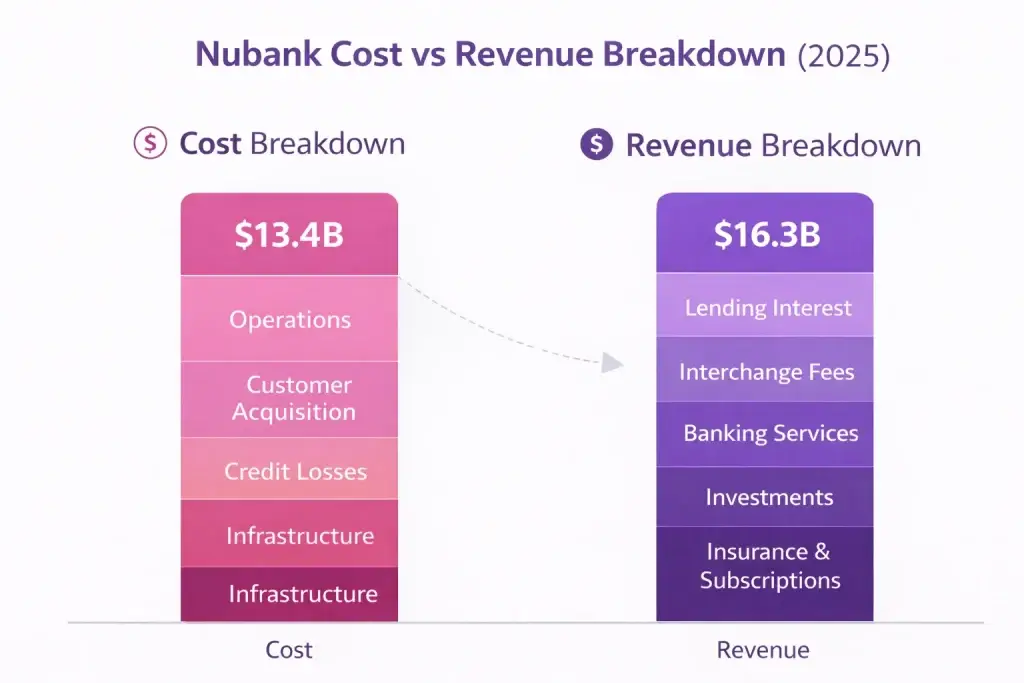
| Lending Interest | Credit cards, personal loans, installment financing | 50–60% | Interest rates on credit |
| Interchange Fees | Merchant transaction fees from card payments | 15–25% | % per transaction |
| Banking Services | Payments, deposits, financial services | 10–15% | Transaction margins |
| Investment Products | Brokerage and wealth management commissions | 5–10% | Trading & advisory fees |
| Insurance & Subscriptions | Insurance distribution and premium services | ~5% | Commissions & subscriptions |
The Fee Structure Explained
Despite marketing itself as a “no-fee bank,” Nubank still monetizes heavily behind the scenes.
It simply charges fees in places customers are less sensitive to.
Platform Fee Structure (Latest Available Data)
| User Type | Fee Type | Typical Fee Range | Notes |
|---|---|---|---|
| Card Users | Interest on credit balances | 20–120% APR depending on risk | Major revenue driver |
| Merchants | Interchange fees | ~1–3% | Paid per card transaction |
| Investors | Brokerage fees | 0–1% per trade | Some trades commission-free |
| Insurance Buyers | Insurance premium commissions | 10–20% | Paid by insurers |
| ATM Users | Withdrawal fees | Varies by region | Charged after free limits |
How Nubank Maximizes Revenue Per User
Nubank’s biggest advantage is customer monetization depth.
Instead of chasing more users endlessly, it increases Average Revenue Per Active Customer (ARPAC).
Strategies include:
1. Product Expansion
A typical Nubank user may start with a credit card, then later adopt:
- savings accounts
- loans
- investments
- insurance
Each new product increases lifetime value.
2. AI-Driven Credit Scoring
Nubank uses AI models to:
- determine credit limits
- predict default risk
- personalize interest rates
This allows them to increase lending safely, boosting revenue.
3. Cross-Selling Financial Products
The app frequently recommends products like:
- loan refinancing
- investment plans
- insurance upgrades
This increases monetization without extra marketing cost.
4. Behavioral Pricing
Nubank dynamically adjusts:
- credit limits
- installment options
- payment schedules
These techniques increase both usage and interest revenue.
Cost Structure & Profit Margins
Although Nubank is profitable, fintech operations still involve significant costs.
Major Cost Categories
Technology infrastructure
- cloud computing
- mobile app development
- payment processing infrastructure
Customer acquisition
- marketing
- referral incentives
- onboarding costs
Credit risk
- loan defaults
- reserve provisions
Operations
- customer support
- compliance
- fraud prevention
Typical Cost Structure
| Cost Category | Description |
|---|---|
| Infrastructure | Cloud systems, fintech platform |
| Customer Acquisition | Marketing and referral programs |
| Credit Losses | Default risk on lending |
| Operations | Support teams and compliance |
| R&D | AI models and product development |
Nubank’s digital-only structure avoids expensive bank branches, giving it much lower operating costs than traditional banks.
Future Revenue Opportunities (2026–2028 Outlook)
Several major growth opportunities remain for Nubank.
1. U.S. Market Expansion
Nubank is exploring entry into the U.S. banking market, which could dramatically expand its revenue base.
2. AI-Driven Lending
AI credit models already improved lending performance and margins.
Expect:
- automated credit approvals
- personalized lending offers
- real-time underwriting
3. SME Banking
Small business banking is a massive opportunity.
Potential products:
- SME loans
- payroll tools
- invoicing
- merchant financing
4. Financial Super App Strategy
Nubank aims to become a financial operating system for customers.
Future products could include:
- tax tools
- payroll
- embedded finance
- crypto services
Lessons for Entrepreneurs
Nubank’s success provides powerful lessons for startup founders.
1. Start With One Killer Product
Nubank started with a single credit card product.
Focus beats complexity.
2. Monetize Through Ecosystems
Instead of charging high fees upfront, Nubank monetizes multiple financial interactions over time.
3. Use Technology to Reduce Cost
By eliminating physical branches, Nubank dramatically improved margins.
4. Cross-Selling Drives Profitability
Fintech profitability often comes from multiple products per user, not just user growth.
Final Thought
Nubank proves that fintech disruption isn’t just about better UX.
The real advantage comes from combining data, AI, and product expansion into a scalable financial ecosystem.
For founders, the real insight is simple: the biggest fintech businesses are built on layered monetization, not a single product.
What makes Nubank particularly powerful is how it starts with one entry product—usually a credit card or digital account—and then expands into a full financial platform. Once users trust the platform, Nubank gradually introduces additional services like loans, investments, insurance, and payments. Each new product increases customer lifetime value without dramatically increasing acquisition costs.
FAQs
1. How much does Nubank make per transaction?
Typically 1–3% of the transaction value through interchange fees when customers use Nubank cards.
2. What is the most profitable revenue stream for Nubank?
Interest income from lending and credit cards is the largest revenue source.
3. How does Nubank’s pricing compare to competitors?
Nubank often offers lower visible fees, but monetizes through lending and financial services.
4. What percentage does Nubank take from providers?
Insurance and financial partners typically pay 10–20% commissions for distribution.
5. How has Nubank’s revenue model evolved?
It started with credit cards, then expanded into loans, banking services, investments, and insurance.
6. Can small startups use a similar model?
Yes. Many fintech startups start with a single product then expand into multi-product ecosystems.
7. What scale is needed for profitability?
Fintech typically requires millions of users to offset infrastructure and compliance costs.
8. How can founders implement a similar model?
Start with:
a strong financial product
digital infrastructure
data-driven lending or payments
Then expand through cross-selling and embedded finance.
9. What alternatives exist to this revenue model today?
Other fintech models include:
SaaS banking infrastructure
embedded finance platforms
payment processing platforms
subscription-based financial apps.
Miracuves is an independent software development company. We are not affiliated with, connected to, sponsored by, or endorsed by any company or product named in this article.
Terms such as “X Clone” are used descriptively. It is how the software industry refers to building a platform with functionality comparable to a known service, and how clients search for it.
The entire design and codebase of our products is built by our own team. Our products contain no code, design, graphics, or content originating from any third-party website or applications.
All third-party names and marks referenced in this article are the property of their respective owners, referenced solely to identify the services discussed.