

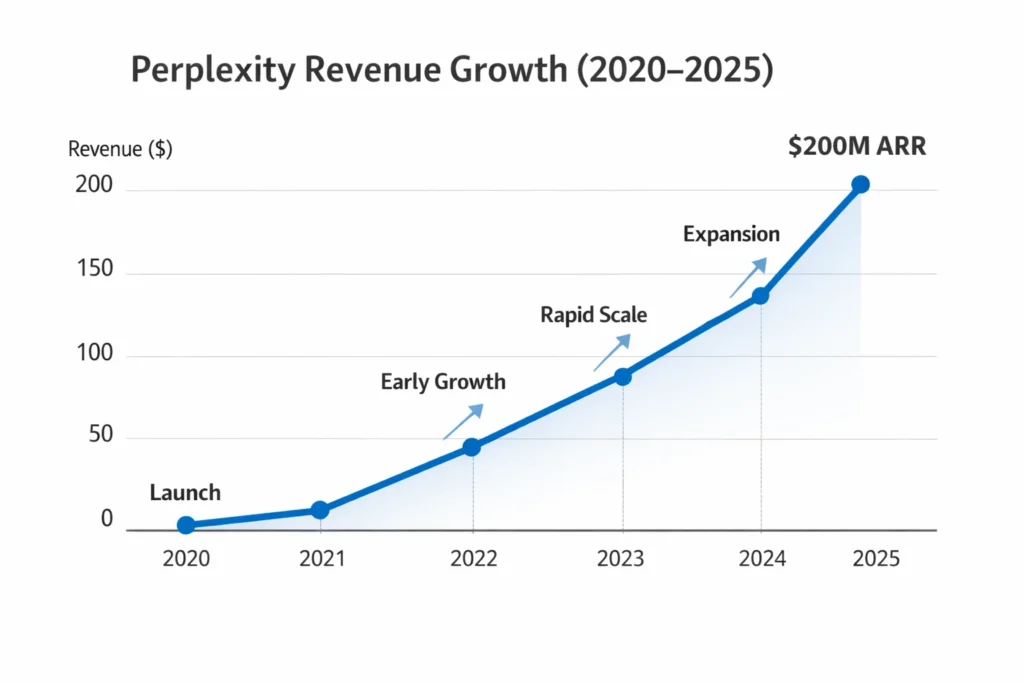
Perplexity reached approximately $200 million in annualized revenue in 2026, making it one of the fastest-growing AI search platforms globally. This growth is driven by daily utility — users rely on it for research, summaries, comparisons, and decision-making. Unlike traditional search engines, it delivers direct answers instead of just links, which increases engagement time and repeat usage. High-frequency usage combined with a subscription model creates predictable recurring revenue and strong retention metrics.
That figure is remarkable for a company that didn’t exist a few years ago. Even more impressive: it’s doing this without relying heavily on traditional advertising. Instead of monetizing attention through ads, it monetizes intelligence through subscriptions. This shifts the value proposition from “free but ad-supported” to “paid but trusted.” By focusing on answer quality, citation transparency, and productivity gains, Perplexity builds user trust — and trust converts into paid upgrades.
For founders, Perplexity represents a new blueprint — monetizing AI-powered search through premium subscriptions, enterprise adoption, and API access. The model shows that vertical AI utilities can charge directly for time saved and decision accuracy. By offering a freemium funnel, limiting advanced capabilities, and upselling heavy users, it increases average revenue per user over time. The real lesson is clear: if your AI product becomes part of a user’s daily workflow, subscription revenue becomes sustainable and scalable.
Perplexity Revenue Overview – The Big Picture
2025 Revenue:
Approximately $200M annualized revenue in 2025.
Valuation:
Estimated around $3 billion in 2025 funding rounds.
YoY Growth:
Revenue reportedly grew more than 3–4x year-over-year from 2024 to 2025.
Revenue by Region (Estimated Split):
- North America: ~55%
- Europe: ~25%
- Asia-Pacific: ~15%
- Other regions: ~5%
Profit Margins:
Still investing heavily in infrastructure and growth. Gross margins typical of SaaS (60–75%), but net profitability not yet fully stabilized due to AI compute costs.
Competition Benchmark:
- ChatGPT (OpenAI) operates on a significantly larger scale (multi-billion revenue range).
- Google Search monetizes primarily via ads (tens of billions annually).
- Perplexity differentiates by subscription-first AI search.
Read More: Perplexity AI Explained: AI Search and Answer Engine
Primary Revenue Streams Deep Dive
Revenue Stream #1: Pro Subscription (Primary Driver)
How it works:
Users pay a monthly or annual fee for advanced AI models, unlimited queries, and priority access.
Pricing Model:
Approximately $20/month for Pro.
Estimated Share: ~60–65% of total revenue.
This predictable recurring revenue fuels growth and improves valuation multiples.
Revenue Stream #2: Enterprise Plans
How it works:
Custom AI search and knowledge assistant deployments for teams and organizations.
Pricing Model:
Per-seat pricing, often $40–60 per user/month depending on features and scale.
Estimated Share: ~20–25%.
Enterprise adoption significantly increases average revenue per account.
Revenue Stream #3: API Access
How it works:
Developers integrate Perplexity’s AI search capabilities into their apps.
Pricing Model:
Usage-based (tokens/queries).
Estimated Share: ~5–10%.
This opens platform-style scalability.
Revenue Stream #4: Sponsored Answers / Partnerships
How it works:
Carefully integrated sponsored responses or brand partnerships within answers.
Estimated Share: ~3–5%.
Unlike traditional ads, these are contextually embedded.
Revenue Stream #5: Data & Insights Monetization (Emerging)
How it works:
Aggregated usage analytics and enterprise insights.
Estimated Share: ~2–3% (early stage).
Revenue Streams Percentage Breakdown:
- Subscriptions — ~65%
- Enterprise — ~22%
- API — ~7%
- Sponsored placements — ~4%
- Data services — ~2%
The Fee Structure Explained
User-Side Fees
- Free tier: Limited queries
- Pro tier: ~$20/month
- Annual discounts offered
Enterprise Fees
- Per-seat monthly fee
- Custom integrations priced separately
- Volume discounts for large teams
Hidden Revenue Layers
- API overages
- Premium model usage
- Custom deployment charges
Regional Pricing Variation
- Slightly adjusted pricing for emerging markets
- Enterprise deals negotiated regionally
Complete Fee Structure by User Type:
- Free Users: Limited AI usage
- Pro Users: Fixed subscription
- Enterprise Clients: Per-seat + customization
- Developers: Usage-based API billing
How Perplexity Maximizes Revenue Per User
Segmentation:
Free → Pro → Enterprise funnel.
Upselling:
Power users quickly hit query limits and upgrade.
Cross-Selling:
Enterprise adds team collaboration tools.
Dynamic Pricing:
Usage-based API billing increases ARPU.
Retention Monetization:
Daily utility increases stickiness.
LTV Optimization:
Subscription model boosts lifetime value.
Psychological Pricing:
$20/month positioned as cheaper than hiring a researcher.
Real data suggests heavy users convert at significantly higher rates than casual users.
Cost Structure & Profit Margins
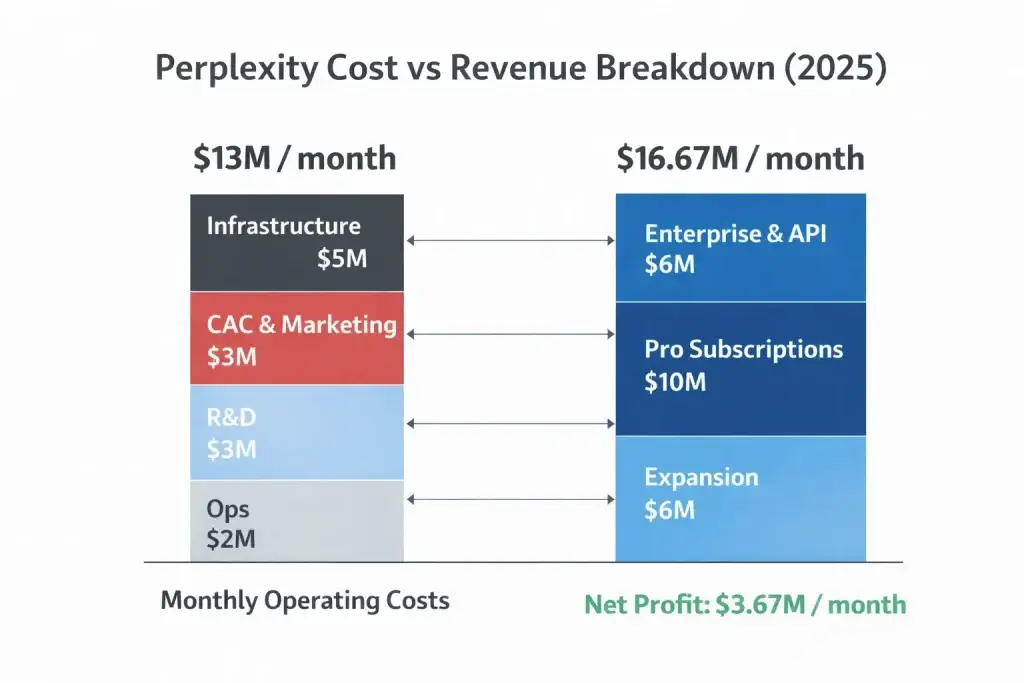
Infrastructure Costs
AI model inference and cloud compute are the largest cost drivers.
Customer Acquisition Cost (CAC)
Heavy digital marketing and influencer partnerships.
Operations
Engineering, AI research, moderation.
R&D
Continuous model integration and performance upgrades.
Unit Economics
High gross margin SaaS structure but pressured by compute costs.
Margin Optimization
Improving inference efficiency lowers cost per query.
Profitability Path
Enterprise expansion + optimized infrastructure.
Future Revenue Opportunities & Innovations (2025–2027)
- AI-powered workflow automation
- Vertical AI search (legal, medical, finance)
- Enterprise knowledge indexing
- AI agents with task execution
- API ecosystem growth
Risks & Threats:
- Big Tech competition
- Compute cost inflation
- Regulatory scrutiny
Opportunities for Founders:
- Niche AI search platforms
- Vertical-specific research tools
- AI-powered SaaS copilots
Lessons for Entrepreneurs & Your Opportunity
What Works:
- Subscription-first model
- Trust-based product positioning
- Clear value differentiation from ads
What to Replicate:
- Freemium funnel
- Strong daily-use case
- Enterprise upsell strategy
Market Gaps:
- Regional AI search platforms
- Industry-specific AI assistants
- Multi-language AI research engines
Final Thought
Perplexity proves that AI search can monetize without relying entirely on ads. Instead of competing for clicks, it competes for accuracy, speed, and usability. By delivering structured, cited answers rather than blue links, it increases user trust and session depth. This trust allows it to position its product as a productivity tool rather than just a search engine, which makes paid upgrades feel justified instead of optional.
Its revenue model is built on subscriptions, enterprise trust, and scalable API infrastructure. The subscription layer captures power users who need advanced models and unlimited queries. Enterprise plans expand monetization through team collaboration, knowledge integration, and security controls. Meanwhile, API access opens platform-level scalability, allowing other applications to embed its intelligence. Together, these layers diversify revenue while keeping the core experience clean and focused.
FAQs
1. How much does Perplexity make per transaction?
There’s no per-transaction model. Revenue primarily comes from recurring subscriptions (~$20/month per Pro user).
2. What’s Perplexity’s most profitable revenue stream?
Pro subscriptions, due to predictable recurring income and high margins.
3. How does Perplexity’s pricing compare to competitors?
It is competitively priced versus other AI tools and cheaper than many enterprise knowledge platforms.
4. What percentage does Perplexity take from providers?
It does not operate a provider marketplace model, so no commission structure applies.
5. How has Perplexity’s revenue model evolved?
From pure consumer subscription focus to adding enterprise and API monetization layers.
6. Can small platforms use similar models?
Yes, especially vertical AI search or niche research platforms.
7. What’s the minimum scale for profitability?
Strong subscription conversion and efficient compute costs are key.
8. How to implement similar revenue models?
Use freemium access, limit usage, and upsell heavy users to paid tiers.
9. What are alternatives to Perplexity’s model?
Ad-supported AI search or hybrid subscription + ad models.
Miracuves is an independent software development company. We are not affiliated with, connected to, sponsored by, or endorsed by any company or product named in this article.
Terms such as “X Clone” are used descriptively. It is how the software industry refers to building a platform with functionality comparable to a known service, and how clients search for it.
The entire design and codebase of our products is built by our own team. Our products contain no code, design, graphics, or content originating from any third-party website or applications.
All third-party names and marks referenced in this article are the property of their respective owners, referenced solely to identify the services discussed.