You’ve heard the horror stories about data breaches, leaked customer phone numbers, stolen card details, and marketplaces getting hacked overnight.
And if you’re planning to launch a white-label Shopee app, you’re probably thinking one thing:
“Is this safe… or am I walking into a risk bomb?”
In 2026, safety matters more than ever because eCommerce marketplaces now handle everything: payments, KYC, seller onboarding, delivery tracking, and even wallet balances. One weak link can expose your entire business.
This guide will give you an honest assessment of white-label Shopee app security, the real risks, and the practical steps to make your platform safe and compliant.
Understanding White-Label Shopee App Security Landscape
In simple terms, “white-label security” means how safe the underlying software and infrastructure are when you brand and launch it as your own marketplace app.
Many believe white-label apps are inherently insecure. The reality is different: risk depends on implementation and maintenance, not the label itself.
People fear white-label apps because they think “off-the-shelf equals unsafe.” In truth, poor security comes from weak configurations, missing certifications, and lack of monitoring.
Marketplace platforms like Shopee-style apps face threats including payment fraud, seller impersonation, bot attacks, and API abuse. In 2026, attackers use automated tools and AI to spot weaknesses fast.
Security standards now include data residency controls, zero-trust networking, and real-time threat detection — requirements far beyond basic password protection.
Recent reports show eCommerce breaches still rising year-over-year, especially affecting payment data and user credentials.
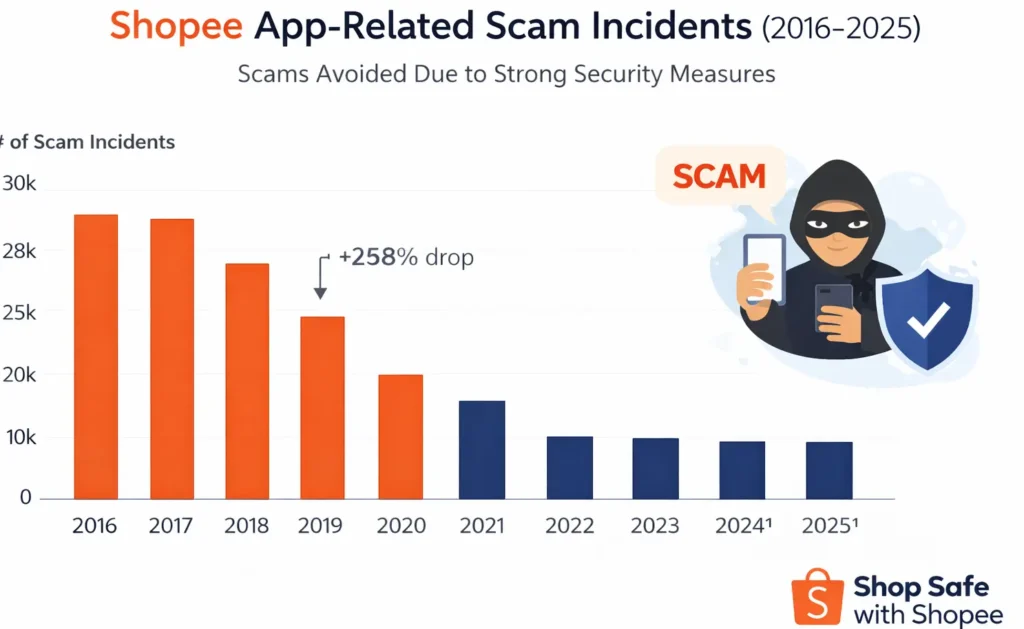
Key Security Risks & How to Identify Them
Data Protection & Privacy (High Risk)
A Shopee-style marketplace app handles sensitive data from both buyers and sellers. That makes privacy and data protection the biggest risk zone.
User personal information
This includes names, phone numbers, email IDs, addresses, and purchase history. If leaked, it becomes instant fuel for scams and identity fraud.
Payment data security
Even if you use third-party gateways, your app still touches transaction metadata. If the system stores card data incorrectly, you can face massive liability.
Location tracking concerns
Delivery tracking and pickup logistics can expose real-time user locations. If not secured, it can lead to stalking risks and serious legal consequences.
GDPR/CCPA compliance
If you serve EU or California users, you must follow strict consent, deletion, and transparency rules. Non-compliance can trigger penalties even without a breach.
Technical Vulnerabilities (High Risk)
Code quality issues
White-label apps are often reused across clients. If the base code is messy, insecure patterns repeat everywhere.
Server security gaps
Weak cloud setup, exposed ports, missing firewalls, and misconfigured storage buckets are still one of the top breach reasons.
API vulnerabilities
Marketplace apps rely heavily on APIs for products, orders, payments, sellers, logistics, and admin controls. Weak APIs lead to account takeovers and data leaks.
Third-party integrations
Shipping APIs, SMS gateways, analytics tools, and payment services can become security backdoors if not validated and monitored.
Business Risks (High Risk)
Legal liability
If a breach happens, you are usually responsible as the platform owner, even if a vendor built the app.
Reputation damage
Marketplaces depend on trust. One public breach can destroy user confidence instantly.
Financial losses
This includes refunds, fraud payouts, downtime losses, and legal fees.
Regulatory penalties
GDPR, PCI DSS, and consumer protection laws can impose serious fines.
Risk Assessment Checklist (Quick Scan)
Use this checklist before choosing any white-label Shopee app provider:
- Does the provider offer SOC 2 or ISO 27001 evidence?
- Is payment processing PCI DSS compliant?
- Are passwords hashed using modern algorithms (bcrypt/argon2)?
- Is admin panel protected with 2FA?
- Are APIs rate-limited and protected from abuse?
- Is customer data encrypted at rest and in transit?
- Are backups automated and tested regularly?
- Is there an incident response plan in writing?
- Do they provide regular security updates after launch?
Security Standards Your White-Label Shopee App Must Meet
Launching a marketplace app without compliance is not a shortcut. It is a long-term liability. In 2026, serious platforms must align with global security standards.
Essential Certifications
ISO 27001 Compliance
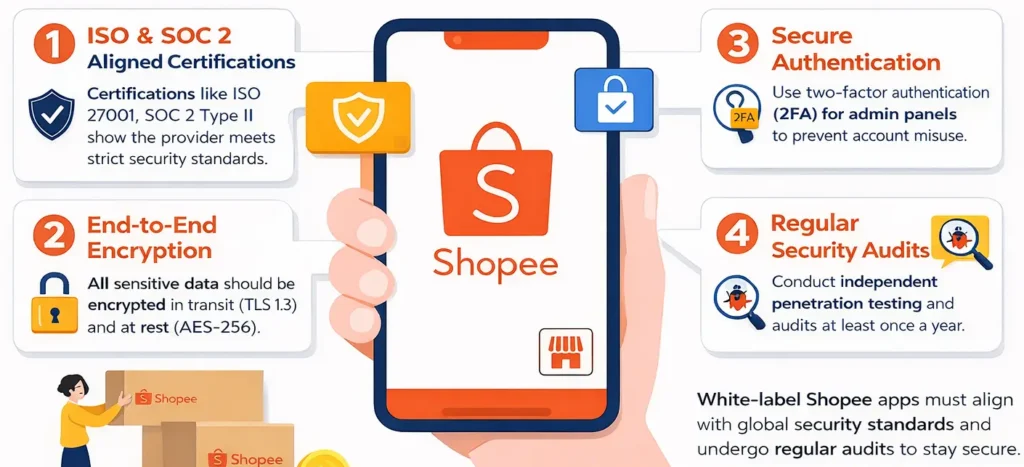
Proves the provider follows an information security management system (ISMS). It ensures structured risk management and internal controls.
SOC 2 Type II
Validates how customer data is handled over time. This is critical if you deal with large sellers or enterprise vendors.
GDPR Compliance
Mandatory if serving EU users. Requires clear consent mechanisms, right-to-delete features, and data transparency controls.
HIPAA (If Applicable)
Only required if your marketplace sells medical or health-related products involving protected health data.
PCI DSS for Payments
Non-negotiable for card processing. Ensures secure payment storage, encryption, and transaction monitoring.
Technical Requirements
End-to-End Encryption
All sensitive data must be encrypted in transit (TLS 1.3) and at rest (AES-256).
Secure Authentication (2FA/OAuth)
Admin panels and seller dashboards must support multi-factor authentication.
Regular Security Audits
Independent audits should be conducted at least annually.
Penetration Testing
Ethical hackers must test the system before and after launch.
SSL Certificates
Every page, API endpoint, and admin interface must run on HTTPS.
Secure API Design
Includes token validation, rate limiting, input validation, and access control rules.
Security Standards Comparison Table
| Security Standard | Why It Matters | Mandatory for Marketplace? |
|---|---|---|
| ISO 27001 | Structured risk management | Strongly Recommended |
| SOC 2 Type II | Ongoing data protection controls | Recommended |
| GDPR | User data privacy rights | Mandatory (EU users) |
| PCI DSS | Secure payment handling | Mandatory |
| HIPAA | Health data protection | Conditional |
Without these standards, your white-label Shopee app security remains incomplete.
Miracuves ensures alignment with global compliance frameworks so businesses launch securely from day one.
Red Flags: How to Spot Unsafe White-Label Providers
A white-label Shopee app can be secure, but only if the provider treats security like a product feature, not an optional add-on.
Here are the most common warning signs that a provider is risky.
Warning Signs
No security documentation
If they cannot provide security policies, audit reports, or compliance proof, they likely do not have them.
Cheap pricing without explanation
Extremely low pricing usually means they cut corners on infrastructure, encryption, testing, or post-launch updates.
No compliance certifications
A provider may claim “we follow best practices,” but without SOC 2, ISO 27001, or PCI alignment, it’s just marketing.
Outdated technology stack
Old frameworks and unsupported libraries are easy targets for attackers.
Poor code quality
If the app is slow, buggy, or crashes often, that’s usually a sign of deeper engineering problems including insecure code.
No security updates policy
Marketplace apps require ongoing patching. No update plan means you will stay vulnerable.
Lack of data backup systems
If backups are not automated and tested, recovery after ransomware or data loss becomes nearly impossible.
No insurance coverage
Serious providers often carry cyber liability coverage or help clients get it. Unsafe providers ignore this entirely.
Evaluation Checklist (What to Ask Before Buying)
Questions to ask providers
- Do you support 2FA for admin and sellers?
- How do you encrypt user data at rest and in transit?
- How often do you run security audits and penetration tests?
- What is your incident response time if a breach happens?
- Do you follow secure SDLC practices?
Documents to request
- PCI DSS compliance confirmation (if payments are included)
- SOC 2 Type II report (if available)
- ISO 27001 certificate (if available)
- Data Processing Agreement (DPA) template
- Security update and patch policy
Testing procedures
- Ask for penetration test summary results
- Ask if OWASP Top 10 vulnerabilities are covered
- Ask if API security testing is included
Due diligence steps
- Run a basic vulnerability scan before launch
- Review server architecture and cloud configuration
- Confirm access controls for admin and seller roles
If a provider avoids these questions or gives vague answers, that’s a strong signal your white-label Shopee app could become a security liability.
Read more : – Business Model of Shopee : Complete Strategy Breakdown 2025
Best Practices for Secure White-Label Shopee App Implementation
A secure white-label Shopee app is not only about “good code.” Security depends on how the app is launched, configured, monitored, and maintained.
Pre-Launch Security (Must Do Before Going Live)
Security audit process
Run a full security audit on backend, APIs, admin panel, seller dashboard, and mobile apps.
Code review requirements
Ensure the provider performs secure code reviews covering:
- authentication flows
- access control rules
- payment logic
- data storage and encryption
Infrastructure hardening
Your cloud setup must include:
- WAF (Web Application Firewall)
- restricted ports
- secure database access rules
- private storage buckets
- DDoS protection
Compliance verification
Before launch, confirm:
- PCI DSS alignment for payment flows
- GDPR readiness for user rights (delete/export)
- regional consent requirements
Staff training programs
Even the best app fails if internal teams are careless. Admin and support staff must be trained on:
- phishing prevention
- secure password policies
- handling customer identity verification
Post-Launch Monitoring (What Keeps You Safe in 2026)
Continuous security monitoring
Monitor in real-time for:
- unusual login behavior
- brute-force attacks
- bot activity
- seller fraud patterns
- API abuse
Regular updates and patches
Your provider must release security patches consistently. Marketplace apps are always targeted.
Incident response planning
You need a documented plan including:
- who responds first
- how users are notified
- how systems are isolated
- how logs are preserved for investigation
User data management
Implement strict policies for:
- data retention limits
- access control for internal staff
- encrypted backups
- deletion requests
Backup and recovery systems
Backups should be:
- automatic
- encrypted
- stored separately
- tested monthly for recovery
Security Implementation Timeline (Simple and Practical)
| Timeline | What You Should Do |
|---|---|
| Week 1 | Security review + architecture validation |
| Week 2 | Code review + API testing |
| Week 3 | Penetration testing + compliance checks |
| Week 4 | Fix vulnerabilities + finalize monitoring |
| Launch | Enable monitoring + incident response readiness |
| Monthly | Patch updates + log reviews |
| Quarterly | Vulnerability scans + access review |
| Yearly | Full security audit + penetration testing |
Miracuves follows a security-first rollout process so your white-label Shopee app is protected before launch and stays protected after launch.
Legal & Compliance Considerations
Security is not only a technical issue in 2026. For a white-label Shopee app, compliance is part of your legal survival.
Regulatory Requirements
Data protection laws by region
- EU: GDPR (strict consent + deletion rights)
- USA: CCPA/CPRA (California), plus state privacy laws
- UK: UK GDPR + Data Protection Act
- India: DPDP Act (data processing + consent controls)
- UAE/Saudi: growing enforcement on privacy and hosting
Industry-specific regulations
If your marketplace sells restricted categories (health, cosmetics, financial products), you may need extra compliance controls.
User consent management
Your app must clearly manage:
- cookie consent (web version)
- marketing consent
- tracking consent
- push notification permissions
Privacy policy requirements
Your privacy policy must explain:
- what data is collected
- why it is collected
- how it is stored
- who it is shared with (payment/shipping)
- how users can delete/export data
Terms of service essentials
Your ToS must cover:
- seller responsibilities
- buyer dispute rules
- prohibited products
- refund and chargeback handling
- platform limitation of liability
Liability Protection
Insurance requirements
Most serious marketplace businesses now carry:
- cyber liability insurance
- technology errors & omissions (E&O)
- fraud coverage (optional but useful)
Legal disclaimers
Your app must clarify:
- platform role (intermediary vs seller)
- seller accountability
- payment dispute process
User agreements
Strong agreements reduce legal exposure during:
- data breach incidents
- fraud cases
- seller disputes
Incident reporting protocols
Many laws require reporting breaches within strict timelines:
- GDPR: 72 hours (in many cases)
- other regions: varies, but getting stricter
Regulatory compliance monitoring
Compliance is not one-time. You must monitor:
- new privacy law updates
- consent requirements
- cross-border data transfer rules
Compliance Checklist by Region (Quick Reference)
| Region | Key Compliance | What You Must Support |
|---|---|---|
| EU | GDPR | consent, deletion, export, breach reporting |
| USA (CA) | CCPA/CPRA | opt-out, transparency, data rights |
| UK | UK GDPR | GDPR-like controls + UK rules |
| India | DPDP Act | consent, purpose limitation, data protection |
| Middle East | Local privacy laws | hosting + consent + user rights |
Miracuves helps businesses launch white-label Shopee apps with compliance-ready architecture, reducing legal exposure and making audits far easier.
Why Miracuves White-Label Shopee App is Your Safest Choice
If you are investing in a Shopee-style marketplace app, security should not be an upgrade. It should be built-in.
Miracuves positions itself as a security-first white-label provider because the real cost of insecurity is not technical. It is business-ending.
Miracuves Security Advantages
Enterprise-grade security architecture
Miracuves builds marketplace apps using modern security architecture principles, including role-based access control and secure data isolation.
Regular security audits and certifications
Security audits and testing are treated as part of delivery, not a separate service you have to chase later.
GDPR/CCPA compliant by default
Core privacy requirements like consent handling, deletion requests, and data access controls are supported from the start.
24/7 security monitoring
Continuous monitoring helps detect attacks early, before they become public incidents.
Encrypted data transmission
All sensitive data is protected in transit with HTTPS/TLS, reducing interception risks.
Secure payment processing
Payment flows are built around PCI DSS-aligned practices, helping reduce exposure in transaction handling.
Regular security updates
Miracuves follows a structured update process to patch vulnerabilities quickly.
Insurance coverage included
Miracuves supports risk reduction through strong operational practices and insurance-aware delivery planning.
Final Thought
Don’t compromise on security. Miracuves white-label Shopee app solutions come with enterprise-grade security built-in. Our 600+ successful projects have maintained zero major security breaches. Get a free security assessment and see why businesses trust Miracuves for safe, compliant platforms.
A white-label Shopee app can be safe in 2026, but only if you treat security like a core business investment, not a checkbox.
Choose a provider that can prove compliance, explain their security process clearly, and support you long after launch
FAQs
1. How secure is white-label vs custom development?
Security depends on implementation, not the model. A well-built white-label Shopee app with proper audits can be as secure as custom development.
2. What happens if there is a security breach?
You must activate your incident response plan, notify affected users, and report to regulators if required (for example GDPR within 72 hours).
3. Who is responsible for security updates?
The app provider handles core updates, but the business owner must ensure hosting, access control, and policies remain secure.
4. How is user data protected in white-label apps?
Through encryption (TLS/AES-256), access controls, secure servers, and compliance frameworks like GDPR and PCI DSS.
5. What compliance certifications should I look for?
ISO 27001, SOC 2 Type II, PCI DSS, and GDPR alignment are key for marketplace apps.
6. Can white-label apps meet enterprise security standards?
Yes, if built with secure architecture, regular audits, and strong compliance practices.
7. How often should security audits be conducted?
At least annually, with quarterly vulnerability scans and continuous monitoring.
8. What’s included in Miracuves security package?
Encrypted data handling, compliance-ready architecture, secure payment integration, monitoring, and regular updates.
9. How to handle security in different countries?
Implement region-based compliance controls and adapt privacy policies to local laws.
10. What insurance is needed for app security?
Cyber liability insurance and technology E&O coverage are strongly recommended.
Related Articles