


Key Takeaways
- A creator subscription platform should protect payments, premium content, creator accounts, subscriber profiles, and personal data through multiple security layers.
- Core protections include secure payment processing, encryption, strong authentication, access controls, content permissions, fraud monitoring, and privacy-focused data handling.
- Platform security should be built into registration, subscriptions, messaging, content delivery, payouts, account recovery, and admin workflows rather than added only after launch.
Security & Protection Signals
- Payment protection should cover secure gateways, transaction verification, payout controls, refund handling, chargeback monitoring, and suspicious payment activity.
- Content protection can use subscriber permissions, signed access links, watermarking, download restrictions, storage controls, and monitoring for unauthorized sharing.
- Account and user data security should include multi-factor authentication, encrypted credentials, session management, role-based access, privacy controls, backups, and audit logs.
Platform Risk Insights
- Creators need reliable account recovery, payout protection, content ownership controls, impersonation reporting, moderation tools, and visibility into suspicious login activity.
- Admins should monitor failed payments, unusual logins, content reports, account abuse, payout anomalies, permission changes, and other high-risk platform events.
- Miracuves develops customizable creator subscription platforms with secure payments, content access controls, creator accounts, subscriber management, privacy tools, moderation, analytics, and admin security controls.
Creator subscription platforms are built on trust.
Fans trust the platform with payment details, private interactions, account history, and subscription access. Creators trust the platform with premium content, earnings, identity verification, payout information, and audience relationships. Operators trust the backend to manage renewals, refunds, content reports, moderation, verification, and sensitive admin actions without creating unnecessary risk.
That is why security cannot be treated as a technical add-on. For a creator subscription platform, security is part of the product experience. If payments fail, creators lose income. If content leaks, creators lose confidence. If accounts are compromised, users leave. If user data is mishandled, the platform faces operational, legal, and reputation risk.
This guide explains how founders should think about platform security across four critical areas: payments, content, accounts, and user data.
Why Security Matters More for Creator Subscription Platforms
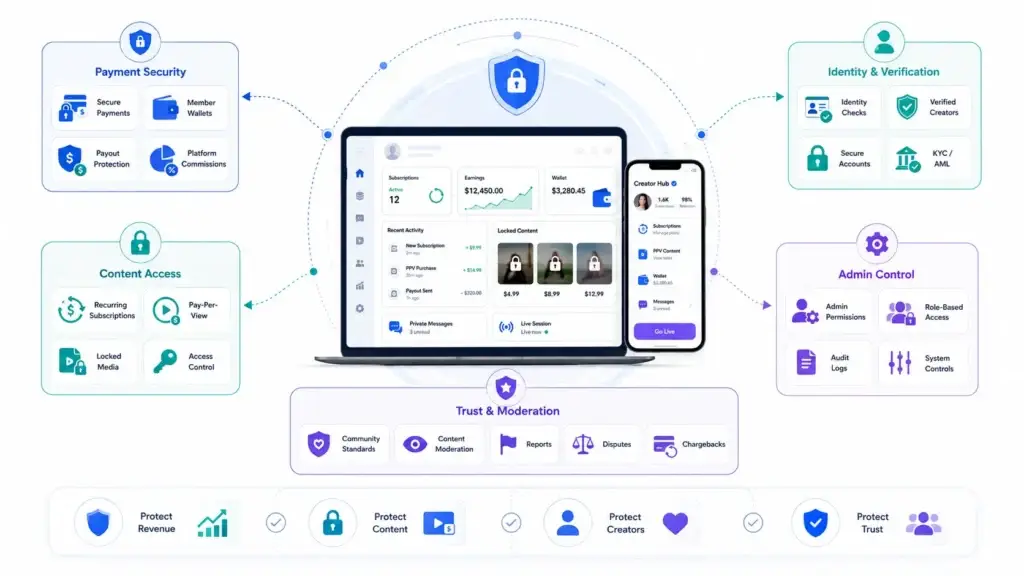
A normal social app mainly handles profiles, feeds, comments, and engagement. A creator subscription platform handles much more sensitive workflows because the business model usually depends on subscriptions, paid messages, locked content, wallet activity, creator earnings, and private fan interactions. If the reader needs more context before the security layer, this guide on how creator subscription platforms work explains the core platform flow in more detail.
It may include recurring subscriptions, pay-per-view content, private messages, creator payouts, member wallets, locked media, live sessions, identity checks, age-related workflows, reports, disputes, chargebacks, and platform commissions.
That makes the business risk higher. A small issue in the payment layer can affect renewals. A weak content access system can expose premium media. A careless admin permission can reveal creator data or payment records. A poor moderation process can damage platform trust.
For founders, the real question is not only “Is the app secure?” The better question is: “Does the platform have the right security controls for how this business actually earns, stores content, verifies users, and handles disputes?”
Security also becomes more important when the platform is built for a specific creator niche. A fitness creator community, coaching platform, fan membership app, or private media marketplace may all use subscriptions, but each model has different risks around content access, payments, moderation, and user privacy. That is why founders should also think about their niche creator platform strategy before deciding what security workflows the product needs.
The Four Security Layers Every Creator Subscription Platform Needs
| Security Layer | What It Protects | Founder Risk If Ignored |
|---|---|---|
| Payment security | Subscriptions, tips, wallet top-ups, payouts, refunds, chargebacks | Failed renewals, creator payout disputes, payment fraud, revenue leakage |
| Content security | Premium photos, videos, messages, live content, downloads | Content leaks, scraping, creator churn, loss of exclusivity |
| Account security | Fans, creators, moderators, finance teams, administrators | Account takeover, over-permissioned staff access, internal misuse |
| User data security | Identity data, payment metadata, messages, reports, activity records | Privacy complaints, breach exposure, legal risk, reputation damage |
A secure platform should connect all four layers. Payment access should trigger content entitlement correctly. Account roles should decide who can approve refunds or takedowns. Moderation records should be logged. User data should be handled with clear privacy and retention rules. These controls should also be mapped to the right creator subscription platform features, so founders can evaluate whether the product has the right modules for payments, gated content, moderation, verification, and admin governance.
How Creator Platforms Should Protect Payments
Payment protection starts before the first transaction happens.
A creator platform should not treat payments as a simple checkout button. It needs a structured payment system that supports recurring billing, renewals, failed-payment recovery, creator earnings, payout requests, refunds, disputes, and transaction logs. These payment flows directly shape the creator membership revenue model, because subscriptions, tips, paid unlocks, wallets, refunds, and payouts all affect how the platform earns and how creators receive income.
The PCI Security Standards Council maintains PCI DSS v4.0.1 as the active data security standard for payment-card environments, and its document library describes resources for safe handling of cardholder information.
For creator subscription platforms, payment security should include:
- Secure payment gateway integration. The platform should use trusted payment gateways that match the platform’s content category, region, and recurring billing requirements.
- Tokenized payment handling where supported. Platforms should avoid storing raw card data directly. Tokenization helps reduce sensitive data exposure by replacing card details with payment tokens managed by approved payment systems.
- Webhook validation. Subscription renewals, failed payments, refunds, chargebacks, and payout updates often depend on gateway webhooks. These callbacks should be signed, validated, logged, and processed carefully.
- Recurring billing lifecycle control. Renewals, retries, cancellations, upgrades, downgrades, proration, grace periods, and expiry rules must behave correctly every cycle.
- Refund and chargeback workflows. Admin teams should be able to review refund requests, chargeback signals, suspicious payment activity, and creator payout implications before taking action.
- Payout monitoring. Creator balances, withdrawal requests, payout status, and reconciliation records should be visible to the right admin roles.
A creator platform payment system is not just about accepting money. It is about proving that every subscription, unlock, refund, and creator payout has a clear record. Founders who depend on recurring billing should also understand smart payment routing for creator platforms, because gateway failures, failed renewals, chargebacks, and payout delays can directly affect creator trust and platform revenue.
How Platforms Should Protect Premium Content
Premium content is the product.
If a platform sells access to locked photos, videos, private media, paid messages, live sessions, or digital downloads, the content layer needs more than a visible paywall.
A paywall controls what users see in the interface. Content security controls whether the underlying files can be accessed, copied, scraped, reused, or shared outside the intended session. For a deeper explanation of how paid media can be exposed through weak storage, reusable links, and poor access rules, read Miracuves’ guide on premium content protection for creator platforms.
Strong content protection should include:
- Access checks before delivery. The backend should confirm that the user has a valid subscription, purchase, membership tier, or entitlement before serving media.
- Expiring media URLs. Premium media links should not remain accessible forever. Time-limited links reduce the risk of link sharing and automated scraping.
- Private storage configuration. Premium media should not sit in publicly accessible storage buckets or predictable file paths.
- CDN-aware delivery. A content delivery network can improve performance, but it should be configured with access rules, signed URLs, cache controls, and origin protection.
- Watermarking where relevant. Dynamic or user-specific watermarking can discourage casual redistribution and help with leak investigation.
- Download and screen-recording controls where possible. No system can fully prevent all copying, but the platform can still reduce obvious abuse through playback controls, device rules, and monitoring.
- Moderation and takedown workflows. Creators and users should be able to report stolen content, impersonation, abuse, harassment, and policy violations.
For founders, the key lesson is simple: locked content must be protected at the backend, not only hidden on the frontend.
How Platforms Should Protect User and Creator Accounts
Account security is where many platform risks begin.
If a fan account is compromised, private subscriptions and payment history may be exposed. If a creator account is compromised, earnings, content, messages, and audience trust are at risk. If an admin account is compromised, the damage can be much larger.
OWASP’s API Security Top 10 identifies broken object-level authorization, broken authentication, object property authorization failures, resource abuse, and broken function-level authorization as major API security risks. These are especially relevant for apps with mobile clients, web dashboards, admin panels, payment APIs, and creator accounts.
A creator subscription platform should use:
- Strong authentication. Users, creators, moderators, and administrators should have secure login flows. Higher-risk roles should support stronger authentication controls.
- Multi-factor authentication for sensitive roles. Admins, finance users, moderators, and creator accounts with large earnings should have additional protection.
- Role-based access control. A moderator should not automatically have finance access. A support agent should not automatically control platform settings. A finance approver should not automatically change content policies.
- Session management. Sessions should expire appropriately, support logout across devices, and respond to suspicious activity.
- Rate limits. Login attempts, password resets, OTP requests, uploads, payment actions, message sending, and report submissions should be protected from abuse.
- Secure password reset flows. Password recovery endpoints should not leak tokens, reveal account existence carelessly, or allow brute-force abuse.
- Device and activity signals. Unusual login locations, repeated failed attempts, payout changes, and bulk content actions should be visible to the platform operator.
- The safest approach is to give every role only the access it needs. Over-permissioned admin access is one of the easiest ways to turn a small mistake into a serious incident.
How Platforms Should Protect User Data
Creator subscription platforms collect and process sensitive data.
This may include profile information, subscription history, content access records, payment metadata, private messages, reports, creator verification documents, payout details, admin logs, device information, and consent records.
Data protection should include:
- Encrypted data transfer. App, web, API, admin, and payment interactions should use secure communication.
- Encrypted storage for sensitive data. High-risk records should be stored with appropriate encryption and access controls.
- Data minimization. The platform should avoid collecting data it does not need.
- Consent and privacy controls. Users should understand what data is collected, why it is collected, and how it is used.
- Account deletion and retention workflows. Privacy-conscious platforms should support account deletion, data export readiness, and retention rules based on legal and business requirements.
- Audit logs. Sensitive actions such as verification decisions, refunds, payout approvals, content takedowns, admin role changes, and account restrictions should be logged.
Breach response planning. The European Commission explains that when a personal data breach is likely to pose a risk to individuals’ rights and freedoms, organizations must notify the supervisory authority without undue delay and, where feasible, within 72 hours after becoming aware of it.
For founders, this means privacy cannot be handled only through a policy page. The platform itself needs workflows that support access control, data handling, deletion, reporting, and incident response.
Why Admin Governance Is the Real Security Control Layer
A creator subscription platform becomes easier to manage when the admin dashboard is designed for governance, not just visibility.
The admin layer should help platform operators manage users, creators, payments, verification, reports, moderation, takedowns, revenue visibility, gateway configuration, commission settings, and policy workflows. Miracuves’ product page describes an operations console for member base management, subscription state, renewals, payment failures, creator management, moderation, verification, payout controls, and admin reporting.
A strong admin layer should include:
- Role-scoped dashboards. Finance, moderation, support, compliance, and owner roles should see different controls.
- Attributable actions. Every refund, takedown, verification decision, payout approval, and account restriction should show who did it and when.
- Payment and payout controls. Admins should be able to review transactions, creator balances, withdrawal requests, gateway events, refund cases, and failed payments.
- Moderation queues. Reported content, blocked users, takedown requests, comments, and suspicious creator activity should move through a review process.
- Verification records. Creator identity, age-related checks, business verification, and provider callbacks should be logged carefully.
Platform settings control. Subscription rules, pricing, commissions, payment providers, feature access, and content policies should be manageable without exposing every setting to every staff member.
Admin governance is where security becomes operational. Without it, even a technically strong platform can become difficult to control as creators, payments, disputes, and reports increase.
Founder Decision Signals
Payment Risk
If the business depends on recurring revenue, review how renewals, failed payments, refunds, chargebacks, and payout approvals are handled before launch.
Content Risk
If creators upload premium media, check whether the platform uses secure access rules, protected storage, expiring links, moderation, and leak-response workflows.
Account Risk
If different teams manage support, moderation, finance, and platform settings, role-based access and admin audit logs are essential.
Privacy Risk
If the platform handles identity documents, private messages, or payment metadata, data retention, deletion, consent, and breach-response processes should be planned early.
Security Checklist Before Launch
| Area | What to Check |
| Payments | Gateway approval, tokenized payment handling, webhook validation, refund controls, chargeback workflows, payout logs |
| Subscriptions | Renewals, failed-payment retry logic, cancellation, expiry, grace periods, entitlement updates |
| Content | Private storage, signed URLs, access checks, watermarking, CDN rules, takedown workflows |
| Accounts | Strong login, MFA for sensitive roles, session expiry, password reset protection, suspicious activity alerts |
| Admin | Role-based access, moderation logs, payout approval logs, permission boundaries, activity history |
| Data | Encrypted transfer, privacy controls, account deletion, retention rules, consent records, breach response planning |
| Moderation | Abuse reporting, manual review queues, creator verification, blocked-user controls, policy enforcement |
| Operations | Incident playbooks, staff access review, backup strategy, monitoring, update process |
Common Mistakes Founders Should Avoid
Treating secure payments as the whole security strategy
Secure payment processing matters, but it does not automatically protect private content, creator accounts, admin access, or user data. A creator subscription platform needs security across the full product workflow.
Assuming a paywall protects media files
A paywall is only one layer. If the underlying media file can be accessed through a reusable URL or exposed storage path, the premium content layer remains weak.
Giving every admin too much access
Support, finance, moderation, and platform-owner roles should not all have the same permissions. Admin access should be role-scoped and reviewed regularly.
Ignoring failed-payment and payout workflows
Revenue risk is also a security and trust issue. Failed renewals, unclear payout status, refund misuse, and chargeback disputes can damage creator confidence.
Leaving privacy controls for later
Privacy workflows are harder to retrofit after users and creators have already uploaded data, content, identity records, and transaction history.
Security-focused creator platforms require more than front-end screens and subscription buttons. Before choosing a team, founders should check whether the partner understands payment workflows, premium content protection, creator verification, admin governance, moderation queues, audit logs, and privacy-conscious data handling. A strong creator subscription platform development partner should be able to explain how these layers work together before launch.
Where Miracuves Fits Into This Decision
Founders do not need to choose between launching faster and taking platform security seriously.
Miracuves helps founders build creator membership platforms with source-code ownership, admin dashboards, monetization workflows, payment flows, verification, moderation, and branded deployment support. The commercial product page for this category explains that the platform includes a unified fan and creator app, web access, operations console, source-code ownership, configurable tiers, payment workflows, verification, moderation, and admin governance.
For founders comparing build options, the smarter approach is not to copy a well-known platform name in the blog content. The better approach is to understand the security foundation required for a serious creator subscription business, then evaluate whether the product page offers the right platform fit.
For the next commercial step, review Miracuves’ source-code-owned fan membership platform foundation to see how subscriptions, gated content, wallets, verification, moderation, and admin controls are structured.
Final Thoughts
Creator subscription platforms grow when users trust the payment experience, creators feel confident sharing premium content, and operators have clear control over accounts, moderation, payouts, and platform activity.
That trust does not come from attractive app screens alone. It comes from secure payments, protected media delivery, account safeguards, privacy-conscious data handling, moderation workflows, and admin governance working together as one product foundation.
For founders, security should be planned before launch, not added later as a quick fix. Miracuves helps businesses build creator membership platforms with source-code ownership, admin control, payment workflows, content access layers, and moderation features designed to support safer growth. When payments, content, accounts, and user data are protected together, the platform has a stronger foundation for creator trust, lower operational risk, and long-term scalability.
FAQs
What is creator subscription platform security?
Creator subscription platform security refers to the controls that protect payments, premium content, user accounts, creator earnings, private messages, identity records, admin actions, and user data across the platform.
Is a paywall enough to protect premium creator content?
No. A paywall controls what users see in the interface, but premium content also needs backend access checks, protected storage, expiring media links, CDN rules, watermarking where relevant, and abuse-reporting workflows.
How should creator platforms protect payments?
Creator platforms should use secure payment gateways, tokenized payment handling where supported, signed webhook validation, recurring billing controls, refund workflows, chargeback monitoring, payout review queues, and transaction audit logs.
Why is role-based access important for admin dashboards?
Role-based access prevents every team member from seeing or changing everything. A moderator, support agent, finance approver, and platform owner should have different permissions based on their responsibilities.
What data protection controls should a creator membership app include?
Important controls include encrypted data transfer, privacy-conscious storage, consent records, account deletion workflows, retention rules, audit logs, secure API access, and incident response planning.
How can platforms reduce account takeover risk?
Platforms can reduce account takeover risk with strong authentication, MFA for sensitive roles, password reset protection, login rate limits, suspicious activity monitoring, session expiry, and device-level activity checks.
What should founders check before launching a creator subscription platform?
Founders should review payment workflows, content access rules, storage permissions, admin roles, moderation queues, verification records, payout controls, data retention, and breach-response planning before launch.
Can Miracuves help build a secure creator subscription platform?
Yes. Miracuves helps founders build white-label creator membership platforms with source-code ownership, admin control, payment workflows, subscriptions, verification, moderation, and security-conscious architecture. Final scope depends on selected modules, integrations, compliance needs, and customization requirements.
Miracuves is an independent software development company. We are not affiliated with, connected to, sponsored by, or endorsed by any company or product named in this article.
Terms such as “X Clone” are used descriptively. It is how the software industry refers to building a platform with functionality comparable to a known service, and how clients search for it.
The entire design and codebase of our products is built by our own team. Our products contain no code, design, graphics, or content originating from any third-party website or applications.
All third-party names and marks referenced in this article are the property of their respective owners, referenced solely to identify the services discussed.