




Squarespace-like platforms generated over $1.2 billion in revenue last year, driven by the explosive global shift toward no-code website builders and DIY digital entrepreneurship. With millions of creators, freelancers, and small business owners choosing subscription-based website builders instead of hiring developers, the demand for all-in-one website creation systems has surged dramatically in 2024–2025.
This rise isn’t just a trend—it’s a structural shift. Businesses want faster launches, predictable costs, built-in hosting, templates, e-commerce tools, and drag-and-drop customization. As a result, website builder platforms now operate as highly profitable SaaS businesses with strong recurring revenue, high retention, and scalable margins.
For entrepreneurs, understanding how a Squarespace-style revenue model works is essential. These platforms prove that subscription-first digital products are among the most stable and lucrative online business models of Sqaurespace today. By analyzing how these builders earn, charge fees, retain customers, and scale revenue, you can replicate their model and launch your own profitable platform with far lower development costs—especially when using Miracuves’ ready-made Squarespace Clone solution.
Squarespace Clone Revenue Overview – The Big Picture
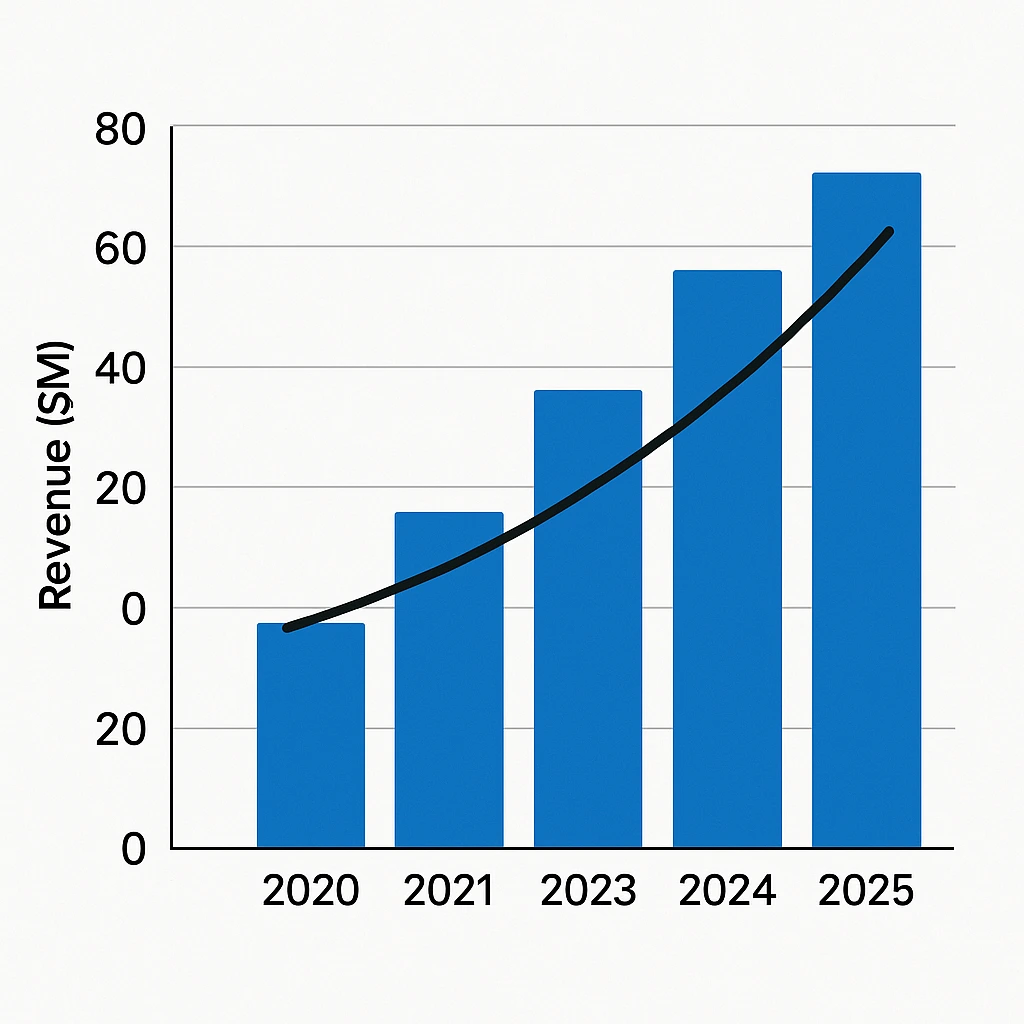
A modern Squarespace clone platform operating in 2025 typically earns between $8M–$60M annually, depending on scale and markets served. The global website builder market crossed $3.8B in 2024, growing at a strong 17% YOY, with North America contributing 42%, Europe 31%, and Asia-Pacific rapidly expanding at 22%.
Profit margins remain strong at 18%–32%, thanks to subscription-led recurring revenue and high retention. Compared to competitors like Wix, Webflow, and Shopify (for eCommerce sites), a Squarespace clone can position itself as a simplified, cost-effective option.
Read More: How Square App Works – Payments, POS & Business Tools
Primary Revenue Streams Deep Dive
Revenue Stream #1: Subscription Plans
This is the core revenue engine for Squarespace clone platforms.
How it works:
Users pay monthly or yearly fees to access website-building tools, hosting, and templates.
Percentage of total revenue: 55%–70%
Common pricing structure:
Basic $10–$15/month
Professional $20–$30/month
E-commerce $29–$55/month
Growth trends:
Subscription revenue grows 12%–20% YOY as creators, small businesses, and freelancers shift to no-code builders.
Example:
A platform with 10,000 paying subscribers at $18 ARPU → $180,000/month.
Revenue Stream #2: E-commerce Fees
How it works:
The platform charges a transaction or commission fee on online store sales.
Percentage of total revenue: 12%–22%
Pricing structure:
2%–4% commission on each sale OR 0% on higher-tier plans
Growth trend:
E-commerce adoption is increasing 19% per year across global SMBs.
Example:
If merchants generate $5M annual GMV, and you charge 2%, that’s $100,000/year.
Revenue Stream #3: Premium Templates & Themes
How it works:
Users buy premium design templates or UI themes.
Percentage of total revenue: 5%–12%
Pricing structure:
$10–$150 one-time fees
Example:
Selling 1,000 templates at $40 = $40,000.
Revenue Stream #4: Add-ons & Integrations
How it works:
Monetization through third-party apps, plugins, marketing tools, and SEO add-ons.
Percentage: 4%–9%
Pricing structure:
$5–$99/month per add-on
OR 20% revenue share with third-party tools
Example:
1,500 users buy an SEO addon at $9 → $13,500/month.
Revenue Stream #5: Domain Sales & Renewals
How it works:
Domains are sold at a margin.
Percentage: 3%–6%
Pricing structure:
Domain registration $12–$20/year
Renewals with markup
Revenue Streams Percentage Breakdown Table
| Revenue Stream | Percentage of Total Revenue |
|---|---|
| Subscriptions | 55%–70% |
| E-commerce Fees | 12%–22% |
| Premium Templates | 5%–12% |
| Add-ons / Plugins | 4%–9% |
| Domains | 3%–6% |
The Fee Structure Explained
User-Side Fees
Service fees: Subscription charges
Premium features: Templates, plugins
E-commerce transaction fees: 2%–4%
Hosting fees included in plans
Upgrades for analytics, SEO, email marketing
Provider-Side Fees
Commission taken from merchants
Domain reseller margins
Third-party app partner fees
Listing fees for premium marketplace tools
Hidden Revenue Tactics
Upsells through limited-site features
Paywalls for advanced customization
Email marketing credit limitations
Storage upgrade fees
Regional Pricing Variations
India, Indonesia, and Brazil follow lower tiers ($4–$12/month)
US & EU remain highest-priced markets ($12–$45/month)
Complete Fee Structure Table (By User Type)
| User Type | Fees |
|---|---|
| Basic website creators | $10–$15/month |
| Business users | $20–$30/month |
| E-commerce merchants | $29–$55/month + 2%–4% fee |
| Domain buyers | $12–$20/year |
| Add-on purchasers | $5–$99/month |
How a Squarespace Clone Maximizes Revenue Per User
User segmentation:
Beginners, freelancers, SMB owners, e-commerce sellers.
Upselling techniques:
Push users from basic → business → e-commerce plans.
Cross-selling:
Domains, email tools, marketing add-ons.
Dynamic pricing:
AI-based plan recommendations
Time-limited discounts to convert trials
Retention monetization:
Annual plan discounts
Free migration support
Feature-based lock-ins
Lifetime value optimization:
Higher ARPU through plugin ecosystem
Long-term brand-building tools
Psychological pricing tricks:
Decoy pricing
$29 over $30
“Most popular” tier highlighting
Example:
Upgrading 25% of users from $15 → $30 doubles per-user revenue instantly.
Cost Structure & Profit Margins
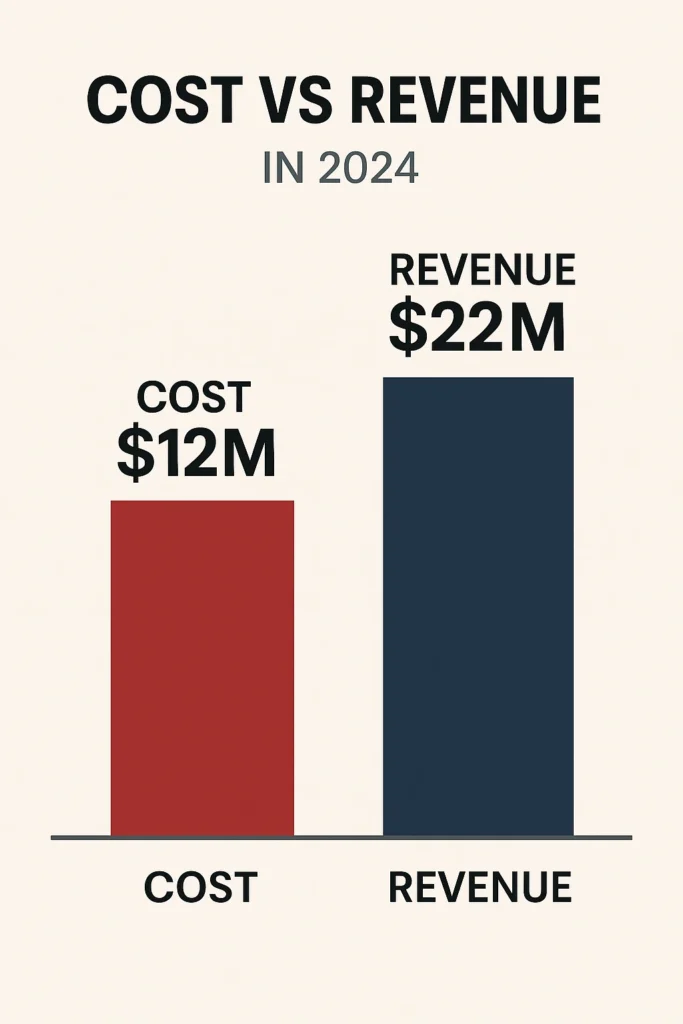
Major cost categories:
Technology infrastructure (servers, bandwidth, CDN)
Marketing / CAC (ads, influencers, SEO)
Support & operations
R&D (templates, AI tools, integrations)
Unit economics:
Average CAC: $17–$40
Average ARPU: $16–$28
Payback period: 2–3 months
Path to profitability:
Subscription retention offsets CAC
Templates and add-ons increase margins
E-commerce fees become passive income
Margin improvement strategies:
AI automation for design
Marketplace revenue share
Aggressive upselling
Read More: Best Squarespace Clone Script 2025 | Build a No-Code Web Builder
Future Revenue Opportunities & Innovations
New revenue streams testing in 2025:
AI website generator fees
AI branding tools
Marketing automation
CRM + invoices + SMS tools
AI/ML monetization potential:
Autonomous landing page creation
Automatic SEO optimization
AI product descriptions
Dynamic personalization
Expansion markets:
Latin America and Southeast Asia growing at 20%+ annually
Emerging features to monetize:
Customer portals
Advanced membership tools
AI-driven e-commerce personalization
Threats:
Rising competition from WordPress builders
AI-first website generators
Price-sensitive markets
Why this creates opportunities for new players:
Users want simpler, cheaper, faster alternatives to expensive website tools.
Lessons for Entrepreneurs & Your Opportunity
Key takeaways:
Recurring subscription revenue ensures stability
Template marketplaces increase passive income
E-commerce commissions add exponential revenue
Add-ons multiply ARPU
Market gaps to exploit:
Cheaper plans for India, Africa
AI-first builder focused on speed
Affordable templates marketplace
Revenue model innovations:
AI bundles
Usage-based pricing
Tiered commission models
Want to build a platform with Squarespace’s proven revenue model? Miracuves helps entrepreneurs launch revenue-generating platforms with built-in monetization features. Our Squarespace clone scripts come with flexible revenue models you can customize. In fact, some clients see revenue within 30 days of launch. Get a free consultation to map out your revenue strategy.
Final Thought
A Squarespace clone can become a powerful recurring-revenue business if structured with the right monetization layers, pricing strategy, and scalable features. The success of modern website builders proves that entrepreneurs don’t need massive engineering teams or huge marketing budgets to build a profitable SaaS platform—what they need is a clear revenue architecture, predictable value delivery, and features that truly help users grow.
In 2025 and beyond, the opportunity is even larger. More businesses are shifting online, creators want personal portfolios, freelancers need client-ready sites, and small retailers want simple e-commerce stores without technical headaches. A well-designed Squarespace-like platform can position itself precisely at the center of this demand—offering speed, affordability, and automation.
FAQs
1. How much does a Squarespace clone make per transaction?
Typically 2%–4% commission on e-commerce transactions.
2. What’s the most profitable revenue stream?
Subscriptions, contributing up to 70% of total revenue.
3. How does its pricing compare to competitors?
It is more affordable than Shopify and Webflow, while staying similar to Wix — and with Miracuves, you can build a comparable platform starting at just $2899.
4. What percentage does a Squarespace clone take from providers?
Usually 2% on basic e-commerce plans; 0% on premium tiers.
5. How has the revenue model evolved?
Shift from templates to subscription bundles and AI monetization.
6. Can small platforms use similar models?
Yes, even small-scale builders can profit using subscriptions and templates.
7. What’s the minimum scale for profitability?
Around 1,500–2,000 paying users.
8. How to implement similar revenue models?
Adopt subscription tiers, templates marketplace, and add-on upsells.
9. What are alternatives to this model?
Marketplace commissions, ads, freemium models, SaaS usage-based billing.
10. How quickly can similar platforms monetize?
With the right model and automations, traditional platforms take 30–45 days — but with Miracuves, monetization can begin in just 3–9 days.