


You’ve heard the horror stories about data breaches, leaked user profiles, and apps getting banned overnight due to compliance issues. And if you’re planning to launch a white-label Thrillz app, the fear is valid.
In 2026, app security matters more than ever because:
- User data laws are stricter worldwide
- Payment and identity fraud are rising
- Platforms are being targeted by automated attacks
- Customers expect enterprise-grade privacy by default
This guide gives you an honest safety assessment of Thrillz-style platforms, the real risks, and exactly what security standards your app must meet.
When done right, a white-label Thrillz app can be secure, compliant, and scalable. But only if the provider builds it with security-first architecture.
Understanding White-Label Thrillz App Security Landscape
What “white-label security” actually means
White-label security refers to how well the underlying app platform is protected, regardless of branding. It covers data storage, user access, payments, APIs, encryption, monitoring, and compliance.
Why people worry about white-label apps
People fear outsourced development, lack of transparency, outdated tech, and weak compliance documentation.
Current threat landscape for Thrillz-style platforms
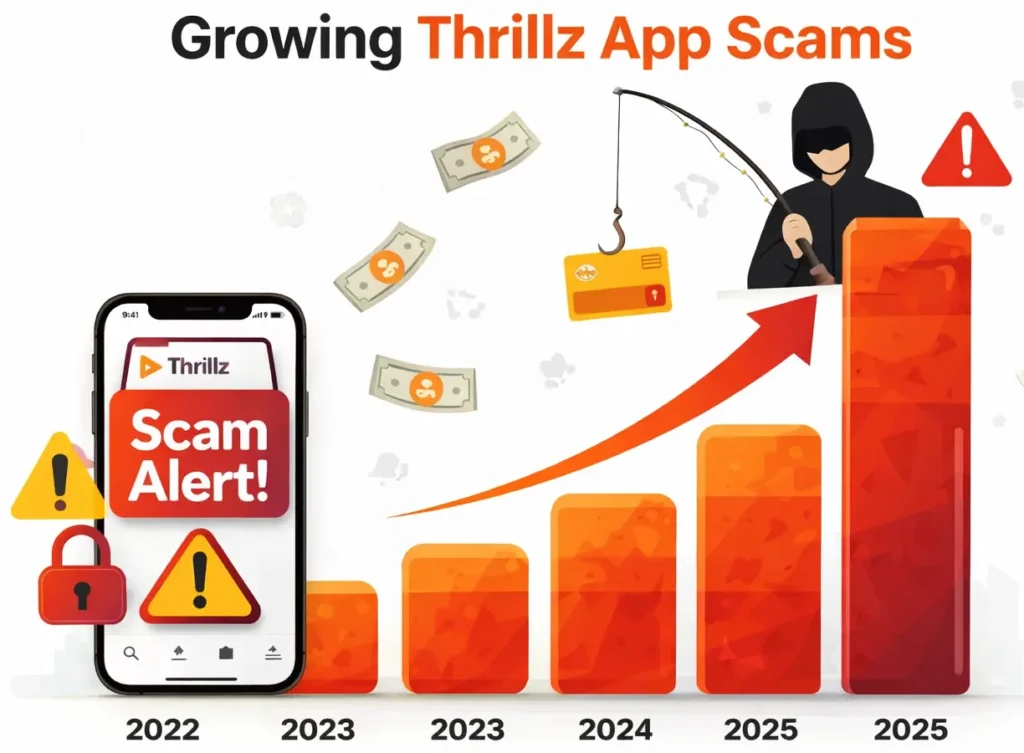
Thrillz apps typically handle user profiles, geolocation, chats, and payments — all of which are high-value targets for attackers. In 2025, identity theft and API attacks increased year over year across app ecosystems.
Security standards in 2026
Strong app security now requires strict compliance with global regulations (GDPR, CCPA), encrypted data in transit and at rest, secure authentication, and regular audits.
Real-world statistics on app security incidents
Recent reports show that nearly 50% of data breaches come from vulnerable APIs and improper encryption, not lack of features.
Key Security Risks & How to Identify Them
Data Protection & Privacy (Highest Risk Area)
A white-label Thrillz app typically collects and processes sensitive user data. This is where most real-world breaches happen.
User personal information
If your app stores names, phone numbers, emails, profile photos, or IDs, it becomes a direct target for account takeover and identity fraud.
Payment data security
If payments are involved, weak handling of card data can trigger major legal and financial consequences. This is why PCI DSS compliance is critical.
Location tracking concerns
Thrillz-style apps often use real-time location. If location data is exposed, it becomes a serious privacy and personal safety risk.
GDPR/CCPA compliance
If your app has users in the EU, UK, or California, you must manage:
- Consent tracking
- Data deletion requests
- Data access requests
- Breach notification rules
Technical Vulnerabilities (Where most providers fail)
Even if an app looks polished, the backend may be weak.
Code quality issues
Poor code increases the risk of:
- Data leaks
- Authentication bypass
- Hidden vulnerabilities
Server security gaps
Unsafe infrastructure can lead to:
- Database exposure
- Misconfigured cloud storage
- Unauthorized admin access
API vulnerabilities
APIs are the most common attack point in modern apps. Typical API failures include:
- No rate limiting
- Weak authentication
- Broken authorization
- Exposed endpoints
Third-party integrations
Many Thrillz-style apps rely on:
- Payment gateways
- SMS OTP providers
- Analytics tools
- Push
Read more : – Business Model of Thrillz : Complete Strategy Breakdown 2025
Security Standards Your White-Label Thrillz App Must Meet
Essential Certifications
These are the core compliance standards a serious white-label Thrillz app provider should support in 2026.
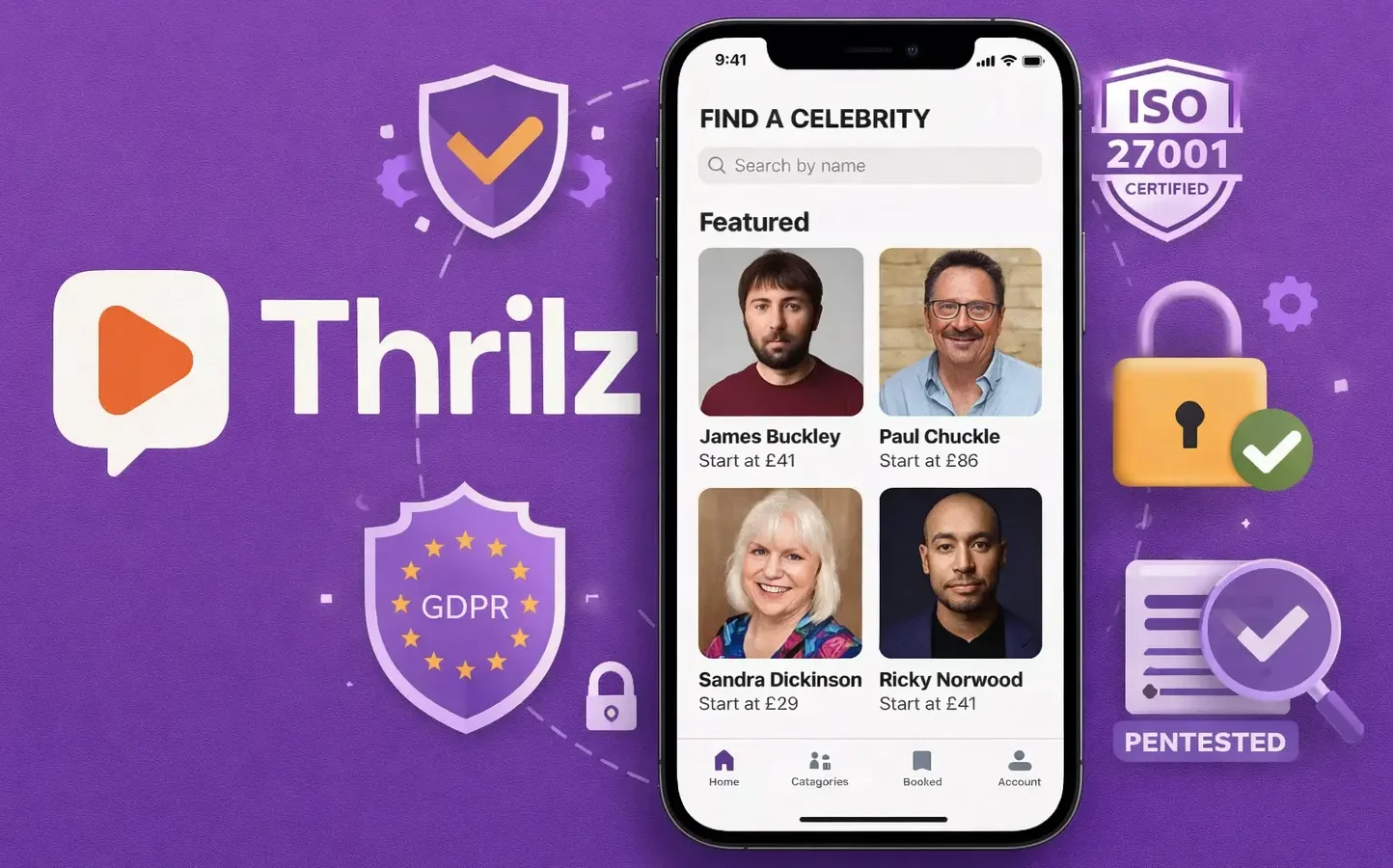
ISO 27001 compliance
Proves the provider follows a formal Information Security Management System (ISMS), including policies, risk controls, audits, and incident handling.
SOC 2 Type II
Shows the provider has been independently audited for security controls over time (not just a one-time check).
GDPR compliance
Mandatory if you serve EU/UK users. It covers:
- lawful data processing
- consent management
- breach reporting
- user rights (delete/export data)
HIPAA (if applicable)
Only required if your Thrillz app stores health-related data. Most platforms don’t need this, but some wellness or medical-style variants might.
PCI DSS for payments
Mandatory if your app processes card payments directly. Even if you use Stripe or similar, you must ensure secure handling of payment flows.
Technical Requirements
These are non-negotiable for a safe white-label Thrillz app.
End-to-end encryption
Sensitive communications and private user data must be encrypted.
Secure authentication (2FA/OAuth)
A secure app must support:
- OTP login
- 2FA for admins
- OAuth where relevant
- session expiration and refresh tokens
Regular security audits
Audits must be scheduled, documented, and repeatable.
Penetration testing
A provider should perform real pentests before launch and regularly after.
SSL certificates
Every domain and API endpoint must use HTTPS with valid TLS certificates.
Secure API design
APIs should include:
- token-based authentication
- role-based access control
- rate limiting
- input validation
- logging and monitoring
Security Standards Comparison Table
| Standard | Required For | What It Protects | Must-Have For Thrillz App |
|---|---|---|---|
| ISO 27001 | Security management | Policies, governance, risk controls | Strongly recommended |
| SOC 2 Type II | Enterprise trust | Ongoing security control audits | Highly recommended |
| GDPR | EU/UK users | Privacy, consent, breach reporting | Mandatory if EU/UK |
| CCPA/CPRA | California users | Consumer data rights | Mandatory if US scale |
| PCI DSS | Payments | Cardholder data security | Mandatory if payments |
Red Flags: How to Spot Unsafe White-Label Providers
Warning Signs
These are the biggest signs a white-label Thrillz app provider may be unsafe.
No security documentation
If they can’t share security policies, architecture details, or compliance documents, it’s a major risk.
Cheap pricing without explanation
Ultra-low pricing often means:
- reused insecure code
- no audits
- no monitoring
- no long-term patching
No compliance certifications
A provider claiming “we are secure” without proof is not reliable in 2026.
Outdated technology stack
Old frameworks and unpatched servers create easy attack paths.
Poor code quality
Signs include slow performance, unstable admin panels, and frequent bugs.
No security updates policy
If the provider doesn’t offer ongoing security updates, your app becomes vulnerable over time.
Lack of data backup systems
No backups means one incident can permanently destroy your business.
No insurance coverage
Professional providers often have cyber liability coverage. Unsafe ones usually don’t.
Evaluation Checklist (What to Ask Before Buying)
Questions to ask providers
- Do you follow ISO 27001 or SOC 2 practices?
- How often do you run penetration testing?
- Do you provide security patches after launch?
- Where is data stored and in which region?
- How do you handle breach reporting?
Documents to request
- security policy overview
- penetration testing summary
- GDPR compliance documentation
- data retention and deletion policy
- incident response plan
Testing procedures
- API security testing
- admin panel access testing
- role-based access testing
- payment flow validation
Due diligence steps
- verify past client history
- review uptime and incident records
- ask about third-party dependencies
- confirm backup and recovery process
Best Practices for Secure White-Label Thrillz App Implementation
Pre-Launch Security (Before You Go Live)
This is where most businesses either get secure, or get exposed later.
Security audit process
Run a complete audit covering:
- mobile apps
- admin panel
- APIs
- database and storage
- cloud infrastructure
Code review requirements
A secure provider should ensure:
- no hardcoded keys
- secure authentication flow
- safe input handling
- protected admin endpoints
Infrastructure hardening
Your app must use:
- firewall rules
- private database access
- secure server roles
- restricted admin access by IP
Compliance verification
Confirm GDPR/CCPA readiness including:
- consent logging
- user data export
- user data deletion
- privacy policy alignment
Staff training programs
Even strong apps fail due to human mistakes. Admins should be trained for:
- phishing awareness
- safe password policies
- access management
Post-Launch Monitoring (Security is Continuous)
Launching is not the finish line. It is the start of real risk.
Continuous security monitoring
A secure app should have:
- login anomaly detection
- API abuse detection
- server intrusion alerts
- database activity logs
Regular updates and patches
Security patches must be deployed monthly (or faster if a major issue appears).
Incident response planning
You need a plan for:
- breach containment
- user notification
- regulator reporting
- system recovery
User data management
Implement:
- access controls
- data retention rules
- safe deletion workflows
Backup and recovery systems
Backups must be:
- automated
- encrypted
- tested regularly
- stored in separate locations
Security Implementation Timeline
| Phase | Timeline | What Must Be Done |
|---|---|---|
| Planning | Week 1 | compliance and risk requirements |
| Pre-launch hardening | Week 2–3 | audits, code review, infra security |
| Testing | Week 3–4 | pentesting, API security, admin security |
| Launch | Week 5 | monitoring + logging enabled |
| Post-launch | Ongoing | patching, audits, incident drills |
Legal & Compliance Considerations
Regulatory Requirements
A white-label Thrillz app is legally responsible for how it handles user data, even if the provider built the platform.
Data protection laws by region
- EU/UK: GDPR
- USA (California): CCPA / CPRA
- Canada: PIPEDA
- India: DPDP Act (Digital Personal Data Protection)
- UAE/Saudi: local privacy and cyber laws (increasing enforcement)
Industry-specific regulations
If your Thrillz app includes payments, identity verification, or adult content, extra legal checks may apply depending on region.
User consent management
Your app must support:
- clear consent before tracking
- opt-out options
- transparent data usage disclosures
Privacy policy requirements
A valid privacy policy must clearly state:
- what data you collect
- why you collect it
- who you share it with
- how long you store it
- how users can delete data
Terms of service essentials
Your terms must include:
- platform rules
- prohibited behavior
- payment and refund rules
- user responsibility clauses
- dispute resolution
Liability Protection
Even with a secure provider, the business owner is usually the first target in lawsuits.
Insurance requirements
Recommended insurance in 2026:
- cyber liability insurance
- professional indemnity insurance
- general business liability coverage
Legal disclaimers
Your app must clearly disclaim:
- user-generated content responsibility
- third-party service dependency
- service availability limitations
User agreements
Strong user agreements reduce legal exposure for:
- fraud disputes
- misuse complaints
- identity theft claims
Incident reporting protocols
You must define:
- who investigates
- how fast you respond
- when regulators must be notified
- how users are informed
Regulatory compliance monitoring
Compliance is not “one-time.” Laws change, and your app must adapt.
Compliance Checklist by Region
| Region | Key Law | Main Requirement |
|---|---|---|
| EU/UK | GDPR | consent, deletion, breach reporting |
| California | CCPA/CPRA | opt-out, disclosure, deletion rights |
| India | DPDP Act | consent + lawful processing |
| Canada | PIPEDA | transparency + data safeguards |
| Middle East | local laws | storage rules + cyber compliance |
Why Miracuves White-Label Thrillz App is Your Safest Choice
Miracuves Security Advantages
Most white-label app failures happen because security is treated as an add-on. Miracuves positions security as the foundation of the platform.
Enterprise-grade security architecture
Miracuves white-label Thrillz apps are built with modern security architecture that supports:
- secure backend design
- protected APIs
- hardened infrastructure
- role-based admin access
Regular security audits and certifications
Miracuves follows audit-ready security practices so businesses can scale toward ISO 27001 and SOC 2 expectations.
GDPR/CCPA compliant by default
Miracuves focuses on privacy-first implementation including:
- consent workflows
- deletion/export handling
- secure data retention policies
24/7 security monitoring
A secure Thrillz app must detect threats in real time. Miracuves includes continuous monitoring support for critical systems.
Encrypted data transmission
All app-to-server communication is secured through TLS/SSL with secure encryption standards.
Secure payment processing
Miracuves supports PCI DSS-aligned payment integrations using secure gateway-based payment flows.
Regular security updates
Miracuves provides structured security patching and upgrade support to prevent apps from becoming outdated and vulnerable.
Insurance coverage included
A major difference between unsafe providers and professional providers is risk coverage
Final Thought
A white-label Thrillz app can be safe in 2026, but only if security is treated as a business requirement, not a feature.
If you choose a provider that ignores compliance, skips audits, or avoids transparency, you are not just buying an app. You are buying long-term legal and financial risk.
Miracuves builds white-label Thrillz apps with security-first architecture, privacy compliance readiness, and ongoing protection, so you can launch confidently and scale without fear.
FAQs
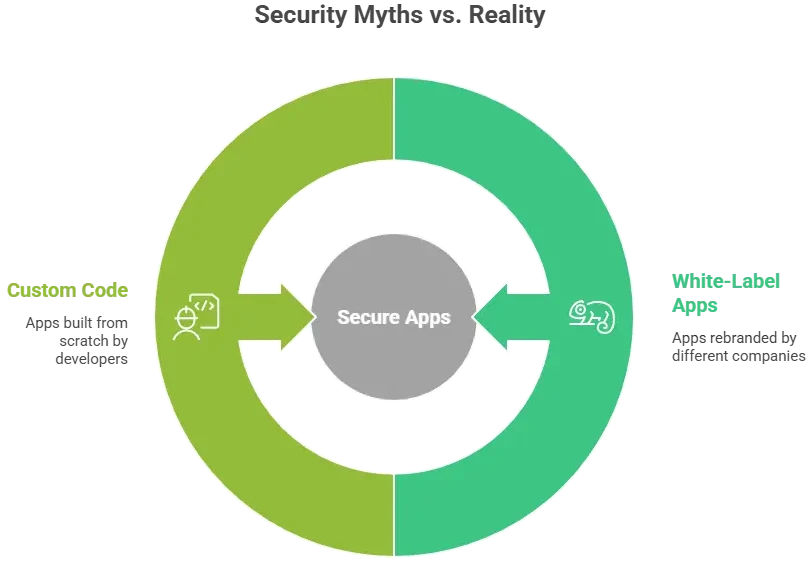
1. How secure is white-label vs custom development?
White-label Thrillz apps can be as secure as custom apps if audits, standards, and regular updates are followed.
2. What happens if there’s a security breach?
A breach can cause legal reporting, penalties, downtime, and trust loss. The business owner is usually legally responsible.
3. Who is responsible for security updates?
The provider handles platform patches, while the business owner manages admin access and operational security.
4. How is user data protected in white-label apps?
Through TLS/SSL encryption, encrypted storage, access controls, secure APIs, and database protection.
5. What compliance certifications should I look for?
ISO 27001, SOC 2 Type II, GDPR, CCPA/CPRA, and PCI DSS (for payments).
6. Can white-label apps meet enterprise security standards?
Yes, if built with secure infrastructure, monitoring, and regular security testing.
7. How often should security audits be conducted?
Before launch, quarterly scans, yearly pentesting, and after major updates.
8. What’s included in Miracuves security package?
Secure architecture, encryption, compliance setup, monitoring, and security updates.
9. How to handle security in different countries?
Follow GDPR-level privacy as a base, then adjust for regional laws.
10. What insurance is needed for app security?
Cyber liability, professional indemnity, and general business liability.
Related Articles