


Tinkoff has grown into one of the most successful digital-only banking ecosystems, generating an estimated $5 billion+ in revenue in 2025 while serving 40+ million customers.
Unlike traditional banks with branches, Tinkoff built a fully digital financial ecosystem that combines banking, investments, payments, insurance, and lifestyle services inside one app.
For founders and fintech operators, Tinkoff is a powerful example of how a single product—credit cards—can evolve into a multi-product financial super app.
Tinkoff Revenue Overview – The Big Picture
Tinkoff began as a credit card company in Russia but has evolved into a full digital banking ecosystem offering multiple financial services.
Its strategy centers around:
- digital banking infrastructure
- AI-driven financial products
- high-margin lending
- cross-selling financial services
Key Financial Snapshot
| Metric | Latest Data |
|---|---|
| Latest Revenue | ~$5B+ (2025 estimate) |
| Customers | 40M+ |
| Primary Market | Russia |
| Core Business | Digital banking & fintech |
| Estimated Net Profit | ~$1B+ |
| Business Model | Digital-only banking ecosystem |
Tinkoff achieved strong profitability by avoiding expensive branch networks and focusing on mobile-first banking.
Read More: What Is Tinkoff? A Digital-First Banking Platform Explained
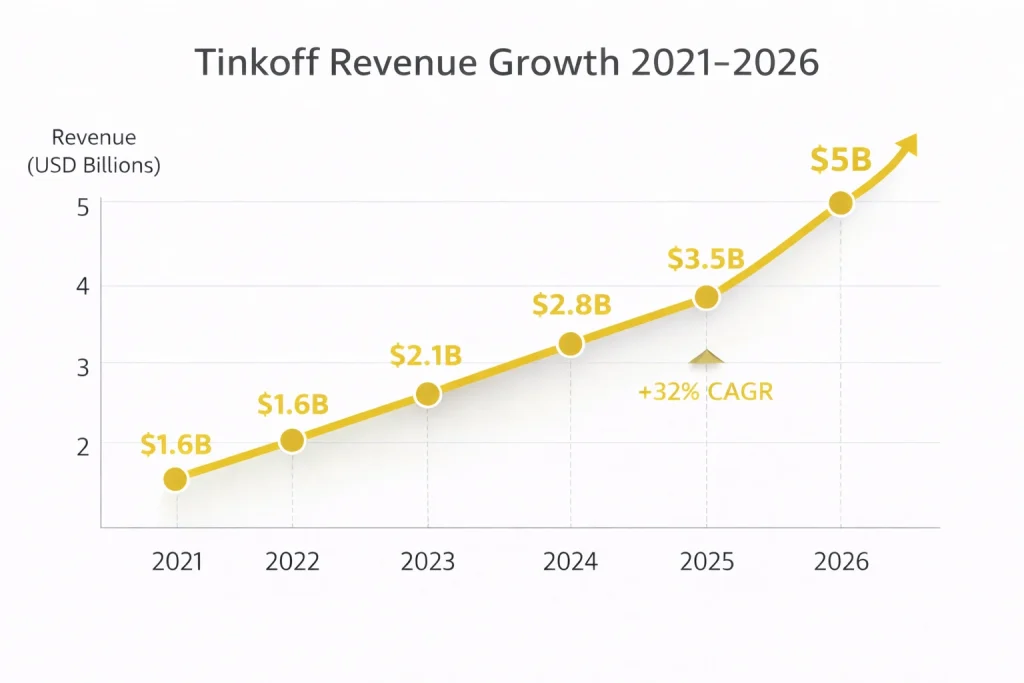
Primary Revenue Streams Deep Dive
Tinkoff earns money through multiple financial services layered inside its fintech ecosystem
Revenue Stream #1: Lending Interest
Lending is the largest revenue driver.
The bank offers:
- credit cards
- personal loans
- installment financing
- small business loans
Customers who carry balances generate interest income, which represents the majority of revenue.
Estimated contribution: 55–65%
Pricing model:
- interest rates on credit products
- installment financing fees
Revenue Stream #2: Interchange Fees
Whenever a Tinkoff debit or credit card is used, merchants pay transaction fees.
Tinkoff receives a share through the card network.
Estimated contribution: 15–20%
Pricing model:
- small percentage per transaction
Because Tinkoff has millions of active card users, these small fees scale significantly.
Revenue Stream #3: Brokerage & Investment Services
Tinkoff operates a large investment platform.
Users can trade:
- stocks
- ETFs
- bonds
- derivatives
The company earns revenue through:
- trading commissions
- margin lending
- brokerage service fees
Estimated revenue share: 10–15%
Revenue Stream #4: Insurance Products
The platform offers several insurance products including:
- travel insurance
- health insurance
- auto insurance
Tinkoff earns revenue through insurance commissions and partnerships with insurers.
Estimated contribution: 5–8%
Revenue Stream #5: Subscription Services
Tinkoff introduced premium subscriptions like Tinkoff Pro.
These subscriptions offer benefits such as:
- cashback boosts
- investment discounts
- better exchange rates
Estimated revenue share: 5–10%
Revenue Streams Breakdown (Latest Available Data)
| Revenue Stream | Description | Estimated Revenue Share | Pricing Model |
|---|---|---|---|
| Lending Interest | Credit cards and loans | 55–65% | Interest on balances |
| Interchange Fees | Card transaction fees | 15–20% | % per transaction |
| Investment Services | Brokerage and trading services | 10–15% | Trading commissions |
| Insurance Products | Insurance sales and commissions | 5–8% | Commission-based |
| Subscriptions | Premium banking services | 5–10% | Monthly subscription |
The Fee Structure Explained
Although many services appear low-cost to customers, Tinkoff monetizes across several financial layers.
Platform Fee Structure (Latest Available Data)
| User Type | Fee Type | Typical Fee Range | Notes |
|---|---|---|---|
| Credit Card Users | Interest rates | 20–35% APR | Major revenue driver |
| Merchants | Interchange fees | ~1–3% | Per card transaction |
| Investors | Trading commissions | 0–0.3% | Per trade |
| Premium Users | Subscription fees | $5–10/month | Extra financial benefits |
| Insurance Buyers | Insurance commissions | 10–20% | Paid by insurers |
How Tinkoff Maximizes Revenue Per User
Tinkoff’s biggest advantage is multi-product monetization.
1. Financial Super App Strategy
The Tinkoff app combines:
- banking
- investments
- insurance
- lifestyle services
This increases user engagement and spending.
2. AI-Based Credit Scoring
Tinkoff uses machine learning to:
- predict customer credit risk
- optimize interest rates
- personalize loan offers
This increases lending revenue while reducing defaults.
3. Cross-Selling Financial Products
A user may start with:
- a debit card
Then later adopt:
- loans
- brokerage accounts
- insurance
Each additional service increases lifetime value.
4. Cashback & Reward Ecosystem
The bank uses cashback incentives to increase:
- card spending
- transaction volume
- interchange revenue.
Cost Structure & Profit Margins
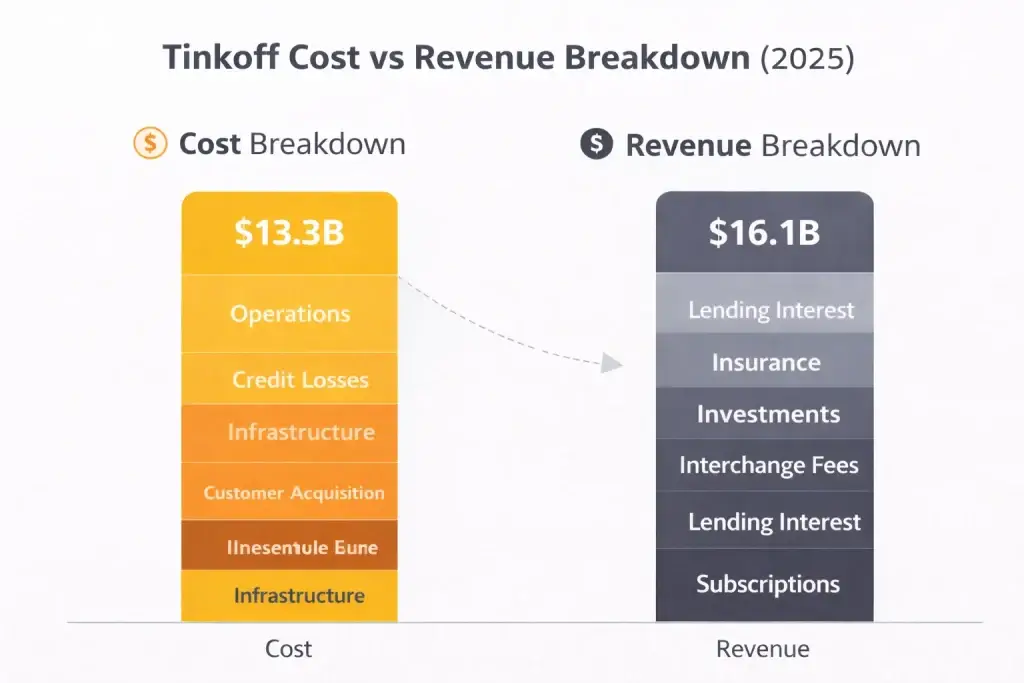
Operating a digital bank still involves several cost layers.
Major Cost Categories
Technology infrastructure
- banking systems
- cloud infrastructure
- payment processing
Customer acquisition
- marketing campaigns
- referral programs
Credit risk
- loan defaults
- risk provisions
Operations
- customer support
- regulatory compliance
Typical Cost Structure
| Cost Category | Description |
|---|---|
| Infrastructure | Banking platform and technology |
| Customer Acquisition | Marketing and user acquisition |
| Credit Losses | Loan default risk |
| Operations | Support and compliance |
| R&D | AI, product development |
Because Tinkoff has no physical branches, operating costs are significantly lower than traditional banks.
Read More: Best Tinkoff Clone Script 2026 | AI-Powered Digital Banking App
Future Revenue Opportunities (2026–2028 Outlook)
Several opportunities exist for future growth.
1. Expansion of Investment Products
Investment services could grow rapidly as retail investing increases.
2. AI-Powered Financial Services
AI can enable:
- automated financial planning
- personalized credit offers
- smarter fraud detection.
3. SME Banking
Small business financial services represent a massive opportunity.
Potential services include:
- business loans
- payroll management
- merchant financing.
4. Embedded Finance
Tinkoff could expand into embedded finance solutions for other platforms.
Lessons for Entrepreneurs
Tinkoff provides valuable lessons for fintech founders.
1. Start With a Strong Core Product
Tinkoff began with credit cards, then expanded into a full fintech ecosystem.
2. Build a Financial Ecosystem
Multiple financial services increase revenue per user.
3. Use Data as a Competitive Advantage
AI-driven credit scoring improved lending profitability.
4. Digital Infrastructure Reduces Cost
Branchless banking dramatically lowers operating costs.
Final Thought
Tinkoff proves that the future of banking belongs to digital-first financial ecosystems.
The real competitive advantage lies not in individual products but in integrating multiple financial services into a single platform.
What makes Tinkoff particularly powerful is its super-app strategy. Instead of offering isolated banking tools, the platform connects credit cards, investments, insurance, payments, and lifestyle services within one unified ecosystem. This approach increases user engagement and encourages customers to manage most of their financial activities in a single app.
Another key factor behind Tinkoff’s success is its data-driven infrastructure. By leveraging advanced analytics and machine learning, the company can personalize financial offers, optimize credit risk, and deliver tailored services to millions of users. This allows the bank to scale efficiently while maintaining strong lending performance.
FAQs
1. How much does Tinkoff make per transaction?
Tinkoff typically earns 1–3% per card transaction through interchange fees.
2. What is the most profitable revenue stream for Tinkoff?
Interest income from lending and credit cards generates the largest share of revenue.
3. How does Tinkoff’s pricing compare to competitors?
Tinkoff often offers competitive pricing while monetizing through lending and financial services.
4. What percentage does Tinkoff take from providers?
Insurance partners usually pay 10–20% commissions for product distribution.
5. How has Tinkoff’s revenue model evolved?
It started with credit cards, then expanded into investments, insurance, subscriptions, and banking services.
6. Can small startups use a similar model?
Yes, fintech startups can start with a single financial product and expand into multiple services.
7. What scale is needed for profitability?
Digital banking usually requires millions of users to reach profitability.
8. How can founders implement a similar model?
Start with:
a strong financial product
scalable digital infrastructure
cross-selling financial services.
9. What alternatives exist to this revenue model today?
Alternative fintech models include:
payment processing platforms
banking-as-a-service platforms
embedded finance ecosystems
subscription-based fintech apps.
Miracuves is an independent software development company. We are not affiliated with, connected to, sponsored by, or endorsed by any company or product named in this article.
Terms such as “X Clone” are used descriptively. It is how the software industry refers to building a platform with functionality comparable to a known service, and how clients search for it.
The entire design and codebase of our products is built by our own team. Our products contain no code, design, graphics, or content originating from any third-party website or applications.
All third-party names and marks referenced in this article are the property of their respective owners, referenced solely to identify the services discussed.