



You’ve heard the horror stories about real estate apps leaking personal data — buyers’ details exposed, financial info stolen, and fake listings flooding the market. In a time when your users trust your app with their personal and property details, security isn’t optional — it’s everything.
As the real estate industry rapidly digitizes, white-label Trulia apps are helping companies launch property platforms fast and at scale. But with speed comes the question every business owner asks: “Is it really safe?”
In 2025, app safety has become more than just technical — it’s about trust, compliance, and data integrity. With rising cybersecurity threats, stricter privacy laws, and AI-driven scams, understanding your white-label Trulia app’s security posture is essential.
This article gives you an honest, practical assessment of how secure white-label Trulia apps truly are, what risks to watch for, and how Miracuves ensures enterprise-grade protection for your business and your users.
Understanding white-label Trulia app security landscape
When businesses hear “white-label security,” they often assume it’s just about data encryption or user authentication. In reality, it goes far deeper — it’s the entire framework that protects users, data, servers, and transactions within the white-label Trulia app environment.
Many misconceptions still circulate. Some believe white-label apps are inherently insecure because they’re pre-built; others assume buying from a reputable vendor guarantees safety. The truth lies somewhere in between — security depends on architecture, compliance, and ongoing management, not merely on who built it.
Why people worry about white-label apps
The biggest concern comes from a perceived loss of control. Since the app isn’t coded from scratch, founders fear there might be hidden vulnerabilities, reused components, or outdated modules that can be exploited. With real estate apps handling sensitive data — location info, user identity, payment details — these fears are justified.
The current threat landscape
In 2025, cyberattacks on property platforms have increased by more than 40%. According to the Ponemon Institute, real estate apps are among the top five targets for phishing and identity theft. Cloud misconfigurations, insecure APIs, and unencrypted storage continue to drive data breaches.
Security standards in 2025
Modern regulations such as GDPR, CCPA, and ISO 27001 compliance are now baseline expectations. Businesses must also align with secure development practices (OWASP Top 10), regular vulnerability scans, and continuous compliance monitoring.
The bottom line? A white-label Trulia app can be just as secure — or even more secure — than a custom-built one, but only if it’s backed by the right provider and security standards.
Key security risks & how to identify them
Every white-label Trulia app operates in an ecosystem where personal, financial, and property data flow constantly between users, servers, and third-party services. Each of these layers introduces potential vulnerabilities — and identifying them early is critical to maintaining user trust and regulatory compliance.
Data protection & privacy risks
User personal information — such as names, phone numbers, and property preferences — can be targeted if the database lacks encryption or access control. Payment details for premium listings or subscription plans must comply with PCI DSS standards to avoid exposure. Real estate platforms also handle location data, which, if misused or leaked, could endanger users’ privacy. Ensuring GDPR and CCPA compliance is non-negotiable for apps with global reach.
Technical vulnerabilities
Some white-label apps may suffer from code quality issues, especially if reused modules or outdated frameworks are involved. Server misconfigurations, weak admin passwords, or lack of SSL certificates can lead to unauthorized access. Insecure APIs — often used to connect to listing feeds or payment gateways — are another high-risk zone. Similarly, unvetted third-party integrations (like map or analytics plugins) can expose sensitive user data.
Business risks
Security lapses don’t just harm users — they damage your reputation and finances. A breach can lead to legal liability, reputation loss, financial penalties, and even temporary suspension of your app in marketplaces. Non-compliance with privacy laws could result in multi-million-dollar fines, as seen in multiple 2024 data-violation cases in Europe and the US.
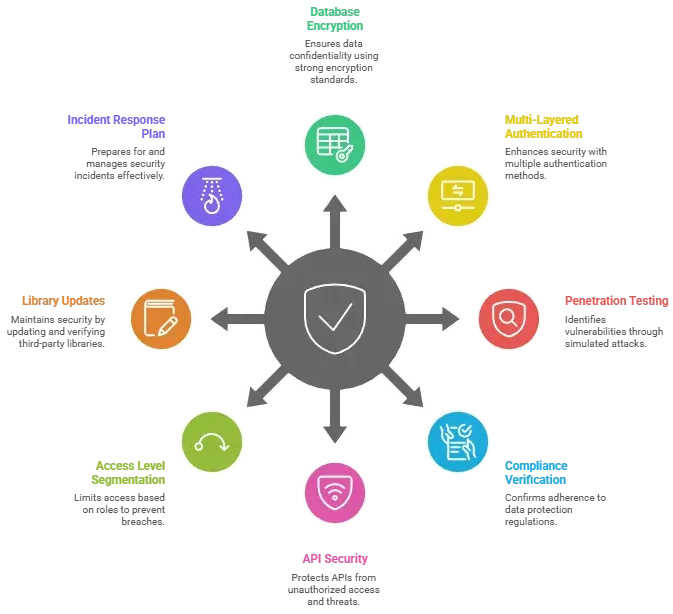
Risk assessment checklist
- Are databases encrypted (AES-256 or equivalent)?
- Is user authentication multi-layered (2FA/OAuth)?
- Are regular penetration tests conducted?
- Is GDPR/CCPA compliance verified annually?
- Are APIs secured and monitored?
- Are employee access levels properly segmented?
- Are third-party libraries updated and verified?
- Is there a clear incident-response plan?
Identifying and mitigating these risks early ensures that your white-label Trulia app operates in a secure, compliant, and user-trusted environment.
Read more : – Top Trulia Features Every Real Estate App Needs
Security standards your white-label Trulia app must meet
Building user trust starts with compliance. A secure white-label Trulia app must adhere to internationally recognized standards and implement strong technical safeguards to protect sensitive data and ensure platform integrity.
Essential certifications
- ISO 27001 compliance: Ensures your app provider follows structured, risk-based information security management practices.
- SOC 2 Type II: Verifies that controls for security, availability, and data integrity are audited and operational over time.
- GDPR compliance: Mandatory for handling European users’ data, emphasizing consent, transparency, and the right to erasure.
- HIPAA (if applicable): Relevant for real estate apps integrated with health or housing benefit systems.
- PCI DSS: Required for apps that process or store payment information, ensuring encrypted, tokenized transactions.
Technical requirements
To maintain continuous protection, your app must integrate:
- End-to-end data encryption for both stored and transmitted information
- Secure authentication methods like 2FA or OAuth 2.0
- Scheduled security audits and vulnerability assessments
- Penetration testing at least once a year
- Valid SSL/TLS certificates for all communication channels
- Secure API design with token-based access and rate limiting
Security standards comparison table
| Security Standard | Purpose | Required For | Renewal Frequency |
|---|---|---|---|
| ISO 27001 | Comprehensive data protection | All white-label apps | Every 3 years |
| SOC 2 Type II | Continuous monitoring & trust verification | Enterprise clients | Annual audit |
| GDPR | Data privacy and user consent | EU/Global users | Continuous |
| PCI DSS | Payment data protection | Apps with payment modules | Annual |
| HIPAA | Healthcare data protection | Sector-specific integrations | Annual |
These standards collectively form the backbone of a secure white-label Trulia app — preventing data leaks, ensuring compliance, and reinforcing brand credibility.
Read more : – Top 5 Mistakes Startups Make When Building a Trulia Clone
Red flags – how to spot unsafe white-label providers
Not all white-label app providers maintain the same level of diligence when it comes to security. Choosing the wrong partner can expose your business to hidden vulnerabilities, compliance risks, and data breaches. Here’s how to recognize unsafe providers before signing a deal.
Evaluation checklist
- Ask for documentation of encryption protocols and compliance certificates.
- Request a recent third-party security audit report.
- Verify that the provider performs regular penetration testing.
- Check if their infrastructure uses AWS, Google Cloud, or another secure hosting platform.
- Confirm there’s a defined data backup and disaster recovery process.
- Review update frequency and patch management policies.
- Ask about cybersecurity insurance and liability coverage.
- Test demo access using a dummy account to assess performance and safety.
Doing this due diligence before onboarding a white-label partner can save you from massive security, financial, and reputational damage down the road.
Best practices for secure white-label Trulia app implementation
Even the most secure codebase can become vulnerable if implementation and maintenance aren’t handled properly. Following structured best practices ensures your white-label Trulia app stays compliant, resilient, and trustworthy throughout its lifecycle.
Pre-launch security
- Conduct a full security audit: Review app architecture, APIs, and data flow diagrams before deployment. External audits by certified firms help uncover unseen risks.
- Perform code reviews: Enforce strict peer review protocols to ensure no insecure libraries or hardcoded credentials are left behind.
- Harden infrastructure: Configure firewalls, intrusion detection systems, and DDoS protection on hosting environments.
- Verify compliance: Align your app with ISO 27001, SOC 2 Type II, and GDPR before going live.
- Train your team: Developers, admins, and support staff must undergo cybersecurity awareness sessions to handle data responsibly.
Post-launch monitoring
- Continuous security monitoring: Use real-time monitoring tools to detect suspicious login attempts or data anomalies.
- Regular updates and patches: Keep frameworks, libraries, and dependencies updated to close vulnerabilities quickly.
- Incident response planning: Define clear procedures for detecting, reporting, and mitigating breaches.
- User data management: Limit data retention to only what’s necessary and anonymize sensitive information when possible.
- Backup and recovery systems: Automate secure backups with verified recovery points to maintain continuity during an attack or outage.
Security implementation timeline
| Phase | Duration | Key Activities |
|---|---|---|
| Planning | Week 1–2 | Risk assessment, architecture review, compliance mapping |
| Development | Week 3–6 | Code reviews, encryption setup, vulnerability testing |
| Launch | Week 7–8 | Penetration testing, SSL certification, compliance audit |
| Post-launch | Continuous | Monitoring, updates, staff training, user feedback integration |
A structured implementation like this ensures your white-label Trulia app not only meets compliance requirements but also earns long-term user trust.
Legal & compliance considerations
When operating a white-label Trulia app, legal compliance is as important as technical security. Each region enforces its own data protection laws, and understanding them is key to avoiding penalties and maintaining user trust.
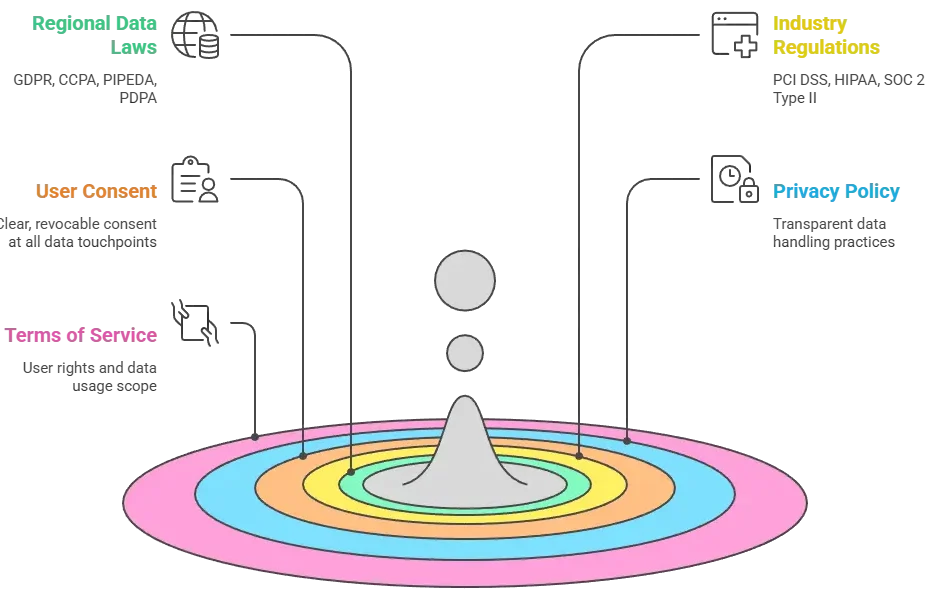
Liability protection
- Insurance requirements: Cyber liability insurance helps cover the cost of breaches, lawsuits, and user compensation.
- Legal disclaimers: Clearly state the company’s role, data responsibilities, and limitations in your app’s documentation.
- User agreements: Include consent clauses for data collection, communication, and third-party integration.
- Incident reporting protocols: Establish steps for notifying users and regulators within the legal time frame after a breach.
- Regulatory compliance monitoring: Conduct bi-annual compliance audits and maintain versioned records of all changes.
Compliance checklist by region
| Region | Primary Law | Key Requirements | Penalty for Violation |
|---|---|---|---|
| EU | GDPR | Consent, data access, erasure rights | Up to €20M or 4% of revenue |
| US (California) | CCPA | Opt-out, transparency, data deletion | $7,500 per incident |
| Canada | PIPEDA | Data storage & consent | Up to CAD $100,000 |
| Australia | Privacy Act | Notification & user rights | AUD $2.2M for corporations |
| Singapore | PDPA | Consent, disclosure limits | SGD $1M fine |
Meeting these compliance standards ensures that your white-label Trulia app stays legally protected and user-trusted across global markets.
Read more : – How to Hire the Best Trulia Clone Developer
Why Miracuves white-label Trulia app is your safest choice
When it comes to white-label real estate apps, Miracuves stands out as a security-first technology provider. Every white-label Trulia app developed by Miracuves is engineered to meet enterprise-grade compliance and cybersecurity standards — ensuring that your business, users, and data remain protected at every layer.
Miracuves security advantages
- Enterprise-grade security architecture: Built with secure frameworks, modular encryption layers, and real-time monitoring.
- Regular security audits and certifications: Every Miracuves app undergoes scheduled vulnerability scans and independent SOC 2 Type II and ISO 27001 audits.
- GDPR/CCPA compliant by default: All data storage, transmission, and user consent mechanisms are globally compliant.
- 24/7 security monitoring: Dedicated threat detection systems monitor suspicious activity across all endpoints.
- Encrypted data transmission: Data at rest and in motion are encrypted using AES-256 and TLS 1.3.
- Secure payment processing: PCI DSS compliance ensures that all financial transactions are tokenized and fully protected.
- Regular security updates: Patch cycles are automated to address vulnerabilities before they’re exploited.
- Insurance coverage included: Every Miracuves deployment includes cyber liability insurance to safeguard against rare breach events.
Conclusion
Don’t compromise on security. Miracuves white-label Trulia app solutions come with enterprise-grade protection built-in from day one. With over 600 successful projects and zero major security breaches, Miracuves continues to set the standard for trust and compliance. discover why businesses worldwide rely on Miracuves for safe, compliant, and scalable platforms.
Don’t compromise on security. Miracuves white-label Trulia app solutions come with enterprise-grade protection built-in from day one. With over 600 successful projects and zero major security breaches, Miracuves continues to set the standard for trust and compliance.
Get a free security assessment today and discover why businesses worldwide rely on Miracuves for safe, compliant, and scalable platforms.
FAQs
How secure is a white-label app compared to custom development?
With proper audits and encryption, it can be equally or more secure — faster to deploy and easier to maintain.
What happens if there’s a security breach?
A defined incident-response plan isolates, reports, and resolves the issue within legal timelines.
Who handles security updates?
Miracuves manages scheduled patches and real-time monitoring for all deployed apps.
How is user data protected?
All user data is encrypted (AES-256), anonymized, and stored on compliant cloud servers.
What certifications matter most?
ISO 27001, SOC 2 Type II, GDPR, and PCI DSS are essential.
Can white-label apps meet enterprise standards?
Yes. Miracuves’ infrastructure and audits meet enterprise-level benchmarks.
How often should security audits be done?
At least twice a year, or after any major update.
What’s included in Miracuves’ security package?
Encryption, compliance checks, 24/7 monitoring, secure payments, and liability insurance.
How does security vary across regions?
Miracuves ensures GDPR, CCPA, and PDPA compliance based on your target market.
Do I need insurance for app security?
Yes — Miracuves provides integrated cyber liability coverage for full protection.
Related Articles: