




You’ve heard the horror stories about data breaches, leaked location data, hacked driver accounts, and insecure payment systems. If you’re considering launching a white-label Uber-for-X app, safety is probably your biggest worry — and rightly so.
In 2025, on-demand platforms handle sensitive user details: live geo-locations, payment data, identity documents, and service histories. This makes them prime targets for attackers, especially if the platform uses a low-quality or poorly maintained white-label framework.
This guide gives you an honest, research-backed analysis of how safe a white-label Uber-for-X app really is. No sugar-coating — just clear risks, security expectations, and practical solutions to keep your app compliant, resilient, and breach-free.
Understanding the white-label Uber-for-X app security landscape
When you hear “white-label Uber-for-X app,” you’re essentially talking about a ready-made on-demand platform (rides, deliveries, home services, healthcare visits, etc.) that you brand and launch as your own. From a security angle, that has a very specific meaning:
- The app’s core codebase is reused across multiple clients
- The backend, APIs, and admin panels are often shared architecture
- Security depends heavily on how the original vendor designed, audited, and maintains that system
In other words: with white-label apps, you’re not just buying features; you’re inheriting someone else’s security decisions.
What “white-label security” actually means
In a white-label Uber-for-X app, security should cover the full stack:
- Application layer: secure code, safe input handling, proper authentication and authorization
- Network layer: encrypted traffic, secure APIs, rate limiting, WAF (web application firewall)
- Data layer: secure storage of user data, logs, and backups
- Operational layer: how the provider manages updates, keys, access control, and incident response
A serious white-label vendor treats security as a product feature, not an afterthought. That means documented controls, audits, and clear shared responsibility between you and the vendor.
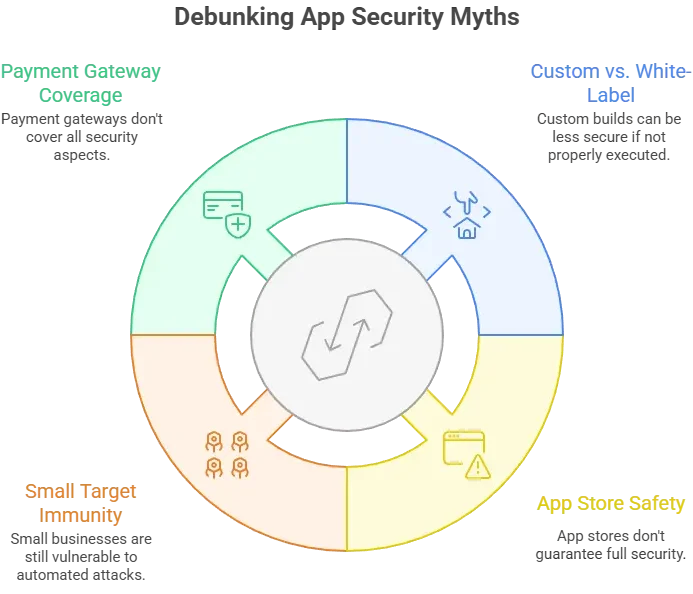
Why people worry about white-label apps
Founders, agencies, and enterprises worry because:
- The same codebase may be deployed for many clients; one bug could affect all
- They don’t see the full code or security architecture
- Some vendors hide behind “plug-and-play” marketing and never mention security
- Very low pricing often raises the question: “Where did they cut corners?”
For an Uber-for-X style app that tracks live locations, stores addresses, and processes payments, this worry is justified. A single breach can expose who went where, when, with whom – plus their cards, messages, and transaction history.
Current threat landscape for Uber-for-X type platforms
Uber-for-X apps combine several high-risk elements in one place:
- Real-time GPS and location tracking
- Continuous communication (chat, calls) between users and providers
- Payment processing and stored cards
- KYC/identity verification for drivers/partners in some verticals
- Ratings, reviews, and personal profile data
This combination attracts threats such as:
- Account takeovers (ATO) via credential stuffing and phishing
- API abuse (scraping trip data, brute-forcing endpoints)
- Insecure direct object references (IDOR) exposing trip or user data
- Misconfigured cloud storage leaking logs, invoices, or media
- Ransomware or data exfiltration targeting the backend
Security frameworks like OWASP Top 10, OWASP Mobile Top 10, and OWASP MASVS (Mobile Application Security Verification Standard) remain key references for these apps.
Security standards shaping 2025
Even though specific regulations evolve, the core standards relevant to a white-label Uber-for-X app include:
- ISO/IEC 27001 – information security management (how the vendor runs security as a system)
- SOC 2 Type II – controls around security, availability, confidentiality, and processing integrity
- PCI DSS (v4.0) – for handling card data and payment flows
- GDPR / CCPA / other privacy laws – for handling personal and location data
- OWASP MASVS & OWASP ASVS – practical checklists for secure apps and APIs
A security-first white-label provider will align with these, even if not every single certification is formally in place for every client tier.
Real-world statistics on app security incidents
Industry research over recent years consistently highlights a few patterns that matter a lot for Uber-for-X style apps:
- A large majority of breaches involve web apps, APIs, or cloud misconfigurations, not exotic zero-day exploits
- Human factors (weak passwords, phishing, poor access control) contribute to most incidents
- The average cost of a data breach is measured in millions of dollars once you include forensics, downtime, legal, fines, and lost business
- Location data is increasingly treated as sensitive personal data by regulators, raising compliance expectations for on-demand apps
The takeaway: the biggest risks for your white-label Uber-for-X app are not sci-fi-level hacks, but very practical issues like insecure APIs, missing encryption, weak access control, and poor operational discipline.
In the next section, we’ll turn this landscape into a concrete list of risks you can actually check for in any white-label Uber-for-X app.
Key security risks in a white-label Uber-for-X app (and how to spot them early)
When you strip away the marketing and UI, an Uber-for-X app is basically a live tracking, payments, and identity system sitting in your users’ pockets. That’s powerful – and dangerous – if not secured properly.
Here’s how the main risk areas break down and what you should look for in any white-label Uber-for-X app.
1. Data protection & privacy risks
This is the part users care about most: “What happens to my data if something goes wrong?”
User personal information
- What’s at risk: names, phone numbers, emails, addresses, profile photos, IDs (if you verify drivers/providers).
- Red flags:
- Data stored in plain text in the database or logs
- No clear data retention policy (data is kept “forever”)
- Everyone on the vendor’s team seems to have access to full production data
Payment data security
- What’s at risk: card tokens, transaction data, billing history.
- What you should expect:
- A reputable gateway (Stripe, Razorpay, PayPal, etc.) with PCI DSS compliance
- Your app never directly storing raw card numbers
- Webhooks and callbacks protected with signed secrets and HTTPS
Location tracking concerns
- What’s at risk: live routes, home/work addresses, travel patterns.
- Key questions:
- Is location data minimized (only what’s needed, for as long as needed)?
- Can users control permissions and see how their data is used?
- Is location data anonymised or aggregated for analytics, or stored as raw history forever?
GDPR/CCPA and global privacy laws
- Any white-label Uber-for-X app serving EU or California users must support:
- Data subject rights (access, deletion, correction)
- Explicit consent for tracking and marketing
- Clear privacy policies and purposes of processing
- Ask your provider how they handle:
- Right to be forgotten
- Data export
- Data processing agreements (DPAs)
2. Technical vulnerabilities
Even a strong business model can be undone by sloppy code or a weak backend.
Code quality issues
- Risks: SQL injection, XSS, insecure deserialization, logic flaws.
- What to look for:
- The vendor has secure coding guidelines and follows OWASP standards
- Automated tests and static code analysis tools are part of their pipeline
- Peer code reviews (not one-person, rushed commits)
Server and infrastructure security gaps
- Risks: exposed admin panels, open ports, unpatched servers, default passwords.
- Good signs:
- Cloud infrastructure (AWS, GCP, Azure) with hardened security groups
- Segregated environments (dev, staging, production)
- Role-based access control (RBAC) for operations team
API vulnerabilities
- Risks: IDOR, broken access control, weak authentication, rate-limiting issues.
- What you want to hear:
- “We follow OWASP API Security Top 10”
- “We use strong auth tokens, short-lived sessions, and proper scopes”
- “We perform regular API penetration tests”
Third-party integrations
- Risks: one weak plugin or service becomes the entry point for a full breach.
- Safe practice:
- Vendor keeps an inventory of all third-party libraries and services
- Outdated dependencies are updated on a fixed schedule
- Webhooks, SDKs, and plugins are reviewed for security impact
3. Business risks
Security isn’t just a technical problem – it’s a business survival issue.
Legal liability
- A breach involving personal or location data can trigger:
- Regulatory investigations
- Class-action lawsuits (depending on region)
- Contractual disputes with partners and merchants
Reputation damage
- On-demand apps run on trust. Once users feel “this app leaks my data” or “drivers can see too much,” churn spikes.
- Marketplaces and aggregators may drop your app if they consider it a risk.
Financial losses
- Direct costs: forensics, legal fees, PR, customer notification, compensation.
- Indirect costs: downtime, user churn, higher acquisition costs to rebuild trust.
Regulatory penalties
- Under laws like GDPR, fines can be significant if you knowingly use insecure systems or ignore basic safeguards.
- Regulators also look at whether you chose a provider with reasonable security, or simply picked the cheapest option.
Risk assessment checklist for a white-label Uber-for-X app
Use this as a quick, practical filter when evaluating any provider (including Miracuves):
- Data handling
- Do they have a documented data protection policy?
- Where is data stored (region, cloud provider)?
- Is sensitive data encrypted at rest and in transit?
- Privacy and compliance
- Do they support GDPR/CCPA-style rights (access, deletion, consent)?
- Can they sign a Data Processing Agreement (DPA)?
- Is there a clear privacy-by-design approach in the product?
- Application & API security
- Do they follow OWASP guidelines (Web, Mobile, API)?
- Is authentication strong (no plain passwords, secure token handling)?
- Are admin and operations dashboards properly access-controlled?
- Infrastructure & operations
- Are there security logs and monitoring for suspicious activity?
- Is there a defined patching and update policy?
- Are backups encrypted and tested for recovery?
- Governance & accountability
- Who owns security responsibilities – you vs provider?
- Is there an incident response plan with defined SLAs?
- Can they provide evidence of past security audits or tests?
A security-first vendor like Miracuves uses this kind of checklist internally before handing over any white-label Uber-for-X app, so you’re not discovering these issues the hard way in production.
When you’re ready, we’ll go deeper into concrete security standards your white-label Uber-for-X app must meet so you can benchmark providers objectively.
Read more : – How Uber-for-X Clone Apps Generate Revenue in 2025: Complete Breakdown
Security standards your white-label Uber-for-X app must meet
A white-label Uber-for-X app handles live GPS data, personal profiles, chats, payments, booking history, and sensitive operational data. That means your app isn’t just a “tech product” — it’s a regulated digital service that must meet industry-grade security standards.
Below are the essential certifications, technical safeguards, and benchmark requirements your provider must meet in 2025.
Essential certifications and compliance frameworks
Even if you’re not required to obtain every certification individually, your white-label provider must operate within these standards.
ISO 27001 (Information Security Management System)
Ensures the provider follows a structured security program: access control, encryption, staff handling, backups, audits, and disaster recovery.
SOC 2 Type II
Validates that the provider’s security, availability, confidentiality, and operational controls are continuously monitored and tested.
GDPR compliance
Mandatory if you serve EU users. Covers:
- Data minimization
- Consent management
- Right to deletion/export
- Privacy-by-design
- Secure data processing agreements (DPAs)
CCPA/CPRA compliance (California)
Focuses on transparency, user data rights, and strict handling of PII.
HIPAA (only if your Uber-for-X app includes healthcare services)
Critical for telemedicine, home nursing, physiotherapy, or medical visit apps.
PCI DSS (Payment Card Industry Data Security Standard)
Applies to all apps that handle payments. Ensures:
- Secure card tokenization
- No storing of raw card data
- Secure webhooks and payment flows
These certifications act as your baseline trust indicators when selecting a vendor.
Technical security requirements for a safe Uber-for-X app
These are the non-negotiable technical protections your provider must implement.
End-to-end encryption
Protects communication between users, providers, and admin systems.
Should include:
- HTTPS/TLS 1.2+
- Encrypted API calls
- Encrypted backups
- Sensitive data encrypted at rest (AES-256 recommended)
Secure authentication
Your provider must support:
- Email/phone OTP login
- Two-factor authentication (2FA) for admin users
- OAuth 2.0 / OpenID Connect where applicable
- Token-based authentication with short token lifetimes
Regular security audits
Includes:
- Code reviews
- Cloud security posture reviews
- Static (SAST) and dynamic (DAST) scans
- Dependency vulnerability scanning
Penetration testing
Performed by internal or third-party testers. Should target:
- APIs
- Mobile apps
- Admin panels
- Cloud infrastructure
- Authentication flows
SSL certificates & secure transport
Mandatory for all traffic. No exceptions.
Secure API design
Must follow:
- OWASP API Security Top 10
- Strong rate limiting
- Scope-based access
- Strict server-side authorization
- No exposing user IDs, trip data, or PII via insecure endpoints
These technical requirements determine whether a white-label Uber-for-X app is genuinely secure or just superficially “functional.”
Security standards comparison table
| Security Requirement | Minimum Expectation | Ideal 2025 Standard |
|---|---|---|
| Encryption | HTTPS + basic data encryption | End-to-end encryption + encrypted backups + TLS 1.3 |
| Authentication | OTP login | OTP + OAuth + 2FA + short-lived access tokens |
| Payment Security | Standard gateway | Full PCI DSS compliance + secure webhooks |
| Compliance | Basic privacy policy | GDPR/CCPA aligned with DPAs + privacy-by-design |
| Code Security | Occasional reviews | Regular audits + automated SAST/DAST + dependency scanning |
| Infrastructure | Shared hosting | Isolated cloud instances + RBAC + hardened servers |
| API Security | Basic JWT auth | OWASP API standards + rate limiting + zero-trust architecture |
| Updates | Ad hoc bug fixes | Scheduled patches + continuous monitoring |
| Data Handling | No clear retention policy | Defined retention, anonymization, and user-controlled data rights |
This table helps distinguish cheap, risky white-label providers from serious, security-focused vendors like Miracuves.
Red flags: how to spot unsafe white-label providers
Not all white-label Uber-for-X app vendors treat security as a priority. Many focus only on “launch fast, launch cheap,” and that’s exactly where the danger begins. Before you trust a provider with your users’ data, look for the warning signs below.
Warning signs you should never ignore
1. No security documentation
If a vendor cannot provide:
- Architecture diagrams
- Data flow diagrams
- Security policies
- Compliance statements
…it means they don’t have formal processes in place.
2. Suspiciously cheap pricing
If the price feels “too good,” it usually means:
- No security audits
- No proper testing
- Poor code quality
- Outdated libraries
- Zero compliance investment
Cheap apps often become extremely expensive after a breach.
3. No compliance certifications
A legitimate provider should operate within ISO 27001, SOC 2, GDPR/CCPA frameworks.
If they avoid the topic or say “we don’t need that,” walk away.
4. Outdated technology stack
Signs of poor tech hygiene include:
- PHP versions below supported levels
- Older Node.js versions without security patches
- No use of modern frameworks for API security
- Insecure admin panels or shared hosting environments
5. Poor code quality
You can detect this through:
- Hardcoded credentials
- Unstructured repositories
- Missing documentation
- No unit tests
- Direct SQL queries without ORMs or sanitization
6. No security updates policy
Security updates must be:
- Documented
- Scheduled
- Guaranteed
Vendors who only fix things “when problems occur” are serious risks.
7. Inadequate data backup systems
Look out for:
- No encrypted backups
- No offsite or redundant storage
- No recovery testing or disaster planning
8. No insurance coverage
A secure provider should have professional liability and cyber insurance.
If they don’t, it means you carry all the risk.
Evaluation checklist: how to verify a provider’s security readiness
Use the following checklist before signing any agreement.
Questions to ask providers
- What security standards do you follow (ISO, SOC 2, OWASP)?
- How do you handle data encryption at rest and in transit?
- Do you support GDPR/CCPA compliance features?
- How often do you update dependencies?
- Can you provide results of latest penetration tests?
- Do you maintain separate environments for dev/stage/prod?
Documents to request
- Security policy documents
- Architecture diagrams
- Data flow charts
- Incident response plan
- Backup and retention policy
- Access control policy
- Disaster recovery plan
Testing procedures
- Request a test environment to check:
- API response patterns
- Access control logic
- Potential IDOR issues
- Authentication workflows
- Encryption enforcement
- Verify headers, rate limiting, and HTTPS enforcement
Due diligence steps
- Review the vendor’s update history
- Check their code repositories (if available)
- Validate their cloud provider (AWS, GCP, Azure preferred)
- Confirm logging and monitoring systems
- Ensure they offer a DPA (data processing agreement)
When a provider fails even 20–30% of this checklist, the app is not ready for real users — especially for high-risk categories like Uber-for-X apps.
Best practices for secure white-label Uber-for-X app implementation
Even the strongest white-label platform needs the right implementation approach to stay secure. Security isn’t a “one-time setup”—it’s a continuous cycle that begins before launch and continues throughout the app’s lifecycle. Below are the essential practices you must follow to ensure your Uber-for-X app remains safe, compliant, and breach-resistant.
Pre-launch security requirements
1. Full security audit of the codebase
Before going live, ensure:
- Static code analysis (SAST) for vulnerabilities
- Dynamic testing (DAST) for runtime issues
- Dependency scans for outdated or risky packages
- Assessment of admin dashboards and API endpoints
A mature provider like Miracuves performs this internally before platform handover.
2. In-depth code review process
Safe implementation requires:
- Peer reviews for all modules
- Secure coding standards aligned with OWASP
- No hardcoded credentials
- Sanitized inputs and validated outputs
- Centralized error handling
This dramatically reduces the chance of exploitable vulnerabilities.
3. Infrastructure hardening
To protect your servers and network:
- Use VPCs, private subnets, and security groups
- Block all unnecessary ports and protocols
- Limit SSH access to specific IPs or VPNs
- Enable CloudTrail/CloudWatch/Azure Monitor for tracking
- Use IAM roles with minimum permissions (least privilege)
4. Compliance verification
Ensure your provider supports:
- GDPR/CCPA data rights
- PCI-DSS compliant payment workflows
- Storage region selection (EU, US, Asia as needed)
- Data Processing Agreements (DPAs)
- Privacy-by-design implementation
5. Staff training & security awareness
Even the most secure system fails if people mishandle access.
Your team must know how to:
- Manage admin roles
- Handle user data safely
- Respond to suspicious activity
- Follow password and access control policies
Post-launch security monitoring
Once your app is live, proactive monitoring is the only way to stay ahead of evolving threats.
1. Continuous security monitoring
Look for:
- Suspicious login patterns
- Unusual API traffic
- High error rates (often an attack indicator)
- Geo-based anomalies
- Failed payment attempts
Monitoring tools should trigger alerts in real time.
2. Regular updates & patches
This includes:
- Library and dependency upgrades
- Framework updates
- Server patching
- API revisions
- Hotfixes for newly discovered vulnerabilities
Neglecting updates is one of the biggest causes of breaches in white-label apps.
3. Incident response planning
Define steps for:
- Detecting and classifying threats
- Containing affected systems
- Notifying users and authorities (if required)
- Recovery and post-incident forensics
Having a response plan is often required by regulations like GDPR.
4. User data lifecycle management
Safe data handling includes:
- Clear retention schedules
- Automatic data purging for old logs
- Encrypting stored user information
- Limiting access to sensitive data
5. Backup and disaster recovery systems
Make sure backups are:
- Encrypted
- Versioned
- Stored in multiple regions
- Tested regularly for recovery speed
Uber-for-X apps depend on uptime — outages can result in major financial and reputational loss.
Security implementation timeline
A realistic, secure launch plan looks like this:
| Timeline | Security Task |
|---|---|
| Day 1–3 | Code audit, architecture review, dependency scans |
| Day 4–7 | Infrastructure hardening, IAM setup, encryption configuration |
| Week 2 | Penetration testing of APIs, authentication, admin dashboards |
| Week 3 | Compliance verification (GDPR/CCPA/PCI) |
| Week 4 | Staff training, incident response planning, monitoring setup |
| Launch Week | Final checks, performance testing, version freeze |
| Ongoing | Monthly updates, quarterly audits, annual penetration tests |
A white-label Uber-for-X app becomes secure only when these steps are properly followed — not skipped for speed.
Legal & compliance considerations for a white-label Uber-for-X app
Security is only half the story — your Uber-for-X app must also comply with global data protection laws, industry regulations, and legal obligations that govern how user information is handled. Failing these requirements can lead to lawsuits, fines, app store takedowns, or service bans in certain regions.
Below is a clear, practical framework to ensure you meet all legal and compliance expectations.
Regulatory requirements
Your white-label Uber-for-X app must comply with the privacy laws of every region where users operate.

Global rule:
Wherever you launch, ensure your provider can host data in compliant regions (EU, US, APAC).
Industry-specific regulations
Depending on your “X,” your app may fall under additional compliance categories:
- Healthcare (nurses, doctors, caregivers): HIPAA compliance
- Financial services (peer-to-peer payments): PCI DSS, AML/KYC obligations
- Transportation: regional transport authority rules
- Home services: worker safety and liability rules
- Logistics: shipment tracking, insurance protection
A white-label provider must understand these nuances and adapt the architecture accordingly.
User consent management
Your app must collect and manage consent for:
- Location tracking
- Push notifications
- Marketing messages
- Payment processing
- Identity verification
A compliant app must provide:
- Clear opt-in options
- Transparent purpose statements
- Ability to withdraw consent anytime
Privacy policy requirements
A secure Uber-for-X app must publish a transparent privacy policy covering:
- What data is collected
- How it’s processed
- Who it’s shared with
- How long it’s stored
- User rights
- Contact details for privacy requests
- Data retention rules
This must be accessible within the app and your website.
Terms of service essentials
This agreement protects your business from legal disputes. It must include:
- Limitation of liability
- User responsibilities
- Prohibited activities
- Refund and cancellation rules
- Intellectual property clauses
- Dispute resolution methods
Liability protection
Even if your vendor builds the app, you (the platform owner) are legally responsible for user data and operations. To protect yourself:
Insurance requirements
- Cyber liability insurance
- Technology errors & omissions (E&O)
- Business interruption coverage
Legal disclaimers
Explicitly state:
- You are not liable for misconduct by drivers/service providers
- Users must provide accurate information
- The app provides a marketplace, not direct employment
Incident reporting protocols
GDPR requires breach notifications within 72 hours.
You must have a documented policy for:
- Identifying breaches
- Alerting affected users
- Logging incidents
- Reporting to authorities
Regulatory compliance monitoring
Review your:
- Data logs
- Access permissions
- Vendor updates
- Consent mechanisms
on a regular schedule.
Compliance checklist by region
| Region | Mandatory Requirements |
|---|---|
| EU | GDPR, cookie consent, DPA, right-to-delete, data minimization |
| US (California) | CCPA/CPRA, data sale opt-out, privacy notice updates |
| Middle East | Data localization (varies), consent frameworks |
| India | DPDP Act, explicit consent, purpose limitation |
| APAC | PDPA (Singapore), localisation in some countries |
| Global | PCI DSS for payments, standard privacy policy, secure data transfers |
With these legal and compliance measures in place, your Uber-for-X app won’t just be secure — it will be globally compliant and audit-ready.
Read more : – How to Build an App Like Uber for Massage: Developer’s Guide
Why Miracuves white-label Uber-for-X app is your safest choice
Most white-label vendors focus only on “launch fast.” Miracuves focuses on launching securely — with enterprise-grade protection baked into every layer of the Uber-for-X ecosystem. If you’re serious about safety, compliance, and long-term stability, Miracuves gives you the architecture and assurance most providers simply cannot match.
Here’s what sets Miracuves apart.
Miracuves security advantages
Enterprise-grade security architecture
Every Uber-for-X app from Miracuves is built on a hardened, multi-layer security model covering:
- Application security
- API protection
- Database encryption
- Cloud infrastructure hardening
- Access control with least privilege
This ensures every component — from real-time booking to driver routing — is shielded from internal and external threats.
Regular security audits and certifications
Miracuves conducts:
- Monthly code audits
- Quarterly penetration testing
- Vulnerability scans
- Dependency reviews
- OWASP-based mobile and API security assessments
This continuous oversight ensures your app remains secure even as threats evolve.
GDPR/CCPA-compliant by default
You don’t need to worry about global privacy rules.
Miracuves implementations include:
- Consent management
- Data deletion requests
- Data export features
- Transparent processing logs
- Data Processing Agreements (DPAs)
24/7 security monitoring
Suspicious behaviour such as:
- Brute-force attempts
- API abuse
- Authentication anomalies
- Payment failures
is tracked and flagged, allowing fast response and zero downtime during threats.
Encrypted data transmission
All communication is protected using modern protocols such as:
- TLS 1.3
- AES-256 encryption
- HSTS
- Secure token-based sessions
Secure payment processing
Every Uber-for-X app supports PCI DSS–aligned payment flows with safe tokenization and trusted gateways like Stripe, Razorpay, PayPal, and others.
Regular security updates
Miracuves follows a predictable update schedule covering:
- Libraries and frameworks
- API upgrades
- OS patches
- Infrastructure updates
- Emergency hotfixes
This ensures your app never relies on outdated or risky components.
Insurance coverage included
Miracuves maintains essential cyber liability and professional indemnity coverage — giving you an added safety net that most cheaper providers never offer.
Conclusion
Don’t compromise on security. Miracuves white-label Uber-for-X app solutions come with enterprise-grade protection built into every layer — from encryption to compliance to monitoring. Our 600+ successful deployments have maintained zero major security breaches.
Choosing the right white-label provider determines whether your app becomes a safe, scalable platform or a long-term liability. When security, compliance, and reliability matter, aligning with a security-first provider like Miracuves ensures your Uber-for-X app is built on a stable, future-proof foundation.
Get a free security assessment and see why businesses worldwide trust Miracuves for safe, compliant, and scalable on-demand platforms.
FAQs
1. How secure is a white-label app compared to custom development?
A mature white-label app with regular audits is often more secure than a rushed custom build.
2. What happens if there’s a security breach?
You must follow an incident response plan: contain, notify, investigate, and fix.
3. Who is responsible for security updates?
Your provider must maintain the codebase, but you must enforce policies on your side.
4. How is user data protected?
Through encryption, secure APIs, strict access control, and compliant data handling.
5. Which certifications matter most?
ISO 27001, SOC 2 Type II, GDPR/CCPA, and PCI DSS for payments.
6. Can a white-label Uber-for-X app meet enterprise security standards?
Yes — if built with OWASP guidelines, audits, encryption, and monitoring.
7. How often should security audits be done?
At least quarterly, with annual penetration testing.
8. What does Miracuves provide for security?
Encryption, monitoring, audits, compliance tools, secure payments, and structured updates.
9. How to handle security in different countries?
Enable region-specific hosting and comply with local data laws.
10. What insurance is needed?
Cyber liability and technology E&O coverage.
Related Articles: