
Vacation rentals have transformed the travel industry, and Vrbo stands as one of the largest platforms connecting travelers with private vacation homes. As part of the Expedia Group ecosystem, Vrbo has scaled into a multi-billion-dollar marketplace focused entirely on whole-home rentals.
For founders and product builders, Vrbo offers a clear lesson in building two-sided marketplaces with strong monetization mechanics that scale globally.
Vrbo Revenue Overview — The Big Picture
Vrbo (Vacation Rentals by Owner) operates as a two-sided marketplace connecting property owners with travelers seeking short-term vacation rentals. Unlike some travel platforms, Vrbo focuses specifically on entire homes rather than shared spaces, making it popular for families and group travelers.
2026 Estimated Snapshot
| Metric | Value |
|---|---|
| Estimated Revenue (2026) | ~$3B |
| YoY Growth | ~10–12% |
| Parent Company | Expedia Group |
| Global Listings | ~2M vacation homes |
| Market Focus | Whole-home vacation rentals |
| Profitability | Positive operating margin within Expedia ecosystem |
Vrbo competes with several major travel platforms including:
- Airbnb
- Booking.com
- Tripadvisor Rentals
- Vacasa
While Airbnb dominates the short-term rental market overall, Vrbo remains a strong competitor in the family vacation rental niche.
Read More: What Is Vrbo? A Simple Guide to the Vacation Rental Platform
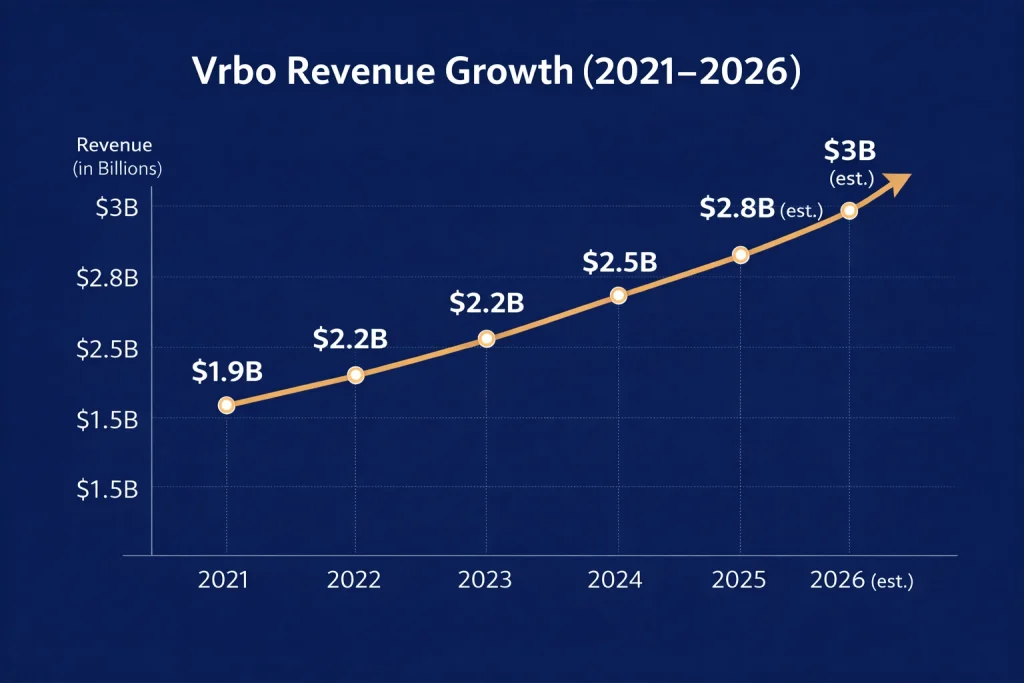
Estimated trajectory:
| Year | Revenue |
|---|---|
| 2021 | ~$1.9B |
| 2022 | ~$2.2B |
| 2023 | ~$2.5B |
| 2025 | ~$2.8B (est.) |
| 2026 | ~$3B (est.) |
Primary Revenue Streams Deep Dive
Vrbo’s revenue model is built on transaction-based marketplace fees combined with advertising and premium listing services.
Owner Commissions (Host Service Fees)
The primary revenue stream comes from property owner commissions on bookings.
When a traveler books a property, Vrbo collects a commission from the host.
Typical commission range:
~5% host service fee per booking
This fee is deducted directly from the rental amount.
Hosts benefit from Vrbo’s:
- global traveler demand
- payment processing
- marketing reach
- booking management tools
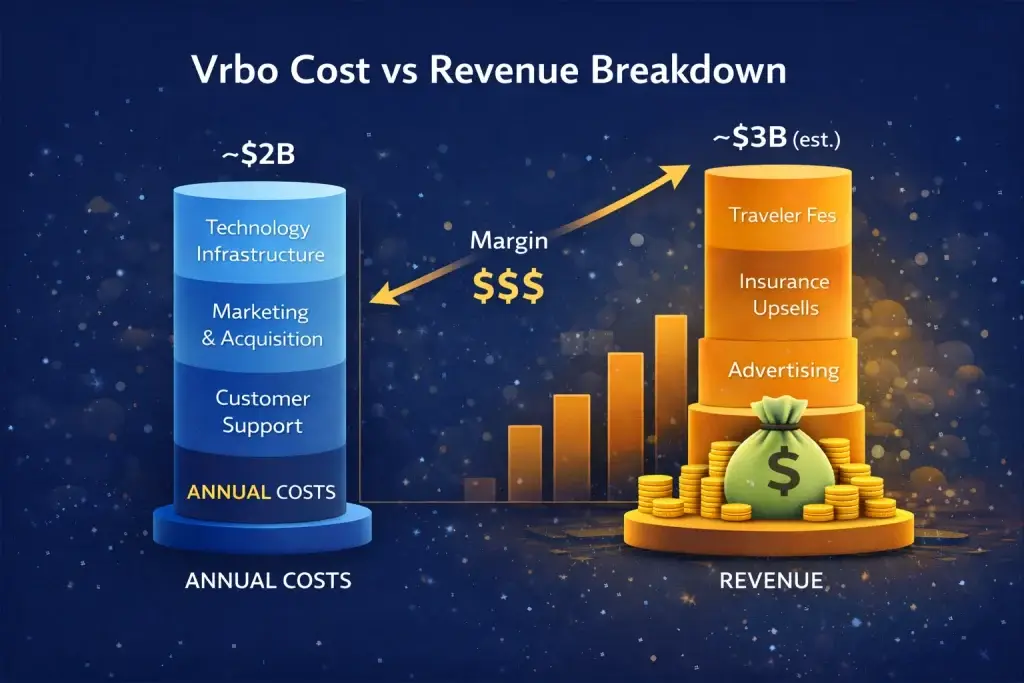
Estimated revenue contribution: ~55–60%
Traveler Booking Fees
Vrbo also charges a service fee to travelers when they complete a booking.
This fee covers:
- platform operations
- customer support
- fraud protection
- payment processing
Typical range:
~6–12% of booking value
The traveler fee varies depending on:
- trip duration
- property price
- destination
Estimated revenue contribution: ~12–18%
Subscription Listing Plans
Vrbo offers hosts an annual subscription model instead of paying commissions.
This option is designed for high-volume property managers.
Typical pricing:
~$499 per year per property listing
This allows hosts to accept unlimited bookings without commission charges.
Estimated revenue contribution: ~8–10%
Advertising & Boosted Listings
Hosts can pay for promoted property placements to increase visibility in search results.
Advertising options include:
- promoted search placement
- sponsored listings
- destination promotions
This monetization model is similar to e-commerce advertising marketplaces.
Estimated revenue contribution: ~7–9%
Travel Insurance & Add-On Services
Vrbo also generates revenue through travel-related services.
Examples include:
- travel insurance
- damage protection plans
- payment processing margins
These services are often integrated during checkout.
Estimated revenue contribution: ~5–7%
Revenue Streams Breakdown (Latest Available Data)
| Revenue Stream | Description | Estimated Revenue Share | Pricing Model |
|---|---|---|---|
| Host Service Fees | Commission on bookings | 55–60% | Percentage commission |
| Traveler Booking Fees | Service fee on reservations | 12–18% | % of booking |
| Listing Subscriptions | Annual host listing plans | 8–10% | Yearly subscription |
| Advertising Solutions | Boosted property visibility | 7–9% | Pay-per-promotion |
| Add-On Services | Insurance & protection plans | 5–7% | Service fees |
The Fee Structure Explained
Vrbo operates with a dual-fee marketplace model, charging both hosts and travelers.
This structure enables Vrbo to monetize both sides of the marketplace transaction.
Platform Fee Structure (Latest Available Data)
| User Type | Fee Type | Typical Fee Range | Notes |
|---|---|---|---|
| Hosts | Service commission | ~5% per booking | Standard commission model |
| Hosts | Listing subscription | ~$499/year | Optional for high-volume hosts |
| Travelers | Booking service fee | ~6–12% | Charged during checkout |
| Hosts | Advertising | Variable | Promoted listings |
| Travelers | Insurance | Variable | Optional protection plans |
This dual monetization allows Vrbo to maintain strong unit economics while scaling globally.
How Vrbo Maximizes Revenue Per User
Vrbo uses several marketplace strategies to increase revenue per booking and per host.
Dynamic Pricing
Hosts use pricing tools that adjust rates based on:
- seasonality
- demand
- local events
- market supply
This increases booking value and platform commissions.
Cross-Selling Travel Services
Vrbo integrates travel services into the booking flow.
Examples include:
- travel insurance
- trip protection
- premium customer support
These services increase average transaction value.
Host Upselling
Hosts are encouraged to purchase:
- promoted listings
- advertising visibility
- property management tools
This increases host lifetime value.
Marketplace Liquidity
Vrbo focuses on entire vacation homes, which attract higher-value bookings.
Family vacations typically produce:
- longer stays
- larger groups
- higher booking values
This increases revenue per transaction.
Cost Structure & Profit Margins
Vrbo benefits from the asset-light marketplace model.
The company does not own the properties listed on its platform.
Major cost areas include:
Technology Infrastructure
- cloud infrastructure
- booking systems
- fraud prevention
- payment processing
Marketing & Customer Acquisition
Travel platforms invest heavily in:
- search engine marketing
- brand advertising
- affiliate partnerships
Customer acquisition represents one of the largest costs.
Customer Support
Vrbo provides support for:
- booking disputes
- refunds
- host management
This requires global support teams.
Product Development
Continuous investment goes into:
- mobile apps
- booking optimization
- AI pricing tools
- fraud detection systems
Future Revenue Opportunities (2026–2028 Outlook)
The vacation rental industry continues to expand globally.
Vrbo’s growth opportunities include several strategic areas.
AI-Driven Travel Recommendations
AI can improve booking conversion through:
- personalized destination suggestions
- dynamic pricing recommendations
- automated itinerary planning
Premium Property Segments
Vrbo may expand further into luxury vacation homes and curated experiences.
Higher-end properties generate significantly higher booking values.
Global Market Expansion
Emerging growth regions include:
- Southeast Asia
- Latin America
- Middle East
Vacation rental adoption continues to rise in these markets.
Integrated Travel Ecosystem
Because Vrbo belongs to Expedia Group, the platform can integrate with:
- flights
- hotels
- car rentals
- travel packages
This creates cross-selling opportunities across Expedia’s travel network.
Lessons for Entrepreneurs
Vrbo highlights several powerful marketplace principles.
What Works Well
- two-sided marketplace structure
- dual monetization (host + traveler fees)
- subscription and commission hybrid model
- advertising revenue layers
What Startups Can Replicate
Founders building marketplaces can replicate:
- commission-based transaction fees
- subscription tiers for power users
- promoted listings as advertising revenue
Market Opportunities
Emerging startup opportunities exist in:
- niche travel marketplaces
- luxury vacation rental platforms
- AI travel planning tools
- short-term rental management SaaS
Final Thought
Vrbo proves that a focused marketplace can scale into a multi-billion-dollar platform. By concentrating on whole-home vacation rentals and building strong monetization layers, the company created a durable travel marketplace with global reach.
What stands out is Vrbo’s ability to monetize both sides of the marketplace effectively. By charging hosts through commissions or subscriptions and travelers through service fees, the platform maximizes revenue per transaction without relying on a single income stream. This dual monetization strategy is a key reason why marketplaces like Vrbo achieve strong unit economics at scale.
Another important takeaway is positioning. Instead of competing head-on across all segments, Vrbo carved out a niche in family and group travel, where booking values are higher and stays are longer. This strategic focus increases average transaction value and improves overall profitability.
FAQs
1. How much does Vrbo make per transaction?
Vrbo typically earns 5% from hosts plus 6–12% from travelers, depending on booking value.
2. What is the most profitable revenue stream for Vrbo?
Host service commissions remain the largest revenue contributor.
3. How does Vrbo pricing compare to competitors?
Vrbo charges similar fees to Airbnb but focuses mainly on entire vacation homes.
4. What percentage does Vrbo take from hosts?
Vrbo generally takes around 5% per booking from hosts.
5. How has Vrbo’s revenue model evolved?
The company expanded from subscription listings to a hybrid model including commissions and advertising.
6. Can small startups replicate this model?
Yes, niche marketplaces can adopt similar commission-based revenue structures.
7. What scale is required for profitability?
Marketplace profitability typically requires large supply and demand liquidity.
8. How can founders build a similar platform?
Focus on solving a specific marketplace problem, build trust systems, and scale both supply and demand sides.
9. What alternatives exist to this model today?
Alternatives include subscription marketplaces, SaaS management tools, and vertically integrated travel platforms.
Miracuves is an independent software development company. We are not affiliated with, connected to, sponsored by, or endorsed by any company or product named in this article.
Terms such as “X Clone” are used descriptively. It is how the software industry refers to building a platform with functionality comparable to a known service, and how clients search for it.
The entire design and codebase of our products is built by our own team. Our products contain no code, design, graphics, or content originating from any third-party website or applications.
All third-party names and marks referenced in this article are the property of their respective owners, referenced solely to identify the services discussed.