



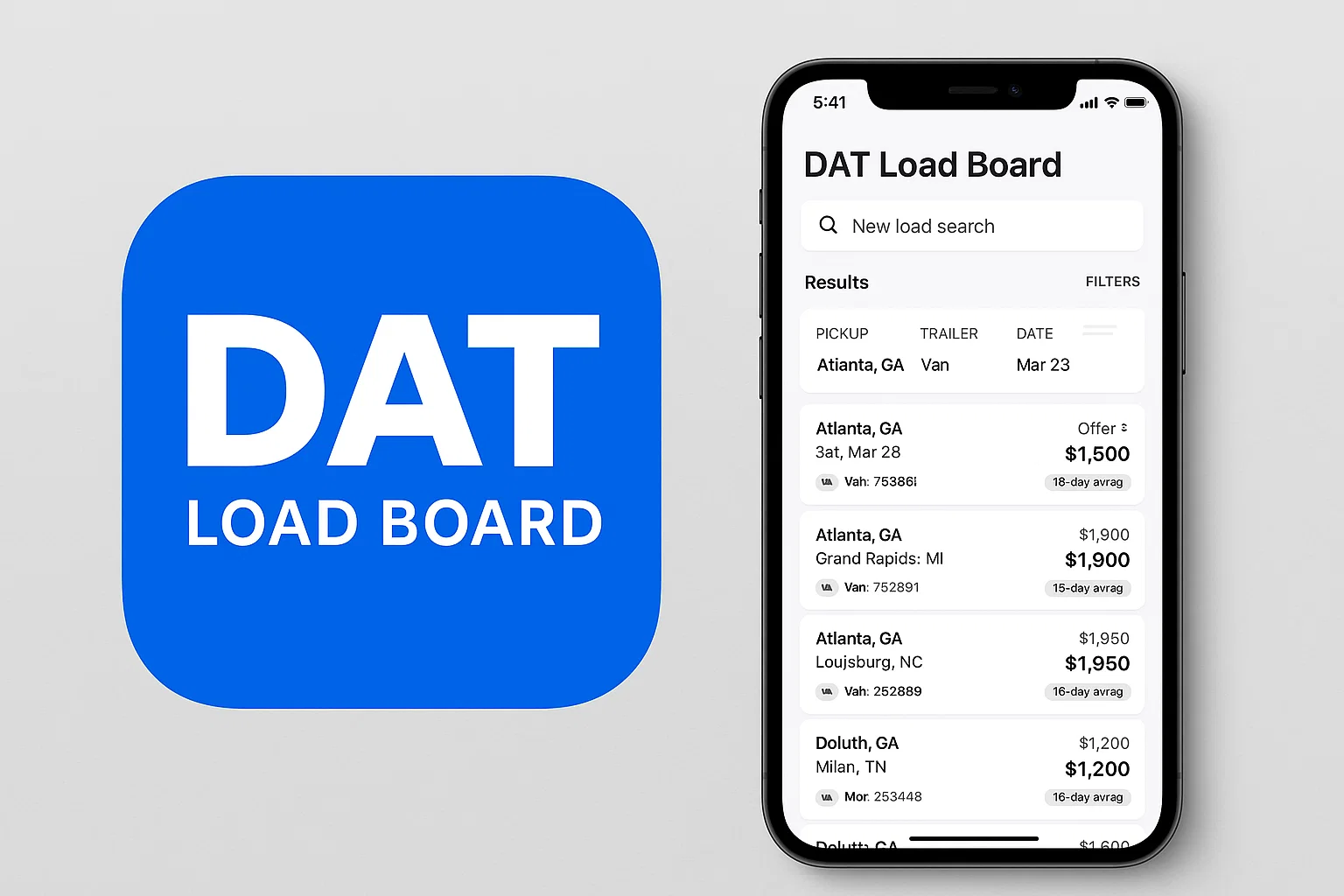
Imagine you’re a truck driver on the road, with an empty trailer and no confirmed load to deliver. Every hour wasted means lost income. That’s exactly the problem DAT Load Board solves—helping carriers, shippers, and brokers instantly find loads, negotiate rates, and optimize routes in real time.
Founded in 1978, DAT Load Board has grown into America’s largest freight marketplace, powering over 500 million load and truck posts every year. Today, it’s used by 80% of trucking companies across the U.S. and remains a core player in logistics technology.
In this article, you’ll understand:
- What DAT Load Board really is
- How the platform works
- Features & technology behind it
- Business model & revenue breakdown
- Market opportunities for entrepreneurs
- How to build your own DAT-like platform
By the end, you’ll clearly understand the entire DAT Load Board system — from user journey to technical structure and revenue model.
What Is DAT Load Board? – The Simple Explanation
DAT Load Board is a digital freight matching platform that connects carriers, shippers, and freight brokers in real time. It helps truck drivers find loads instantly, shippers post available freight, and brokers negotiate rates efficiently. Instead of making dozens of calls, all opportunities appear in one place—like a marketplace for trucking jobs.
It solves the biggest problem in logistics: empty trucks on the road. Every mile without cargo means financial loss. DAT Load Board ensures better route planning, higher trip efficiency, and faster load bookings—even for independent truckers.
Target Users & Use Cases
- Truckers/Owner-Operators → Find nearby loads fast
- Freight Brokers → Post loads and manage capacity
- Shippers → Move goods with verified carriers
- Logistics Companies → Optimize routing and pricing
Current Market Position (2025)
- 500M+ posts/year (loads & trucks)
- 80% of U.S. carriers use DAT
- Trusted by 57,000+ brokers
- Market leader in digital freight matching
Why It Became Successful?
- Real-time freight data
- Verified and vetted carriers
- Accurate market rate tools
- Easy-to-use app interface
- Truck searching & GPS-based matching
How Does DAT Load Board Work? Step-by-Step Breakdown
For Users (Carriers / Truckers)
1. Account creation
- Download the DAT Load Board app or use the web platform
- Choose a plan (Starter, Pro, or higher tier based on features)
- Verify business details (MC/DOT number, carrier info, contact details)
- Set preferences: equipment type (dry van, flatbed, reefer), home base, preferred lanes
2. Main features walkthrough
Once logged in, a carrier can:
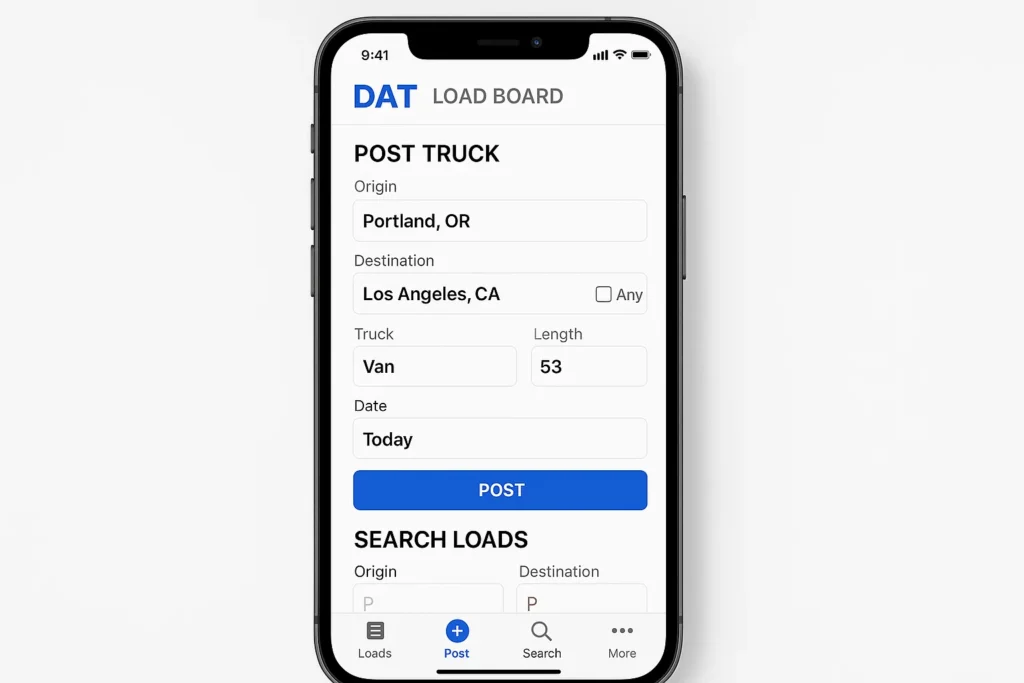
- Search loads by lane, origin/destination, date, equipment type
- Filter by rate per mile, distance, load size, broker rating
- View rate estimates based on current market data
- Call or message brokers directly from the app
- Save favorite routes and set alerts for preferred lanes
3. Typical user journey (example)
- A driver in Dallas finishes a delivery and needs a backhaul to Atlanta
- Opens DAT → searches “Dallas → Atlanta” for tomorrow
- Filters for dry van loads, minimum rate per mile, and preferred brokers
- Chooses a suitable load after checking details and broker credit score
- Calls the broker, negotiates rate, confirms booking
- Uses the load details in the app for pickup, drop, and documentation
In simple terms:
Truck empty → Open DAT → Find load → Negotiate → Haul → Get paid.
Key functionalities that matter
- Real-time load search
- Rate insights (to avoid underpricing)
- Broker and carrier verification
- Lane and route planning
- Mobile-friendly booking on the go
For Service Providers (Shippers & Brokers)
1. Onboarding process
- Create an account as a shipper or broker
- Verify business, authority, insurance, and compliance details
- Add payment and billing information
- Set up posting preferences (equipment, locations, urgency, special instructions)
2. How they operate on the platform
- Post loads with origin, destination, pickup date/time, load details, and rate
- Receive calls/messages from carriers interested in the load
- Compare carrier profiles, safety ratings, and history
- Confirm and assign the load to a chosen carrier
- Track status and manage ongoing shipments from a centralized dashboard
3. Earnings / commission structure (simplified view)
- Shippers pay brokers to move their loads
- Brokers post loads on DAT to reach a large carrier base
- Brokers typically earn the spread between what the shipper pays and what the carrier gets
- DAT earns through subscription fees from brokers/shippers using higher-tier tools (we’ll detail this in the business model section)
Technical Overview (Simple)
Think of DAT Load Board as a real-time matchmaking engine:
- Front-end:
Mobile apps (iOS/Android) + web dashboard where users search, post, and manage loads - Back-end logic:
- Stores millions of loads and truck postings
- Matches posts based on location, equipment, time, price
- Updates availability and status in real time
- Manages messaging, notifications, and alert systems
- Key technologies typically involved (high-level, simplified):
- Cloud infrastructure to handle huge traffic and data
- Real-time databases / caching for instant search results
- Mapping and geolocation services for lane and distance calculation
- APIs to connect with TMS (Transportation Management Systems), factoring, and payment partners
- Security layers for user data, documents, and financial info
DAT Load Board’s Business Model Explained
DAT Load Board operates on a subscription-based SaaS model, combined with data-driven services and API integrations. It earns revenue by offering premium tools to carriers, brokers, and shippers that help with load finding, pricing intelligence, route planning, and compliance verification.
How DAT Makes Money
- Monthly subscription plans (Starter, Enhanced, Pro)
- DAT RateView (market rate analytics)
- Factoring & payment partner commissions
- Carrier compliance & background verification fees
- API access for enterprise TMS integrations
- Load posting fees for high-volume brokers
Current Pricing Structure (2025)
| Plan | Monthly Pricing | Best For | Key Features Included |
|---|---|---|---|
| DAT One Express | $45/month | New carriers | Basic load search |
| DAT One Enhanced | $85/month | Growing carriers | Rate data + alarm alerts |
| DAT One Pro | $135/month | Professional carriers | Market analytics + lane tools |
| DAT One TruckersEdge | Starts at $39 | Owner operators | Simple booking & search |
Pricing may vary by region & feature access. DAT continues to offer custom enterprise plans for shippers and brokers.
Commission / Fee Breakdown
- Brokers earn spread between shipper fees and carrier payouts
- DAT earns no commission from per-load transactions
- Instead, it profits from monthly SaaS revenue and data licensing services
Market Size & Growth Stats (2025)
- Freight brokerage market: $200+ Billion
- 3PL & logistics software: $28 Billion (growing at 11% CAGR)
- DAT controls the largest freight load network in North America
- Over 1.6M active trucks use DAT data tools
Profit Insights
- Recurring subscription revenue = stable business model
- High switching costs = strong retention
- Core value = market rate data + trust + easy load search
Read Also :-Business Model of DAT Load Board : Complete Strategy 2025
Revenue model breakdown
| Revenue Stream | Description | Share of Revenue |
|---|---|---|
| Subscriptions | Main source – monthly plans | 60% |
| RateView Data | Sold to brokers & carriers | 20% |
| Enterprise/API | Large-scale integrations | 10% |
| Compliance Services | Carrier verification/data | 5% |
| Partner Commissions | Factoring/payments, etc. | 5% |
DAT Load Board has built a profitable ecosystem based on data and user trust — not per-load commissions.
Key Features That Make DAT Load Board Successful
DAT Load Board has become the go-to platform for carriers, shippers, and freight brokers because it offers powerful tools that simplify logistics, reduce downtime, and help users maximize revenue per mile. Its success lies in data accuracy, reliability, and ease of use—especially for independent truckers.
Top Features Explained – Why They Matter
- Real-Time Load Search
Users can instantly find loads based on location, equipment type, date, rate per mile, and urgency. Fast matching means less idle time and better earnings. - Rate Insights & Market Analytics
DAT provides current market rates using historical data and real-time trends. Helps carriers negotiate better and avoid underpriced loads. - Carrier & Broker Verification
Every profile is vetted with safety ratings, MC/DOT verification, history, and reviews—making transactions safer and more trustworthy. - Lane & Route Optimization
Users can analyze profitable lanes, predict fuel costs, and save preferred lanes for future alerts and planning. - Load Alerts & Notifications
Users receive alerts for preferred lanes or specific requirements (e.g., “Flatbed load from Houston to Denver”). - Mobile + Web Access
Fully functional app + browser dashboard allows drivers to book loads on the go without waiting for calls or emails. - Document Management & ePOD
Upload and share documents like BOLs, rate confirmations, invoices, and proof of delivery directly through the platform. - RateView & Pricing Tools
DAT’s price estimation tools help users compare rates and set competitive pricing based on real data. - Trip Planning Tools
Drivers can estimate fuel expenses, tolls, distance, and weigh station information to optimize their trips. - Dispatch & Team Management Tools
Larger trucking businesses can assign loads, manage fleets, and view trip histories—all within the platform.
2025 Feature Updates
- Smart AI-based load suggestions
- Improved broker history tracking
- Digital payment integrations for faster payouts
- Enhanced GPS matching for nearby loads
- Predictive pricing based on seasonality & weather trends
AI & Machine Learning Integrations
- Suggest most profitable loads based on truck history
- Estimate best times to move freight in key lanes
- Predict price fluctuations and seasonal trends
- Auto-match trucks and loads based on routing logic
What sets DAT apart?
- Accuracy of data
- Size of its freight network
- Decades of trust in the industry
- Real-time matching instead of manual searching
The Technology Behind DAT Load Board
DAT Load Board runs on a modern logistics tech stack designed for real-time matching, high availability, and data-heavy analytics. You don’t see the complexity as a user, but under the hood it behaves like a very fast, specialized search engine for freight.
Tech stack overview (simplified)
At a high level, a DAT-style platform typically uses:
- Cloud infrastructure (AWS/Azure/GCP) to handle millions of posts and searches
- Web front-end built with modern JavaScript frameworks for dashboards
- Native or cross-platform mobile apps for iOS and Android
- High-performance back-end services (Node.js, Java, .NET, Go, etc.) to process searches, alerts, and matches
- Scalable databases (SQL + NoSQL) to store loads, trucks, routes, and pricing history
Real-time features explained
When a broker posts a new load or a carrier updates truck availability, that data has to appear in search results almost instantly. This is handled through:
- Real-time databases and caching layers for fast lookups
- Event-based systems (message queues/streams) to broadcast new loads and updates
- Push notifications and alerts to mobile apps for new load matches
All of this ensures drivers don’t miss profitable opportunities just because of slow refresh times.
Data handling and privacy
DAT manages sensitive business data: lanes, pricing, documents, and identity details. A platform like this typically:
- Uses encryption for data in transit (HTTPS/TLS) and at rest
- Applies role-based access so each user only sees their relevant data
- Stores audit logs of changes and transactions
- Integrates with compliance checks (authority, insurance, safety ratings)
This combination builds the trust layer that makes shippers and carriers comfortable using the platform daily.
Scalability approach
Freight volumes are highly dynamic: some days and lanes spike, others are quiet. To stay responsive, a DAT-like system usually:
- Uses microservices or modular services so different parts (search, alerts, analytics) scale independently
- Auto-scales compute resources during peak hours (e.g., Monday mornings, quarter ends)
- Uses optimized indexing for search-by-lane, equipment, distance, and rate filters
That’s how it keeps search fast even when millions of loads and trucks are online.
Mobile app vs web platform
- Mobile app (for drivers on the road): quick search, one-tap call/message, alerts, route view, and document upload
- Web platform (for brokers, dispatchers, fleet owners): bulk load posting, analytics dashboards, team view, and integrations
Both talk to the same back-end services and databases, so changes are synced in real time.
API integrations
DAT doesn’t live in isolation. It connects with:
- TMS (Transportation Management Systems) used by brokers and carriers
- Fuel card and factoring partners for payments and cash flow
- Mapping and routing APIs for distance and toll estimations
- Accounting and invoicing tools
APIs are the bridge that allows bigger logistics companies to embed DAT-like functionality inside their own tools.
Why this tech matters for business
- Real-time data = better rates and fewer empty miles
- Scalable architecture = no slowdowns at peak times
- Strong integrations = fits into existing logistics workflows
- Secure design = protects sensitive operational data
This is exactly the kind of architecture entrepreneurs look for when they build a DAT Load Board–like platform—fast, reliable, secure, and ready to integrate with other logistics systems.
DAT Load Board’s Impact & Market Opportunity
DAT Load Board hasn’t just built a useful app—it has changed how North American trucking actually works. By turning freight matching into a real-time digital marketplace, it reduced empty miles, increased transparency, and helped smaller carriers compete with larger fleets.
Industry disruption
Before platforms like DAT, matching loads to trucks depended on phone calls, fax, emails, and local relationships. DAT digitized this process and scaled it nationwide. Today it runs the largest load board network in North America, with more than 235–267 million loads posted every year, and millions of matches happening through its system.
Market statistics and growth
DAT operates inside the broader freight brokerage and digital freight market, which is currently worth $50–60 billion globally and projected to grow steadily through 2030+ as shippers adopt more tech platforms.
In the U.S., freight forwarding and brokerage-related services represent well over $150 billion in annual economic activity, showing just how central digital freight tools have become to the supply chain.
User demographics and behavior
- Owner-operators and small fleets using DAT daily to avoid running empty
- Mid to large fleets using DAT as one of their primary capacity and pricing tools
- Freight brokers relying on it to reach capacity quickly in tight markets
- Shippers using DAT data to understand true market rates and timing
Most users open the app multiple times a day—before a trip, during a trip for backhauls, and when planning future lanes. That repeat usage is what makes DAT a “daily habit” tool in logistics.
Geographic presence
While DAT is strongest in the U.S. and Canada, its data and tools support cross-border freight and connect to routes across North America. Many international logistics companies also use DAT data to understand U.S. lane rates and market trends.
Future projections
As e-commerce, same-day delivery, and nearshoring increase freight volumes, tools like DAT become even more important. With AI-driven pricing, predictive load suggestions, and tighter TMS integrations, DAT-style platforms are expected to:
- Handle more of the planning work automatically
- Suggest optimized multi-leg trips to minimize empty miles
- Become central decision tools for dispatchers and fleet owners
Opportunities for entrepreneurs
This success is exactly why many founders now want to build DAT Load Board–like platforms for:
- Specific regions (e.g., Middle East, Africa, Southeast Asia)
- Specific modes (reefer-only, last-mile, LTL, container drayage)
- Niche verticals (construction materials, farm produce, cold-chain, pharma)
If you can combine a focused niche + strong technology + reliable carrier network, there’s still plenty of room to build profitable freight marketplaces inspired by DAT’s model.
This massive success is why many entrepreneurs are actively exploring “DAT Load Board clone” or “DAT-style freight marketplace” ideas—and why partnering with a strong development team becomes critical.
Building Your Own DAT Load Board–Like Platform
The logistics industry is evolving rapidly—and platforms like DAT have proven that digital freight marketplaces are one of the most scalable and profitable models in transportation technology. Many businesses now want to create their own DAT-style platform tailored to specific regions, industries, or cargo types.
Why Businesses Want DAT Load Board Clones
- Massive demand for freight visibility and real-time matching
- High subscription-based revenue potential (SaaS model)
- Opportunity to focus on niche markets
- AI-based pricing and lane prediction can create competitive advantage
- Lower dependency on manual broker calls
- Growing adoption of digital logistics apps worldwide
Key Considerations for Development
Before building a platform like DAT Load Board, businesses must carefully plan:
- Target audience: carriers, brokers, shippers, or dispatchers
- Niche positioning: nationwide, regional, or industry-specific
- Feature importance: live load search, rate analytics, booking, payments
- Technology stack: mobile + web + scalable backend
- Monetization strategy: subscription? transaction fees? enterprise tools?
- Legal & compliance requirements: MC/DOT check, insurance verification
- Integration readiness with TMS or route planning tools
Cost Factors & Pricing Breakdown
DAT Load Board-Like App Development — Market Price
| Development Level | Inclusions | Estimated Market Price (USD) |
|---|---|---|
| Basic Load Board MVP | Core web platform for posting and browsing loads, carrier and broker registration & login, basic lane search, simple load posting, contact/expression-of-interest flow, basic availability management, standard admin panel | $40,000 |
| Mid-Level Freight Matching Platform | Advanced search & filters (lane, equipment type, weight, dates), real-time load and truck postings, rating & feedback system, notifications & alerts, basic pricing tools, document upload (POD, rate confirmations), richer analytics dashboard, mobile-ready experience | $100,000 |
| Advanced DAT-Level Load Board Ecosystem | Large-scale multi-region load board, dynamic pricing tools, multi-user company accounts, advanced capacity & lane analytics, integrations with TMS/ELD/telematics, in-app messaging, dispute workflows, multi-currency & multi-language support, native mobile apps, cloud-native scalable backend | $200,000+ |
DAT Load Board-Style Platform Development
The prices above reflect the global market cost of developing a DAT Load Board-style freight matching and trucking marketplace — typically ranging from $40,000 to over $200,000, with a delivery timeline of approximately 4–12 months for a full, from-scratch build. This usually covers platform architecture, complex search and matching logic, integration planning (TMS/telematics/payments), security, and extensive testing for real-world logistics operations.
Miracuves Pricing for a DAT Load Board-Like Platform
Miracuves Price: Starts at $12,999
This is positioned around Miracuves’ official JS-based Load Board solution pricing and should be used for every Load Board blog. At this price point, you get a feature-rich DAT Load Board-style freight marketplace that covers core workflows such as load posting, carrier and broker onboarding, search & match flows, notifications, basic document handling, analytics, and modern web + mobile apps—while leaving room to extend into more advanced analytics, integrations, and automation as your logistics business scales.
Note: This includes full non-encrypted source code (complete ownership), complete deployment support, backend & API setup, admin panel configuration, and assistance with publishing on the Google Play Store and Apple App Store—ensuring you receive a fully operational load board ecosystem ready for launch and future expansion.
Delivery Timeline for a DAT Load Board-Like Platform with Miracuves
Because this is a readymade Load Board solution, the typical delivery timeline with Miracuves is 3–9 days, depending on:
- Depth of load board features (search, filters, matching logic, analytics, etc.)
- Number and complexity of third-party integrations (TMS, telematics/ELD providers, payment gateways, mapping/route APIs)
- Complexity of company accounts, role-based access, and compliance workflows
- Scope of mobile apps, branding requirements, and long-term scalability targets
Tech Stack
We preferably will be using JavaScript for building the entire solution (Node.js/Nest.js/Next.js for the web backend + frontend) and Flutter / React Native for mobile apps, considering speed, scalability, and the benefit of one codebase serving multiple platforms.
Other technology stacks can be discussed and arranged upon request when you contact our team, ensuring they align with your internal preferences, compliance needs, and infrastructure choices.
Essential Features to Include
- Real-time load and truck posting
- Verified carrier/broker profiles
- GPS-based matching
- Pricing insights and analytics
- Smart load alerts
- Document management (BOL, invoices, ePOD)
- Trip planning + scheduling
- In-app communication and calls
- Admin dashboard for platform control
Read More :- Best DAT Load Board Clone Scripts 2025 — Build Your Freight Load Marketplace Fast
Conclusion
DAT Load Board transformed freight logistics by solving a very simple but costly problem — trucks running empty. Its success proves that real-time data, smart technology, and easy access can reshape an entire industry. With growing demand for efficient freight matching across the world, this market still holds huge potential for new players — especially those who focus on a specific region, cargo type, or niche logistics segment. The right technology and strategy can turn that opportunity into a scalable business.
FAQs :-
How does DAT Load Board make money?
DAT operates on a subscription-based model. Users pay monthly fees for load search, rate analytics, verification tools, and route planning features. It also earns through data services, API integrations, and compliance tools.
Is DAT Load Board available in my country?
DAT is primarily used in the U.S. and Canada, but its tools and data are also used globally for market rate insights and planning. Expansion opportunities exist for regional and industry-specific platforms outside North America.
How much does DAT Load Board charge users?
Pricing starts from around $39/month (basic plans) and goes up to $135+/month for advanced features like live rate analytics, lane alerts, and pro-level tools. Custom enterprise plans are also available.
What is the commission for service providers?
DAT itself doesn’t take a commission on bookings. Instead, brokers earn commissions from shippers, and carriers negotiate their own rates. DAT only charges platform subscription fees.
How does DAT Load Board ensure safety?
DAT uses MC/DOT verification, insurance checks, carrier safety ratings, reviews, fraud detection tools, and identity verification. This builds trust and prevents misuse of the platform.
Can I build something similar to DAT Load Board?
Yes. With modern technology, digital freight marketplaces can be built for niche regions, verticals, or cargo types. Miracuves specializes in building DAT-like load board platforms with fast delivery timelines.
What makes DAT different from competitors?
Its massive freight network, decades of data, reliable market rate tools, verified users, and real-time matching engine. This combination makes DAT the most trusted tool in U.S. logistics.
How many users does DAT Load Board have?
DAT handles over 500 million posts annually and is used by 80% of U.S. trucking companies. The platform powers millions of matches every month between carriers, brokers, and shippers.
What technology does DAT Load Board use?
It uses cloud infrastructure, real-time databases, mapping APIs, secure data layers, scalable backend services, and AI-based load suggestions. The architecture is built for speed, security, and high availability.
How can I create an app like DAT Load Board?
You can build it from scratch or use a ready-to-launch clone solution. Miracuves offers DAT Load Board–like platforms with source code, deployment, customization, and launch support — delivered in just 3-9 days.