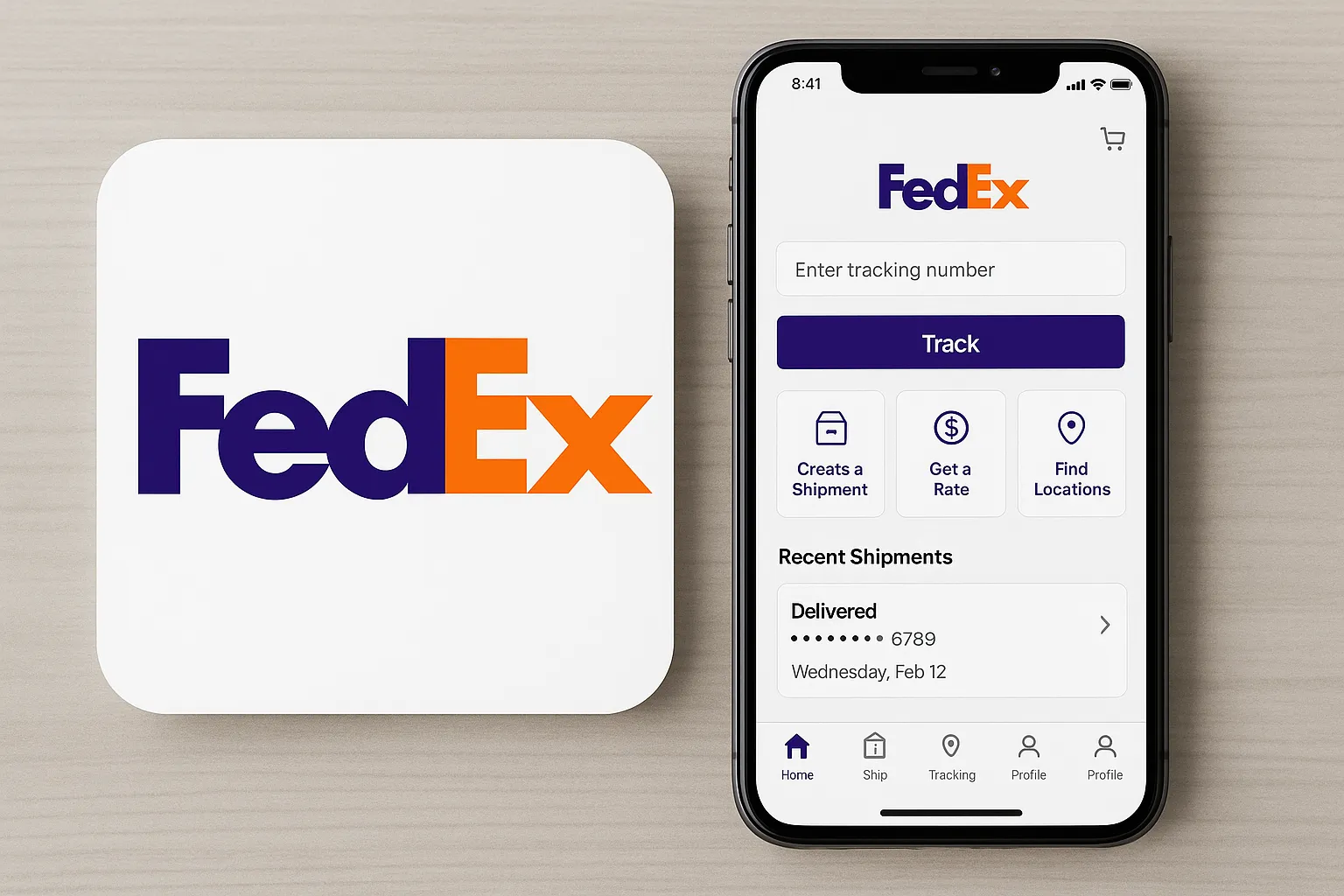
Imagine you’ve ordered an urgent document pickup or an international shipment that needs tracking every step of the way. The FedEx App makes this seamless — letting you book, ship, and track deliveries globally, right from your phone. And if you’re an entrepreneur inspired by this efficiency, a FedEx clone app can help you build a similar logistics platform with real-time tracking, smart automation, and global reach.
Founded in 1971, FedEx began as a small overnight delivery service and has since evolved into a global logistics powerhouse. With its official mobile app, FedEx has digitized the shipping process, providing instant tracking, smart label printing, and delivery scheduling across 220+ countries.
In 2025, over 65 million users rely on the FedEx App for both personal and business logistics — making it a leader in digital shipping solutions worldwide.
What is FedEx? The Simple Explanation
The FedEx App is a digital logistics companion that helps users ship, track, manage, and schedule deliveries directly from their smartphones or desktops. Whether it’s sending a document across town or shipping goods internationally, the app provides a one-stop platform for every logistics need.
Core Problem It Solves
Before apps like FedEx, customers faced uncertainty about package status, long lines at shipping centers, and slow customer service. The FedEx App solved this by offering real-time shipment visibility, digital documentation, and automated support — putting control back in users’ hands.
Read more: How to Build an App Like FedEx – A Developer’s Guide from Scratch
Target Users and Use Cases
- Individual users: For sending personal parcels, gifts, and documents.
- Businesses & eCommerce sellers: To manage bulk shipments, generate labels, and integrate with online stores.
- Corporate clients: For managing large-scale logistics, tracking invoices, and automating supply chain updates.
Common use cases include:
- E-commerce order fulfillment
- International courier management
- Return shipments
- Scheduled pickups for businesses
Current Market Position (2025 Stats)
- Active app users: 65+ million worldwide
- Daily shipments managed: Over 16 million
- App downloads: 50M+ across Android and iOS
- Countries covered: 220+
- Customer satisfaction rate: 4.7/5 based on App Store ratings
FedEx continues to dominate the logistics market, maintaining its reputation for speed, reliability, and transparency in global delivery operations.
Why It Became Successful
FedEx succeeded because it combined powerful backend logistics with user-centric technology. Features like live package tracking, digital customs forms, push notifications, and automated delivery rescheduling created a smooth, trustworthy experience — something traditional courier systems lacked.
How Does the FedEx App Work? Step-by-Step Breakdown
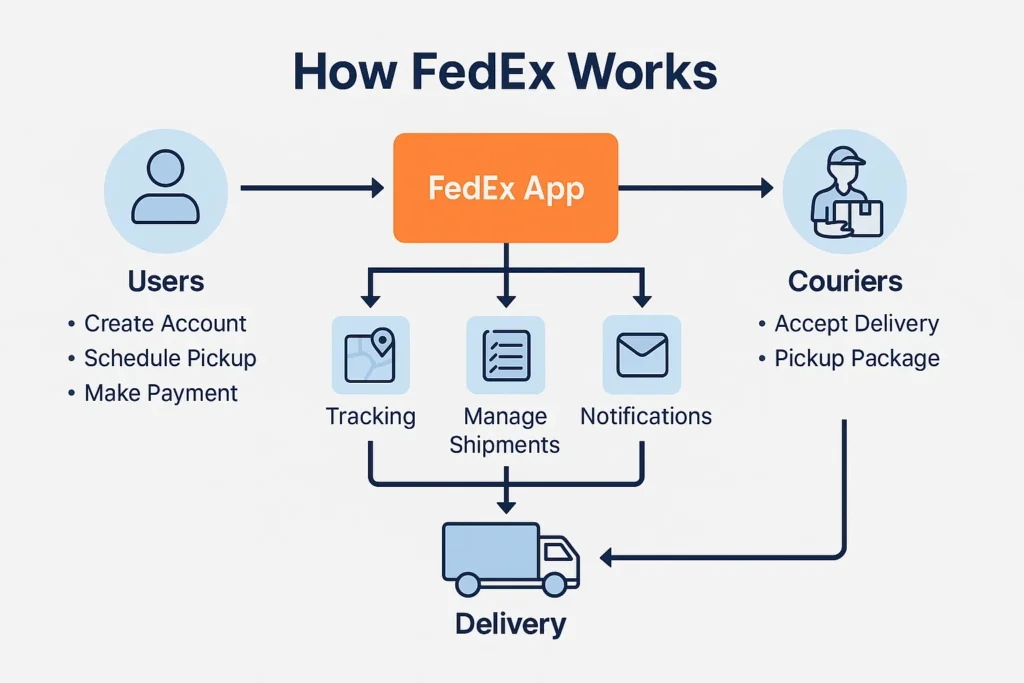
Let’s break down how the FedEx App actually works for both users and service providers, plus a quick look under the hood at its technical flow.
For Users (Customers)
1. Account Creation
Users can sign up using their email, mobile number, or business account ID. FedEx also supports single sign-on (SSO) for enterprise users, making access quick and secure.
2. Shipment Booking
After logging in, users can:
- Enter pickup and delivery addresses
- Choose service type (SameDay, International Priority, Economy, etc.)
- Estimate costs instantly with the in-app rate calculator
- Schedule pickup times and select packaging options
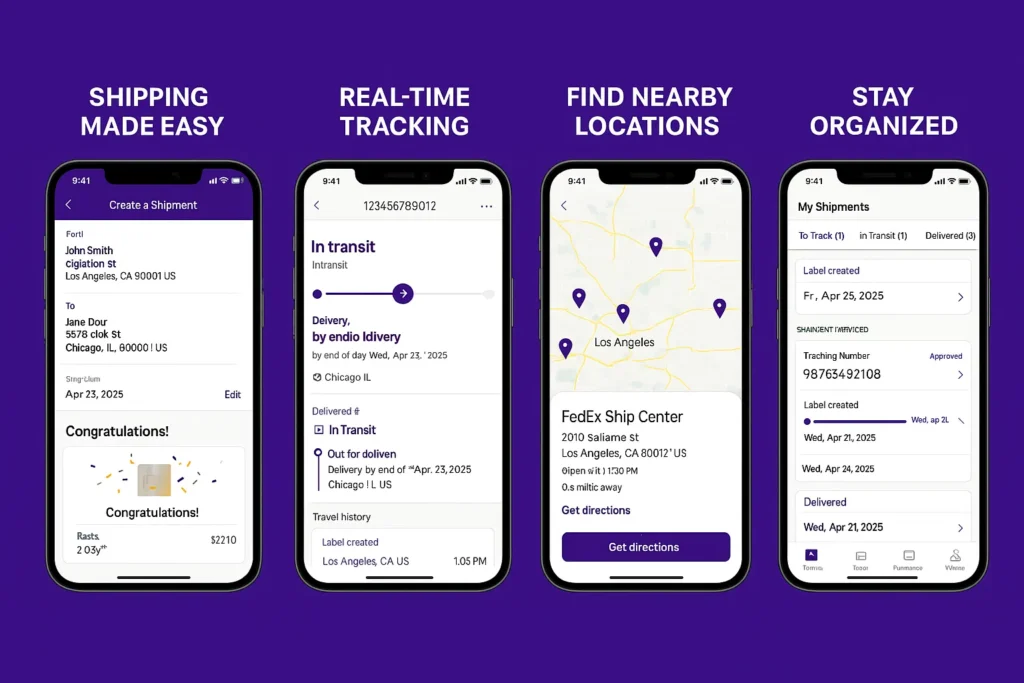
3. Tracking & Notifications
Once shipped, users get a unique tracking ID. The app provides:
- Real-time location updates
- Delivery progress timeline
- Push notifications for each milestone
- Predictive delivery estimates (AI-based ETA predictions in 2025 update)
4. Delivery & Proof
Upon delivery, users receive:
- Digital proof of delivery (POD) with signature/photo
- Automated invoice generation
- Option to rate the service or schedule returns
Example:
Imagine Priya in Mumbai ships a parcel to London using FedEx Priority Overnight. She books via the app, pays online, and tracks it live — watching it move across sorting hubs until it arrives at her recipient’s doorstep within 24 hours.
For Service Providers (FedEx Agents & Partners)
1. Onboarding
FedEx-certified partners register through the internal partner portal, providing business documents and completing compliance checks.
2. Operations via App Dashboard
Partners can:
- Manage pickups and drop-offs
- Scan barcodes for package updates
- Access shipment data and route optimization suggestions
- Communicate directly with customers via in-app chat
3. Earnings & Commission
Commissions vary by region and service:
| Service Type | Avg. Commission | Payment Cycle |
| Domestic Courier | 12–15% | Weekly |
| International | 8–10% | Bi-weekly |
| Freight/Logistics | Custom | Contract-based |
FedEx uses a transparent earning system where partners can view performance reports, payout history, and delivery KPIs directly in the app.
Technical Overview (Simplified)
Behind the scenes, the FedEx App integrates a powerful logistics architecture:
- Frontend: React Native for cross-platform mobile support
- Backend: Node.js and Java with RESTful APIs
- Database: Oracle + MongoDB hybrid for speed and scalability
- AI Layer: Predictive route optimization and ETA forecasting
- Cloud Infrastructure: AWS and Azure hybrid cloud
- Tracking System: GPS + IoT sensors for package location accuracy
This combination ensures 24/7 uptime, fast processing, and secure transactions for millions of shipments daily.
FedEx’s Business Model Explained
The FedEx App is more than just a delivery platform — it’s a multi-channel logistics ecosystem that generates revenue through diversified streams. Let’s unpack how it makes money, the pricing structure, and the market power behind it.
How FedEx Makes Money
FedEx operates on a multi-revenue model combining service fees, logistics contracts, surcharges, and value-added services. Here are the main revenue channels:
| Revenue Source | Description | Example |
| Shipping Charges | Fees paid by customers for domestic and international deliveries | Overnight delivery from NYC to LA |
| Value-Added Services | Insurance, signature confirmation, weekend delivery, etc. | Additional $3–$10 per service |
| Customs & Brokerage Fees | For cross-border logistics and paperwork | International imports/exports |
| Fuel Surcharges | Variable fee adjusted with fuel price changes | Typically 8–15% of delivery cost |
| E-commerce Fulfillment | Partnerships with online sellers for storage and delivery | FedEx Fulfillment program |
| API Integrations | Businesses pay to integrate FedEx APIs into their websites/apps | Shopify, WooCommerce, etc. |
| Subscription & Membership Plans | FedEx Advantage® and business plans offer discounts for high-volume shippers | Annual memberships or volume-based pricing |
Pricing Structure (2025 Overview)
FedEx pricing varies based on distance, weight, service type, and urgency. Below are average rates in 2025:
| Service | Avg. Cost (per kg) | Delivery Time | Target Users |
| FedEx SameDay | $10–$20 | Within hours | Businesses, urgent couriers |
| FedEx Express Saver | $5–$8 | 1–3 days | SMEs, retailers |
| FedEx International Priority | $12–$25 | 1–2 days | Global shipments |
| FedEx Freight | $50+ | 3–7 days | Bulk logistics |
Read more: Business Model of FedEx : Complete Strategy Breakdown 2025
Commission & Fees Breakdown
- Service Providers: 8–15% commission based on volume
- Fuel surcharge (variable): Adjusted weekly
- Peak-season surcharges: +10–20% (Q4 2024–Q1 2025)
- Residential delivery fee: $3.50–$5.00
Market Size & Growth (2025 Data)
- Global logistics market: $10.2 trillion (2025, projected CAGR 6.8%)
- FedEx annual revenue (FY 2024): $90.2 billion
- Mobile app–based shipments: 38% of total FedEx bookings
- SME user growth: +23% YoY via digital platforms
FedEx’s app-first strategy has helped capture the digitally-driven logistics boom, especially from eCommerce and B2B automation.
Profit Margins Insights
Despite operational costs, FedEx maintains:
- Net margin: 8–9% (2025 est.)
- Average revenue per shipment: $12.8
- Operational efficiency gains: 17% improvement with AI route optimization
These efficiencies allow FedEx to maintain competitive pricing while enhancing user experience through technology.
Key Features That Make FedEx Successful
The FedEx App stands out because it’s not just about deliveries — it’s about control, visibility, and trust in every shipment. Over the years, FedEx has transformed its app into a complete logistics assistant powered by technology, automation, and AI. Here are the top 10 features that make it successful in 2025.
1. Real-Time Package Tracking
Why it matters: Customers want to know where their parcel is — instantly.
Benefit: The FedEx app provides live GPS-based updates, location history, and estimated delivery times using AI prediction models.
Innovation: IoT-enabled scanning devices update shipment status every few minutes.
2. Predictive Delivery Estimates (AI-Driven)
Why it matters: Traditional tracking only showed “in transit” updates.
Benefit: The 2025 version uses machine learning models to predict the exact hour of delivery based on route traffic, weather, and courier performance.
3. Easy Label Generation & Paperless Shipping
Why it matters: Manual labels are slow and error-prone.
Benefit: Users can generate shipping labels digitally, schedule pickups, and scan QR codes — no printer needed.
Innovation: Integration with Apple Wallet and Google Wallet for label storage.
4. Smart Notifications
Why it matters: Users don’t want to refresh the app repeatedly.
Benefit: Push alerts for every milestone — pickup, transit, customs clearance, and delivery.
Innovation: Users can customize notification types and frequency.
5. In-App Customs and Duties Estimator
Why it matters: International shipping often brings surprise charges.
Benefit: The app calculates customs duties and taxes upfront.
Innovation: FedEx partners with government APIs for real-time customs data.
6. Proof of Delivery (POD) with Signature & Photo
Why it matters: Reduces disputes and ensures accountability.
Benefit: Digital signatures or photo-based confirmations instantly stored in the user’s order history.
7. Secure Payments & Billing Integration
Why it matters: B2B users need structured billing and invoices.
Benefit: Integration with PayPal, Apple Pay, and direct invoice downloads.
Innovation: Subscription-based discounts for bulk shippers.
8. Returns & Reverse Logistics
Why it matters: Return logistics are critical for eCommerce sellers.
Benefit: One-tap return creation, printable QR code, and door pickup.
Innovation: AI detects frequent return patterns for seller insights.
9. Multi-Stop Route Optimization (2025 Update)
Why it matters: Drivers save time and fuel.
Benefit: FedEx’s AI maps out shortest and most efficient delivery routes for couriers in real time.
Innovation: Integration with Google Maps API and FedEx proprietary routing AI.
10. Enhanced Security & Fraud Detection
Why it matters: Online shipments face risks of tampering or misdelivery.
Benefit: AI models detect unusual delivery patterns and alert both sender and recipient.
Innovation: Blockchain-backed proof-of-ownership testing in pilot programs.
Read more: Must-Have FedEx Features for Delivery App Startups
Recent 2025 Updates
- AI Customer Support Assistant integrated with ChatGPT API for instant help
- Voice Search for Shipments using Google Assistant and Siri
- FedEx Carbon Footprint Tracker for sustainable shipping choices
- Instant QR Returns feature for contactless returns
What Sets FedEx Apart
Unlike standard courier apps, FedEx offers:
- Global coverage (220+ countries)
- B2B integrations with ERP and CRM systems
- Enterprise analytics dashboard for logistics teams
- 24/7 support through chat and phone integration
Together, these create a smart, scalable logistics solution trusted by individuals and corporations alike.
The Technology Behind FedEx
Behind FedEx’s seamless deliveries and real-time tracking lies a powerful technology ecosystem that blends AI, automation, and secure cloud infrastructure. Let’s break down how the FedEx App and its logistics backbone work in 2025.
Tech Stack Overview (Simplified)
| Layer | Technology | Purpose |
| Frontend (App) | React Native, Flutter | Cross-platform app for iOS & Android |
| Backend | Node.js, Java Spring Boot | High-performance API handling |
| Database | Oracle + MongoDB | Combines structured shipment data with real-time tracking logs |
| Cloud Infrastructure | AWS + Microsoft Azure hybrid | Ensures 99.99% uptime and global scalability |
| AI/ML Layer | Python (TensorFlow, PyTorch) | Route prediction, fraud detection, ETA optimization |
| APIs & Integrations | FedEx RESTful API Suite | Enables third-party apps and eCommerce integration |
| Analytics | Power BI + Snowflake | Business intelligence, route efficiency, and customer insights |
Real-Time Features Explained
FedEx’s app is powered by live synchronization between drivers, sorting centers, and customers.
- IoT-enabled scanners update package status every few minutes.
- GPS + Geo-Fencing ensure accurate courier tracking.
- Push-based architecture (using WebSockets) delivers instant status updates.
This allows customers to view their shipment journey — literally, second by second.
Data Handling & Privacy
FedEx follows strict data privacy protocols across its global operations:
- End-to-end 256-bit encryption for all transactions.
- GDPR and CCPA compliant data policies.
- Sensitive shipment and address data anonymized after 30 days.
- Biometric access (Face ID, fingerprint) for business accounts.
FedEx also utilizes AI-driven anomaly detection to prevent data breaches and unauthorized access attempts.
Scalability Approach
To handle millions of daily shipments, FedEx uses:
- Microservices architecture for modular scalability
- Auto-scaling cloud clusters to manage high-demand periods (like Black Friday)
- Content Delivery Networks (CDNs) for global data sync and low-latency operations
Result: The system supports over 16 million daily shipments without downtime.
Mobile App vs. Web Platform
| Feature | Mobile App | Web Platform |
| Ease of use | 1-tap access | Dashboard view for businesses |
| Tracking updates | Push notifications | Bulk shipment analytics |
| Best for | Individuals & SMEs | Enterprises & logistics managers |
Both are synced under a single account, ensuring continuity across devices.
API Integrations & Ecosystem
FedEx’s API suite powers hundreds of eCommerce and enterprise platforms:
- Shopify, WooCommerce, Magento (for eCommerce logistics)
- Salesforce, SAP, Oracle ERP (for enterprise automation)
- Third-party courier partners for regional delivery optimization
Developers can also use the FedEx Developer Portal to integrate shipment tracking, rate calculation, and pickup scheduling directly into their apps.
Why This Tech Matters for Business
This robust infrastructure gives businesses:
- Faster deliveries via automated route assignment
- Lower costs through real-time analytics and AI planning
- Higher customer retention via accurate delivery ETAs
- Reduced carbon footprint using optimized logistics paths
FedEx has turned technology into its competitive advantage, ensuring reliability at global scale.
FedEx’s Impact & Market Opportunity
The FedEx App has redefined how people and businesses think about global logistics. It’s not just a courier tool—it’s a digital logistics powerhouse that connects continents, accelerates trade, and empowers entrepreneurs.
Industry Disruption
Before digital logistics apps, international shipping was slow, opaque, and document-heavy.
FedEx revolutionized this by offering:
- Real-time tracking transparency
- Digital documentation and customs clearance
- AI-powered delivery predictions
This tech-first approach positioned FedEx as a pioneer of digital transformation in the logistics sector, forcing competitors like DHL and UPS to upgrade their tech ecosystems to keep pace.
Market Statistics (2025 Update)
| Metric | 2025 Value | Growth |
| Global logistics market size | $10.2 trillion | CAGR 6.8% |
| Cross-border eCommerce shipments | 5.3 billion parcels/year | +19% YoY |
| FedEx app active users | 65 million+ | +12% YoY |
| App downloads (iOS + Android) | 50 million+ | +18% YoY |
| AI automation adoption rate | 72% of FedEx operations | +20% YoY |
FedEx’s continued investment in digital-first logistics gives it a sustainable edge in an increasingly app-driven economy.
User Demographics & Behavior
- 55% of app users are eCommerce sellers and small businesses.
- 30% are corporate logistics clients using FedEx dashboards for analytics.
- 15% are individual consumers for personal shipments.
- Top usage regions: USA, India, UK, Germany, UAE, and Singapore.
Interestingly, India and Southeast Asia have seen the highest year-over-year growth due to booming online retail exports.
Geographic Presence
FedEx operates in 220+ countries with:
- 700+ aircraft
- 180,000+ ground vehicles
- 5,000+ logistics facilities
- 600,000+ employees worldwide
This immense reach is tightly integrated with the FedEx App’s real-time infrastructure, ensuring consistency across borders.
Future Projections (2025–2030)
Analysts predict:
- Global digital logistics apps will surpass $250 billion market cap by 2030.
- FedEx aims to automate 85% of shipment processes using AI and robotics.
- FedEx’s carbon-neutral goal by 2040 will drive eco-focused delivery innovation.
- Drone and autonomous vehicle delivery pilots are expected to roll out in select US and EU regions by late 2026.
Opportunities for Entrepreneurs
The success of FedEx highlights a massive opportunity for startups and tech founders:
- On-demand courier apps for local and regional markets
- Niche delivery platforms (e.g., pharmacy, groceries, legal docs)
- White-label logistics APIs for eCommerce integrations
- Sustainable delivery solutions using EV fleets
The logistics and delivery ecosystem is expanding fast — and entrepreneurs can build profitable FedEx-like solutions by leveraging proven clone models and next-gen technology.
Building Your Own FedEx-Like Platform
With global eCommerce expanding and logistics technology advancing rapidly, creating your own FedEx-like platform is one of the most profitable ventures in 2025. Whether you’re targeting a niche market (like groceries, B2B freight, or cross-border delivery) or replicating the full courier ecosystem, the opportunity is enormous.
Why Businesses Want FedEx-Like Clones
- Proven Business Model – FedEx’s tech-driven delivery approach is already validated and trusted by millions worldwide.
- Scalable Market Demand – Every country now needs fast, transparent, app-based logistics.
- Recurring Revenue Streams – Multiple monetization options: delivery fees, commissions, partner APIs, and enterprise plans.
- Faster Launch Time – With ready-made FedEx clone scripts, entrepreneurs can go live in under 14 days.
- Lower Development Risk – Miracuves provides pre-tested frameworks that eliminate bugs, delays, and technical uncertainty.
Key Considerations for Development
When planning your FedEx clone, focus on:
| Aspect | Description |
| User App | Clean UI for booking, tracking, and payments |
| Driver/Partner App | Route optimization, earnings reports, and GPS navigation |
| Admin Dashboard | End-to-end analytics, shipment control, and user management |
| AI & Automation | Smart routing, predictive ETAs, and demand forecasting |
| Security | End-to-end encryption, OTP verifications, and digital PODs |
| Scalability | Cloud infrastructure capable of handling thousands of concurrent users |
Cost Factors & Pricing Breakdown
Fedex-Like App Development — Market Price
| Development Level | Inclusions | Estimated Market Price (USD) |
| Basic Logistics MVP | Shipment booking, tracking page, courier roles, simple dispatch workflow | $60,000 |
| Mid-Level Courier & Parcel Delivery System | Multi-hub routing, courier app, parcel status updates, mobile apps, payment integration | $180,000 |
| Advanced Logistics Platform (FedEx-scale) | Real-time shipment tracking, multi-warehouse automation, API integrations, high-concurrency backend, fleet management, native apps | $250,000+ |
These amounts reflect the global market cost to build a FedEx-style logistics and courier delivery platform from scratch, typically requiring 6–12 months of development depending on routing complexity, multi-hub automation, and real-time tracking integrations.
Miracuves fedex-Style Marketplace Pricing
Miracuves Price: Starts at $2,899
This solution is built with robust frameworks — Web using PHP + MySQL and Apps using Flutter, ensuring smooth parcel management, reliable tracking, and stable multi-hub logistics operations.
Note: This includes full non-encrypted source code, complete deployment support, backend setup, admin panel configuration, and publishing on Google Play Store & Apple App Store—ensuring you receive a fully operational, launch-ready logistics platform.
Delivery Timeline for FedEx
Deployment is rapid — 3–9 days, since it is a fully developed readymade solution requiring only branding, setup, and configuration.
Tech Stack
This solution is built with robust frameworks — Web using PHP, MySQL & Apps using Flutter, optimized for performance, stability, and easy maintenance. Other tech stacks can be discussed and arranged upon request — Contact us
Essential Features to Include
- Real-time GPS tracking
- Multi-service booking (express, freight, returns)
- Smart rate calculator
- Label generator & barcode scanner
- AI-powered route optimization
- Wallet, invoice, and subscription modules
- Partner/driver onboarding and payout systems
- Push notifications & delivery alerts
Conclusion
In 2025, the FedEx App stands as a benchmark for what smart, scalable, and customer-first logistics technology can achieve. From real-time shipment tracking to AI-driven delivery predictions, FedEx has turned complex global supply chains into seamless user experiences — all from the palm of your hand.
But what truly sets FedEx apart is its vision for the future — sustainability, automation, and precision at scale. Its success story is proof that with the right mix of technology, strategy, and user focus, logistics can become faster, smarter, and more transparent than ever before.
For entrepreneurs, this is the perfect moment to act. The market for app-based logistics platforms is expanding rapidly across the globe — from local courier startups to full-scale international delivery solutions. And with Miracuves Technologies, building your own FedEx-like platform has never been easier.
Turn your idea into a scalable FedEx-style logistics app. Miracuves provides ready-made FedEx clone scripts with real-time tracking, payments, and route optimization. Get Started with Miracuves today!
FAQs
Q:1 How does the FedEx App make money?
The FedEx App earns revenue through shipping fees, customs and fuel surcharges, eCommerce integrations, and subscription-based business services.
Q:2 Is the FedEx App available in my country?
Yes. The FedEx App operates in 220+ countries and territories, making it one of the most globally accessible logistics platforms.
Q:3 How much does FedEx charge users?
Pricing depends on distance, service type, and urgency — typically ranging from $5 to $25 per kilogram for express and international shipments.
Q:4 What’s the commission for service providers or partners?
FedEx partners earn 8–15% commission per shipment, with variations based on delivery volume, region, and type of service.
Q:5 How does FedEx ensure package safety?
FedEx uses IoT-enabled scanners, GPS tracking, photo-based proof of delivery, and blockchain-backed verification systems to ensure security and authenticity.
Q:6 Can I build something similar to the FedEx App?
Absolutely! With Miracuves’ FedEx Clone Solution, you can build and launch your own custom logistics app within 3-9 days, tailored to your market.
Q:7 What makes FedEx different from competitors like DHL or UPS?
FedEx offers real-time tracking precision, AI-driven ETA predictions, and superior app usability, setting it apart in speed, transparency, and global reach.
Q:8 How many users does FedEx have in 2025?
As of 2025, the FedEx App has over 65 million active users and facilitates more than 16 million shipments daily worldwide.
Q:9 What technology does FedEx use?
FedEx’s ecosystem runs on React Native, Node.js, Oracle, MongoDB, AWS, and AI/ML models for routing, delivery prediction, and fraud prevention.
Q:10 How can I create an app like FedEx?
Partner with Miracuves Technologies, experts in clone app development.
They offer ready-made FedEx-like logistics scripts that can be customized, scaled, and deployed in 3-9 days with full tech support.
Related Articles: