

Key Takeaways
What You’ll Learn
- Google Flights helps users compare and book airline tickets faster.
- Price tracking, date grids, and price graphs help find better fares.
- Best Flights, Cheapest Flights, and Explore make search easier.
- The platform focuses on speed, flexibility, and fare insights.
- It shows how travel platforms can improve booking with real-time pricing data.
Stats That Matter
- Google Flights compares fares across airlines and booking partners.
- Date Grid, Price Graph, Explore, and Price Tracking help users plan smarter.
- Price Tracking alerts users when fares change.
- Best Flights balance price and convenience, while Cheapest Flights focus on lower fares.
- Flexible dates and multi-airport search improve travel options.
Real Insights
- Google Flights reduces confusion in flight booking.
- Fare alerts help users avoid overpaying.
- Flexible search tools make cheaper options easier to find.
- Fast filters improve the travel search experience.
- The strongest flight platforms combine pricing data, alerts, and smooth booking workflows.
Imagine you’re planning a trip from Los Angeles to New York, or maybe you just want to go somewhere affordable next month. You open one airline website, then another, then maybe a travel app, then another browser tab for price comparison.
A few minutes later, you still have the same problem.
You don’t really know if you found the best fare, the best timing, or the smartest booking option.
That’s exactly where Google Flights becomes useful.
Google Flights helps travelers compare airfare quickly, explore cheaper dates, track price changes, and discover destinations without manually checking dozens of websites. Google’s official platform says users can explore and compare cheap flights to anywhere, track price changes, and find the best deals more easily.
How Google Flights Started and Why It Matters
Google Flights is part of Google Travel and has become one of the most widely used flight search tools in the world. It is designed to help users find plane tickets faster by combining search, comparison, flexible-date tools, and price tracking in one interface. Google’s help documentation says users can find round-trip, one-way, and multi-city tickets, use an interactive calendar and price graph, and filter by cabin class, airline, and stops.
What makes Google Flights especially important is that it goes beyond a basic search engine. It gives travelers tools to compare fares over time, track route prices, explore destination options, and understand when a fare may be a better deal. Google also now highlights “Best” and “Cheapest” result tabs, which helps users compare not just raw prices but overall value.
What You’ll Learn in This Guide
By the end of this guide, you’ll clearly understand what Google Flights is, how Google Flights works, why so many travelers use it before booking, how its business model fits into Google’s travel ecosystem, which features make it powerful, and why many businesses want to build similar flight-search platforms. Google’s current product already shows why the model is so attractive: it combines search, flexible pricing tools, fare tracking, and destination discovery in one clean experience.
What Is Google Flights? The Simple Explanation
What Is Google Flights ?
Google Flights is a flight search and fare-comparison tool that helps travelers find, compare, and track airfare across airlines and travel providers. It lets users search for one-way, round-trip, and multi-city flights, compare dates, filter by stops and airlines, and monitor prices over time. Instead of acting like a full travel agency, Google Flights mainly helps people research and compare options before choosing where to book. Google’s own help pages describe it as a tool for finding plane tickets with calendars, price graphs, filters, and price tracking features.
The Core Problem Google Flights Solves
Flight booking is often confusing because prices change constantly, schedules vary, and different providers may show different fares. Travelers usually waste time checking several airline sites and travel apps just to figure out whether a fare is actually good.
Google Flights solves that by bringing search, comparison, and price tracking into one interface. Google says users can explore and compare cheap flights, track price changes, and find the best deals more easily. It also lets users compare flights using “Best” and “Cheapest” tabs, which helps people think beyond the lowest price alone.
In simple terms, Google Flights helps travelers search faster and book with more confidence.
Who Uses Google Flights?
Google Flights is useful for several kinds of travelers:
• Travelers with fixed routes who want fast fare comparison
• Flexible travelers searching for cheaper dates or destinations
• Budget travelers watching price changes before booking
• Frequent flyers comparing schedules, airlines, and stop counts
• Travelers who want to research first and book later with the provider they prefer
Because the tool supports calendar-based comparison, route tracking, and destination exploration, it works well both for highly specific searches and for more open-ended trip planning.
Google Flights’ Market Position
Google Flights is one of the most widely used flight-search tools in the world, largely because it is simple, fast, and tied into Google’s broader travel ecosystem. Its live product pages focus heavily on exploring cheap flights globally, tracking price changes, and surfacing flight deals through both classic search and newer AI-based deal discovery. Google also now has AI-powered Flight Deals that let users describe a trip idea in natural language and receive tailored bargains.
Why Did Google Flights Become So Successful?
Google Flights became successful because it combines three things very well:
• Fast flight comparison
• Strong flexible-date and tracking tools
• Simple user experience with helpful decision support
It is especially strong at showing travelers whether a fare is worth booking now or worth watching. Google’s help pages highlight features like price tracking, Best vs Cheapest views, and fare calendars, while some itineraries also display a price guarantee badge when Google’s systems are confident the fare is the lowest available before departure.
What Makes Google Flights Different from Traditional Flight Booking?
Traditional flight booking usually means going directly to an airline or online travel agency and seeing only that seller’s options. Google Flights is different because it is built for comparison first. It helps users search across routes, dates, and providers, then decide when and where to book.
What makes it especially useful is that it does not just show flights — it also helps users understand pricing trends, compare value with the Best and Cheapest tabs, and track routes over time. That makes it more of a decision tool than a simple booking page.
How Does Google Flights Work? Step-by-Step Breakdown
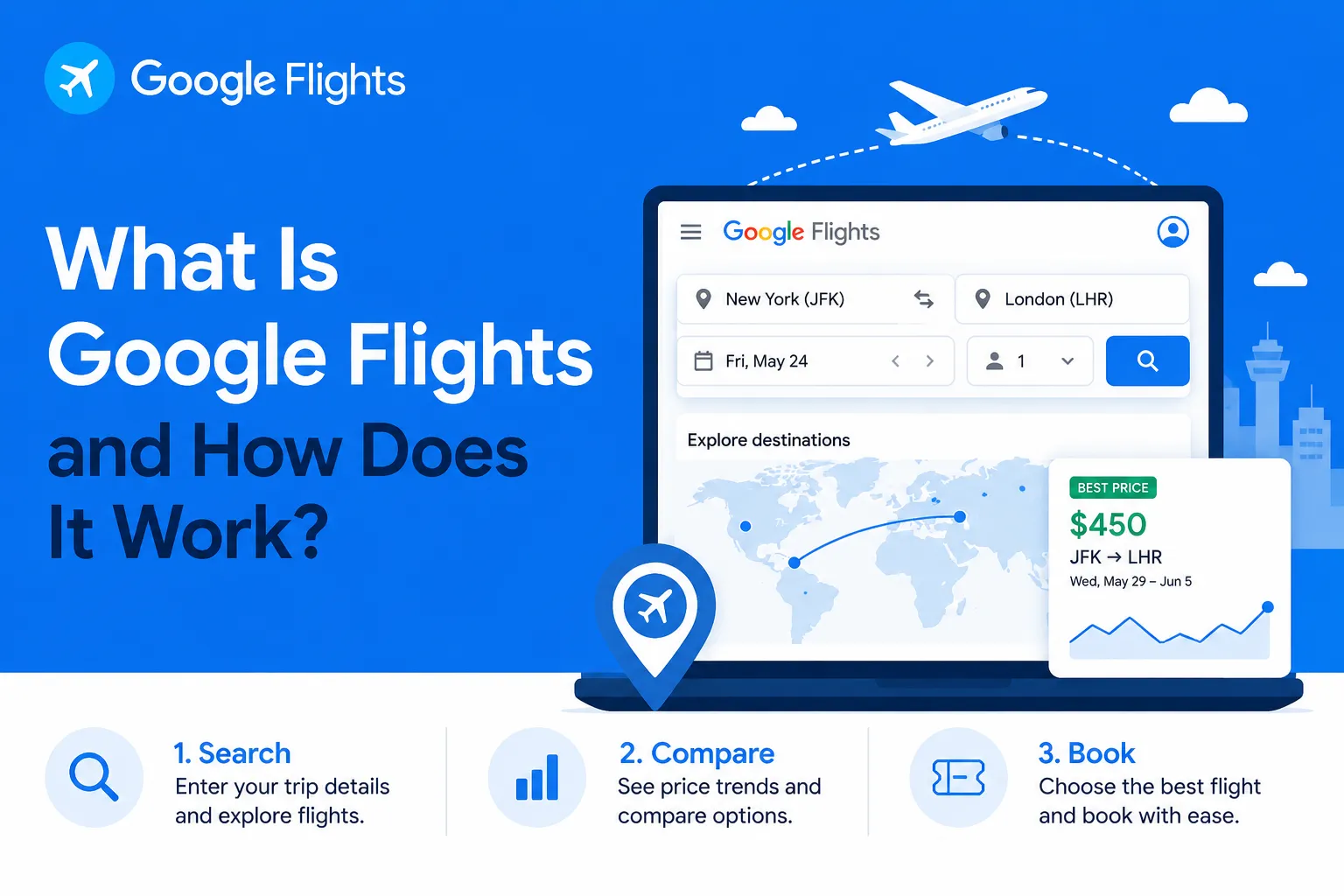
Google Flights works like a flight search and comparison engine. You enter where you want to fly, when you want to go, and how many people are traveling. Google Flights then pulls together flight options, shows them in one interface, and helps you compare them using calendars, graphs, filters, and price-tracking tools. Google’s help pages say users can search round-trip, one-way, and multi-city tickets, use an interactive calendar and price graph, and filter by airline, cabin class, and number of stops.
How Google Flights Works for Travelers
Search Your Route
• Open Google Flights
• Enter your departure airport, destination, and travel dates
• Choose round-trip, one-way, or multi-city
• Set passenger count, cabin class, and stop preferences
Once you search, Google Flights shows available itineraries and lets you refine them using filters like airlines, bags, stops, and trip length. Google’s official help documentation confirms these search and filter options are built into the platform.
Compare Results in a Smarter Way
One of the most useful things Google Flights does is help users compare value, not just raw fares. Google says search results automatically show two tabs: Best and Cheapest. The Best tab favors a balance of price, convenience, and ease of booking, while the Cheapest tab prioritizes lower prices, even if those itineraries may involve trade-offs like longer travel time or online-travel-agency combinations.
That means travelers do not just see “the lowest number.” They also get help deciding whether a fare is actually worth booking.
Use the Calendar and Price Graph
If your dates are flexible, Google Flights becomes much more powerful.
After you search, Google lets you use:
• An interactive calendar
• A price graph
• Flexible-date comparisons
Google’s support pages say the calendar and graph help users find the best fares, and its flexible-date help explains that the calendar shows low prices for trips beginning on the selected day.
This is especially useful if you care more about getting a cheaper fare than flying on one exact date.
Track Prices Instead of Booking Immediately
If you are not ready to book, Google Flights lets you track prices. Google says users can turn on Track prices for searched dates or even for Any dates if plans are flexible. When the price changes significantly, users can receive email updates. You can also track a specific flight after selecting it.
This feature is one of the main reasons travelers use Google Flights early in the planning process instead of only at the final booking stage.
Explore Destinations If You Are Flexible
Google Flights also supports destination discovery through Explore. Instead of choosing one fixed destination first, users can browse cheaper flight options to many places and compare them by budget, timing, and travel preferences. Google’s Explore pages describe it as a way to compare cheap flights to anywhere, track price changes, and find the next trip more easily.
So if you know you want a trip but do not know where to go yet, Google Flights can help narrow that down.
Book with the Airline or Travel Partner
After you choose a flight, Google Flights usually sends you to the airline or booking partner to complete the purchase. In other words, Google Flights helps with the research and comparison stage, but the final payment and ticketing normally happen with the provider. That behavior is consistent with Google Flights’ role as a search-and-comparison product rather than a full-service airline agency. This is partly an inference from the product flow, supported by Google’s search-and-help documentation.
Technical Overview Explained Simply
At a simple level, Google Flights works like this:
• You enter a route and dates
• Google organizes flight options into results
• You compare them using filters, graphs, and Best vs Cheapest views
• You can track prices if you want to wait
• When ready, you choose an itinerary and move to the booking provider
The product is built to help travelers answer four key questions quickly: What are my options? Which one is best? Should I book now? Should I change dates? Google’s official pages specifically highlight search tools, price tracking, Explore, and Best vs Cheapest result views as part of that workflow.
Google Flights’ Business Model Explained
Google Flights is not a traditional airline or a typical online travel agency. Its role is mainly to help users search, compare, and track fares, then send them to the airline or online travel agency to complete the purchase. Google’s own help pages say that when a user clicks Select for a ticket, they are usually taken to the airline’s website or an online travel agency to finish the transaction, and any booking changes or problems are handled with that provider.
How Google Flights Makes Money
Google Flights does not work like a platform that primarily earns by issuing tickets itself. Instead, its value comes from:
• directing high-intent travel traffic to airlines and online travel agencies
• strengthening Google’s broader travel-search ecosystem
• supporting partner visibility and booking referral flows
• creating more travel-related search activity inside Google products
Google’s help pages confirm that Google Flights works with more than 300 airline and online travel agency partners, and that users are typically redirected to those partners to complete bookings.
Referral and Partner-Driven Value
The clearest business logic behind Google Flights is partner redirection.
Here’s how that works:
• a traveler searches for a route on Google Flights
• Google compares available offers from airline and OTA partners
• the traveler selects the option they want
• Google sends the traveler to the provider to complete the booking
That means Google Flights owns the comparison stage, while the airline or agency owns the final sale. Even when Google does not directly process the booking, controlling this decision stage is extremely valuable because it influences where the traveler books. Google’s help pages explicitly state that Google Flights allows booking from 300+ partners and that users are usually taken to the airline or OTA site to finish the transaction.
Why It Matters: Google benefits from being the place where flight-buying decisions begin.
Technical Innovation: Search ranking, fare comparison, and redirect systems connect user intent to airline and OTA partner inventory.
Search Ecosystem Value
Google Flights is also strategically important because it strengthens Google’s wider travel and search ecosystem. The tool keeps users inside Google longer, encourages repeat visits for fare tracking, and increases the value of Google Travel as a planning hub.
Google’s own support pages show that the product includes:
• flight search
• price tracking
• cheapest-date and price-graph tools
• Best and Cheapest result tabs
• tracked flights pages for saved routes
These features make Google Flights more than a one-time search tool. They turn it into a recurring travel decision platform.
Why It Matters: The more travelers rely on Google Flights during planning, the stronger Google’s position becomes in travel discovery.
Technical Innovation: Persistent tracking, saved routes, and email alerts create repeat engagement instead of one-off search use.
Why Airlines and OTAs Benefit Too
Google Flights is useful to airlines and online travel agencies because it can send them highly qualified traffic. These are not casual browsers — they are users who have already compared routes, dates, and prices and are close to making a booking decision.
Google says partnerships do not affect the ranking of suggested offers, which helps the product maintain trust while still working as a major distribution channel for airlines and travel agencies.
Why It Matters: Providers get access to motivated travelers who are close to converting.
Technical Innovation: Large-scale partner integration makes Google Flights a major discovery channel without turning it into a classic OTA.
Market Strength Behind the Model
This model works because Google Flights operates at huge scale and combines that reach with strong utility. Google’s live Flights interface includes dedicated sections for Flight Deals and Tracked flight prices, while its help pages show mature features like route tracking, any-date tracking, price graphs, and flexible-date discovery. That combination helps Google capture users early in the booking journey and keep them engaged until they are ready to buy.
Revenue Model Breakdown
| Revenue Stream | How It Works | Why It Matters |
|---|---|---|
| Partner Referral Value | Users are sent to airlines or OTAs to book | Core comparison-to-booking model |
| Search Ecosystem Retention | Users keep returning for tracking and comparison | Strengthens Google Travel engagement |
| Travel Discovery Influence | Google owns the decision stage before booking | Makes the platform strategically powerful |
| Provider Distribution Channel | Airlines and OTAs gain qualified booking traffic | Increases partner value |
Google Flights’ business model is powerful because it does not need to sell the ticket itself to influence the booking. It wins by owning the comparison moment — the point where travelers decide which flight is worth booking and where to book it.
Key Features That Make Google Flights Successful
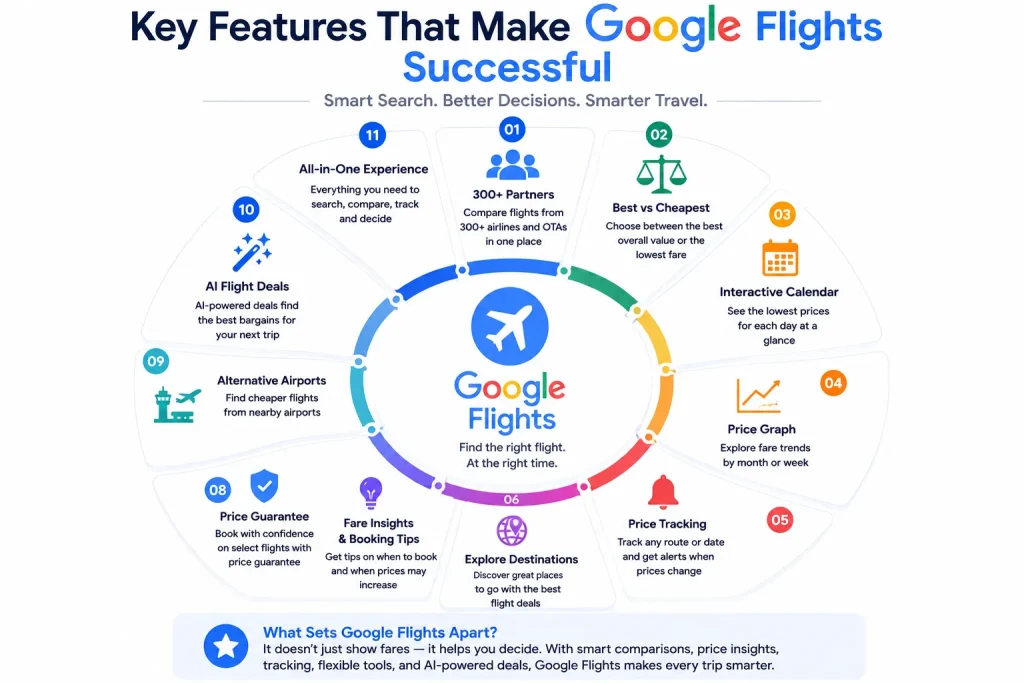
Google Flights has become one of the most trusted flight-search tools because it does more than list fares. It helps travelers compare options faster, understand whether a price is good, explore flexible plans, and decide when to book. Google’s own help and product pages show that the platform now combines core fare search with calendars, graphs, Best vs Cheapest views, tracking, and AI-based deal discovery.
Fast Fare Comparison Across 300+ Partners
Google says Google Flights allows users to book flights from more than 300 airline and online travel agency partners.
Why It Matters: Travelers can see a wide range of options without checking airline and OTA websites one by one.
Technical Innovation: Large-scale partner aggregation and ranking systems pull flight offers into one searchable interface.
Best vs Cheapest Tabs
Google Flights automatically shows results in two tabs: Best and Cheapest. Google says the Best tab focuses on the best trade-off between price, convenience, and ease of booking, while the Cheapest tab prioritizes lower fares, including more OTA-based and trade-off-heavy itineraries.
Why It Matters: Users can choose based on value, not just the absolute lowest number.
Technical Innovation: Ranking logic balances price, duration, stops, airport changes, and booking convenience.
Interactive Calendar
Google Flights lets users use an interactive calendar to find the best fares and shows the lowest total price for each day.
Why It Matters: Travelers with flexible dates can save money by spotting cheaper departure days instantly.
Technical Innovation: Calendar-based fare visualization turns changing airline prices into an easy planning tool.
Price Graph
Google’s help pages say users can use a price graph to explore fare trends by month or week.
Why It Matters: This helps travelers understand whether a route is unusually expensive or relatively affordable right now.
Technical Innovation: Historical and current fare data are turned into trend visuals that support timing decisions.
Route and Flight Price Tracking
Google Flights lets users track prices for a route, for specific dates, or even for Any dates if plans are flexible. Google says users receive email updates when the tracked route price changes significantly.
Why It Matters: Travelers do not need to keep repeating the same search every day.
Technical Innovation: Automated fare-monitoring and notification systems watch selected routes and trigger updates when pricing moves.
Explore Destinations
Google Flights also links to Google’s Explore experience, where users can compare flights to many destinations instead of choosing one exact city first.
Why It Matters: This is ideal for flexible travelers who care more about finding a good trip than flying to one fixed destination.
Technical Innovation: Destination-discovery tools scan many routes and combine them with fare comparison in one map-based experience.
Fare Insights and Booking Tips
After a search, Google Flights shows “Flight insights,” including recommendations for when to book, when prices are less than usual, and when prices are likely to increase.
Why It Matters: Travelers get guidance, not just raw numbers.
Technical Innovation: Predictive pricing analysis uses past fare trends to estimate whether a deal looks strong or whether waiting may be risky.
Price Guarantee on Some Flights
Google has a Price Guarantee feature for some itineraries, where a badge appears when Google is confident the fare is the lowest before departure.
Why It Matters: This gives travelers more confidence that booking now is the right move.
Technical Innovation: Confidence-based fare prediction models support guarantee-style recommendation signals.
Alternative Airports Suggestions
Google Flights’ fare tools also surface cheaper options from nearby airports.
Why It Matters: Travelers can often save money simply by switching airports, especially in large metro areas.
Technical Innovation: Nearby-airport comparison logic broadens the search beyond the exact airport initially entered.
AI Flight Deals Discovery
Google now includes AI-based flight-deal discovery in Google Flights, and its help pages include a dedicated resource for finding flight deals with AI. The live Flights product also highlights Flight Deals and Tracked flight prices directly in navigation.
Why It Matters: This moves Google Flights beyond passive search into proactive deal discovery.
Technical Innovation: AI-assisted travel search helps surface bargain opportunities and simplifies open-ended planning.
What Sets Google Flights Apart
What really sets Google Flights apart is that it helps with the booking decision, not just the search. Plenty of tools can show fares. Google Flights stands out because it layers comparison, timing advice, tracking, flexible-date tools, and value-based ranking into one simple interface. That is why so many travelers use it before they ever book with an airline or OTA.
The Technology Behind Google Flights
Google Flights runs on a large search-and-comparison system that is built to do three things very well: gather flight options from many partners, organize those options into useful comparisons, and help travelers decide whether to book now or wait. Google’s own help pages say Google Flights works with more than 300 airline and online travel agency partners, supports one-way, round-trip, and multi-city search, and includes tools like calendars, price graphs, filters, and price tracking.
Large-Scale Fare Aggregation
One of Google Flights’ core strengths is aggregation. It gathers flight options from hundreds of airline and OTA partners and puts them into one search experience. Google says these partnerships do not affect how offers are ranked.
Why It Matters: Travelers get a broad market view without checking every airline or agency site manually.
Technical Innovation: Multi-partner fare aggregation and search infrastructure pull together schedules and pricing from more than 300 booking partners into one interface.
Search, Filter, and Ranking Logic
Google Flights does not just show a long list of fares. It structures results using filters and ranking tools. Google says users can filter by cabin class, airlines, and number of stops, and can sort by top flights, price, duration, and departure time.
Why It Matters: Travelers need help turning thousands of possible fare combinations into a short list they can actually compare.
Technical Innovation: Search indexing, ranking logic, and result filtering transform raw fare data into clear decision-making options.
Best vs Cheapest Decision Layer
Google Flights now highlights Best and Cheapest result tabs. Google explains that “Best” focuses on the best trade-off between price and convenience, while “Cheapest” surfaces lower fares that may involve more trade-offs.
Why It Matters: This helps users understand value, not just cost.
Technical Innovation: Ranking models weigh factors like duration, number of stops, airport changes, and booking convenience to create more useful result groupings.
Interactive Calendar and Price Graph
Google says users can use an interactive calendar and a price graph to find better fares, with the calendar showing the lowest total price for each day and the graph showing fare trends by month or week.
Why It Matters: Flexible travelers can often save more by moving dates than by switching airlines.
Technical Innovation: Calendar-based pricing and trend-visualization tools convert changing fare data into simple visual planning aids.
Price Tracking and Alerts
Google Flights lets users track prices for a route, a specific flight, searched dates, or even Any dates. Google says users get email updates when prices change significantly, when prices are likely to rise, or when a current fare may expire soon.
Why It Matters: Travelers do not have to keep repeating the same search every day.
Technical Innovation: Fare-monitoring and notification systems watch selected routes over time and trigger alerts based on pricing changes and prediction signals.
Fare Insights and Prediction Signals
Google’s help pages say Google Flights provides flight insights, including recommendations on when to book, whether prices are likely to rise, and estimates of how much prices may increase, along with Google’s confidence in those estimates.
Why It Matters: This moves the product beyond search into booking guidance.
Technical Innovation: Predictive pricing models analyze fare behavior and attach confidence-based recommendations to route tracking and search results.
Alternative Airport and Flexible Search Tools
Google Flights also surfaces fares for alternative airports and supports broader destination discovery through world-map and destination-finding options from the search flow.
Why It Matters: Travelers can uncover cheaper or more convenient options they may not have considered on their own.
Technical Innovation: Nearby-airport comparison and flexible-destination search expand the search space beyond one fixed route.
Redirect and Booking-Handoff Infrastructure
Google says that when users click Select on a ticket, they are usually taken to the airline’s website or an online travel agency to complete the transaction.
Why It Matters: Google Flights is designed to own the comparison stage while partners own the final booking and payment stage.
Technical Innovation: Redirect and partner-handoff systems connect Google’s comparison layer to airline and OTA booking flows.
Why This Technology Matters for Business
The technology behind Google Flights matters because it helps Google own the moment where travelers compare options and decide whether to book. By combining fare aggregation, intelligent ranking, calendars, price tracking, and prediction signals, Google Flights becomes much more than a search box. It becomes a flight-decision engine, and that is exactly what makes the platform so powerful.
Google Flights’ Impact & Market Opportunity
Google Flights has had a major impact on how people search for airfare because it made fare comparison faster, more visual, and easier to act on. Instead of checking one airline site after another, travelers can now compare routes, dates, nearby airports, and booking options in one interface. Google’s own product and help pages show that the platform supports price tracking, flexible-date search, route exploration, and value-based ranking through Best and Cheapest tabs, which means it is doing much more than just listing flights.
How Google Flights Changed Flight Search
One of Google Flights’ biggest contributions is that it turned airfare shopping into a decision tool instead of just a search results page. Google says users can use an interactive calendar, a price graph, route tracking, and flight insights that indicate when prices are likely to rise. It also says users can compare offers from more than 300 airline and online travel agency partners. That combination gives travelers more context before they book.
It also changed how travelers think about flexibility. Instead of asking only “What is the cheapest flight from A to B on this exact day?”, users can now ask broader questions like:
• What if I leave two days earlier?
• What if I fly into a nearby airport?
• What if I track this route and wait?
• What if a different destination is cheaper?
Those kinds of decisions are exactly where Google Flights creates value. Google’s own help pages confirm support for alternative airports, tracked prices, and flexible-date tools.
Market Size and Why the Opportunity Is So Big
The market opportunity behind Google Flights is enormous because air travel search is a high-frequency, high-intent behavior. Google Flights sits right at the point where booking intent begins. Travelers come to compare fares, not casually browse. That makes the platform valuable even before the final transaction happens.
Google also benefits from massive ecosystem reach. Google Flights is part of Google Travel, and the live product now includes sections like Flight deals and Tracked flight prices, showing that the company is trying to keep users engaged not only at the first search, but throughout the booking-decision cycle.
Why Travelers Keep Using It
Google Flights stays relevant because it solves several traveler problems at once:
• comparing many providers quickly
• spotting cheaper travel dates
• deciding whether to book now or wait
• tracking fares automatically
• finding better-value options, not just lower prices
That last point matters a lot. Google says the Best tab helps users balance price and convenience, while the Cheapest tab shows lower-cost options that may involve trade-offs. That makes the product more useful than a basic cheapest-fare finder.
Why the Model Is Still Strong
The Google Flights model is still strong because trusted comparison remains valuable even if users do not complete the booking on Google itself. Google’s help pages make clear that users usually finish the purchase with the airline or OTA, but Google still owns the comparison stage — the moment where many booking decisions are made. That gives the platform strategic value even without acting like a full-service airline agency.
The product is also expanding beyond static search. Google now highlights AI-based flight-deal discovery and dynamic tracking tools inside the live Flights experience, which suggests the future opportunity is not just comparison, but proactive recommendation and smarter timing support.
Opportunities for Entrepreneurs
This is exactly why many entrepreneurs want to build Google Flights-like products. There is room for:
• regional fare-comparison platforms
• niche flight-search tools
• price-tracking and prediction apps
• AI-based travel-decision assistants
• flexible-destination discovery products
The bigger lesson is simple: if a platform can own the comparison moment and make booking decisions easier, it can become very valuable without needing to issue the ticket itself. Google Flights is one of the clearest examples of that model working at scale.
This massive success is why many entrepreneurs want to create similar platforms that connect travelers with airlines and travel agencies through smarter flight comparison.
Building Your Own Google Flights-Like Platform
Google Flights shows that travelers do not always want a traditional booking site first. Often, what they need most is a fast, trustworthy way to compare fares, understand timing, and decide whether to book now or wait. That is exactly why the model is so attractive. Google Flights built value by owning the comparison-and-decision stage with tools like interactive calendars, price graphs, Best vs Cheapest views, tracked prices, and AI-powered deal discovery. Google’s help pages also show that it works with more than 300 airline and online travel agency partners, which gives the platform broad search coverage without needing to directly sell every ticket itself.
Why Businesses Want a Google Flights Clone
Entrepreneurs are drawn to this model because it can become highly valuable without taking on the full complexity of being an airline ticket merchant.
A Google Flights-like platform creates value in several ways:
• It attracts high-intent travel search traffic
• It helps users compare and decide faster
• It can monetize referrals, partner traffic, or sponsored visibility
• It can build repeat usage through price tracking and alerts
• It can expand into flexible discovery and AI-assisted planning
The biggest advantage is simple: the platform becomes useful before the booking even happens. That is often the most important moment in the user journey.
Key Considerations Before Development
Before building a Google Flights-style product, a business needs to define exactly what kind of flight-search engine it wants to become.
Important questions include:
• Will the platform focus only on flights, or expand into hotels and other travel categories later?
• Will it target one country, one region, or global routes?
• Will it mainly compare providers, or also support direct booking with partners?
• Will it include price tracking, flexible-date search, and route discovery?
• Will it offer AI-based travel deal discovery or conversational search?
• How will partner fare data be integrated and refreshed?
These decisions matter because Google Flights is successful not just because it searches fares, but because it helps people make better booking decisions with less friction. Google’s official help pages show the current product already includes route tracking, any-date tracking, calendar views, graph views, Best vs Cheapest comparisons, and AI-based deal search.
Miracuves Google Flights-Like Platform Solution Cost and Tech Stack
Miracuves pricing for a Google Flights-like travel search and flight comparison platform built with JavaScript architecture is available on request. The final cost depends on platform modules, flight API integrations, search logic, fare comparison workflows, payment systems, scalability needs, and deployment scope. Estimated delivery timeline: 30 to 90 days.
Build a powerful flight search and comparison platform designed for travel startups, online travel agencies, airline aggregators, trip planning businesses, travel marketplaces, and booking-focused digital platforms.
- Core Workflows: Flight search, fare comparison, route selection, airline filtering, date-based price view, booking redirection, trip planning, user profiles, travel alerts, and payment or partner booking workflows.
- Search and Fare Logic: Real-time flight availability, fare comparison, flexible date pricing, airline-wise filtering, route suggestions, price tracking, deal alerts, and travel recommendation logic.
- Management Hub: Admin dashboards, flight API management, user management, partner controls, search analytics, booking performance tracking, offer management, notification controls, and support workflows.
- Enterprise Readiness: Customizable architecture for high-volume flight searches, multiple airline/supplier integrations, real-time fare updates, multi-region travel operations, and long-term platform growth.
Why a Google Flights-Like Platform Requires JavaScript Architecture
A Google Flights-like platform handles real-time flight searches, fare comparison, airline data, route filters, travel alerts, booking redirections, and user-facing search experiences. It requires fast API handling, smooth frontend performance, scalable backend logic, and interactive dashboards for travel businesses and administrators.
We recommend a modern JavaScript-based architecture for this type of platform because:
- Built for API-Heavy Operations: JavaScript-based backend systems support flight APIs, airline data feeds, fare comparison engines, search requests, booking partners, and real-time availability checks.
- Advanced User Experience: React.js or other JavaScript frontend frameworks can power smooth flight search pages, flexible date views, price calendars, filters, route comparison screens, alert pages, and admin panels.
- Scalable Travel Search Logic: This architecture is suitable for handling large flight search volumes, dynamic fare data, customer preferences, route recommendations, and multi-region travel marketplace operations.
- Flexible Integration Layer: The platform can connect with flight APIs, airline suppliers, global distribution systems, payment gateways, map services, email/SMS tools, CRM systems, analytics platforms, and customer support tools.
You get a scalable, travel search platform designed for smart flight discovery, smooth fare comparison, and long-term marketplace growth.
Note: Final pricing depends on selected platform modules, flight API integrations, fare comparison logic, booking workflows, deployment infrastructure, and custom feature development.
Essential Features to Include
A strong Google Flights-like platform should include:
• Multi-partner fare search
• Interactive calendar and date-flexibility tools
• Price graphs and trend views
• Best-value versus lowest-price result ranking
• Route and fare tracking
• Flexible destination or nearby-airport discovery
• Clear redirect flows to airline or OTA partners
• Email or app alerts for price changes
• Mobile-friendly search experience
• Admin tools for managing partners and route data
More advanced features should include:
• AI-powered flight-deal discovery
• Confidence-based fare signals or booking guidance
• Any-date price tracking
• Nearby-airport suggestions
• Personalized route monitoring
• Decision-support tips about when to book
Google Flights’ live help and product pages already reflect many of these features, including tracked prices, alternative-airport support, Best vs Cheapest ranking, and AI-driven deal finding.
Conclusion
Google Flights proves that a flight platform does not need to issue the ticket itself to become incredibly valuable. By owning the comparison stage, it helps travelers understand prices, compare value, track fares, and decide when to book with much more confidence. That is what makes the product so powerful. Google’s own help pages show that the platform supports interactive calendars, price graphs, tracked prices, Best vs Cheapest comparisons, and booking handoff to 300+ airline and OTA partners, which means it is built around smarter decision-making rather than just raw search.
For entrepreneurs, the bigger lesson is simple: the strongest travel products reduce uncertainty. When a platform helps users answer questions like “Is this a good fare?”, “Should I wait?”, and “Is there a better nearby airport or date?”, it creates real value long before checkout. That is exactly why so many founders want to build Google Flights-like platforms today.
FAQs
What is Google Flights?
Google Flights is a flight search and fare-comparison tool that helps travelers find, compare, and track airfare across airlines and online travel agencies. It is designed to help users research flights, compare dates and routes, and then usually book with the provider they choose.
Is Google Flights free to use?
Yes. Google Flights is free for travelers to use. Google’s live Flights pages position it as a search and comparison tool for exploring cheap flights, tracking prices, and finding better deals more easily.
Does Google Flights book tickets directly?
Usually no. Google’s help pages say that when users choose a ticket, they are generally sent to the airline’s website or an online travel agency to complete the booking.
How does Google Flights make money?
Google Flights creates value mainly by owning the comparison stage of the booking journey and sending high-intent traffic to airlines and online travel agencies. Google says the platform works with more than 300 airline and OTA partners, and users are typically redirected to those partners to complete purchases.
Can Google Flights track prices?
Yes. Google Flights lets users track prices for a route, a specific flight, or even for any dates if travel plans are flexible. Google says users receive email updates when prices change significantly.
Does Google Flights show the cheapest days to fly?
Yes. Google Flights includes an interactive calendar and price graph that help users compare fares by day, week, or month to find lower prices more easily.
What is the difference between Best and Cheapest on Google Flights?
Google says the Best tab highlights the best trade-off between price and convenience, while the Cheapest tab focuses more heavily on lower fares, even if those options may include longer trips, more stops, or less convenient booking paths.
Does Google Flights search nearby airports?
Yes. Google Flights can suggest alternative nearby airports, which can help travelers find cheaper or more convenient options.
Can I explore destinations on Google Flights without choosing one city first?
Yes. Google Flights supports destination exploration through flexible search and Explore-style tools, which help users compare cheap flights to many places instead of locking in one exact destination first.
What makes Google Flights different from other flight websites?
Google Flights stands out because it combines speed, fare comparison, flexible-date tools, price tracking, Best vs Cheapest result ranking, and booking insights in one clean interface. It is built to help travelers decide better, not just search faster.
Can I build a platform like Google Flights?
Yes. A Google Flights-like platform would usually need multi-partner fare aggregation, interactive calendars, price graphs, route tracking, redirect logic, nearby-airport support, and strong ranking systems that help users compare value, not just price. Google Flights’ current feature set shows that the biggest opportunity comes from improving the decision stage of travel booking.
Related Articles :-
Miracuves is an independent software development company. We are not affiliated with, connected to, sponsored by, or endorsed by any company or product named in this article.
Terms such as “X Clone” are used descriptively. It is how the software industry refers to building a platform with functionality comparable to a known service, and how clients search for it.
The entire design and codebase of our products is built by our own team. Our products contain no code, design, graphics, or content originating from any third-party website or applications.
All third-party names and marks referenced in this article are the property of their respective owners, referenced solely to identify the services discussed.