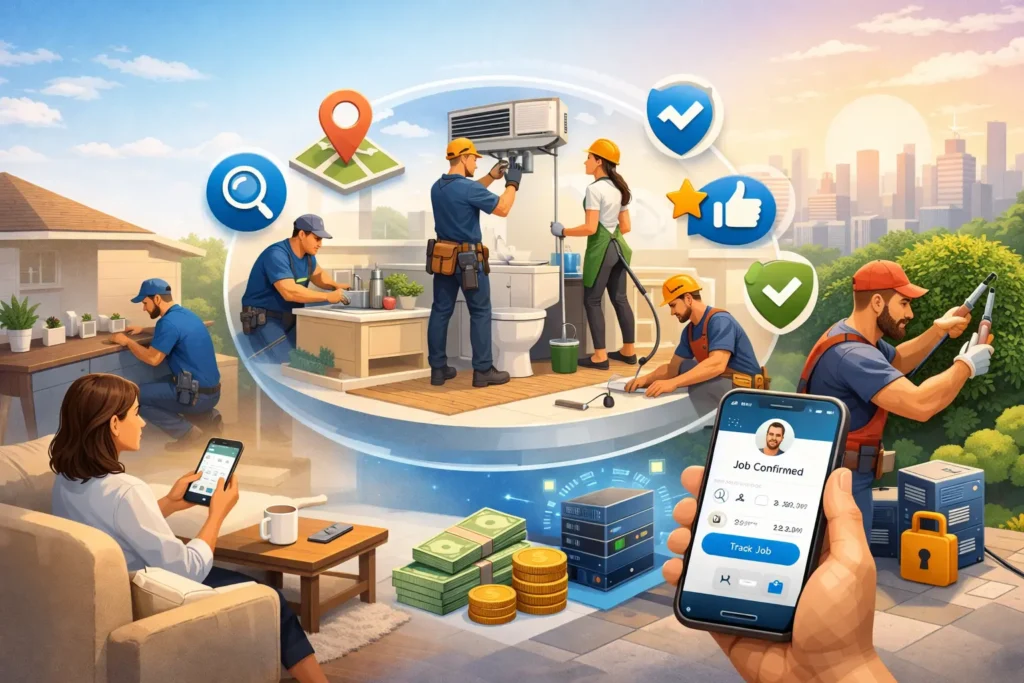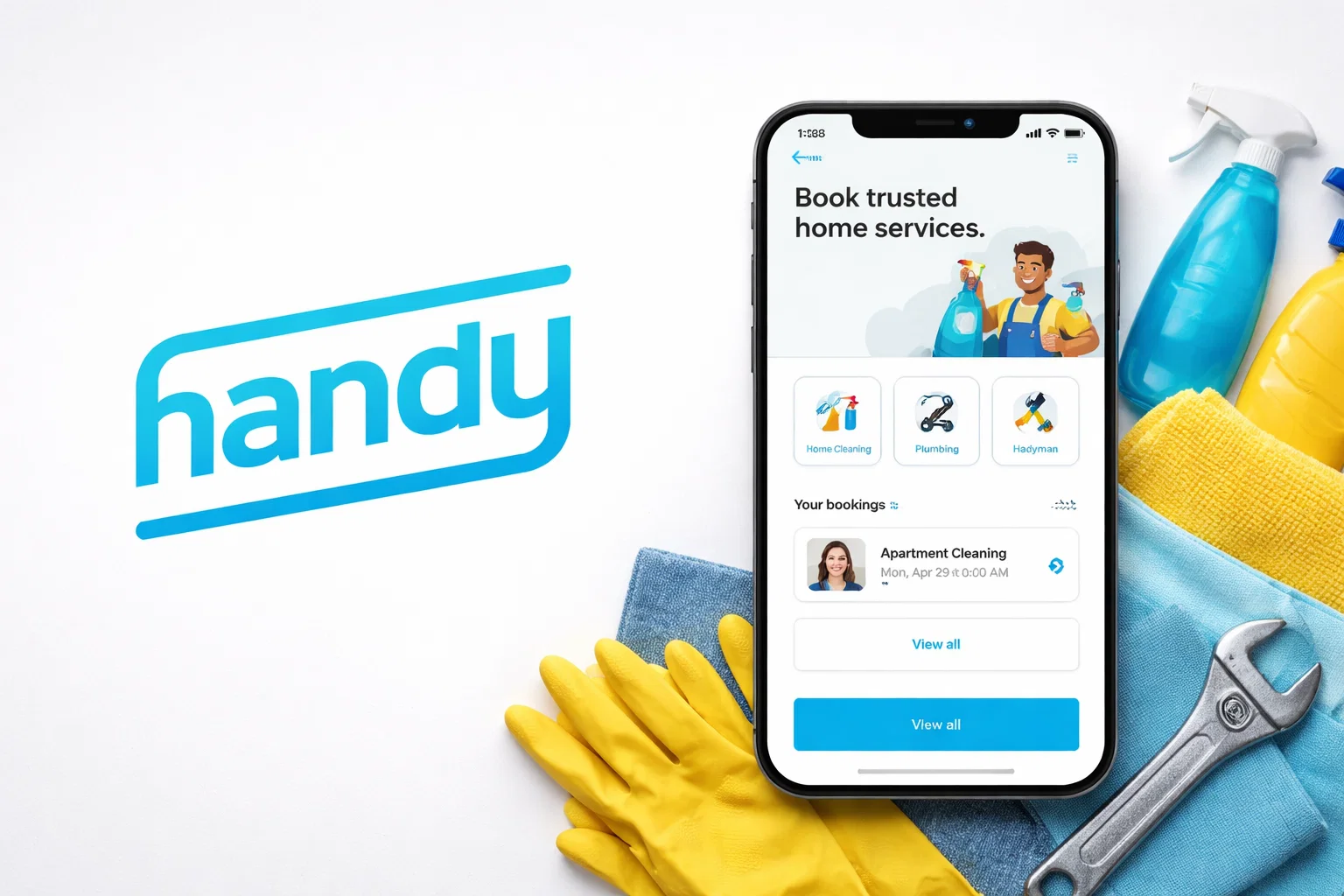
Imagine you need someone to clean your home, fix a leaky faucet, assemble furniture, or install shelves—but you don’t want to deal with random ads, unknown contractors, or complicated scheduling. You open Handy, pick the service you need, choose a time that works for you, and a verified professional arrives to get the job done.
Handy is an on-demand home services platform that connects homeowners with trusted local professionals for cleaning, handyman work, and other household tasks. It simplifies the entire process—search, scheduling, pricing, payments, and reviews—so you can get help quickly and confidently.
This guide will walk you through what Handy is, how it works step by step, its business model, key features, the technology behind it, and why many entrepreneurs build Handy-like platforms (with Miracuves ready to help you launch your idea).
What Is Handy? The Simple Explanation
Handy is an on-demand home services marketplace that lets people book trusted professionals for household tasks like cleaning, furniture assembly, minor repairs, and general handyman work. In simple terms, it helps homeowners get everyday home jobs done without searching, calling, or negotiating with multiple providers.

The Core Problem Handy Solves
Finding reliable home help is often time-consuming and uncertain. People don’t know whom to trust, how much a job should cost, or when someone will be available. Handy solves this by offering pre-defined services, upfront pricing, and scheduled bookings through a single platform.
Target Users and Use Cases
Handy is commonly used by:
• Homeowners needing quick home maintenance
• Renters preparing homes for move-in or move-out
• Busy professionals who prefer convenience over DIY
• People needing one-time or recurring cleaning services
• Users who want fixed pricing and fast booking
Current Market Position
Handy is a well-known on-demand home services platform in the United States, especially recognized for cleaning and handyman-style tasks. It sits between traditional contractors and open marketplaces by offering more structure and standardized services.
Why It Became Successful
Handy became popular because it removed friction. Users don’t have to explain tasks in detail or wait for quotes. Instead, they choose a service, see the price upfront, schedule a time, and get the job done—making home services feel as easy as ordering food.
Handy’s Business Model Explained
How Handy Makes Money
Handy follows a managed marketplace model for home services. Instead of simply listing professionals and passing leads, Handy standardizes services, pricing, and booking—and then earns money by taking a portion of each completed job.
The main revenue sources include:
- Service fees: Handy takes a percentage from every completed booking
- Managed service margins: Fixed-price services allow Handy to control pricing and earn margin
- Recurring bookings: Regular cleaning plans create predictable repeat revenue
This approach gives Handy more control over service quality compared to open marketplaces.
Pricing Structure
Handy uses upfront, fixed pricing for most services. Pricing depends on:
- Type of service (cleaning, assembly, handyman work)
- Estimated time and complexity
- Location and demand
Users see the full price before booking, which reduces uncertainty.
Fee Breakdown
- Users pay a fixed service price
- Handy deducts its platform and management fee
- The remaining amount is paid to the service professional
Additional charges may apply for extra time or add-on services, but these are usually visible in advance.
Market Size and Demand
Home services is a large, recurring market driven by:
- Busy urban lifestyles
- Growth in renting and frequent moves
- Increased online furniture purchases requiring assembly
- Preference for convenience over DIY solutions
Handy benefits because many services are repeatable (cleaning, maintenance).
Profitability Insights
Handy improves margins through:
- Standardized service packages
- Efficient scheduling and assignment
- Repeat customers and subscriptions
- Reduced customer acquisition friction
Revenue Model Breakdown
| Revenue Stream | Description | Who Pays | Nature |
|---|---|---|---|
| Service Fees | Platform cut per job | Users | Transaction-based |
| Fixed Packages | Pre-priced services | Users | Margin-based |
| Recurring Plans | Regular cleaning bookings | Users | Subscription-like |
Key Features That Make Handy Successful
Predefined service packages
Handy offers clearly defined services (like standard cleaning or furniture assembly) with scope and pricing set in advance. This removes confusion and speeds up booking.
Upfront pricing
Users see the full cost before confirming a booking. There are no negotiations or surprise charges, which builds trust.
Fast scheduling
Handy makes it easy to book same-day or near-term services, especially for cleaning and basic handyman tasks.
Verified professionals
Service providers go through verification and background checks, helping users feel comfortable inviting professionals into their homes.
Automatic professional assignment
Handy assigns professionals based on skill match, location, and availability, reducing decision fatigue for users.
Quality control and reviews
After each job, users leave reviews. Handy uses this feedback to monitor performance and maintain service standards.
Secure in-app payments
Payments are handled through the platform, so users don’t need to exchange cash or manage invoices.
Recurring bookings
Users can schedule repeat cleanings, creating convenience and predictable service routines.
Simple, guided booking flow
The app guides users step by step—from service selection to scheduling—making the experience beginner-friendly.
Customer support and issue resolution
Handy provides support if something goes wrong, helping resolve issues and protect both users and professionals.

The Technology Behind Handy
Tech stack overview (simplified)
Handy runs on a managed two-sided marketplace system designed to control service quality and delivery speed. The platform has three main layers:
- Customer app/web: service selection, scheduling, pricing, payment, reviews
- Professional app: job assignments, schedule management, earnings, notifications
- Operations backend: matching, pricing rules, quality control, support tools
Service catalog and pricing engine
Unlike open marketplaces, Handy relies on a structured service catalog. Each service has:
- Defined scope (what’s included/excluded)
- Standard duration estimates
- Fixed or rule-based pricing
This pricing engine ensures consistency and reduces disputes.
Scheduling and assignment system
Handy’s core technology challenge is assigning the right professional at the right time. The system considers:
- Location proximity
- Skill eligibility
- Availability windows
- Past performance and reliability
Jobs are often auto-assigned to keep booking fast and reduce user decision-making.
Real-time notifications and coordination
Both users and professionals receive instant notifications for:
- Booking confirmations
- Professional assignment
- Arrival updates
- Job completion status
This keeps expectations aligned and reduces no-shows.
Payments and payouts
Handy’s payment system handles:
- Upfront authorization
- Post-completion charging
- Platform fee deductions
- Professional payouts
- Refunds and adjustments
This ensures professionals get paid reliably and users are charged only after service delivery.
Quality monitoring and trust systems
Because Handy manages service quality, its tech includes:
- Review and rating analysis
- Performance scoring for professionals
- Automated flags for cancellations or complaints
- Support dashboards for dispute handling
Low-performing providers can be retrained or removed, protecting the brand.
Scalability approach
Handy must handle demand spikes during:
- Weekends
- Move-in/move-out periods
- Holiday seasons
Scalable infrastructure and queue-based assignment systems help keep bookings smooth even at peak times.
Why this technology matters for business
Handy’s tech enables a predictable service experience, which is hard to achieve in local services. By standardizing pricing, matching, and quality control, the platform builds repeat usage and customer trust.
Handy’s Impact & Market Opportunity
Industry disruption caused
Handy helped shift home services from a quote-based, uncertain process to a productized, on-demand experience. Instead of calling multiple contractors or waiting for estimates, users could book common services with fixed pricing and guaranteed scheduling. This changed expectations around speed and convenience for home services.
It also introduced a more managed marketplace approach—balancing flexibility with standardized service quality—positioning itself between open marketplaces and traditional service companies.
Market size and growth drivers
Home services is a large and resilient market driven by:
- Busy lifestyles and limited time for DIY
- Growth in renting and frequent relocations
- Increased online furniture purchases needing assembly
- Aging homes requiring ongoing maintenance
- Preference for convenience and predictable pricing
Because many services are repeatable (cleaning, maintenance), platforms like Handy benefit from recurring demand.
User demographics and behavior
Handy users typically include:
- Urban renters and homeowners
- Professionals who value speed and simplicity
- People needing last-minute or scheduled help
- Users comfortable with app-based services
Service professionals often include cleaners, assemblers, and handypeople who prefer steady job flow without managing marketing or invoicing themselves.
A key behavior pattern is repeat usage—once users trust the platform, they often book again for similar tasks.
Geographic presence
Handy-style platforms perform best in cities and metro areas where:
- There is dense demand for home services
- A reliable supply of service professionals exists
- Same-day or next-day service is valuable
Urban concentration makes scheduling and assignment more efficient.
Future projections
The evolution of Handy-like platforms is moving toward:
- More bundled and subscription-based services
- Faster booking and instant assignments
- Stronger vetting and training standards
- Expanded service categories
- AI-driven scheduling and demand forecasting
Opportunities for entrepreneurs
There is strong opportunity to build Handy-style platforms for:
- City-specific home services
- Cleaning-only or assembly-only verticals
- Move-in/move-out service bundles
- Subscription-based home care
- Premium managed services with guaranteed quality
This massive success is why many founders aim to build managed service platforms—when services feel predictable and product-like, users return frequently.
Building Your Own Handy-Like Platform
Why businesses want Handy-style managed service platforms
Handy proves that home services work best when they are productized and standardized. Entrepreneurs like this model because it offers:
- Predictable pricing and service scope
- Better control over service quality
- Faster booking compared to quote-based platforms
- Higher trust through managed professionals
- Strong repeat usage via subscriptions and recurring services
Instead of acting only as a connector, the platform owns more of the service experience.
Key considerations before development
If you’re planning to build a Handy-like platform, these decisions are critical:
- Service focus: cleaning, handyman, assembly, or multi-category
- Pricing logic: fixed packages vs hourly hybrids
- Professional onboarding, training, and verification
- Auto-assignment vs user choice of professionals
- Cancellation, rescheduling, and no-show rules
- Quality control and performance scoring
- Customer support and issue resolution flows
Also Read :- Top 10 Ideas for Handyman Services Business Startups
Cost Factors & Pricing Breakdown
Handy-Like App Development — Market Price
| Development Level | Inclusions | Estimated Market Price (USD) |
|---|---|---|
| Basic Local Services Marketplace MVP | Core web + mobile-ready platform for posting household tasks and browsing local pros, customer and tasker registration & login, basic profiles, task/job posting with description and budget, simple search & filters, basic booking/accept flow, in-app notifications, standard admin panel, basic reports | $60,000 |
| Mid-Level Home Services & Booking Platform | Advanced search & filters (service type, location, price, ratings), richer pro profiles (photos, skills, reviews), availability management, in-app chat, quotes/proposals, secured payments & payouts (via your payment partners), dispute flags, analytics dashboard, polished mobile-first UX (web + apps) | $140,000 |
| Advanced Handy-Level Home Services Ecosystem | Large-scale multi-city services marketplace, complex pricing & fee logic, promotions & coupons, advanced trust/safety flows, ID/KYC checks (via providers), insurance hooks, recurring jobs & subscriptions, sophisticated matching & recommendation engine, multi-language support, cloud-native scalable architecture | $240,000+ |
Handy-Style Local Services Platform Development
The prices above reflect the global market cost of developing a Handy-like home services and local task marketplace — typically ranging from $60,000 to over $240,000, with a delivery timeline of around 4–12 months for a full, from-scratch build. This usually includes customer and pro flows, marketplace and booking logic, payments and payouts, reviews and ratings, trust & safety basics, analytics, and production-grade web and mobile experiences for multi-city operations.
Miracuves Pricing for a Handy-Like Custom Platform
Miracuves Price: Starts at $13,999
This is positioned for a feature-rich, JS-based Handy-style local services marketplace that covers task/job posting and browsing, customer and service provider onboarding, category and location-based search, booking and acceptance flows, in-app chat and notifications, secure payments & payouts (via your chosen providers), reviews & ratings, core analytics, and a modern admin console plus mobile apps. From this foundation, the platform can be extended into promotions and coupons, advanced trust & safety controls, KYC/ID checks, insurance hooks, and smarter recommendation/matching as your marketplace scales.
Note: This includes full non-encrypted source code (complete ownership), complete deployment support, backend & API setup, admin panel configuration, and assistance with publishing on the Google Play Store and Apple App Store—ensuring you receive a fully operational home services marketplace ecosystem ready for launch and future expansion.
Delivery Timeline for a Handy-Like Platform with Miracuves
For a Handy-style, JS-based custom build, the typical delivery timeline with Miracuves is 30–90 days, depending on:
- Depth of marketplace and booking features (service categories, matching logic, pricing/fees, etc.)
- Number and complexity of payment, payout, KYC/ID, and notification integrations
- Complexity of trust & safety, dispute handling, and rating/review flows
- Scope of web portal, mobile apps, branding requirements, and long-term scalability plans
Tech Stack
We preferably will be using JavaScript for building the entire solution (Node.js/Nest.js/Next.js for the web backend + frontend) and Flutter / React Native for mobile apps, considering speed, scalability, and the benefit of one codebase serving multiple platforms.
Other technology stacks can be discussed and arranged upon request when you contact our team, ensuring they align with your internal preferences, compliance needs, and infrastructure choices.
Essential features to include
A strong Handy-style MVP should include:
- Service selection with fixed scopes
- Booking calendar and time slots
- Auto-assignment of verified professionals
- Secure in-app payments
- Reviews and performance tracking
- Cancellation and refund workflows
- Admin panel for operations and quality control
High-impact extensions you can add later:
- Subscription plans (weekly/monthly cleaning)
- Move-in/move-out bundles
- Professional training and certification modules
- Dynamic pricing for peak demand
- AI-driven scheduling optimization
Read More :- How to Start a Home Services Marketplace Platform Business
Conclusion
Handy shows that home services don’t have to be messy or unpredictable. By turning common household tasks into standardized, bookable services with upfront pricing, it made hiring help fast and stress-free for users.
For entrepreneurs, Handy highlights the power of managed marketplaces. When you control service quality, pricing, and scheduling, you can deliver consistent experiences that drive repeat usage and long-term trust—key ingredients for building a scalable home services platform.
FAQs :-
What is Handy used for?
Handy is used to book home cleaning, furniture assembly, handyman, and installation services through an on-demand app.
How does Handy make money?
Handy earns revenue by taking a platform fee from each completed service. Because pricing is standardized, it can earn margin while managing quality.
Are Handy professionals employees?
No. Professionals on Handy are independent service providers, not employees of the platform, even though services are managed and standardized.
How much does Handy charge users?
Pricing is upfront and fixed based on the selected service and estimated duration. Users see the full price before booking.
Is Handy safe to use?
Handy uses identity verification, background checks, reviews, and secure payments to create a trusted experience for users.
Can I book recurring services on Handy?
Yes. Handy supports recurring bookings, especially for home cleaning services.
Do users choose the professional?
In most cases, Handy assigns a professional automatically based on availability and skill match to ensure fast booking.
What makes Handy different from TaskRabbit or Angi?
Handy focuses on managed, fixed-price services, while platforms like TaskRabbit allow users to choose professionals and Angi focuses more on lead generation.
Can I build an app like Handy?
Yes. With the right service catalog, scheduling engine, payment system, and quality control tools, a Handy-style platform can be built.
How can Miracuves help build a Handy-like platform?
Miracuves helps founders launch Handy-style managed service platforms in 30-90 days, offering service catalogs, automated scheduling, secure payments, professional management, and scalable admin dashboards—fully customizable for your market.