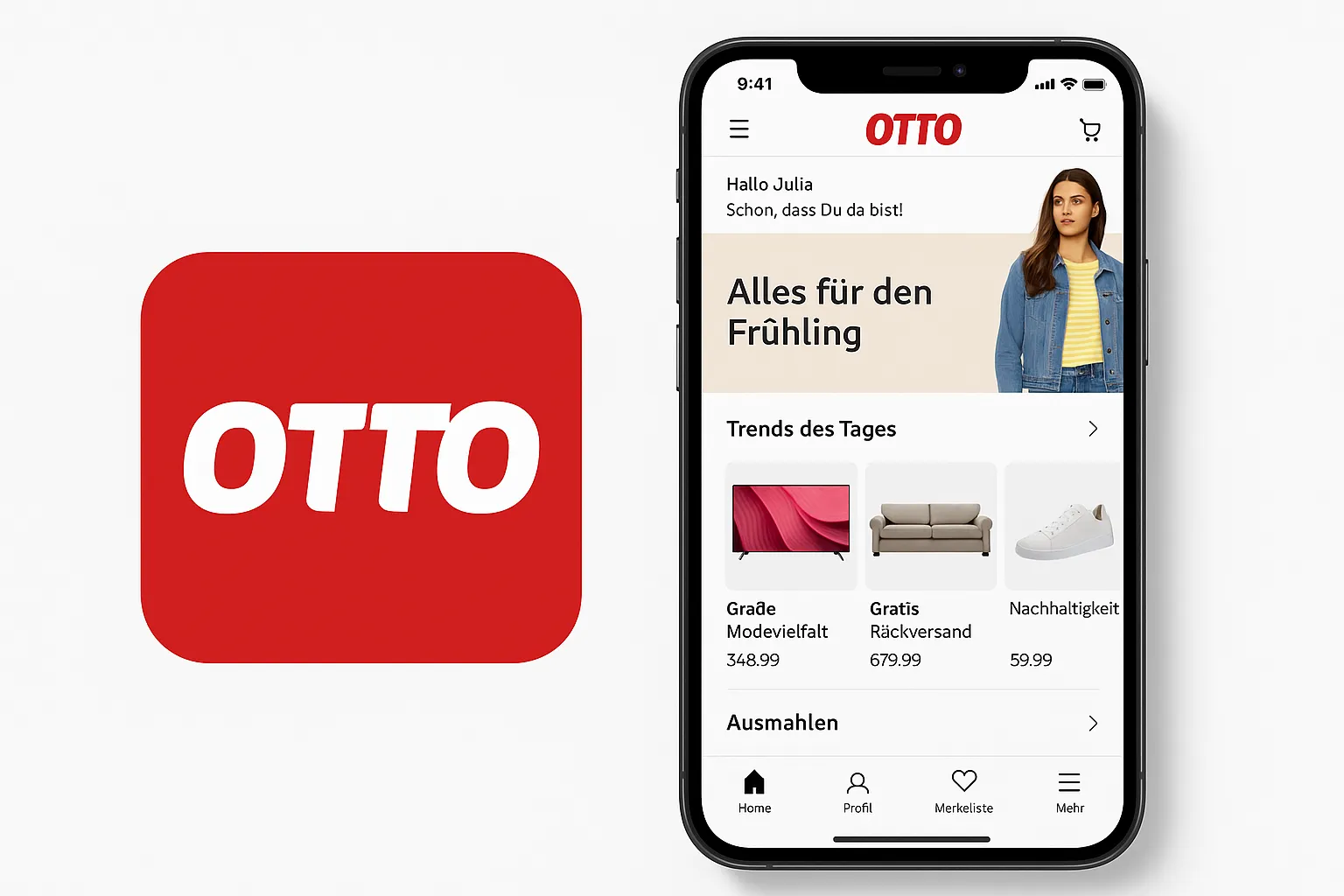
Imagine you’re browsing for a new sofa while sitting in your favourite café in Hamburg. You open an app, filter by “living room”, pick a couch, schedule delivery—all in a few minutes. That’s the reality that OTTO brings to German shoppers: seamless, mobile-first e-commerce across fashion, home, tech and more.
OTTO traces its roots back to 1949 in Hamburg when founder Werner Otto launched a mail-order business. Over the decades it transformed into one of Germany’s largest e-commerce players. The OTTO app now offers over 18 million products. The parent group, Otto Group, reported a turnover of around €6.5 billion in the 2023/24 period. With this scale and mobile-momentum, OTTO stands as a benchmark for clone-app opportunities and is precisely the kind of project that Miracuves can help you build.
What is OTTO? — The Simple Explanation
OTTO is one of Germany’s leading e-commerce platforms, combining the scale of a digital marketplace with the trusted feel of a long-established retail brand. It’s an app and website where users can shop across more than 18 million products—from fashion and home décor to electronics and furniture—all backed by fast delivery and reliable German-quality service.
The Core Problem It Solves
Before OTTO’s digital transformation, German shoppers relied heavily on physical stores or fragmented online sellers. OTTO solved that by bringing trusted brands, quick delivery, and flexible payment options under one secure platform—making online shopping simple, reliable, and localized for Germany’s consumer habits.
Target Users & Use Cases
- Everyday consumers seeking fashion, home, or lifestyle products.
- Families furnishing homes and preferring “Buy Now, Pay Later” options.
- Businesses purchasing electronics or office supplies.
- Users who value German-language support, local logistics, and consistent return policies.
Current Market Position (2025)
OTTO ranks as Germany’s #2 online retailer after Amazon.de, holding around 10–12% market share in the national e-commerce sector. The platform draws more than 11 million monthly active users, according to 2025 analytics reports, and continues to expand its AI-powered personalization and green logistics initiatives.
Why It Became Successful
OTTO’s success stems from its ability to evolve from a mail-order pioneer to a digital powerhouse—leveraging deep customer trust, German logistics excellence, and innovative app-driven experiences such as AI product recommendations, one-click payments, and AR-based furniture previews.
How Does OTTO Work? — Step-by-Step Breakdown
For Users
- Account Creation
Users sign up via the OTTO website or mobile app using their email, Google, or Apple ID. The onboarding includes personalization questions—like preferred categories and brands—to fine-tune recommendations. - Product Browsing & Discovery
The home screen displays AI-curated products, trending items, and dynamic banners. Filters allow sorting by brand, price, sustainability, and delivery time. - Product Selection & Purchase
Each product page includes detailed specs, HD photos, customer reviews, and delivery/pick-up options. Users can add items to cart or wishlist. - Payment & Checkout
OTTO offers multiple payment methods including credit/debit cards, PayPal, Klarna, and OTTO’s proprietary “Rechnung” (Buy Now, Pay Later) option, making it accessible to all customer types. - Delivery & Tracking
Orders are fulfilled via OTTO’s logistics partners or directly from vendors. Users can track their order in real time, modify delivery slots, or request same-day delivery in certain German cities. - Returns & Support
OTTO has an easy return system with doorstep pickup and digital return labels, ensuring customer trust and repeat purchases.
For Sellers & Partners
- Onboarding Process
Sellers register through the OTTO Partner Connect platform, upload catalog details, pricing, and stock info. - Operations & Fulfillment
Vendors can choose FBO (Fulfilled by OTTO) for full logistics or FBM (Fulfilled by Merchant) if they handle their own shipping. - Earnings & Commissions
OTTO typically charges 10–15% commission depending on the category, plus optional fulfillment or ad costs. Sellers receive payouts weekly.
Technical Overview (Simplified)
- Architecture: Microservices-based cloud system enabling scalability across product, payment, and logistics modules.
- Core Technologies: Java Spring Boot, ReactJS, Kubernetes, Elasticsearch, and AWS.
- AI & Data Layer: Uses machine learning for product recommendations, NLP for search, and behavior analytics for personalization.
- Security: GDPR-compliant with SSL encryption and 2FA for both users and sellers.
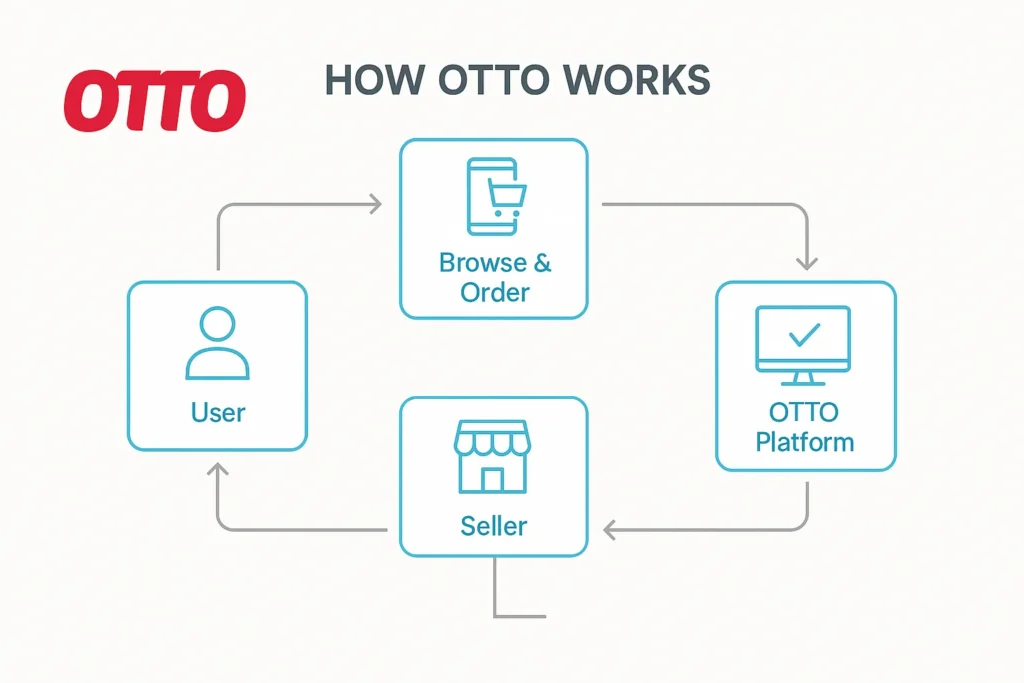
OTTO’s Business Model Explained
How OTTO makes money
- OTTO generates revenue both from direct retail sales (buying stock and selling to consumers) and from its marketplace model where third-party sellers list items and pay fees to OTTO.
- Key revenue streams:
- Product sales margin on OTTO-owned inventory
- Commissions / transaction fees from marketplace sellers
- “Basic fees” or subscription fees from sellers for platform access
- Advertising & promotional services for sellers on OTTO’s platform
- Value-added services like logistics, return collection, premium delivery options
Pricing structure & fee breakdown (2025)
- Sellers on OTTO Market pay a monthly basic fee of around €99.90 (as of mid-2024/25) to list products.
- Commission rates vary by product category: typically 12-15% for most categories, about 7-8% for electronics, and up to 18% for jewellery.
- Example: A seller listing jewellery might pay ~18% of sale price as commission + monthly platform fee.
Market size & growth stats (2025)
- In fiscal year 2024/25, the parent Otto Group reported consolidated revenue just under €15 billion.
- The Platforms segment (which includes OTTO) saw IFRS sales revenue climb from around €6.2 billion to over €6.5 billion.
- Gross Merchandise Value (GMV) of OTTO’s marketplace rose ~9% in 2024/25, from ~€6.5 billion to over €7 billion.
Profitability & margins
- The Otto Group achieved earnings before interest and tax (EBIT) of €276 million in FY 2024/25, up significantly from €8 million in the previous year.
- This suggests that OTTO’s shift toward marketplace and higher margin services is helping lift profitability.
- While specific margin breakdowns aren’t public for each revenue stream, the marketplace model (asset-light, minimal stock risk) generally offers better margins than traditional retail.
Why this model works
- By combining direct retail with marketplace, OTTO diversifies revenue and reduces inventory risk.
- With sellers bearing listing/commission costs, OTTO can scale without proportional inventory investment.
- The marketplace expansion is driving GMV growth (~9% in 2024/25) even in a challenging retail climate.
- Strong brand/trust in Germany helps attract both users and high-quality sellers.
Key Features That Make OTTO Successful
OTTO’s app and ecosystem combine a trusted retail legacy with modern e-commerce technology, creating a platform that’s efficient, user-friendly, and scalable. Below are the top 10 features that define OTTO’s success and ongoing innovation in 2025.
1. Personalized Product Discovery
Why it matters: Every user sees a curated feed of items based on browsing history, purchases, and seasonal trends.
Benefit: Shoppers find what they need faster and are more likely to complete purchases.
Tech: Machine learning algorithms analyze behavior in real time to adapt recommendations dynamically.
2. Fast & Reliable Delivery
Why it matters: OTTO promises 1–2 day delivery in major German cities, leveraging its advanced logistics network.
Benefit: Builds Amazon-level convenience and trust for German shoppers.
Tech: AI-driven warehouse routing and last-mile optimization.
3. Flexible Payment Options
Why it matters: From PayPal to “Kauf auf Rechnung” (Buy Now, Pay Later), OTTO offers over 10 secure payment choices.
Benefit: Encourages conversions and increases affordability.
Tech: Integration with major payment gateways + OTTO’s in-house credit risk scoring.
4. Easy Returns & Refunds
Why it matters: 30-day return policy with free doorstep pickup.
Benefit: High customer satisfaction and low churn rate.
Tech: Automated returns workflow + barcode-based reverse logistics.
5. Smart Search & Filters
Why it matters: Over 18 million products can be searched in milliseconds.
Benefit: Precision and ease of finding items.
Tech: Elasticsearch + NLP (Natural Language Processing) for contextual results.
6. AR Product Preview
Why it matters: Users can visualize furniture and décor in their homes before purchasing.
Benefit: Reduces returns and boosts purchase confidence.
Tech: Augmented Reality with Apple ARKit and WebAR integration.
7. Sustainability Labels
Why it matters: Germany’s eco-conscious users can filter products marked “Sustainable.”
Benefit: Enhances brand image and user trust.
Tech: ESG tagging + sustainability APIs integrated into catalog metadata.
8. Omnichannel Experience
Why it matters: OTTO syncs user data between web, app, and smart home assistants.
Benefit: Consistent experience across devices.
Tech: Cloud-based microservices + RESTful APIs.
9. AI-Powered Customer Support
Why it matters: Automated chat and email support with AI for FAQs and order tracking.
Benefit: 24/7 availability and reduced operational costs.
Tech: NLP-based chatbots + sentiment detection.
10. OTTO Partner Connect Dashboard
Why it matters: Vendors can track sales, analytics, and stock performance in real time.
Benefit: Helps sellers optimize listings and increase revenue.
Tech: React-based analytics dashboard with real-time data visualization.
2025 Updates
- AI Style Advisor: Suggests outfits using user photos and preferences.
- Green Logistics Expansion: Carbon-neutral shipping goal by 2026.
- Voice Commerce: Integration with Alexa and Google Assistant for hands-free shopping.
What Sets OTTO Apart
While Amazon dominates global e-commerce, OTTO thrives as Germany’s “ethical, local alternative”—focusing on trust, transparency, sustainability, and German-language support.
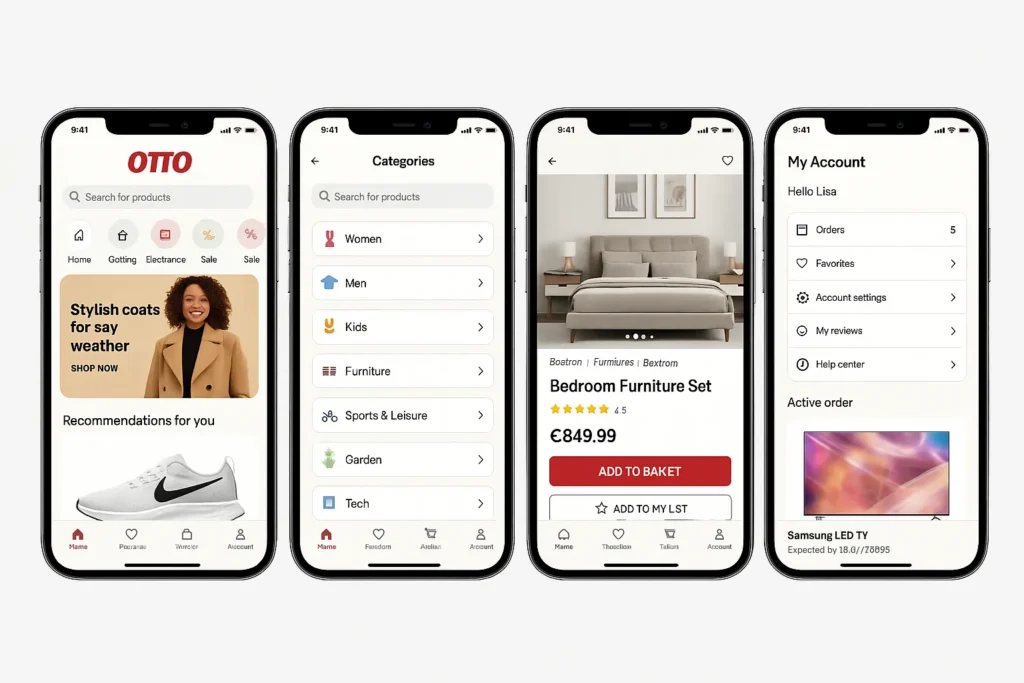
The Technology Behind OTTO
OTTO’s transformation from a traditional mail-order company into a full-fledged digital ecosystem is a masterclass in scalable, secure, and intelligent tech architecture. Its platform blends microservices, AI, and robust data infrastructure to deliver seamless experiences to millions of users daily.
Tech Stack Overview (Simplified)
| Layer | Technology | Purpose |
| Frontend | ReactJS, Next.js, Swift (iOS), Kotlin (Android) | Fast, responsive, cross-platform UI |
| Backend | Java Spring Boot, Node.js microservices | Modular, scalable business logic |
| Database | PostgreSQL, MongoDB, Redis | Product, user, and session data management |
| Search Engine | Elasticsearch + OpenSearch | Ultra-fast, AI-driven product search |
| Cloud Infrastructure | AWS + Kubernetes + Docker | Elastic scaling, high availability |
| AI/ML | TensorFlow, PyTorch, custom recommendation engine | Personalized recommendations, fraud detection |
| Payments & Security | PCI-DSS compliant gateways, SSL, 2FA | Secure and compliant transactions |
| Analytics | Google BigQuery + Tableau | Real-time performance insights |
Real-Time Features Explained
- Instant Stock Updates: Inventory syncs across all sellers every few seconds using event-driven microservices.
- Live Order Tracking: Integration with DHL, Hermes, and OTTO Logistics APIs to provide up-to-the-minute delivery updates.
- Dynamic Pricing Engine: Adjusts prices based on stock, season, and competition using predictive algorithms.
Data Handling & Privacy
- Fully GDPR-compliant, ensuring user data is anonymized and encrypted.
- Uses zero-trust architecture principles to protect buyer and seller information.
- Employs data-minimization and privacy-by-design strategies across all apps and APIs.
Scalability & Performance
- OTTO’s cloud-native design lets it handle up to 20,000 concurrent orders per minute.
- Traffic spikes (e.g., Black Friday 2024) are managed via auto-scaling Kubernetes clusters.
- The system ensures 99.98% uptime with continuous monitoring through Prometheus + Grafana.
Mobile App vs Web Platform
- The mobile app is optimized for personalized browsing, push notifications, and AR visualization.
- The web platform serves as the full catalog and vendor management hub.
- Both share the same APIs, allowing consistent updates and unified analytics.
API Integrations
- Payment: PayPal, Klarna, Giropay, Mastercard, Visa.
- Logistics: DHL, Hermes, DPD APIs for shipment tracking.
- Marketing: Facebook Pixel, Google Analytics 4, OTTO Ads API.
- Sustainability: Integration with climate-impact databases to display CO₂ footprint per product.
Why This Tech Matters for Business
OTTO’s hybrid cloud + AI approach ensures speed, reliability, and user trust—all essential for competing against Amazon and Zalando.
For entrepreneurs, this blueprint demonstrates how a microservice-based architecture + modular clone script can power a large-scale, multi-vendor marketplace in record time.
OTTO’s Impact & Market Opportunity
Industry Disruption
OTTO’s digital reinvention has reshaped Germany’s retail sector — transforming a post-war mail-order company into a tech-driven marketplace. It disrupted legacy chains like Quelle and Kaufhof, setting new standards for customer trust, sustainable logistics, and data-driven retail.
Its move toward an open marketplace model (similar to Amazon but with German roots and ethics) proved that traditional retailers can successfully pivot to platform economics.
Market Statistics (2025)
- Annual revenue: €6.5 billion (2024/25, OTTO Group)
- Active users: Over 11 million monthly active users
- Total products: 18 million+ listed items across 10,000+ brands
- Sellers: 6,000+ third-party merchants on OTTO Market
- App downloads: 15 million+ cumulative installs (Android + iOS)
- Return rate: Below 5% for furniture, well below European average
- Sustainability goal: Carbon-neutral operations by 2026
User Demographics & Behavior
- Core audience: German households aged 25–55, tech-savvy, middle to upper-middle income.
- 60% of OTTO users are women — drawn by fashion, lifestyle, and home décor categories.
- Over 70% of purchases now occur on mobile devices.
- Repeat buyers constitute nearly 45% of total transactions, proving strong loyalty.
Geographic Presence
- Primary market: Germany (accounts for over 90% of sales).
- Expanding into Austria and Switzerland through cross-border e-commerce.
- European logistics hubs in Hamburg, Haldensleben, and Hermes Europe network provide continent-wide delivery coverage.
Future Projections
- Expected GMV growth: +8–10% YoY through 2026.
- AI-driven personalization expected to boost conversion rates by 20%.
- Plans to integrate AR-VR shopping experiences for furniture and apparel by 2026.
- Increased investment in climate-neutral supply chains to strengthen brand reputation.
Opportunities for Entrepreneurs
The OTTO model demonstrates a massive opportunity for localized marketplaces — especially in regions where Amazon or Flipkart dominate but don’t offer tailored, ethical, or localized experiences. Entrepreneurs can replicate OTTO’s success by:
- Building multi-vendor marketplaces with trusted curation.
- Offering green logistics or Buy Now, Pay Later options.
- Partnering with local sellers for authenticity and fast delivery.
Building Your Own OTTO-Like Platform
The success of OTTO proves that localized marketplaces built on trust, usability, and technology can rival global giants. Entrepreneurs across Europe and Asia are now exploring OTTO-like business models to create regional e-commerce ecosystems tailored to their country’s consumers.
Why Businesses Want OTTO Clones
- Proven Model: OTTO’s hybrid structure (retail + marketplace) ensures multiple income streams.
- High Scalability: The marketplace model scales rapidly without maintaining vast inventory.
- Localization Power: Regional languages, local shipping partners, and cultural targeting boost conversions.
- Sustainability Appeal: Consumers prefer ethically run, transparent platforms like OTTO.
Key Considerations for Development
Before developing your OTTO-like platform, it’s crucial to plan around:
- Vendor Management: Simplify onboarding, catalog uploads, and payouts.
- Smart Product Discovery: AI-powered search and filters to handle millions of SKUs.
- User Trust: Verified sellers, transparent pricing, and consistent delivery.
- Payment Flexibility: Integrate BNPL (Buy Now Pay Later) and local payment options.
- Sustainability Tracking: Display eco-impact data per product for ESG-minded consumers.
- Scalable Architecture: Adopt microservices with modular APIs for growth.
Cost Factors & Pricing Breakdown
Otto-Like App Development — Market Price
| Development Level | Inclusions | Estimated Market Price (USD) |
| Basic Ecommerce MVP | Product listings, buyer/seller roles, simple checkout | $150,000 |
| Mid-Level Marketplace | Multi-category catalog, seller dashboards, shipping/payment APIs, mobile apps | $280,000 |
| Advanced Marketplace (OTTO-scale) | High-concurrency backend, logistics routing, personalization engine, multi-region setup, native apps | $400,000+ |
Miracuves OTTO-Style Marketplace Pricing
Miracuves Price: Starts at $15,999
This includes a full-featured multi-category ecommerce system with seller onboarding, advanced catalog management, custom filters, order workflows, logistics-ready architecture, and mobile apps—built to support large-scale traffic and high-volume transactions.
Note: This includes full non-encrypted source code, complete deployment support, backend setup, admin panel configuration, and publishing on the Google Play & Apple App Store—ensuring you receive a fully deployable marketplace.
Delivery Timeline for OTTO-Style Platform
Miracuves development timeline including setup, configuration, admin deployments, API integrations, and platform handover in approximately 30–90 days, depending on customization and additional functional layers requested. This ensures a stable, market-ready system with predictable delivery and no hidden engineering delays.
Tech Stack
This solution is built with robust frameworks — Web using PHP, MySQL & Apps using Flutter, optimized for performance, stability, and easy maintenance. Other tech stacks can be discussed and arranged upon request — Contact us
Essential Features to Include
| Category | Core Features |
| User Side | Account login, personalized feed, AR preview, cart & checkout, BNPL, order tracking |
| Vendor Side | Partner portal, sales analytics, ad campaigns, product sync APIs |
| Admin Panel | Category management, analytics dashboard, commission control |
| Tech Stack | ReactJS + Next.js, Node + Express, MongoDB, AWS, Elasticsearch |
Conclusion
OTTO stands as a shining example of how legacy retail brands can thrive in the digital era. By combining a trusted German reputation with cutting-edge AI, sustainability, and customer-centric design, it has become more than an online store — it’s a lifestyle ecosystem where technology, trust, and local values meet.
As e-commerce continues to evolve in 2025, OTTO’s hybrid marketplace model highlights a powerful truth: regional platforms can compete globally when they embrace innovation, transparency, and user experience. The brand’s focus on eco-conscious logistics, mobile-first design, and personalization sets a blueprint for the next generation of digital entrepreneurs.
For startups and investors, OTTO’s success is an open invitation — a call to create the next big localized marketplace in your region.
FAQs
Q:1 How does OTTO make money?
OTTO earns through direct product sales, marketplace commissions (around 12–15% per transaction), subscription fees from sellers (€99.90/month), and advertising services. It also profits from logistics and premium delivery add-ons.
Q:2 Is OTTO available in my country?
OTTO primarily operates in Germany, with selective cross-border delivery in Austria and Switzerland. It plans to expand European availability gradually through 2026.
Q:3 How much does OTTO charge users?
There are no extra charges for users beyond product prices and delivery fees (if applicable). Users enjoy free returns on most items and flexible payment options like “Buy Now, Pay Later.”
Q:4 What’s the commission for sellers on OTTO?
Sellers typically pay a 12–15% commission on each sale, varying by category (electronics ~7–8%, jewellery up to 18%). A monthly access fee of €99.90 also applies for seller accounts.
Q:5 How does OTTO ensure safety and trust?
OTTO uses two-factor authentication, SSL encryption, and GDPR compliance to protect user data. All sellers are verified through OTTO Partner Connect to ensure authenticity and reliability.
Q:6 Can I build something similar to OTTO?
Yes. Platforms like Miracuves offer customizable OTTO clone solutions that replicate marketplace architecture, AI-driven search, and multi-vendor management
Q:7 What makes OTTO different from competitors like Amazon or Zalando?
OTTO emphasizes localization, sustainability, and transparency. It promotes German brands, eco-friendly products, and fair-trade policies while maintaining world-class tech performance.
Q:8 How many users does OTTO have?
As of 2025, OTTO has over 11 million monthly active users and more than 15 million app downloads across Android and iOS.
Q:9 What technology does OTTO use?
OTTO’s platform runs on ReactJS, Java Spring Boot, Elasticsearch, AWS, and AI-powered microservices, enabling real-time search, scalable architecture, and personalization.
Q:10 How can I create an app like OTTO?
You can build an OTTO-like marketplace using Miracuves’ ready-to-deploy clone scripts. Miracuves offers custom UI, multi-vendor setup, and advanced AI recommendation systems, helping you go live
Related Articles: