


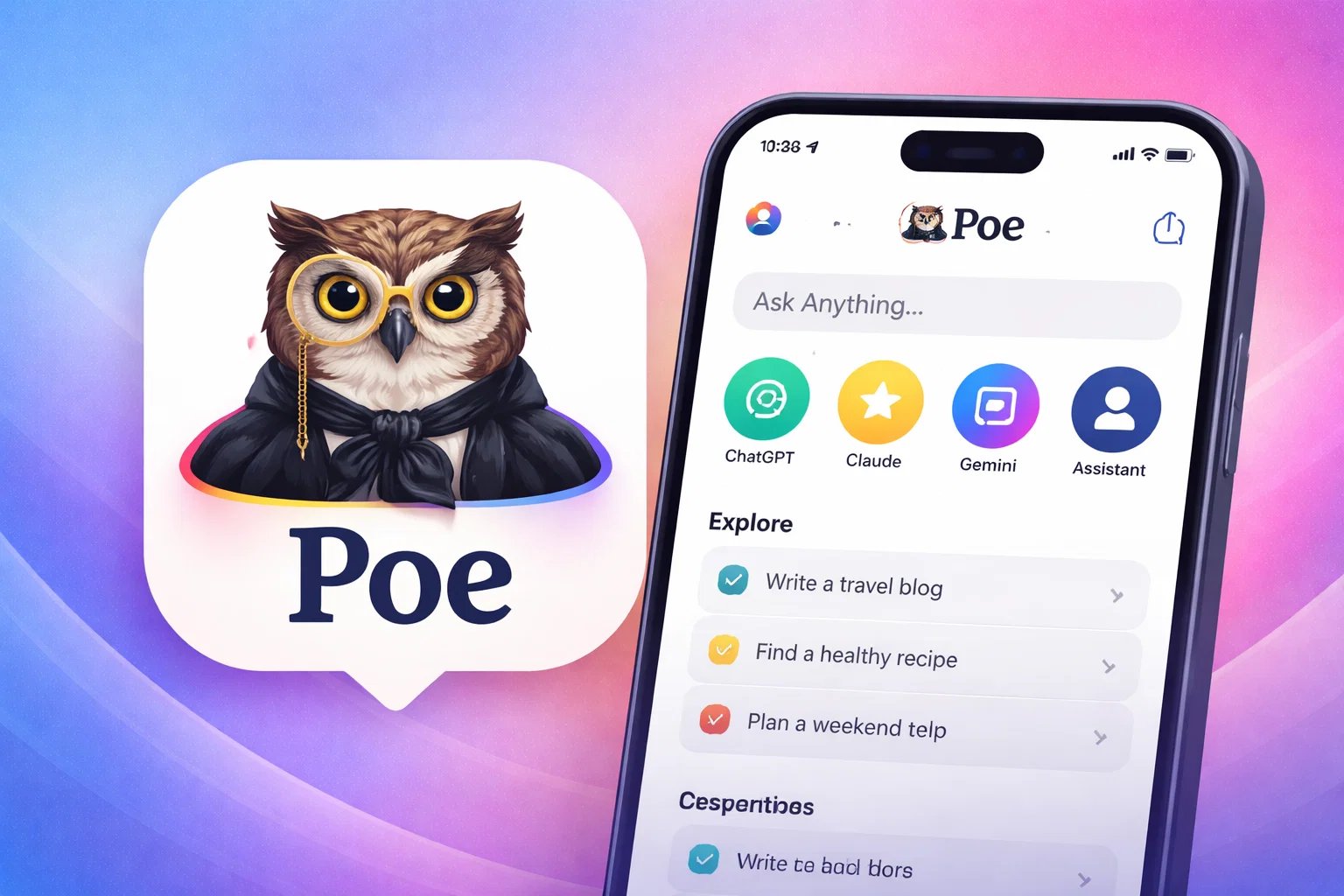
Imagine you want to compare answers from different AI models, experiment with prompts, or build custom bots—without signing up for multiple tools or juggling separate interfaces. Instead of switching platforms, you open one app and talk to several AI models side by side. That’s exactly the problem Poe is designed to solve.
Poe is an AI chat platform developed by Quora that lets users interact with multiple AI models in a single interface. Rather than being a single assistant, Poe acts like a hub—allowing users to ask the same question to different models, compare responses, and even create custom bots for specific tasks.
What makes Poe stand out is flexibility. It’s built for curious users, creators, and developers who want choice, experimentation, and speed—without friction.
By the end of this guide, you’ll understand what Poe is, how it works step by step, its business model, key features, the technology behind it, and why many founders are inspired to build Poe-like AI aggregation platforms—and how Miracuves can help bring those ideas to life.
What Is Poe? The Simple Explanation
Poe is an AI chat aggregation platform that lets users interact with multiple AI models from a single app. In simple terms, instead of choosing just one AI assistant, Poe gives you access to many—so you can ask the same question, compare answers, and pick what works best for your needs.
The Core Problem Poe Solves
As AI tools multiplied, users faced fragmentation: different apps, different logins, different capabilities. Poe solves this by:
- Bringing multiple AI models into one interface
- Removing the need to switch tools constantly
- Making comparison and experimentation easy
- Letting users tailor AI behavior for specific tasks
It’s especially useful for people who want choice and flexibility rather than being locked into one model.
Target Users and Use Cases
Poe is commonly used by:
• Curious users exploring different AI responses
• Writers and researchers comparing outputs
• Developers and prompt engineers testing ideas
• Students experimenting with explanations
• Creators building custom bots for repeat tasks
Current Market Position
Poe is positioned as a model-agnostic AI chat hub. Instead of competing with AI model creators, it sits above them—focusing on experience, speed, and flexibility. This makes it popular among power users who want control and variety.
Why It Became Successful
Poe gained traction because it embraces experimentation. Users can quickly see how different models respond, learn their strengths, and even build custom bots—without technical setup or multiple subscriptions.
How Poe Works — Step-by-Step Breakdown
For Users (Individuals & Creators)
Getting started
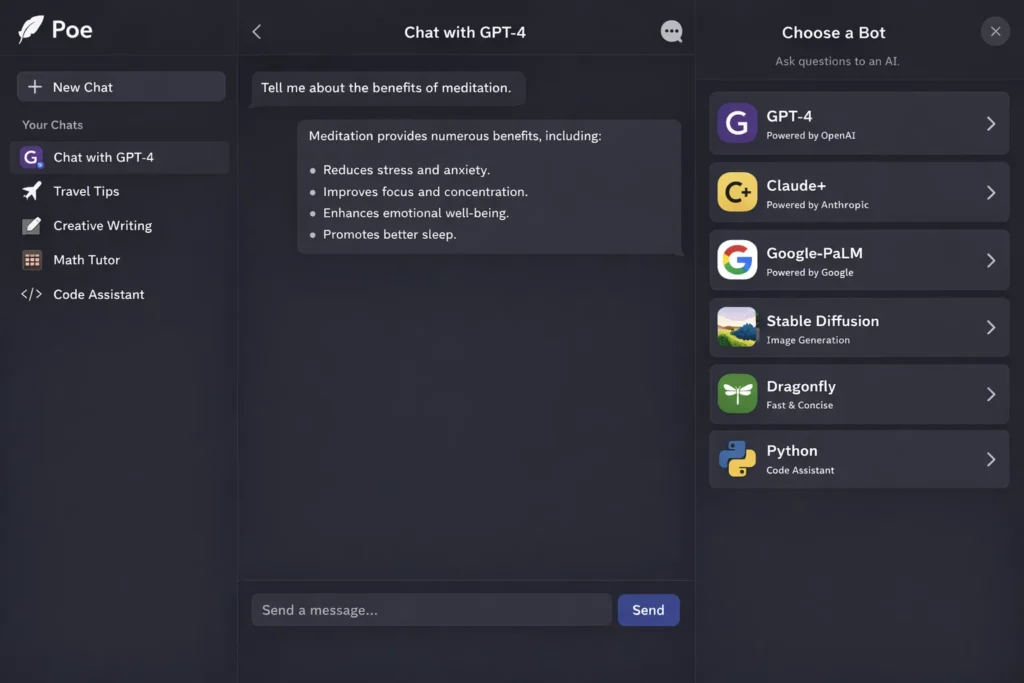
Users sign in and immediately see a list of available AI bots. Each bot represents a different AI model or a custom configuration. There’s no setup required to begin chatting.
Choosing an AI model or bot
Users select a bot based on what they want to do, such as:
- General conversation
- Writing and editing
- Coding help
- Explanations and learning
- Creative brainstorming
You can ask the same question to multiple bots to compare tone, depth, and accuracy.
Chatting and comparing responses
Poe displays conversations in a clean chat interface. Users can:
- Switch between bots instantly
- Re-ask or refine prompts
- Compare answers side by side (by switching bots)
- Continue long conversations with each bot separately
This makes Poe especially useful for learning how different models think.
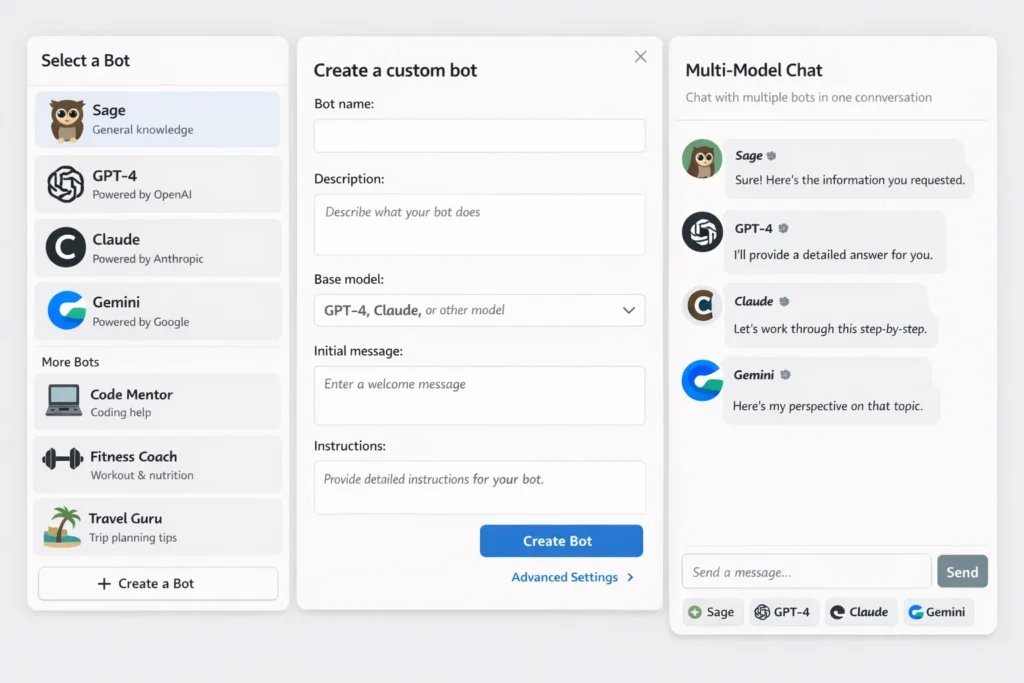
Creating custom bots
One of Poe’s standout features is custom bot creation. Users can define:
- The bot’s role (writer, tutor, analyst, etc.)
- Instructions and tone
- Response style and constraints
Once created, these bots can be reused anytime, saving effort on repetitive tasks.
Sharing and reuse
Custom bots can be kept private or shared with others. This allows communities and teams to reuse useful AI setups without rebuilding prompts each time.
Example user flow
User logs in → selects a bot → asks a question → switches to another bot → compares responses → creates a custom bot → reuses it for future tasks.
For Developers & Power Users
Rapid experimentation
Poe acts as a sandbox for testing prompts and behaviors across different AI models without writing code or managing APIs.
Prompt iteration
Users can refine prompts quickly, see how each model reacts, and adjust instructions for better outputs—ideal for prompt engineering and content workflows.
Technical Overview (Simplified)
Poe works as a unified chat layer that connects users to multiple AI models. It handles:
- Bot selection and routing
- Conversation context per bot
- Prompt instructions and constraints
- Response display and history
The platform focuses on speed, flexibility, and ease of comparison.
Poe’s Business Model Explained
How Poe Makes Money
Poe follows a subscription-based AI access model. Instead of building its own single AI model, Poe monetizes the experience of accessing, comparing, and customizing multiple AI models in one place.
Its main revenue streams include:
- Paid subscriptions: Users pay a monthly fee for higher usage limits and access to more advanced AI models
- Premium model access: Some AI models are available only under paid plans
- Platform value: Poe charges for convenience, flexibility, and aggregation—not for ads or data resale
This approach lets Poe stay neutral and model-agnostic while focusing on user experience.
Pricing Structure
Poe typically offers:
- A free tier with limited daily usage
- Paid plans with higher message limits and access to premium models
- Usage caps that scale with subscription level
Users pay for capacity and choice, not per-task complexity.
Fee Breakdown
- Monthly subscription fee
- Usage-based limits tied to plan level
- No commissions, ads, or per-action fees
This keeps pricing predictable for users who rely on Poe regularly.
Market Size and Demand
Demand for Poe-style platforms is driven by:
- Growth in the number of AI models
- Users wanting to compare outputs easily
- Prompt engineers and creators needing experimentation tools
- Students and professionals exploring AI strengths and weaknesses
As AI diversity grows, aggregation becomes more valuable.
Profitability Insights
Poe improves profitability by:
- Leveraging existing AI models instead of training its own
- Scaling subscriptions rather than one-off usage
- Encouraging repeat daily engagement
- Building community-driven bot sharing
Revenue Model Breakdown
| Revenue Stream | Description | Who Pays | Nature |
|---|---|---|---|
| Subscriptions | Monthly access plans | Users | Recurring |
| Premium Access | Advanced models & higher limits | Users | Tiered |
| Platform Value | Aggregation & customization | Users | SaaS-style |
Read Also :- How to Market an AI Chatbot Platform Successfully After Launch
Key Features That Make Poe Successful
Access to multiple AI models in one place
Poe’s biggest strength is that it brings many AI models into a single interface. Users don’t have to jump between tools or manage multiple accounts—they can switch models instantly inside one app.
Easy comparison of responses
Users can ask the same question to different bots and quickly compare how each model responds. This makes it easier to understand strengths, weaknesses, tone differences, and depth across models.
Custom bot creation
Poe allows users to create custom bots with specific instructions, roles, and tones. This is especially useful for repetitive tasks like writing, tutoring, summarizing, or coding help.
Reusable prompts and workflows
Once a custom bot is created, it can be reused anytime. This saves time and turns good prompts into repeatable workflows instead of one-off experiments.
Clean, fast chat interface
The interface is simple and responsive, which encourages experimentation. Switching between bots feels instant, keeping users focused on outcomes rather than UI friction.
Model-agnostic flexibility
Poe doesn’t push one “best” model. Instead, it gives users freedom of choice, which appeals to power users, researchers, and creators who want control.
Sharing and community-driven bots
Users can share bots with others, allowing useful setups to spread organically. This creates a community layer on top of AI usage.
Great for learning and exploration
Because users can compare explanations from different models, Poe works well as a learning tool, helping people understand concepts from multiple perspectives.
Strong appeal to power users
Prompt engineers, writers, and developers value Poe as a sandbox for testing ideas quickly without code or API setup.
Low barrier to entry
Users can start chatting immediately without technical configuration, making Poe accessible even to non-technical users.
The Technology Behind Poe
Tech stack overview (simplified)
Poe is built as a model-agnostic AI chat platform. Instead of training a single AI model, it focuses on orchestrating access to multiple models through a unified experience. At a high level, the platform includes:
- A fast chat interface for users
- A routing layer that connects prompts to different AI models
- Context management for each bot and conversation
- Custom instruction handling for user-created bots
- Usage tracking and subscription controls
- Scalable backend infrastructure for high message volume
Model routing and abstraction layer
Poe’s core technical strength is its abstraction layer. When a user sends a message, Poe:
- Identifies which bot or model is selected
- Applies any custom instructions tied to that bot
- Routes the prompt to the correct underlying AI model
- Receives the response and formats it consistently
This allows users to switch models without changing how they interact with the platform.
Conversation and context management
Each bot maintains its own conversation context. This means:
- You can have parallel conversations with different bots
- Context does not leak between bots
- Long chats stay coherent per model
- Custom bots behave consistently across sessions
This separation is critical for accurate comparison and reliable reuse.
Custom bot instruction engine
When users create custom bots, Poe stores and applies:
- System-level instructions (role, tone, behavior)
- Formatting preferences
- Constraints and rules
These instructions are injected automatically with every prompt, turning prompt engineering into a reusable configuration rather than repeated manual input.
Performance and speed optimization
Poe is optimized for fast iteration. The platform focuses on:
- Low-latency message handling
- Efficient request batching
- Lightweight UI updates
- Quick bot switching without reloads
This makes experimentation feel instant, which is key to Poe’s appeal.
Usage limits and subscription controls
Behind the scenes, Poe tracks:
- Message counts per user
- Model-specific usage limits
- Subscription tiers and entitlements
This ensures fair use while aligning costs with paid plans.
Scalability and reliability
Poe’s infrastructure is designed to:
- Handle spikes in user activity
- Support thousands of concurrent conversations
- Add or remove models without disrupting users
- Scale globally as AI usage grows
Because Poe does not own the models, reliability depends on both its own systems and the upstream model providers.
Why this technology matters for business
Poe’s technology proves that aggregation itself is a product. By abstracting complexity and offering choice, it creates value without owning the underlying AI models—making it a powerful example of how platform-layer innovation can win in fast-moving AI markets.
Poe’s Impact & Market Opportunity
Industry impact
Poe has changed how people interact with AI by proving that choice and comparison matter. Instead of asking users to commit to a single AI assistant, it lets them explore multiple models side by side. This has influenced how power users, creators, and learners think about AI—not as one voice, but as a set of tools with different strengths.
It also lowered the barrier to prompt experimentation. Users no longer need APIs or technical setups to test ideas across models, which has made AI exploration more accessible.
Market demand and growth drivers
Demand for Poe-style platforms is driven by:
- Rapid growth in the number of AI models
- Users wanting transparency and comparison, not lock-in
- Prompt engineering becoming a real skill
- Creators and professionals seeking the “best answer,” not just an answer
- Curiosity-driven AI usage and learning
As AI capabilities diversify, aggregation platforms become more valuable.
User segments and behavior
Poe is widely used by:
- Writers and researchers comparing outputs
- Students learning concepts from multiple perspectives
- Developers testing prompts and reasoning styles
- Creators building reusable AI workflows
- Power users who want flexibility and control
A common behavior pattern is exploration-first usage—users test, compare, refine, and then settle on a preferred bot or custom setup.
Community and sharing effect
Poe benefits from a strong sharing loop. Custom bots can be shared, reused, and improved by others, creating a growing ecosystem of prompts and AI behaviors without centralized development.
Future direction
The evolution of Poe-style platforms is moving toward:
- More fine-grained control over bot behavior
- Better comparison and evaluation tools
- Deeper customization and workflow chaining
- Team and collaborative bot usage
- Expansion into enterprise experimentation environments
Opportunities for entrepreneurs
There are strong opportunities to build Poe-inspired platforms for:
- Enterprise AI model testing and evaluation
- Education-focused AI learning tools
- Prompt marketplaces and bot libraries
- Vertical-specific AI aggregators (legal, finance, dev tools)
- Internal AI hubs for organizations
This growing demand explains why aggregation and orchestration layers are becoming just as important as the models themselves.
Building Your Own Poe-Like Platform
Why businesses want Poe-style AI aggregation platforms
Poe shows that many users don’t want a single “best” AI—they want choice, comparison, and control. A Poe-style platform is attractive because:
- AI models evolve quickly and have different strengths
- Users want flexibility without vendor lock-in
- Aggregation adds value without training models
- Experimentation and prompt reuse increase productivity
- Subscriptions create predictable recurring revenue
This makes aggregation a durable layer in the AI stack.
Key considerations before development
If you plan to build a Poe-like platform, focus on these early decisions:
- Which models to support (general, coding, creative, domain-specific)
- How bots are defined (system instructions, tone, constraints)
- Context isolation between bots and conversations
- Comparison UX (fast switching, side-by-side thinking)
- Usage limits, quotas, and fair-use controls
- Sharing and discovery of bots (private vs public)
- Privacy, data retention, and compliance expectations
Clear boundaries and a great UX are more important than raw model power.
Read More :- AI Chat Assistant Development Costs: What Startups Need to Know
Cost Factors & Pricing Breakdown
Poe-Like App Development — Market Price
| Development Level | Inclusions | Estimated Market Price (USD) |
|---|---|---|
| 1. Basic AI Chat MVP | Core web or mobile-ready chat interface, user registration & login, integration with one LLM provider (via API), basic prompt → response flow, single-bot experience, simple conversation history, basic usage logging, standard admin panel with simple reports | $80,000 |
| 2. Mid-Level Multi-Bot AI Chat Platform | Support for multiple bots/models, configurable system prompts, per-bot settings, improved conversation history, basic folders/spaces, rate-limiting & usage controls, light theming, simple feedback tools, analytics dashboard, polished web UI and mobile-ready views | $160,000 |
| 3. Advanced Poe-Level Multi-Model AI Ecosystem | Full-scale multi-LLM & multi-bot hub, advanced routing/orchestration, custom bot builder, prompt libraries, RAG/knowledge-base support, teams/spaces, role & permission controls, public sharing links, growth & engagement tooling, detailed observability and safety controls, cloud-native scalable architecture | $260,000+ |
Poe-Style AI Chat & Multi-Bot Platform Development
The prices above reflect the global market cost of developing a Poe-like AI chat and multi-bot platform — typically ranging from $80,000 to over $260,000, with a delivery timeline of around 4–12 months for a full, from-scratch build. This usually includes secure user management, integrations with one or more LLM providers, multi-bot handling and configuration, conversation storage, safety and rate-limiting layers, analytics, and production-grade web and mobile interfaces suitable for consumer or prosumer use at scale.
Miracuves Pricing for a Poe-Like Custom Platform
Miracuves Price: Starts at $15,999
This is positioned for a feature-rich, JS-based Poe-style AI chat and multi-bot platform that covers secure user onboarding, multiple AI bots/models (via your chosen LLM providers), configurable prompts and settings per bot, conversation history, light organization (folders/spaces), usage and analytics views, feedback collection, and a modern, responsive web app with optional companion mobile apps. From this foundation, the solution can be extended into deeper orchestration, custom bot builders, RAG/knowledge-base integrations, sharing links, and richer safety and governance features as your AI product and user base grow.
Note: This includes full non-encrypted source code (complete ownership), complete deployment support, backend & API setup, admin panel configuration, and assistance with publishing on the Google Play Store and Apple App Store—ensuring you receive a fully operational AI chat ecosystem ready for launch and future expansion.
Delivery Timeline for a Poe-Like Platform with Miracuves
For a Poe-style, JS-based custom build, the typical delivery timeline with Miracuves is 30–90 days, depending on:
- Depth of multi-bot features (custom bots, routing, advanced settings, sharing, etc.)
- Number and complexity of LLM, vector/knowledge-base, and third-party integrations
- Complexity of analytics, safety/guardrail policies, and observability requirements
- Scope of web portal, mobile apps, branding, and long-term scalability and governance needs
Tech Stack
We preferably will be using JavaScript for building the entire solution (Node.js/Nest.js/Next.js for the web backend + frontend) and Flutter / React Native for mobile apps, considering speed, scalability, and the benefit of one codebase serving multiple platforms.
Other technology stacks can be discussed and arranged upon request when you contact our team, ensuring they align with your internal preferences, compliance needs, and infrastructure choices.
Essential features to include
A strong Poe-style MVP should include:
- Multi-model bot selection
- Per-bot conversation context
- Custom bot creation with reusable instructions
- Fast switching between bots
- Message limits and subscription tiers
- Clean, responsive chat UI
- Admin tools for models, limits, and moderation
High-impact extensions to add later:
- Bot sharing and discovery marketplace
- Team workspaces and collaboration
- Side-by-side comparison views
- Workflow chaining across bots
- Analytics on prompts and outcomes
Read More :- How to Develop an AI Chatbot Platform
Conclusion
Poe shows that the AI experience doesn’t have to be tied to a single model or provider. By putting choice, experimentation, and customization at the center, it empowers users to understand AI more deeply and use it more effectively.
For builders and entrepreneurs, Poe is a strong reminder that the platform layer matters. As AI models continue to multiply, the products that help people compare, orchestrate, and control those models will become just as valuable as the models themselves.
FAQs :-
What is Poe used for?
Poe is used to chat with multiple AI models in one place, compare their responses, and create custom bots for writing, learning, coding, research, and experimentation.
How does Poe make money?
Poe makes money through paid subscriptions that offer higher usage limits and access to premium AI models. It does not rely on ads.
Is Poe a single AI model?
No. Poe is a platform that aggregates multiple AI models. Each bot represents a different model or a custom configuration.
Can I compare answers from different AI models on Poe?
Yes. One of Poe’s main strengths is allowing users to ask the same question to different models and compare responses easily.
What are custom bots in Poe?
Custom bots are user-created AI assistants with specific instructions, roles, and tones. They can be reused for repetitive tasks and shared with others.
Is Poe useful for developers and prompt engineers?
Yes. Poe is popular among developers and prompt engineers because it allows rapid prompt testing and model comparison without coding or API setup.
Does Poe store conversation history?
Poe keeps conversation history per bot so users can continue chats and refine outputs, helping maintain context and consistency.
Is Poe suitable for beginners?
Yes. Poe has a low barrier to entry. Users can start chatting immediately without technical knowledge, while advanced users can go deeper with custom bots.
What makes Poe different from standalone AI chat apps?
Unlike single-model chat apps, Poe focuses on choice, flexibility, and experimentation by bringing many AI models into one interface.
Can I build a platform like Poe?
Yes. Poe-style platforms can be built by combining multi-model routing, custom instruction handling, and subscription management.
How can Miracuves help build a Poe-like platform?
Miracuves helps founders launch Poe-style AI aggregation platforms with multi-model orchestration, custom bot systems, subscription billing, and scalable infrastructure—fully customizable for your target users and market.