



Imagine buying stocks, ETFs, and even cryptocurrencies instantly from your phone — without paying any commissions or navigating complicated trading tools. That’s exactly what Robinhood brought to the world.
Launched in 2013, Robinhood revolutionized trading by making investing accessible to everyone, especially young investors who never touched a brokerage before. Its tagline — “Investing for All” — became the driving force behind commission-free trading across the entire U.S. industry.
Today in 2025, Robinhood has expanded far beyond stocks. Users can trade crypto, earn interest on cash, buy fractional shares, automate investing, and even access retirement accounts — all from a simple, friendly app designed for beginners.
By the end of this guide, you’ll understand what Robinhood is, how it works, how it makes money, its technology, features, and how you can launch a Robinhood-like trading platform.
What is Robinhood?
Robinhood is a U.S.-based zero-commission trading app that allows users to buy and sell stocks, ETFs, options, and cryptocurrencies without paying traditional brokerage fees. It’s designed for beginners who want a simple, mobile-first way to start investing.
The main problem Robinhood solves is accessibility. Traditional brokerages were expensive, complex, and often required large minimum deposits. Robinhood removed these barriers by offering:
- No trading commissions
- No account minimums
- A clean, easy-to-use interface
- Instant access to investing tools
Its target users include first-time investors, young traders, crypto enthusiasts, and anyone seeking a low-cost way to start building wealth.

As of 2025, Robinhood has tens of millions of users and remains one of America’s most popular investment apps. Its success comes from its simplicity, transparency, and ability to democratize financial markets.
How Does Robinhood Work?
Robinhood works as a commission-free investing platform that lets users trade stocks, ETFs, options, and cryptocurrencies directly from their phone. Its simple interface, instant execution, and zero-fee model make it attractive for both beginners and active traders.
For Users
1. Account Creation
Users sign up through the app, complete identity verification (KYC), link a bank account, and get instant access to trading. New users often receive a free stock or cash reward as part of Robinhood promotions.
2. Deposits & Instant Funding
Users can transfer money from their bank into Robinhood. With Robinhood Instant or Gold, a portion of deposits becomes available immediately for trading before the bank transfer fully settles.
3. Trading Stocks & ETFs
Robinhood allows instant buying and selling of stocks and ETFs with live price updates. There are no commissions, and fractional share buying is available for small-budget investors.
4. Options Trading
Users who complete suitability checks can access commission-free options trading with simplified controls. This feature is a major driver of platform engagement.
5. Cryptocurrency Trading
Users can buy and sell major cryptocurrencies like Bitcoin, Ethereum, and more — without needing a separate crypto exchange.
6. Long-Term Investing
Robinhood offers automated recurring investments, retirement accounts (IRA & Roth IRA), and cash interest earnings through Robinhood Cash.
7. Cash Card & Spending Account
The Robinhood Cash Card provides debit card features, rewards, and round-ups that help users automatically invest spare change.
Key Functionalities Explained
- Real-time order execution and market data
- Fractional shares for flexible investing
- Watchlists for tracking assets
- Custom alerts for price movements
- Tax documents and investment reports
For Service Providers / Partners
Robinhood partners with financial institutions for:
- Clearing and settlement
- Market data streaming
- Crypto liquidity
- Regulatory compliance infrastructure
Technical Overview
Robinhood uses a cloud-based architecture optimized for real-time trading. Key technology components include:
- Event-driven systems for instant order updates
- APIs for market data and order routing
- High-frequency transaction processing
- Secure storage for user data and assets
The app connects users to stock exchanges, options markets, and crypto liquidity providers through an automated backend system that executes trades within milliseconds.
Read Also :- How to Create a Robinhood like Stock Trading App in 2025
Robinhood’s Business Model Explained
Robinhood doesn’t charge trading commissions — but it earns revenue through several powerful financial streams. This model helped it grow into one of the most profitable digital brokerages in the U.S.
1. Payment for Order Flow (PFOF)
A major source of revenue.
When users place trades, Robinhood routes orders to market makers who execute them. These market makers pay Robinhood a small fee for the order flow.
This allows Robinhood to keep trades commission-free.
2. Robinhood Gold Subscriptions
Users can upgrade to Robinhood Gold, which offers:
- Higher instant deposit limits
- Access to margin investing
- Advanced research reports
- Level II market data
Robinhood earns recurring monthly subscription fees from these premium users.
3. Margin Interest
When Gold users borrow money to trade on margin, Robinhood earns interest on the borrowed amount. This is one of the most profitable revenue streams.
4. Cash Interest & Sweep Programs
For uninvested cash sitting in user accounts, Robinhood earns interest by partnering with banks that hold these deposits. A portion of the interest goes to Robinhood.
5. Stock Loan Program
Robinhood lends out fully paid securities to institutional investors (like short sellers) in exchange for additional fees.
6. Crypto Trading Spreads
Crypto trades are commission-free, but Robinhood profits from small buy/sell price spreads.
7. Interchange Revenue
Users who spend using the Robinhood Cash Card generate interchange revenue — a small fee paid by merchants for each transaction.
8. IPO Access & Investments
Robinhood also earns by offering early IPO access and through partnerships related to wealth-building and retirement tools.
Market Growth
By 2025, Robinhood continues to bring in substantial revenue with millions of daily trades, strong user engagement, and an expanding crypto offering.
Key Features That Make Robinhood Successful
Robinhood’s growth comes from its ability to make investing simple, fast, and accessible — especially for beginners stepping into the financial markets for the first time.
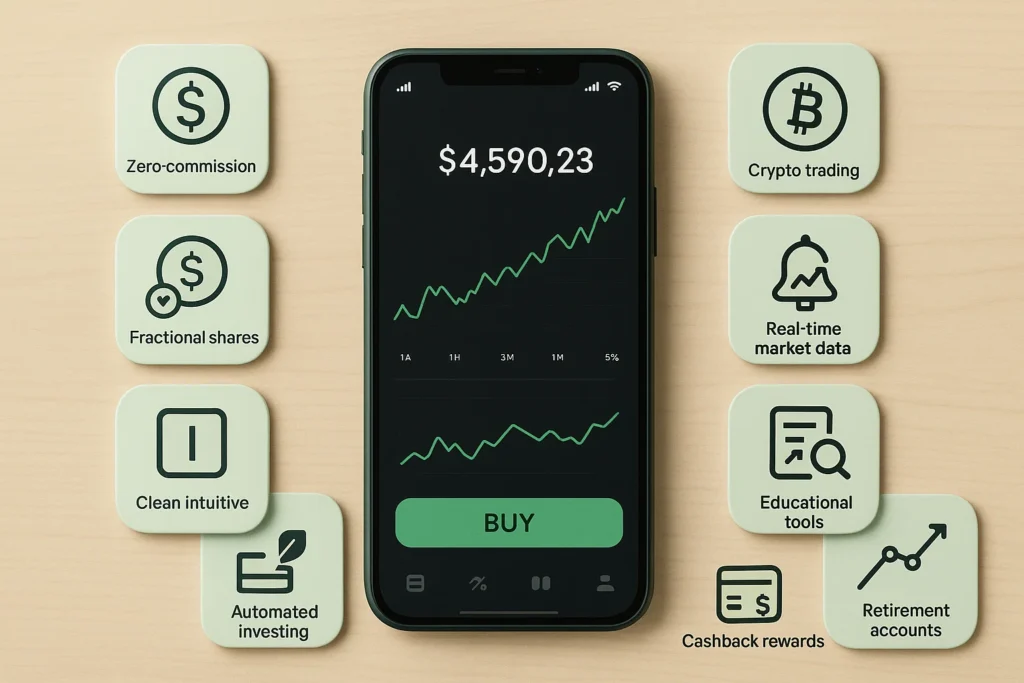
1. Zero-Commission Trading
Robinhood eliminated brokerage fees, forcing the entire industry (Schwab, Fidelity, TD Ameritrade) to eventually follow. This was the biggest shift in U.S. retail trading history.
2. Fractional Shares
Users can buy tiny slices of expensive stocks like Amazon or Tesla, making investing in major companies affordable.
3. Simple, Clean Interface
Robinhood’s minimalist UI makes trading feel intuitive rather than intimidating.
4. Crypto Trading
Users can access major cryptocurrencies in the same app where they manage stocks — no need for a dedicated crypto exchange.
5. Real-Time Market Data
Robinhood provides live charts, instant notifications, and fast order execution.
6. Options Trading
Commission-free options trading with educational tools attracts active and advanced traders.
7. Automated Investing
Recurring investments help users build long-term portfolios effortlessly.
8. Retirement Accounts
Robinhood offers IRAs with contribution matching programs — a key 2025 feature.
9. Robinhood Cash Card
A debit card offering:
- Cashback rewards
- Round-up investing
- Instant spending insights
10. Educational Tools
Users get beginner-friendly guides, explainers, and market insights that make learning easier.
2025 Updates
Robinhood added:
- Smart Order Routing 2.0 (better execution prices)
- AI-based news summaries and alerts
- Advanced charting tools
- Crypto staking options
Read Also :- Top UI/UX Mistakes in Digital Banking & Fintech Apps
The Technology Behind Robinhood
Robinhood’s technology is built to support real-time trading, high user volume, and fast data delivery — all while keeping the interface simple enough for beginners.
Tech Stack Overview
Robinhood uses a modern, cloud-based architecture built on:
- AWS for scalable hosting
- Kubernetes for deploying and managing services
- Python, Go, and Java for backend systems
- React Native for mobile apps
- PostgreSQL and Redis for fast, secure data storage
This setup helps Robinhood process market data instantly and execute trades within milliseconds.
Real-Time Systems
Robinhood’s core engine runs on an event-driven architecture that can:
- Process millions of market price updates
- Execute trades quickly
- Update portfolio values instantly
- Send notifications in real time
This real-time flow is essential for a trading app where seconds matter.
Security & Compliance
As a registered U.S. broker-dealer, Robinhood follows strict regulatory and security standards. Key safety technologies include:
- Encrypted data transmission
- Biometric authentication
- Multi-factor login
- Fraud detection powered by machine learning
- SEC and FINRA compliance systems
Machine Learning & Automation
ML models help Robinhood with:
- Fraud monitoring
- Predictive risk analysis
- Smart order routing
- Personalized content and recommendations
Scalability
Robinhood uses microservices so different components — trading, crypto, notifications, deposits — can scale independently during peak trading hours.
API Integrations
Robinhood integrates with:
- U.S. stock exchanges
- Options markets
- Crypto liquidity providers
- Bank networks for ACH transfers
- Market data providers for live feeds
This multi-network integration allows Robinhood to function as a complete brokerage ecosystem.
Data & Analytics
Tools like Kafka, Snowflake, and Datadog help Robinhood analyze trading trends, monitor system performance, and optimize user experience.
Robinhood’s technology allows millions of users to trade smoothly, securely, and instantly — making it one of the most advanced retail trading apps in the U.S.
Robinhood’s Impact and Market Opportunity
Robinhood has reshaped the U.S. financial landscape more than almost any consumer investing app in history. It empowered an entirely new generation of investors and forced traditional brokerages to modernize.
Industry Disruption
Before Robinhood, trading required:
- Commission fees
- High account minimums
- Complex platforms
- Restricted access to markets
Robinhood erased these barriers, creating a new era of low-cost, beginner-friendly investing. As a result, nearly every major brokerage in America adopted zero-commission trading.
Market Statistics & Growth
As of 2025:
- Robinhood manages millions of active accounts
- Daily trading volume remains among the highest in retail investing
- Crypto trading activity continues to rise
- Robinhood Gold subscriber base grows steadily each year
The U.S. retail investing market is projected to exceed $150 billion by 2030, with mobile-first platforms dominating user acquisition.
User Demographics & Behavior
Most Robinhood users are:
- Young adults (18–35)
- First-time investors
- Crypto holders
- Active traders seeking a simple interface
- Budget-focused investors using fractional shares
Robinhood became the default starting point for millions of Americans entering the world of investing.
Geographic Presence
Robinhood currently focuses on the United States, with selected expansions into the UK. Its foundation as a mobile-first brokerage makes international growth achievable with strong regulatory partnerships.
Future Projections
By 2030, Robinhood aims to:
- Expand globally
- Grow its retirement and long-term investing platforms
- Add more advanced trading tools
- Enhance crypto services and staking
- Integrate AI-powered financial guidance
Opportunities for Entrepreneurs
Robinhood’s success opened doors for new trading apps specialized in:
- Fractional investing
- Crypto-only trading
- Social investing
- Commission-free options
- Micro-investing
- Beginner-friendly robo-advisors
With Robinhood Clone Script, entrepreneurs can launch a modern trading platform — complete with real-time trading, market data, crypto integration, and a sleek UI .
Building Your Own Robinhood-Like Platform
Robinhood proved that trading doesn’t need to be complex or expensive. A simple, zero-commission, mobile-first experience can attract millions of users — especially beginners. This makes Robinhood-style platforms one of the biggest opportunities in the fintech space.
Why Businesses Want Robinhood Clones
A Robinhood-like platform allows companies to offer:
- Zero-commission stock and ETF trading
- Fractional share investing
- Crypto trading in one place
- Options trading with easy controls
- Recurring automated investments
- Real-time charts and price alerts
- Simple, modern UI/UX
- High user engagement with financial education
Such a platform has massive potential in emerging markets where investing is still complicated or restricted.
Key Considerations for Development
To create a robust trading app like Robinhood, focus on:
- Licensing with local regulators (broker-dealer, crypto)
- Bank-grade security & encrypted transactions
- Real-time market data delivery
- Automated KYC/AML verification
- Instant deposits and fast withdrawals
- API integrations with stock exchanges & crypto liquidity providers
- Scalable backend to handle peak market hours
- Clean, beginner-friendly interface
Cost Factors & Pricing Breakdown
Robinhood-Like App Development — Market Price
| Development Level | Inclusions | Estimated Market Price (USD) |
|---|---|---|
| 1. Basic Trading (MVP Stock App) | User registration & login, basic KYC, simple trading for a limited set of stocks/ETFs, real-time or near real-time quotes, buy/sell orders, portfolio overview, basic notifications, web dashboard with mobile-responsive experience | $50,000 |
| 2. Mid-Level Stock Trading Platform | Multi-asset support (stocks, ETFs, basic options), improved charting, watchlists, order types (market/limit/stop), funding & withdrawals, richer portfolio analytics, push notifications, in-app alerts, full web + mobile apps, enhanced security and audit logs | $120,000 |
| 3. Advanced Robinhood-Level Trading Ecosystem | Commission-free trading engine at scale, advanced options trading, fractional shares, real-time market data integrations, complex risk & compliance workflows, cash management features, educational modules, multi-region readiness, cloud-native, high-availability setup | $250,000+ |
Robinhood-Style Trading App Development
The prices above reflect the global market cost of developing a Robinhood-like stock trading and investing platform — typically ranging from $50,000 to over $250,000, with a delivery timeline of 4–12 months depending on trading features, brokerage and market data integrations, compliance scope, and scalability requirements for live trading environments.
Miracuves Pricing for a Robinhood-Like Custom Platform
Miracuves Price: Starts at $15,999
This is positioned for a feature-rich, JS-based Robinhood-style trading platform (commission-free trading flows as per your brokerage setup, core KYC and onboarding, market data display, portfolio tracking, order history, and mobile apps), with room to extend into advanced options trading, fractional investing, deeper analytics, and education/social features as needed.
Note: This includes full non-encrypted source code (complete ownership), complete deployment support, backend & API setup, admin panel configuration, and assistance with publishing on the Google Play Store and Apple App Store—ensuring you receive a fully operational trading ecosystem ready for launch and future expansion.
Delivery Timeline for a Robinhood-Like Platform with Miracuves
For a Robinhood-style, JS-based custom build, the typical delivery timeline with Miracuves is approximately 30–90 days, depending on:
- Depth of trading features (assets supported, order types, fractional shares, options, etc.)
- Number and complexity of integrations (brokerage APIs, KYC/AML, payment rails, market data providers)
- Complexity of analytics dashboards, reporting layers, and compliance workflows
- Scope of mobile apps, white-label needs, and long-term scalability targets
Tech Stack
We preferably will be using JavaScript for building the entire solution (Node.js/Nest.js/Next.js for the web backend + frontend) and Flutter / React Native for mobile apps, considering speed, scalability, and the benefit of one codebase serving multiple platforms.
Other technology stacks can be discussed and arranged upon request when you contact our team, ensuring they align with your internal preferences, compliance needs, and infrastructure choices.
Essential Features to Include
- Fast KYC onboarding
- Zero-commission trading framework
- Real-time price updates
- Fractional investing
- Options trading (optional)
- Crypto buy/sell interface
- Watchlists & alerts
- Instant deposits
- Robo-investing automation
- Educational content
Read More :- Read the complete guide on fintech app development costs
Conclusion
Robinhood changed the way millions of people invest by making trading accessible, simple, and cost-free. It broke down barriers that once kept beginners away from the stock market, and in doing so, sparked a wave of innovation in the fintech industry.
In 2025, Robinhood continues to be a major force in U.S. retail investing, expanding into retirement accounts, automated investing, and crypto features. Its mobile-first approach, clean design, and real-time execution set the standard for modern investing apps.
For entrepreneurs, Robinhood’s success highlights a powerful opportunity: people want easy, affordable ways to grow their money. A well-designed trading platform can attract users rapidly, especially in markets where investing is still traditional or inaccessible.
With Robinhood Clone Script, you can launch a full-featured investing platform — complete with stocks, ETFs, crypto, and fractional shares, fully customizable to your business vision.
You can build the next breakthrough investing app. The technology, expertise, and roadmap are ready — it starts with one decision.
A well-executed idea can become a scalable business with the right support — and Miracuves can help you make it a reality.
FAQs :-
How does Robinhood make money?
Robinhood earns through payment for order flow (PFOF), Robinhood Gold subscriptions, margin interest, crypto trading spreads, cash interest, interchange revenue from the Cash Card, and stock lending.
Is Robinhood a real brokerage?
Yes. Robinhood is a registered U.S. broker-dealer regulated by the SEC and FINRA. Users’ cash is protected by SIPC up to $500,000 (including $250,000 cash claims).
Does Robinhood charge any fees?
Stock and ETF trades are commission-free. However, margin trading, Gold subscriptions, and crypto trades involve fees or spreads.
Can beginners use Robinhood easily?
Yes. Robinhood was designed for new investors, offering an intuitive interface, simple tools, and educational resources.
Does Robinhood support crypto trading?
Yes. Users can trade popular cryptocurrencies such as Bitcoin, Ethereum, Litecoin, and more directly in the app.
Is Robinhood safe?
Robinhood uses encryption, multi-factor authentication, and continuous fraud monitoring. It also complies with U.S. financial regulations.
How many users does Robinhood have?
As of 2025, Robinhood has tens of millions of users, with strong growth among young adults and new investors.
What makes Robinhood different from other trading platforms?
Its zero-commission model, fractional shares, simple design, instant deposits, and combined crypto + stock trading make it unique.
What technology powers Robinhood?
Robinhood uses cloud-native architecture on AWS with microservices, real-time data processing, APIs for market routing, and secure encrypted databases.
Can I build an app like Robinhood?
Yes. With Robinhood Clone Script, you can launch a fully functional stock + crypto trading platform — complete with real-time data, fractional investing, and a sleek UI.
Related Articles :-