Key Takeaways
What You’ll Learn
- Skyscanner works as a travel comparison platform instead of a direct booking seller.
- It helps users compare flights, hotels, and car hire from many providers in one place.
- The platform makes travel research easier through filtering, sorting, and price comparison.
- Booking usually happens on the partner website after the user chooses an option.
- Its business model depends on referral fees, ads, and partner solutions.
Stats That Matter
- The article describes Skyscanner as a travel search and comparison platform for flights, hotels, and car hire.
- 100M+ travelers each month are highlighted as part of its market scale.
- Price Alerts and Everywhere search are positioned as useful features for flexible travelers.
- Filtering and sorting logic help users compare price, duration, stops, provider, and timing.
- Referral fees, advertising, and partner solutions are presented as the main revenue drivers.
Real Insights
- Users trust comparison tools that save time before they trust booking brands.
- Skyscanner wins by reducing search friction, not by handling every booking itself.
- Flexible search features improve engagement for travelers without fixed plans.
- The redirect model keeps the platform simple while still supporting monetization.
- The strongest travel search platforms are built around comparison clarity, not checkout complexity.
Imagine you want to fly from London to anywhere affordable next month. You open a few airline sites, then a couple of online travel agencies, then maybe another hotel app and a car rental website too. After 20 minutes, you still don’t know if you’ve actually found the best deal.
That’s exactly the kind of mess Skyscanner was built to fix.
Skyscanner helps travelers compare flights, hotels, and car hire options in one place instead of checking dozens of websites manually. On its official site, Skyscanner describes itself as a travel search platform where users can compare millions of flights, hotels, and car hire options worldwide for free. It also says that over 100 million travelers come to the platform each month to search for cheap flight tickets, hotels, and car hire.
How Skyscanner Started and Why It Matters
Skyscanner is a UK-based travel company, and its official company details page lists its registered office in London. On its About page, the company says its mission is to become the world’s number one travel ally by helping people move faster, travel smarter, and discover more of the world with confidence.
What makes Skyscanner especially important is that it does not work like a traditional travel agency. The company explains that it helps users plan trips, but it does not handle bookings itself. Instead, it shows available options from airlines, hotels, car hire providers, and online travel agencies, then sends the user to the chosen provider to complete the booking directly. That makes Skyscanner more of a travel comparison engine than a seller.
What You’ll Learn in This Guide
By the end of this guide, you’ll understand what Skyscanner is, how Skyscanner works for travelers, how its business model functions, which features make it successful, what technology powers the platform, and why so many businesses want to build similar travel-comparison platforms. Skyscanner’s current platform already shows why that model is attractive: it combines flight, hotel, and car-hire search with comparison tools, app support, and booking redirection in one streamlined user experience.
What Is Skyscanner? The Simple Explanation
Skyscanner is a travel search and comparison platform that helps people find and compare flights, hotels, and car hire options from airlines, online travel agencies, hotel providers, and car rental companies. It does not usually sell the trip directly itself. Instead, it shows the available options, lets users compare them, and then redirects them to the provider or partner website to complete the booking. Skyscanner’s own company details page says the company helps users plan trips but does not process bookings itself.
The Core Problem Skyscanner Solves
Travel booking can be frustrating because prices and availability are spread across many providers. A traveler may need to check multiple airline websites, a few online agencies, hotel platforms, and car rental brands just to understand the real options.
Skyscanner solves that by acting as a comparison engine. It pulls together many travel options into one interface, making it easier to compare prices, dates, routes, and providers without repeating the same search over and over. Its homepage says users can compare millions of flights, hotels, and car hire options worldwide for free.
In simple terms, Skyscanner saves travelers time and helps them make smarter booking decisions.
Who Uses Skyscanner?
Skyscanner serves several types of travelers:
• Budget travelers looking for cheaper flights
• Flexible travelers comparing dates and destinations
• Holiday planners searching for hotels and cars alongside flights
• Frequent travelers who want fast comparison across providers
• People who want to research first and book later with the provider they prefer
Because it covers flights, hotels, and car hire together, it appeals to both simple one-way trip planners and users building a fuller travel itinerary.
Skyscanner’s Market Position
Skyscanner is one of the best-known travel comparison platforms in the world. On its homepage, the company says 100 million+ travelers each month come to Skyscanner to search for cheap flight tickets, hotels, and car hire. That scale matters because it shows the platform is not just a niche tool — it is a major part of how many people begin their travel-planning journey.
Why Did Skyscanner Become Successful?
Skyscanner became successful because it made travel comparison easier and faster.
Its growth comes from a few simple strengths:
• Broad flight, hotel, and car hire comparison
• Free search for users
• A simple redirect model instead of complicated in-platform sales
• Strong brand recognition for flight comparison
• Helpful discovery tools for flexible travel decisions
The company’s own positioning around free global comparison and its very large monthly audience help explain why the model works so well.
What Makes Skyscanner Different from Traditional Travel Booking?
Traditional travel booking usually means going directly to one airline, one hotel site, or one online agency and seeing only that provider’s inventory.
Skyscanner works differently. It is built to compare options across many providers at once, then send the user to the selected partner to complete the booking. That makes it especially useful at the research and comparison stage of travel planning, which is where many booking decisions are really made.
How Does Skyscanner Work? Step-by-Step Breakdown
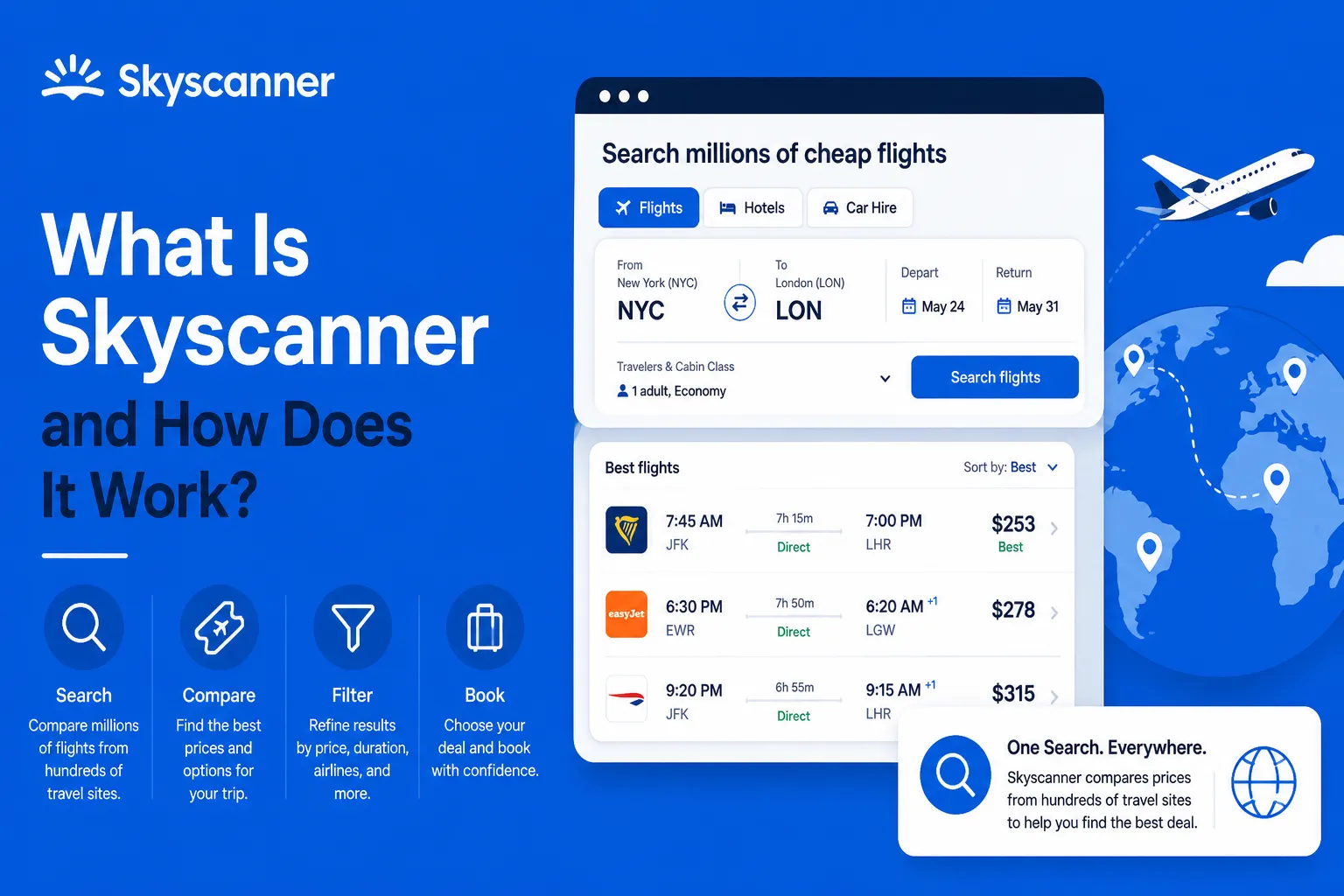
Skyscanner works like a travel comparison engine. Instead of selling you a flight, hotel, or car hire directly in most cases, it searches across airlines, online travel agencies, hotel providers, and car rental partners, then shows the options in one place so you can compare and choose. Skyscanner’s company details page says it helps users plan trips but does not usually handle the booking itself.
How Skyscanner Works for Travelers
Starting a Search
• Users open the Skyscanner website or app
• They choose whether they want to search for flights, hotels, or car hire
• They enter details like departure city, destination, travel dates, and number of travelers
Skyscanner then pulls together available options from many travel providers and displays them in one comparison view. Its homepage says users can compare millions of flights, hotels, and car hire options worldwide for free.
Comparing Flights
• Travelers search for a route and date range
• Skyscanner shows airline and agency results together
• Users can compare by price, travel time, number of stops, departure time, and airline
This is one of Skyscanner’s biggest strengths: it lets users compare many providers without manually checking each airline or travel agency site one by one.
Finding Flexible Options
• Users can search specific routes or use flexible features like broader date or destination discovery
• Skyscanner highlights helpful comparison tools for cheaper and more flexible trip planning
• Travelers can explore different combinations before deciding where and when to book
That makes the platform especially useful for budget-conscious or flexible travelers, not just people with fixed plans. This is supported by Skyscanner’s consumer search design and app-store descriptions highlighting flexible search and travel inspiration features.
Redirecting to the Booking Provider
• Once the traveler chooses an option, Skyscanner sends them to the airline, hotel provider, car rental company, or online travel agency
• The actual booking is then completed on that partner’s website or app
• Payment, ticketing, and final confirmation usually happen with that provider, not directly with Skyscanner
This is a key part of how Skyscanner works. It helps users compare and choose, but the booking itself is generally completed with the selected partner.
Searching Hotels and Car Hire
• For hotels, users search destination and dates, then compare accommodation options across providers
• For car hire, users compare vehicle and rental options based on destination, dates, and availability
• Just like flight search, the goal is to help users compare multiple providers from one interface
Skyscanner’s homepage explicitly lists flights, hotels, and car hire as its main categories.
How Skyscanner Works Behind the Scenes
Partner Aggregation
• Airlines, hotels, car rental brands, and travel agencies provide pricing and availability data
• Skyscanner aggregates those options into searchable results
• Users see the comparison layer, while providers handle the final sale
This partner-based structure is why Skyscanner can offer broad comparison without acting like a traditional travel agency for every booking.
Search, Filter, and Sort Logic
• The system organizes results by criteria like price, duration, stops, provider, and timing
• Users can sort and filter results to match their preferences
• Skyscanner’s product experience is designed to reduce the time needed to evaluate travel options
That filtering and ranking layer is what turns raw travel inventory into a usable comparison tool.
Technical Overview Explained Simply
At a simple level, Skyscanner works like this:
• A user enters a travel search
• Skyscanner checks available options from many partners
• It organizes the results into one comparison page
• The user chooses the best option
• Skyscanner redirects the user to the selected provider
• The provider completes the booking and payment
In simple terms, Skyscanner helps travelers research and compare first, then book with the company they choose.
Skyscanner’s Business Model Explained
Skyscanner makes money without usually selling the booking itself. That is one of the most important things to understand about the platform. Skyscanner’s own company details page says it helps users plan trips but does not handle the booking itself. Instead, users compare options on Skyscanner and then book directly with the airline, hotel provider, car hire company, or travel agency they choose.
How Skyscanner Makes Money
• Referral fees from travel providers
• Advertising and sponsored placement products
• Distribution, data, and affiliate solutions for partners
• Commercial partnerships with airlines, OTAs, hotels, destinations, and car hire brands
A Skyscanner help article explains the referral model very clearly: when a user finds a deal they want, Skyscanner connects them to the airline or travel agency to complete the booking, and the partner then pays Skyscanner a referral fee.
Referral Fee Model
This is the core of Skyscanner’s business model.
When a traveler searches for a flight, hotel, or car hire option:
• Skyscanner compares available partner offers
• The user clicks the deal they want
• Skyscanner sends the user to the provider’s website
• The provider completes the booking
• Skyscanner may earn a referral fee for sending that lead
Why It Matters: This lets Skyscanner stay free for users while still earning money from high-intent travel traffic.
Technical Innovation: Click-tracking, partner attribution, and redirect systems connect search traffic to provider conversions.
Advertising Revenue
Skyscanner also has a strong advertising business. Its partner site says brands can advertise on Skyscanner to reach millions of travelers, grow awareness, and drive more bookings. Skyscanner also now promotes its own Ads Platform as part of its travel advertising business.
Why It Matters: Advertising creates a second major revenue stream beyond referral clicks.
Technical Innovation: Travel ad-tech products let brands target travelers while they dream, plan, and book.
Distribution, Data, and Affiliate Solutions
Skyscanner’s partner platform says it helps businesses grow through distribution, advertising, data, and affiliate solutions. It also offers distribution products that let airlines, hotel businesses, car hire companies, and OTAs connect their content into Skyscanner’s global marketplace.
Why It Matters: This expands Skyscanner from a consumer travel site into a B2B platform for the travel industry.
Technical Innovation: API and distribution infrastructure let suppliers plug inventory into the Skyscanner ecosystem at scale.
Airline, Hotel, and Car Hire Partner Value
Skyscanner’s partner pages show that airlines, hotels, OTAs, destinations, and car hire providers all use the platform to connect with travelers. For example, its airline partner page says airlines can grow and drive quality bookings through Skyscanner’s audience and integration, advertising, and data solutions.
Why It Matters: The more valuable Skyscanner becomes to suppliers, the stronger its marketplace economics become.
Technical Innovation: Partner-side tools combine traffic acquisition, brand promotion, and travel-demand insight inside one ecosystem.
Market Scale That Supports the Model
This model works because Skyscanner operates at very large scale. Skyscanner says more than 100 million people use its app and website every month, and its homepage also says over 100 million travelers come to the platform each month to find cheap flights, hotels, and car rentals. That volume gives Skyscanner a huge base of valuable traffic to monetize through referrals and advertising.
Revenue Model Breakdown
| Revenue Stream | How It Works | Why It Matters |
|---|---|---|
| Referral Fees | Travel providers pay when users click through and book | Core monetization engine |
| Advertising | Brands promote offers and campaigns to travelers | Expands revenue beyond referral traffic |
| Distribution Solutions | Suppliers connect inventory into Skyscanner’s marketplace | Strengthens B2B value |
| Data and Affiliate Solutions | Partners use Skyscanner’s reach and insights to grow | Broadens platform economics |
Skyscanner’s business model is powerful because it does not need to own the booking to benefit from the booking journey. It wins by owning the comparison step, which is often where the traveler’s decision is actually made.
Key Features That Make Skyscanner Successful

Skyscanner has stayed successful because it focuses on one core promise: help travelers compare options fast, clearly, and for free. Its live platform centers around flights, hotels, and car hire, while its app and travel tools are built to make discovery, price tracking, and comparison easier before the user books with a provider.
Flight Comparison Across 1,000+ Providers
Skyscanner’s flight search compares deals from more than 1,000 providers and lets users sort results by options like cheapest, fastest, or lower-emission tickets.
Why It Matters: Travelers can evaluate many airline and OTA options in one place instead of checking each provider manually.
Technical Innovation: Large-scale fare aggregation and ranking systems organize huge amounts of flight inventory into easy comparison results.
Explore Everywhere Search
Skyscanner’s “Everywhere” feature lets users search for cheap flights without choosing a fixed destination first. The company describes it as flipping the usual search flow by turning “Everywhere” into a smart starting point.
Why It Matters: This is perfect for flexible travelers who care more about finding a good trip than locking in one destination.
Technical Innovation: Destination-discovery logic uses route and fare data to surface broad travel options from a single departure point.
Whole Month and Cheapest-Date Discovery
Skyscanner highlights tools that help users find the cheapest month — or even the cheapest day — to fly.
Why It Matters: Travelers often save more by shifting dates than by switching airlines, and this tool makes that visible immediately.
Technical Innovation: Calendar-based fare analysis turns large sets of route pricing into a simple decision tool.
Price Alerts
Skyscanner offers Price Alerts that monitor fare changes and notify users when prices move. Its help and inspiration pages explain that users can build a wishlist and let Skyscanner track prices over time.
Why It Matters: Travelers do not need to keep repeating the same search every day.
Technical Innovation: Automated fare-tracking systems continuously monitor route pricing and trigger alerts through app notifications or email.
Skyscanner App
Skyscanner promotes its app as a free flight, hotel, and car rental deals app, and its guidance pages say the app is central to features like Savvy Search, Everywhere search, and Price Alerts.
Why It Matters: A strong mobile experience keeps travel research fast and convenient, especially when users are comparing options on the go.
Technical Innovation: Mobile-first trip-search workflows combine alerts, saved preferences, and comparison tools in one interface.
Hotels Comparison
Skyscanner Hotels lets users search and compare hotels, apartments, and hostels for free.
Why It Matters: Travelers can extend their comparison workflow beyond flights and keep more of their trip planning in one platform.
Technical Innovation: Accommodation-search aggregation brings multiple stay providers into one searchable interface.
Car Hire Comparison
Skyscanner’s car rental search compares deals from trusted providers in more than 18,000 locations worldwide.
Why It Matters: Travelers can add local transport planning without leaving the Skyscanner ecosystem.
Technical Innovation: Global car-hire inventory aggregation expands the platform beyond airfare comparison into broader trip planning.
No Hidden Fees Positioning
Skyscanner emphasizes “no hidden fees” in its product messaging and says the price shown is the price travelers pay.
Why It Matters: Pricing transparency builds trust, especially in travel where surprise fees can quickly undermine the user experience.
Technical Innovation: Fare and fee display logic is designed to keep pricing clearer at the comparison stage.
Savvy Search and Drops
Skyscanner has also added more app-based discovery features. Savvy Search is an app-only feature, and “Drops” surfaces flight price drops of at least 20% from a user’s top airport.
Why It Matters: These features make Skyscanner more proactive, helping users find good opportunities rather than only reacting to manual searches.
Technical Innovation: Predictive and event-driven travel discovery tools use large-scale fare scanning to surface noteworthy deals automatically.
Savings Generator and Booking Insights
Skyscanner also offers tools like its Savings Generator, which uses flight data to help travelers decide when to book for cheaper fares.
Why It Matters: This turns Skyscanner into more than a comparison engine — it becomes a travel decision-support tool.
Technical Innovation: Historical and current fare-data analysis is used to generate booking-timing guidance.
What Sets Skyscanner Apart
What really sets Skyscanner apart is that it owns the comparison moment. It is not mainly trying to become the seller of record. Instead, it has built a product around helping users search broadly, compare smartly, and then choose the provider they trust most. That makes it especially strong at the research stage of travel planning, where many booking decisions are actually made.
The Technology Behind Skyscanner
Skyscanner runs on a large travel-search and comparison platform that connects flights, hotels, and car hire results from many providers into one fast search experience. It is not mainly designed to issue tickets itself. Instead, its technology is built to gather options, organize them clearly, and send users to the provider they choose. Skyscanner’s company details page says it helps people plan trips but does not usually handle the booking itself, which means the real product is the search, comparison, and redirect engine behind the experience.
Large-Scale Travel Aggregation
One of Skyscanner’s biggest technical strengths is aggregation. Its flight product compares deals from more than 1,000 providers, while its hotel and car hire categories expand that comparison model across other parts of the trip too.
Why It Matters: The platform only becomes useful if it can pull together a very large amount of inventory from many travel providers and present it quickly.
Technical Innovation: Multi-provider aggregation systems connect airlines, OTAs, hotel partners, and car hire providers into one searchable marketplace.
Search, Filter, and Ranking Systems
Skyscanner’s product experience depends on turning huge amounts of travel inventory into simple, comparable results. Users can sort flights by cheapest, fastest, or better environmental options, and they can filter across dates, providers, and journey preferences.
Why It Matters: Travelers need help making decisions, not just access to raw inventory.
Technical Innovation: Search indexing, result ranking, and comparison logic transform large travel datasets into easy booking choices.
Flexible-Date and Destination Discovery
Features like Everywhere search and cheapest-month discovery show that Skyscanner’s technology is built for travel exploration as much as direct booking comparison.
Why It Matters: Many users are flexible on destination or timing, and these features help them discover opportunities they might not have searched manually.
Technical Innovation: Destination-discovery and calendar-pricing systems scan broad route and date combinations to surface cheaper travel options.
Fare Monitoring and Alerts
Skyscanner’s Price Alerts and newer deal-discovery tools like Drops depend on constant fare tracking. The platform says it monitors changes and notifies users when prices move.
Why It Matters: Travel prices change fast, so automated monitoring creates real user value.
Technical Innovation: Fare-tracking infrastructure watches selected routes and triggers email or app alerts when pricing changes or when strong drops appear.
Mobile-First App Experience
Skyscanner’s app is central to many of its newer product experiences, including Price Alerts, Savvy Search, and discovery-oriented trip planning. Its app page positions the mobile experience as a place to search flights, hotels, and car hire deals in one tool.
Why It Matters: Travel comparison often happens in short sessions on mobile, not just long sessions on desktop.
Technical Innovation: Mobile-native search, saved preferences, notifications, and discovery tools support faster repeat engagement.
Redirect and Attribution Infrastructure
Because Skyscanner usually does not complete the final booking itself, its technology has to do one job extremely well: connect the traveler to the right provider and track that referral properly. Skyscanner’s own help content explains that partners pay referral fees after users are connected to them.
Why It Matters: The business model depends on accurate redirect and attribution systems.
Technical Innovation: Click-tracking, deep-linking, and referral attribution systems connect Skyscanner traffic to partner bookings and partner performance.
Advertising and Partner Platform Technology
Skyscanner also runs a partner platform for advertising, distribution, data, and affiliate solutions. Its partner site says brands can advertise to travelers and suppliers can connect inventory into the Skyscanner ecosystem.
Why It Matters: This turns Skyscanner into more than a consumer search engine; it also becomes a travel-tech platform for partners.
Technical Innovation: Ad-tech, partner APIs, and distribution infrastructure support both consumer comparison and supplier-side monetization.
Hotel and Car Hire Comparison Infrastructure
Skyscanner uses the same comparison logic beyond flights. Its hotels product compares accommodation options, while its car hire product compares deals across more than 18,000 locations worldwide.
Why It Matters: Extending comparison technology across multiple categories increases user retention and trip value.
Technical Innovation: Category-specific search layers reuse the same core comparison model while adapting to different travel-product requirements.
Why This Technology Matters for Business
The technology behind Skyscanner matters because it lets the company own the comparison step of travel planning at global scale. That is where many travelers make their real decision. By combining aggregation, ranking, alerts, mobile discovery, and redirect infrastructure, Skyscanner creates value without needing to become the direct seller in most cases. That is why it remains one of the most powerful travel-search businesses in the market.
Skyscanner’s Impact & Market Opportunity
Skyscanner has had a huge impact on how people start planning trips because it made travel comparison fast, free, and much more transparent. Instead of going straight to one airline or one online travel agency, users can compare options across many providers before deciding where to book. That role in the decision stage is powerful. Skyscanner says more than 100 million travelers use its platform each month, and its partner site says it supports more than 1,200 partners worldwide, which shows just how important it has become in the global travel search ecosystem.
How Skyscanner Changed Travel Search
One of Skyscanner’s biggest contributions is that it separated comparison from booking. Its company details page makes this clear: Skyscanner helps people plan trips, but the booking and payment are usually completed directly with the chosen travel provider. That model changed the user experience because travelers no longer had to trust a single seller’s prices or inventory. They could compare many options first, then choose the provider they preferred.
That shift matters because the comparison step is where many booking decisions are actually made. By owning that step, Skyscanner became more than a convenience tool. It became a major traffic and demand engine for airlines, OTAs, hotels, and car hire brands. Skyscanner’s partner platform explicitly pitches this value by offering distribution, advertising, data, and affiliate solutions to travel businesses.
Market Size and Why the Opportunity Is So Big
The global travel market is massive, and Skyscanner sits right at the point where demand starts. Users come to compare prices, explore destinations, and figure out when and where to book. That means the platform benefits from demand across flights, stays, and car hire rather than relying on one narrow category. Its homepage and product pages show that it compares millions of flights, hotels, and car hire options worldwide, which gives it a very broad reach across travel spending.
This also creates a strong business opportunity because comparison platforms can monetize without needing to operate the whole booking stack themselves. Skyscanner’s own help content explains that partners pay referral fees after users are sent to them, and its partner site shows that advertising and distribution add even more monetization beyond simple click-through traffic.
Why Travelers Keep Using It
Skyscanner stays relevant because it serves several strong traveler needs at once:
• finding cheaper options
• comparing many providers quickly
• exploring flexible dates and destinations
• tracking price changes over time
• extending search beyond flights into hotels and car hire
Its newer and current features like Everywhere search, Price Alerts, and app-first discovery tools make it especially useful for flexible and budget-conscious travelers, not just people with fixed plans.
Why the Model Is Still Strong
The Skyscanner model is still attractive because it is hard to replace the value of trusted comparison at scale. Travelers want speed, transparency, and convenience. Suppliers want qualified traffic and bookings. Skyscanner sits in the middle and benefits from both sides. Its partner platform makes that especially clear by offering airlines, OTAs, destinations, and other travel businesses ways to grow through integration, advertising, data, and affiliate tools.
Opportunities for Entrepreneurs
This is exactly why so many entrepreneurs want to build Skyscanner-like products. There is room for niche metasearch platforms, regional travel-comparison apps, vertical-specific booking comparison tools, and travel-intelligence products built around alerts, pricing trends, and discovery. The bigger lesson is simple: if a platform can own the comparison moment, it can become incredibly valuable without having to own the booking itself.
This massive success is why many entrepreneurs want to create similar platforms that connect travelers with airlines, hotels, car hire providers, and agencies through technology-driven travel comparison.
Building Your Own Skyscanner-Like Platform
Skyscanner’s success shows that travelers do not always want another booking website. Often, what they want first is a faster way to compare options, understand pricing, and decide where to book. That is why the comparison model is so powerful. Skyscanner built value by owning the search-and-decision stage, then connecting users to the provider they choose. Its current platform combines flights, hotels, and car hire comparison, while its partner ecosystem adds advertising, distribution, data, and affiliate solutions on top.
Why Businesses Want a Skyscanner Clone
Entrepreneurs are drawn to this model because it can scale without taking full booking risk on every transaction.
A Skyscanner-like platform creates value in several ways:
• It attracts high-intent travel search traffic
• It earns from referrals instead of always being the seller of record
• It can monetize through advertising and partner visibility
• It can expand into multiple categories like flights, hotels, and car hire
• It can build strong repeat usage through alerts and discovery tools
This becomes even more attractive when the platform has scale. Skyscanner says more than 100 million travelers use its platform each month, while its partner platform says it works with 1,200+ partners worldwide. That scale shows why comparison traffic is such a valuable asset in travel.
Key Considerations Before Development
Before building a Skyscanner-style platform, a business needs to decide exactly what comparison problem it wants to solve.
Important questions include:
• Will the platform focus on flights only, or also include hotels and car hire?
• Will it target one country, one region, or global routes?
• Will the product mainly compare providers, or also include booking support?
• Will it rely on affiliate redirects, advertising, or a hybrid model?
• Will it offer flexible tools like price alerts, cheapest-month views, or destination discovery?
• How will supplier inventory and pricing data be integrated and refreshed?
These choices matter because Skyscanner’s strength comes from making comparison simple at scale, not from trying to do every part of travel commerce itself.
Essential Features to Include
A strong Skyscanner-like platform should include:
• Multi-provider search across flights, hotels, or car hire
• Fast filters and sorting by price, timing, stops, and provider
• Clear redirect flows to booking partners
• Price alerts and saved searches
• Flexible-date and cheapest-month tools
• Destination-discovery features like “Everywhere” search
• Mobile-first search and notifications
• Provider attribution and click tracking
• Admin tools for partner management and campaign controls
More advanced features should include:
• App-only discovery tools
• Predictive fare insights
• Transparent fee display
• Deal-drop alerts or flash-travel feeds
• Advertising products for suppliers
• API and affiliate tools for B2B partners
Skyscanner’s current platform already reflects many of these features, especially comparison across 1,000+ providers, Everywhere search, cheapest-date tools, Price Alerts, app-first discovery, and partner monetization infrastructure.
Conclusion
Skyscanner proves that a travel business does not need to own the final booking to become incredibly valuable. By owning the comparison stage, it helps travelers make smarter decisions before they ever reach an airline, hotel brand, or travel agency. That is why the platform remains so influential: it combines large-scale comparison across flights, hotels, and car hire with traveler tools like flexible search and price alerts, while still sending users to the provider they trust to complete the booking.
For entrepreneurs, the bigger lesson is simple. The strongest travel platforms reduce decision friction. When a product helps users compare faster, discover better options, and feel more confident about where to book, it creates value for both travelers and partners. That is exactly why so many founders want to build Skyscanner-like platforms today.
FAQs :-
What is Skyscanner?
Skyscanner is a travel search and comparison platform that helps users compare flights, hotels, and car hire options from many providers in one place. It usually does not complete the booking itself. Instead, it sends users to the airline, hotel provider, travel agency, or car hire company they choose.
How does Skyscanner make money?
Skyscanner mainly makes money through referral fees, advertising, and partner solutions. Its own help content says partners pay Skyscanner a referral fee when users are sent to them and complete a booking, and its partner platform also promotes advertising, distribution, data, and affiliate solutions.
Is Skyscanner free to use?
Yes. Skyscanner’s homepage says users can compare millions of flights, hotels, and car hire options worldwide for free.
Does Skyscanner book flights directly?
Usually no. Skyscanner’s company details page says it helps users plan trips but does not handle the booking itself. After users choose an option, they are generally redirected to the provider to complete the booking.
Can I compare hotels and car hire on Skyscanner too?
Yes. Skyscanner supports comparison across flights, hotels, and car hire, not just airfare. Its homepage and dedicated product pages clearly show all three categories.
What is Skyscanner Everywhere search?
Everywhere search is a feature that lets users explore destination options without choosing one fixed place first. It is designed for flexible travelers who want to find good-value trips from a departure airport.
Does Skyscanner have price alerts?
Yes. Skyscanner offers Price Alerts that monitor fare changes and notify users when prices move. The company also highlights app-based deal-discovery tools like Drops.
What makes Skyscanner different from an online travel agency?
The biggest difference is that Skyscanner is mainly a comparison platform, while an online travel agency usually acts as the booking seller. Skyscanner helps users compare options from many providers, then redirects them to the chosen provider to book.
How many people use Skyscanner?
Skyscanner says more than 100 million travelers use its app and website every month to search for flights, hotels, and car hire.
Can I build a platform like Skyscanner?
Yes. A Skyscanner-like platform would usually need travel-inventory aggregation, multi-provider comparison, filters and sorting, price alerts, mobile-first search, redirect tracking, and partner monetization tools like affiliate or advertising systems. Skyscanner’s own product and partner model show that the biggest value comes from owning the comparison stage of travel planning.
Related Articles :-
Miracuves is an independent software development company. We are not affiliated with, connected to, sponsored by, or endorsed by any company or product named in this article.
Terms such as “X Clone” are used descriptively. It is how the software industry refers to building a platform with functionality comparable to a known service, and how clients search for it.
The entire design and codebase of our products is built by our own team. Our products contain no code, design, graphics, or content originating from any third-party website or applications.
All third-party names and marks referenced in this article are the property of their respective owners, referenced solely to identify the services discussed.