




Imagine having access to powerful AI models that can generate images, audio, video, and text—without being locked into a closed ecosystem. Instead of using AI as a black box, you can build, customize, and innovate on top of open models. That’s the core idea behind Stability AI.
Stability AI is a generative AI company best known for building and releasing open models that creators, developers, and businesses can use freely or customize for their own products. Rather than focusing on a single consumer app, Stability AI provides the foundation technology that powers many AI tools across the internet.
What makes Stability AI stand out is its commitment to open innovation. By releasing models that anyone can run, fine-tune, or deploy, it has played a key role in accelerating adoption of generative AI worldwide.
By the end of this guide, you’ll understand what Stability AI is, how its models work, its business model, key technologies, market impact, and why many entrepreneurs want to build Stability-AI-like platforms—and how Miracuves can help make that possible.
What Is Stability AI? The Simple Explanation
Stability AI is a generative AI company focused on building open models that anyone can use, customize, and deploy. In simple terms, it creates powerful AI engines—especially for images, audio, video, and text—and makes them available so developers and businesses can build their own applications on top.

The Core Problem Stability AI Solves
Many AI platforms are closed systems. You can use them, but you can’t see how they work, customize them deeply, or run them on your own infrastructure. Stability AI solves this by:
- Releasing open models that can be run locally or in the cloud
- Allowing full customization and fine-tuning
- Reducing dependency on single vendors
- Enabling innovation without heavy platform lock-in
This approach gives builders far more control than typical AI SaaS tools.
Target Users and Use Cases
Stability AI is commonly used by:
• Developers building AI-powered apps
• Startups creating image or media tools
• Researchers experimenting with generative models
• Enterprises needing on-premise or private AI
• Creators and platforms building custom workflows
Instead of serving end users directly, Stability AI empowers builders and platforms.
Current Market Position
Stability AI is positioned as a foundation-model provider, especially strong in open-source generative media. Its models power countless third-party tools, apps, and services—often behind the scenes.
Why It Became Successful
Stability AI gained traction by doing what many others wouldn’t: opening access. By releasing high-quality models openly, it enabled rapid experimentation, community adoption, and widespread integration across the AI ecosystem.
How Stability AI Works — Step-by-Step Breakdown
For Developers and Builders
Getting started with the models
Stability AI provides access to its generative models through open releases and developer-friendly distribution. Builders can download models, run them locally, deploy them on cloud infrastructure, or integrate them into their own applications and platforms.
Choosing the right model
Depending on the use case, developers select different types of models, such as:
- Image generation models for visuals and design
- Audio models for music or sound generation
- Video and animation-focused models
- Text-based or multimodal models for broader workflows
Each model is designed to act as a core engine, not a finished app.
Running and customizing the model
Once a model is selected, developers can:
- Run it as-is for quick results
- Fine-tune it on custom datasets
- Adjust parameters to control style, quality, or output behavior
- Integrate it into existing systems or products
This flexibility is a major advantage over closed AI services.
Generating outputs
When a user or system sends an input (such as a text prompt):
- The model interprets the input
- Generates content based on learned patterns
- Produces an output (image, audio, video, or text)
- Returns it to the application using the model
The surrounding product logic—UI, storage, moderation, billing—is handled by the builder, not Stability AI.
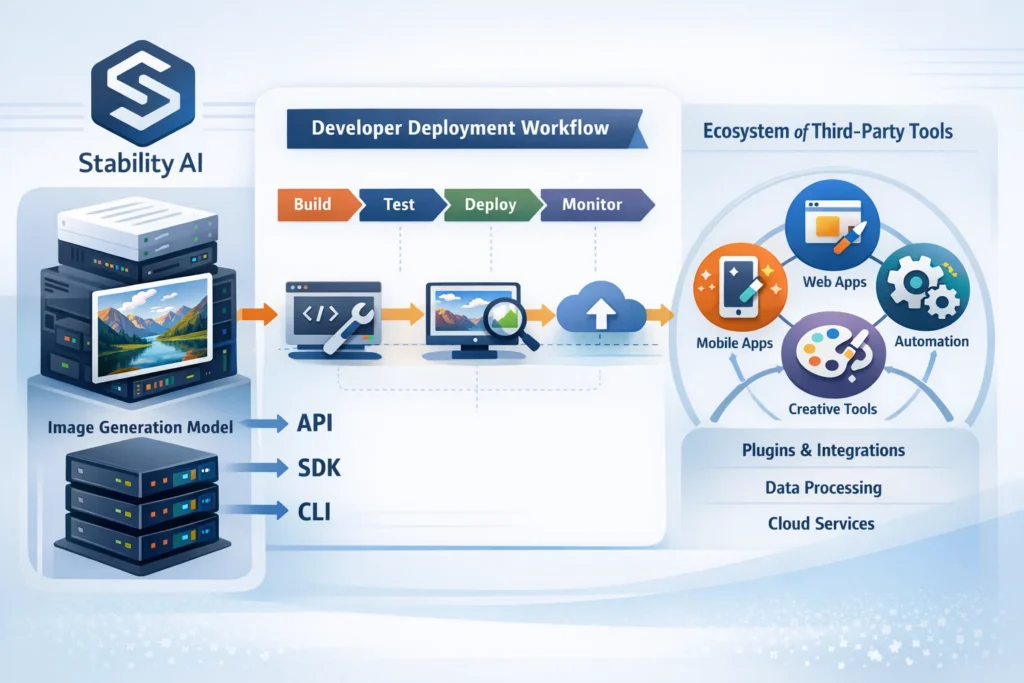
Typical workflow example
Developer selects model → deploys it on infrastructure → connects it to an app or API → users send prompts → AI generates outputs → product delivers results to users.
For Enterprises
Private and controlled deployment
Enterprises often choose Stability AI models because they can be:
- Deployed in private environments
- Controlled under internal security policies
- Customized for specific business needs
- Integrated with existing systems
This is especially valuable for regulated or data-sensitive industries.
Technical Overview (Simplified)
Stability AI operates as a model-first provider, focusing on:
- Training large generative models
- Releasing them in open or accessible formats
- Supporting customization and deployment flexibility
- Letting others build products on top
Rather than owning the entire user experience, Stability AI powers a wide ecosystem.
Stability AI’s Business Model Explained
How Stability AI Makes Money
Stability AI primarily monetizes through a B2B and developer-focused model. Even though many models are openly available, businesses still pay for services that make real-world deployment easier, faster, and more reliable.
Key revenue streams include:
- Hosted APIs and cloud access: Companies pay to use Stability AI models through managed services instead of running infrastructure themselves
- Enterprise licensing: Commercial usage rights, support, and custom terms for large organizations
- Custom model work: Fine-tuning, adaptation, and model development for specific business needs
- Partnerships: Platform integrations where Stability AI models are embedded into third-party tools
In short: open models drive adoption, and commercial services drive revenue.
Pricing Structure
Pricing typically depends on:
- API usage volume (requests, compute, throughput)
- Model type and complexity (image vs video vs audio workloads)
- Enterprise needs (private deployment, SLAs, support)
- Customization and fine-tuning requirements
Businesses pay more when they need reliability, scale, or tailored outputs.
Fee Breakdown
- Usage-based charges for hosted model access
- Enterprise contracts for licensing and support
- Project-based pricing for customization and fine-tuning
This keeps entry easy for builders while supporting large deployments.
Market Size and Demand
Demand for Stability AI-style offerings is driven by:
- Rapid growth in generative media (images, audio, video)
- Businesses needing controllable, customizable AI
- Preference for open models to avoid vendor lock-in
- Expanding use of AI in creative tools and automation platforms
Profitability Insights
Stability AI improves margins by:
- Scaling the same core models across many customers
- Monetizing infrastructure and support rather than only the model
- Building long-term enterprise relationships
- Enabling partners to distribute adoption
Revenue Model Breakdown
| Revenue Stream | Description | Who Pays | Nature |
|---|---|---|---|
| Hosted API Access | Managed model usage | Developers/Companies | Usage-based |
| Enterprise Licensing | Commercial terms & support | Enterprises | Contract |
| Custom Models | Fine-tuning & bespoke builds | Businesses | Project-based |
| Partnerships | Embedded model distribution | Platforms | Strategic |
Key Features That Make Stability AI Successful
Open and accessible AI models
One of Stability AI’s biggest strengths is its commitment to open models. By releasing powerful generative models openly, it allows developers and companies to experiment, build, and innovate without being locked into a closed platform.
Foundation models for multiple media types
Stability AI isn’t limited to one format. Its ecosystem spans:
- Image generation
- Audio and music generation
- Video and animation experiments
- Text and multimodal research
This makes it a broad foundation-layer provider rather than a single-use tool.
High customizability
Because the models are open, users can fine-tune them for:
- Specific visual styles
- Brand consistency
- Industry-specific outputs
- Performance or efficiency goals
This level of customization is difficult with closed AI services.
Strong developer adoption
Developers prefer Stability AI because it gives them control over deployment. They can run models locally, in private clouds, or within secure enterprise environments.
Powering third-party platforms
Many AI tools and creative platforms are built on top of Stability AI models. Even when users don’t see the brand directly, Stability AI often works behind the scenes.
Vendor lock-in avoidance
Businesses that want long-term flexibility choose Stability AI because they aren’t tied to a single SaaS interface or pricing structure.
Scalable from prototype to production
Teams can start small—experimenting locally—and scale up to production-grade deployments using hosted or enterprise services.
Community-driven improvement
Open access encourages research contributions, experimentation, and rapid iteration across the ecosystem, accelerating innovation.
Enterprise-friendly deployment
Stability AI models can be deployed in controlled environments, making them suitable for regulated industries and data-sensitive workflows.
Broad ecosystem impact
By acting as a foundation provider, Stability AI influences a wide range of industries—from design tools to media platforms to internal business automation.
The Technology Behind Stability AI
Tech stack overview (simplified)
Stability AI is built around foundation generative models that can be deployed flexibly. Instead of wrapping everything into one consumer app, the technology stack is designed to be modular and reusable:
- Core generative models (image, audio, video, text)
- Training pipelines for large-scale data learning
- Fine-tuning mechanisms for customization
- Inference systems for running models efficiently
- Deployment options for local, cloud, or private environments
This design makes the technology adaptable to many products and industries.
Foundation model approach
At the core, Stability AI trains large models that learn patterns from massive datasets. These models don’t “store” images or media—they learn relationships between concepts, styles, and structures, which lets them generate entirely new outputs from prompts.
Because the models are released openly, developers can inspect, adapt, and improve how they’re used.
Customization and fine-tuning
A key technical strength is fine-tuning. Builders can adapt base models to:
- Match a brand’s visual identity
- Focus on a specific industry or domain
- Improve output quality for a niche use case
- Optimize performance for specific hardware
This turns a general-purpose model into a specialized engine.
Inference and performance
Running generative models efficiently is complex. Stability AI’s ecosystem supports:
- GPU-accelerated inference
- Batch processing for scale
- Optimization techniques to reduce cost
- Flexible performance trade-offs (speed vs quality)
These capabilities are critical for production systems.
Data handling and safety
Because models are often deployed by third parties, Stability AI focuses on providing tools and guidelines rather than controlling end-user content directly. Builders are responsible for moderation and usage rules, which gives flexibility but also requires careful design.
Scalability approach
Stability AI’s tech scales by:
- Letting builders choose their own infrastructure
- Supporting distributed deployments
- Separating model training from product experience
- Enabling gradual scaling from prototype to enterprise
This makes it suitable for startups and large companies alike.
Why this technology matters for business
Stability AI’s technology puts control back in the hands of builders. Instead of depending on a single SaaS interface, companies can own their AI stack, customize behavior, manage costs, and integrate AI deeply into their products.
Stability AI’s Impact & Market Opportunity
Industry impact
Stability AI has had a major impact by proving that open generative models can compete with closed AI platforms. By releasing high-quality models openly, it accelerated innovation across the AI ecosystem and empowered thousands of startups, researchers, and developers to build products without starting from scratch.
This approach shifted the market conversation from “who owns the best AI” to “who enables the most builders”. Many popular creative tools and AI-powered platforms rely on Stability AI models behind the scenes.
Market demand and growth drivers
Demand for Stability AI–style solutions is driven by:
- Rapid growth of generative media (images, audio, video)
- Businesses wanting control over their AI stack
- Concerns around vendor lock-in with closed platforms
- Need for on-premise or private AI deployments
- Expansion of AI into creative, marketing, and automation workflows
As AI adoption matures, flexibility and ownership become more important than convenience alone.
User segments and behavior
Stability AI serves a different audience than consumer AI apps. Its key users include:
- Startups building AI-first products
- Developers integrating generative features
- Enterprises deploying AI internally
- Creative platforms powering user-generated content
- Research teams experimenting with new models
A common behavior pattern is build-once, customize-deeply. Users adopt a base model and then tailor it extensively for their specific needs.
Ecosystem and partner influence
Stability AI benefits from a wide ecosystem where:
- Developers improve tooling and workflows
- Platforms distribute AI capabilities to end users
- Communities share fine-tuning techniques
- Innovation happens outside a single company’s roadmap
This distributed innovation model scales faster than centralized product development.
Future direction
Foundation-model providers like Stability AI are evolving toward:
- More efficient and specialized models
- Better tooling for fine-tuning and deployment
- Multimodal models combining image, audio, and video
- Enterprise-ready governance and support layers
- Deeper integration into industry-specific products
Opportunities for entrepreneurs
There are strong opportunities to build on Stability AI–style foundations for:
- AI-powered creative platforms
- Brand-specific image and media tools
- Vertical SaaS with embedded generative AI
- On-premise AI solutions for enterprises
- Developer platforms and AI infrastructure tools
This growing demand explains why open foundation models are becoming a strategic asset in the AI economy.
Read More :- How to Develop an AI Chatbot Platform
Building Your Own Stability-AI-Like Platform
Why businesses want Stability AI–style foundations
Stability AI demonstrates that owning and controlling AI infrastructure is valuable for many businesses. Instead of depending on a closed AI service, companies want flexibility, transparency, and the ability to customize models deeply.
Key reasons include:
- Freedom from vendor lock-in
- Ability to deploy AI in private or regulated environments
- Customization for brand, industry, or performance needs
- Long-term cost control
- Ownership of AI-driven product differentiation
This model is especially attractive for startups and enterprises building AI into core products.
Key considerations before development
If you’re planning to build a Stability-AI-like platform or service, consider:
- Which models you will provide (image, audio, video, text)
- Open vs commercial licensing strategy
- Fine-tuning and customization tooling
- Deployment options (local, cloud, private)
- Governance, monitoring, and usage controls
- Support and documentation for developers
Clear positioning as a foundation provider is critical.
Read Also :- How to Market an AI Chatbot Platform Successfully After Launch
Cost Factors & Pricing Breakdown
Stability AI-Like App Development — Market Price
| Development Level | Inclusions | Estimated Market Price (USD) |
|---|---|---|
| 1. Basic Generative AI API MVP | Core backend and web console integrating with one third-party or self-hosted generative model (image/text), API gateway, authentication & rate limiting, basic prompt → output pipeline, simple logs & monitoring, usage metrics, standard admin panel, minimal safety & content filters | $100,000 |
| 2. Mid-Level Generative AI Platform | Multi-model/multi-endpoint support (text, image, embeddings, etc.), routing by task/use-case, projects/workspaces, fine-grained API keys & quotas, improved observability (latency, errors, token/credit usage), model/version management, stronger safety filters & moderation hooks, analytics dashboard, polished web console | $190,000 |
| 3. Advanced Stability AI-Level GenAI Ecosystem | Large-scale, multi-tenant GenAI platform with high-concurrency model serving, custom model hosting (fine-tuned / LoRA / control models), job queue + async pipelines, model catalog & versioning, billing/credits system, enterprise RBAC & orgs, detailed observability, safety & governance tools, cloud-native scalable architecture | $300,000+ |
Stability AI-Style Generative AI Platform Development
The prices above reflect the global market cost of developing a Stability AI–style generative AI platform — typically ranging from $100,000 to over $300,000, with a delivery timeline of around 4–12 months for a full, from-scratch build. This usually includes:
- Model integration and serving pipelines (image/text/other models)
- Project/workspace management and API key handling
- Usage metering, logging, and analytics
- Safety, filtering, and governance layers
- Production-grade infrastructure to support high traffic and multiple tenants.
Miracuves Pricing for a Stability AI-Like Custom Platform
Miracuves Price: Starts at $15,999
This is positioned for a feature-rich, JS-based Stability AI–style generative AI platform that can include:
- Integration with your chosen image/text models or hosted providers
- Multi-endpoint API (e.g., generate, upscale, vary, embeddings, etc.)
- Project/workspace structure with API keys, quotas, and basic rate limiting
- Usage dashboards with request counts, credits/tokens, and performance stats
- Core safety hooks (NSFW filters, blocklists, basic moderation integration)
- A modern web admin console plus user-facing portal for managing keys, logs, and models.
From this foundation, the platform can be extended into custom model hosting, advanced orchestration, enterprise RBAC, billing/credits, and richer safety/governance as your GenAI business scales.
Note: This includes full non-encrypted source code (complete ownership), complete deployment support, backend & API setup, admin panel configuration, and assistance with publishing companion mobile apps on the Google Play Store and Apple App Store—ensuring you receive a fully operational generative AI ecosystem ready for launch and future expansion.
Delivery Timeline for a Stability AI-Like Platform with Miracuves
For a Stability AI–style, JS-based custom build, the typical delivery timeline with Miracuves is 30–90 days, depending on:
- Depth of model support (image/text, upscaling, variations, fine-tuned models, etc.)
- Number and complexity of third-party model, storage, billing, and moderation integrations
- Complexity of observability (metrics, tracing, logging) and safety/governance requirements
- Scope of admin console, user portal, mobile apps, branding, and long-term scalability goals.
Tech Stack
We preferably will be using JavaScript for building the entire solution (Node.js/Nest.js/Next.js for the web backend + frontend) and Flutter / React Native for mobile apps, considering speed, scalability, and the benefit of one codebase serving multiple platforms. Other tech stacks can be discussed upon request — Contact us
Essential features to include
A strong Stability-AI-style MVP should include:
- High-quality generative base models
- Fine-tuning and customization workflows
- Flexible deployment options
- Usage and performance monitoring
- Clear licensing and commercial terms
- Strong developer documentation
High-impact additions later:
- Model marketplaces
- Industry-specific pre-trained variants
- Advanced governance and compliance tools
- Multimodal generation pipelines
- Optimized inference engines
Read More :- AI Chat Assistant Development Costs: What Startups Need to Know
Conclusion
Stability AI has shown that openness can be a competitive advantage in artificial intelligence. By empowering developers and businesses with flexible, customizable models, it helped shift the industry away from closed, one-size-fits-all systems toward a more distributed and innovative ecosystem.
For founders and product teams, Stability AI is a reminder that infrastructure-level platforms can be just as impactful as consumer apps. When builders are given the right tools and freedom, entire markets can emerge on top of a single, well-designed AI foundation.
FAQs :-
What is Stability AI used for?
Stability AI is used to build and power generative AI applications, especially for image, audio, video, and text generation. Developers and businesses use its models as foundations for their own products.
How does Stability AI make money?
Stability AI makes money through hosted APIs, enterprise licensing, custom model work, and partnerships, even though many models are openly available.
Is Stability AI open source?
Many of Stability AI’s models are released as open or openly accessible, allowing developers to run, customize, and deploy them independently.
What makes Stability AI different from closed AI platforms?
Stability AI gives users control over deployment and customization, avoiding vendor lock-in and enabling private or on-premise AI usage.
Who typically uses Stability AI?
Stability AI is commonly used by developers, startups, enterprises, researchers, and creative platforms building AI-powered products.
Can Stability AI models be used commercially?
Yes. Commercial use is possible, often under specific licensing or enterprise agreements depending on the model and deployment method.
Does Stability AI offer APIs?
Yes. Stability AI provides hosted APIs for businesses that want managed access without running their own infrastructure.
Is Stability AI suitable for enterprises?
Yes. Enterprises use Stability AI for private deployments, customization, and controlled AI environments, especially in regulated industries.
Can I build my own platform using Stability AI models?
Yes. Stability AI models are commonly used as core engines inside third-party applications and platforms.
What industries benefit most from Stability AI?
Industries include design, media, marketing, gaming, publishing, e-commerce, and enterprise software.
Can Miracuves help build a Stability-AI-like platform?
Yes. Miracuves helps founders build open, flexible AI foundation platforms with model orchestration, fine-tuning, deployment options, and enterprise-ready architecture—allowing rapid launch and long-term scalability.